Self-serve
From idea to live campaign in minutes
Build and launch conversational campaigns with complete control of budget, creative, and targeting in ChatGPT.
ChatGPT Ads
Thrad helps brands activate and manage high-impact campaigns inside ChatGPT through a fully managed service built for speed, strategy, and performance.
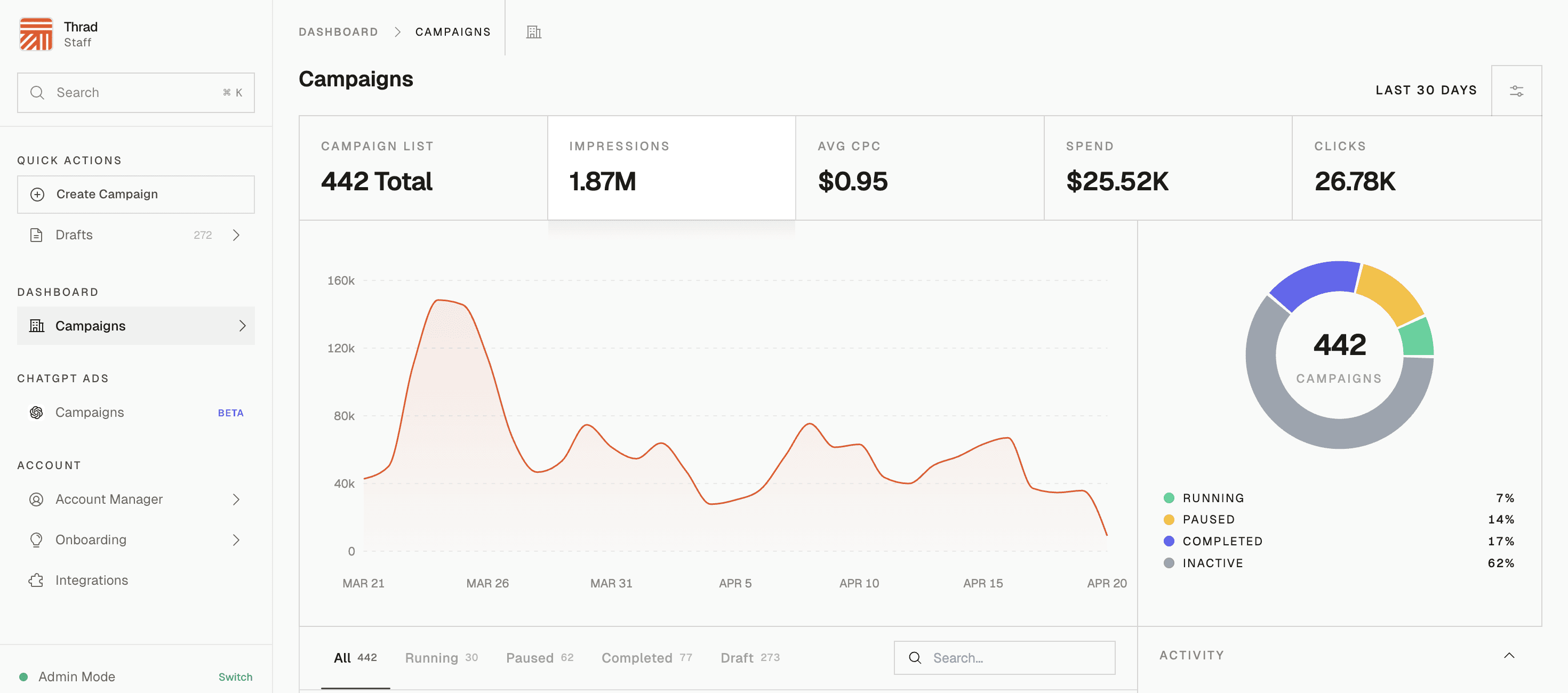
Self-serve
Build and launch conversational campaigns with complete control of budget, creative, and targeting in ChatGPT.
Managed-service
We act as an extension of your growth team, delivering end-to-end campaign management across ChatGPT ads.
How it Works
Our team manages the full campaign lifecycle, from strategy to optimization, so your brand can establish early visibility inside AI conversations.
More than 500 million people every week use ChatGPT to decide what to buy, which software to use, and which brands to trust. For many users, AI is rapidly replacing search engines as the first place they go for answers and recommendations.
This is the beginning of a new distribution channel — one comparable to the early days of Google Ads, when brands that moved first gained a lasting advantage in visibility and customer acquisition.
The difference is that advertising in ChatGPT requires a completely new approach. Traditional search and display strategies are not built for conversational interfaces. Thrad’s managed service helps brands navigate this shift with strategy, creative execution, and campaign optimization designed specifically for AI-native environments.
We help brands place sponsored products and solutions inside ChatGPT, identifying competitive gaps and high-intent conversational moments.
Our team creates and launches native conversational placements designed to appear as relevant, trustworthy recommendations.
We continuously refine targeting, creative, and placements to maximize visibility, clicks, and business outcomes.
Common questions
ChatGPT ads are sponsored placements that appear inside ChatGPT conversations — shown to users on the Free and ChatGPT Go tiers as clearly labeled “Sponsored” cards below the AI’s response. Ads don’t influence what ChatGPT says — they sit in a separate, labeled box, and OpenAI’s Answer Independence principle means paid placements cannot change the organic response. The format is called a chat_card: it carries a title, up to 100 characters of body copy, an image, a favicon, and a destination URL. What makes this different from any existing channel is the targeting model: ads combine the intent signal from what someone just asked with behavioral context from their chat history and saved memories — a combination that hasn’t existed before in advertising.
ChatGPT ads appear in conversations with commercial intent, shown only to Free and Go tier users in the US, Canada, Australia, and New Zealand. Users on Plus, Pro, Team, and Enterprise plans see no ads at all. That might sound like a limitation, but it’s actually a targeting advantage: the free-tier audience is massive, actively researching, and has not yet committed to a subscription. ChatGPT accounts for 70% of AI assistant traffic, and ChatGPT crossed 300 million weekly active users in early 2026, making it one of the most visited destinations on the internet. The highest-value opportunities are in categories where the buying decision is complex and the conversation context is rich — B2B software, professional services, premium consumer goods, education, and financial services.
ChatGPT ad targeting is not keyword bidding in the traditional sense. Think “context matching” first: OpenAI starts by matching ads to what’s being discussed in the current chat thread. If a user opts into personalized ads, OpenAI may use additional signals such as past chats, memory, and past ad interactions to improve relevance. On Meta, you target demographic segments and behavioral audiences. On ChatGPT, you provide context hints describing the conversation topics where your product is relevant, and the system decides when and where to surface your ad. The upside of this model is access to users who are mid-problem, articulating their needs in far more detail than a search query ever captures. The real shift is intent over demographics — contextual targeting reborn inside the moment someone is actively asking for help.
Pricing has moved fast since launch. ChatGPT ads launched at $60 CPM with a $200,000 minimum spend in February 2026. By May 5, 2026, OpenAI removed the minimum entirely and CPMs had dropped to around $25. CPC bidding with $3–$5 bid floors by category is now live alongside the CPM model. Criteo, one of the official ad tech partners, has since reduced ChatGPT campaign spending minimums to $10,000, further lowering the barrier for brands that want managed access rather than self-serve. Early data shows LLM referrals convert at 1.5 times the rate of other digital channels — which helps justify the premium CPM compared to Google Display or Meta, where users are browsing rather than actively solving a problem.
Self-serve access is now available to all US advertisers with no minimum spend, via the Ads Manager at ads.openai.com. If you prefer a managed approach, you can work through agency partners — Dentsu, Omnicom, Publicis, and WPP — or through ad tech platforms like Criteo, StackAdapt, Kargo, and Pacvue. Ad copy that performs in conversational environments tends to be outcome-oriented (what problem does this solve right now), matches the user’s language rather than internal product taxonomy, and uses specifics that reduce friction — price, timing, guarantee, delivery window, or availability. For brands that want early-mover advantage without managing campaigns directly, Thrads offers a managed service that handles strategy, creative execution, and optimization — built specifically for AI-native ad environments.
The platform is evolving rapidly. Key developments already announced or rolling out in 2026: Product feed ads launched in May 2026, letting e-commerce advertisers generate ads from their full catalog automatically. Custom audiences launched in May, allowing advertisers to target or suppress their own first-party customer lists. Conversion-optimized campaigns launched in early June for accounts that configure the OpenAI Pixel or Conversions API. Looking further ahead: multi-turn conversation retargeting is targeting Q4 2026 — letting advertisers reach users who had deep conversations about the problem their product solves, but didn’t convert. That’s a different category of intent signal than anything currently available on Google or Meta. Voice-enabled ad experiences are also expected in late 2026, allowing users to engage with ads through natural speech rather than tapping and typing — letting them ask questions, compare features, or initiate purchases entirely through voice.
Get started
Tell us what you want to run and how much of it you want to own. We will come back with a route in, and what it costs today.
Thanks — we have it
Someone from the team will be in touch by email within one business day.
Further reading