

Built for tired eyes, found by tired eyes: Eyezen with Thrad
A lens made for screens, found on the screens people can’t step away from.
47,000
People reached in Singapore in 17 days
80%
Lower cost per click than search advertising
3m 19s
Average time on site
The challenge
Eyezen lenses are designed for people who spend most of their day in front of screens: software developers working across several monitors, designers, office workers at a desk from morning to evening, and heavy users of social media and streaming. EssilorLuxottica’s Singapore team knew exactly who that audience was. Reaching them efficiently was the hard part.
Search advertising only works once someone is looking for a product, and most people with tired eyes are not. They treat the discomfort as a normal part of working on screens and rarely go looking for a solution. Social platforms can reach them, but only as part of a much broader audience.
“Google and Meta give me that mainstream or mass audience,” says Jenny Saraiya, Director of Digital Marketing at EssilorLuxottica. “These AI platforms give me the niche audience, which is what I am after.”
The approach
Reaching the right people at the moment that matters
In September 2026, Eyezen launched its campaign with Thrad. Advertising inside AI conversations allowed Eyezen to reach a targeted set of users at the moment that matters most, and gave the team a far clearer picture of that audience: when they engaged, on which platforms, and what they were working on at the time.
That moment is usually a focused one. Someone working through a demanding task in an AI assistant can spend long stretches reading text on a screen, rarely aware of the strain it puts on their eyes. Eyezen appears within that session, bringing the strain to their attention along with a lens designed for it: a solution to a problem they never knew they had.
Because AI assistants have become a core part of how people work, Eyezen reaches its audience inside the very activity its lenses are designed for.
In the moment
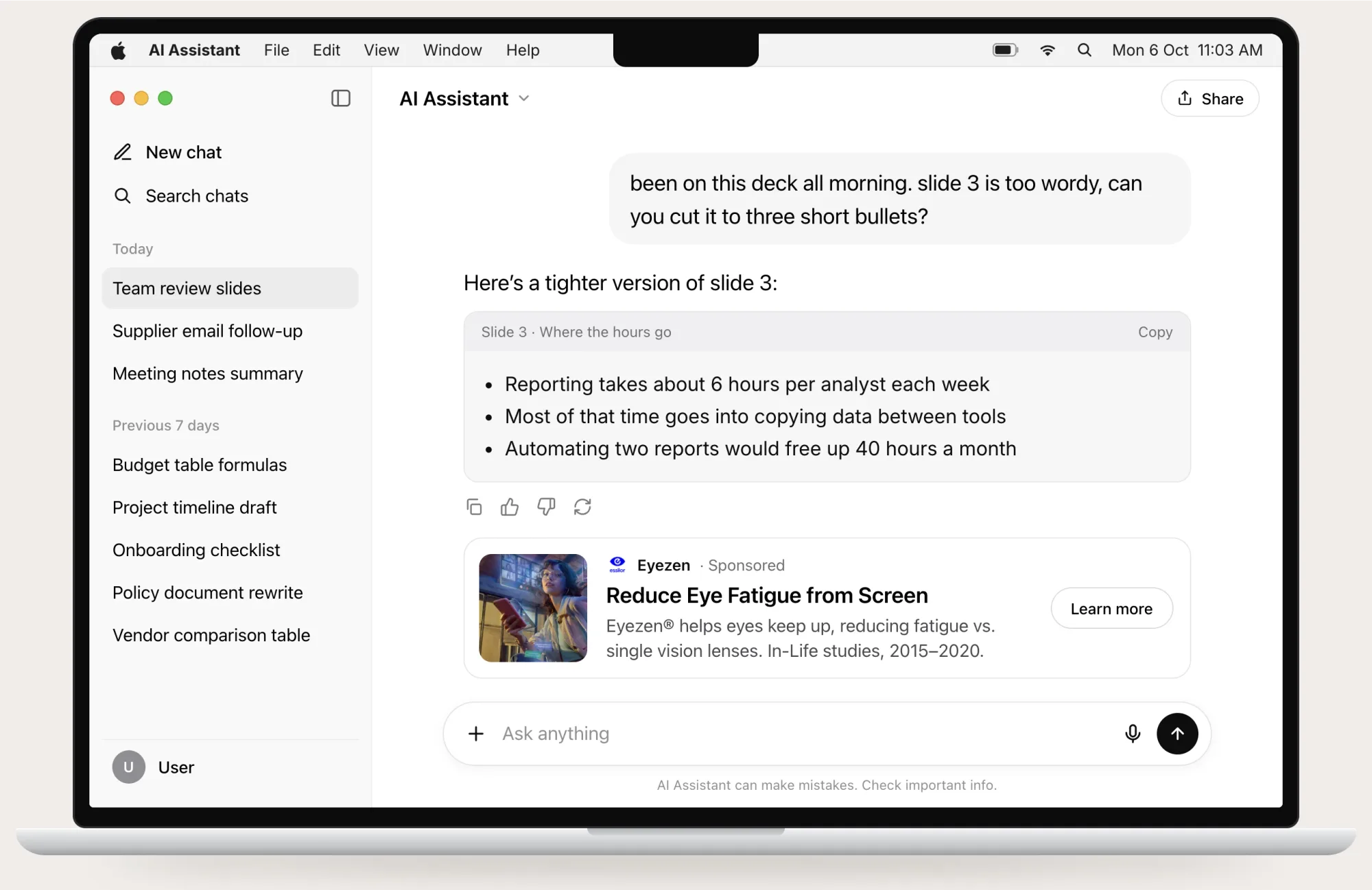
Prompt, squint, repeat
The example below shows a typical placement, during a long morning spent preparing a presentation.
The results
Quality traffic from a hard-to-reach audience
In its first 17 days, the campaign reached 47,000 people in Singapore. EssilorLuxottica’s own analytics showed the quality of that audience. Visitors who arrived from AI conversations spent longer on the Eyezen site than visitors from search or Meta, and more than a quarter of all visits were qualified sessions, averaging 3 minutes and 19 seconds.
Each of those visits makes Eyezen a more familiar name. “Building that sort of familiarity is very important,” says Jenny, “because there are lots of competitors offering the same solution.”
Advertising inside AI conversations gave Eyezen what search and social could not: a precise audience, reached during the screen time its lenses are made for, and visitors who stayed to learn about the product.