Guide
AI Advertising Reporting: How to Show Clients What Ads in AI Conversations Deliver
The short answer
Reporting is where agency relationships are won or lost, and ads inside AI conversations are hard to report on well. Clients know search and social reports. They have not seen one for this channel, and many will judge it by whatever you show them first. This guide explains how to structure AI advertising reporting for clients: what to include, how to frame results honestly, and a layout you can reuse. It is part of our series on AI advertising for agencies.
What Clients Want From AI Advertising Reporting
Clients usually want four things: confidence that their money was spent where agreed, evidence that it produced outcomes, an explanation of what was learned, and a clear next step. A report that answers those four questions in plain language beats a long dashboard export.
The Building Blocks of an AI Advertising Report
| Section | What it covers | Why it matters |
|---|---|---|
| Summary | Three to five sentences: what ran, what happened, what we recommend | Executives read only this |
| Spend and delivery | Budget, pacing, markets, devices | Shows money was used as planned |
| Placement quality | Sampled examples of real placements and topics | Proves relevance and brand fit |
| Response | Clicks, click-through rate, interaction | A diagnostic of attention |
| Outcomes | Conversions, cost per outcome, assisted outcomes | The measure of value |
| Learning | Which questions and creative performed | Feeds client strategy beyond this channel |
| Next steps | Stop, repeat or scale, with reasons | Makes the report actionable |
Scroll to compare all columns
How to Frame Results Honestly in AI Advertising Reporting
- Say what the data cannot tell you. Without identifiers, some conversions cannot be tied to an ad. Explain how you handled that.
- Use a baseline.Compare against the same product's results in other channels, or against a holdout.
- Show quality, not only totals. A handful of real placement examples builds trust.
- Avoid cross-channel comparisons that mislead. A click rate in an AI placement is not the same thing as a search click rate.
- Report losses. Topics that did not work are part of the learning.
For the underlying metrics, see our guide to conversational metrics to track in 2026 and our overview of measuring AI assistant ad performance honestly.
Questions Clients Ask About AI Advertising Results
- Where did my ads appear? Show sampled placements and the topics they matched.
- Why was the click rate different from search? Explain that the channel works differently and set expectations against your own baseline.
- Can I trust the conversion numbers? Describe the tracking method and its limits in plain words.
- Should we spend more? Link the answer to the agreed success measure, not to enthusiasm.
- What did we learn? Share the customer questions and creative that performed, because they are useful beyond this channel.
Prepare short answers to these in advance. Meetings go better when the agency has already thought through what the client will ask.
A Reporting Cadence for AI Advertising
- Weekly: a short internal check on spend, relevance samples and anything unusual.
- Fortnightly or monthly: the client report using the layout above.
- End of test or quarter: a readout with decisions and recommendations.
Using Platform Reporting for Clients
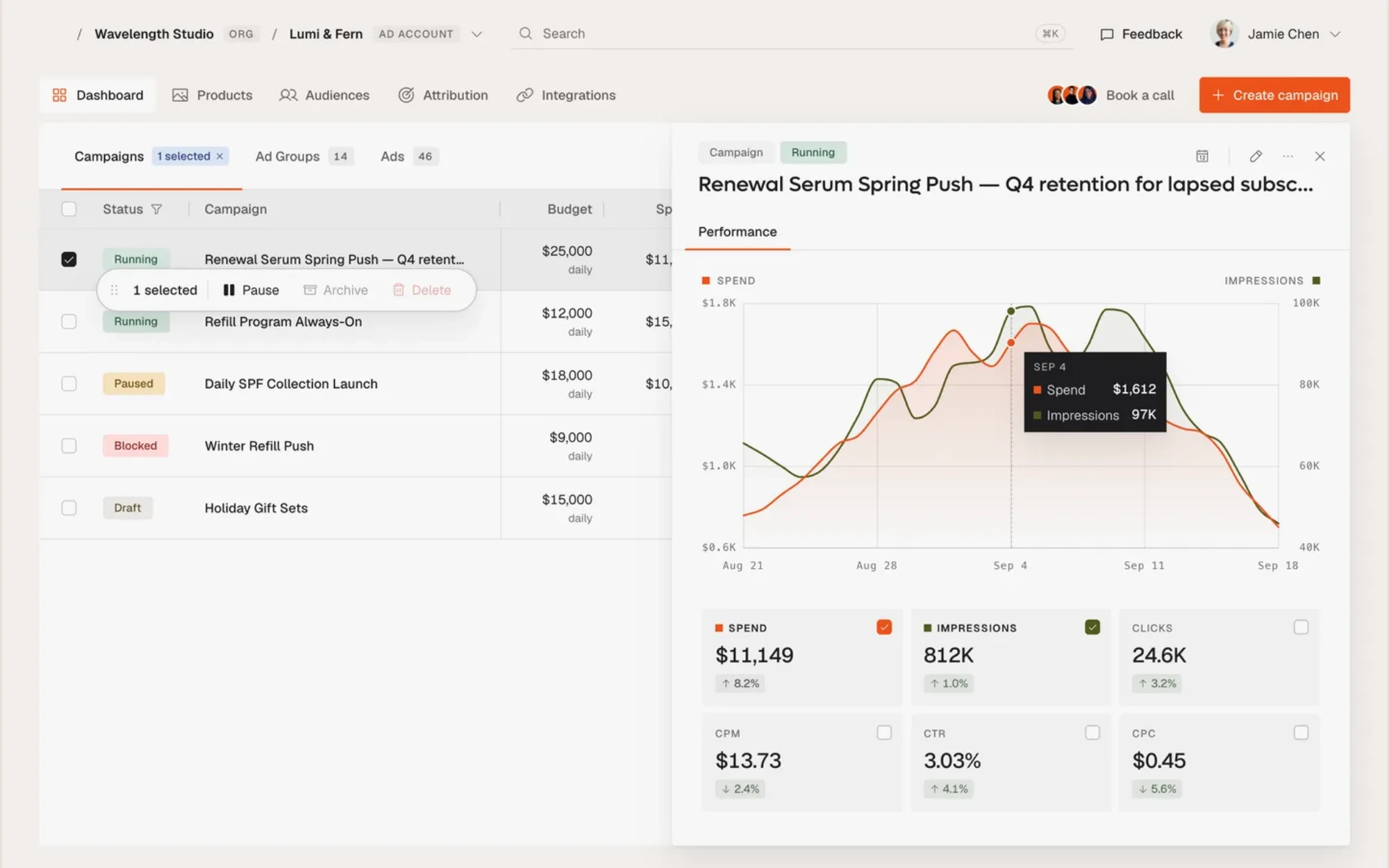
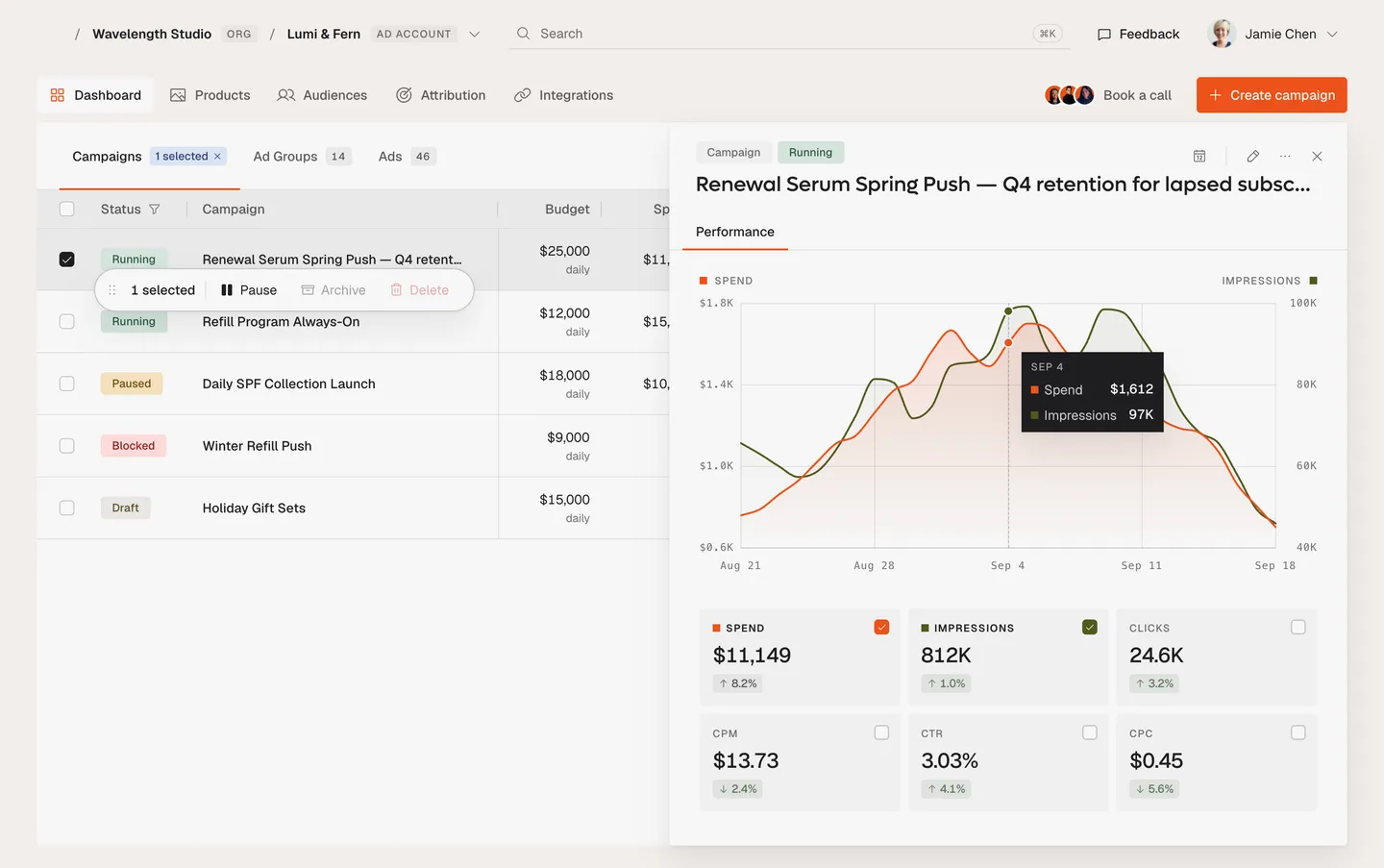
Platform dashboards save time if clients can see them. Thrad describes real-time shared workspaces with client access and approval flows on its agencies page, dashboards broken down by campaign, ad, country and device with CSV and Excel export, and a weekly written summary on its Autopilot page. Whatever tools you use, add your own interpretation. A dashboard shows numbers. A report explains them.
Add AI conversations to your media plan
Explore the buying options for client campaigns and the questions to settle before a test.
See Thrad for agenciesTailoring AI Advertising Reporting to the Audience
A report for a marketing manager differs from one for a chief executive. The manager wants detail: topics, creative variants and next tests. The executive wants the headline, the cost of an outcome, any risks, and a decision. Prepare one source report and two views of it. The short version leads with the summary and the recommendation. The long version adds placement samples, tables and the change log. Offering both saves meetings and makes sure each reader finds what they need without wading through the rest.
A Short Narrative You Can Adapt
"Over the last four weeks we ran [number] ads inside AI conversations about [topic]. Placements matched the topics we agreed, and we excluded [categories]. [Outcome result]. The strongest conversations were [type], and the weakest were [type]. We recommend [action] because [reason]." Fill the brackets only with figures you can show.
Showing Placement Examples in AI Advertising Reporting
Placement examples are the most persuasive part of a report in this channel, because clients cannot picture where their ads appeared. Choose a handful that represent the range, including at least one that was only an acceptable match. For each, show the conversation topic in summary form, the ad, and a one-line note on why it matched. Handle conversations with care: show enough to demonstrate relevance without exposing personal details, and follow the platform's rules on what can be shared.
Explaining Limits to Clients in AI Advertising Reporting
Clients trust reports that say what is unknown. Three limits come up often. Attribution is imperfect, so some conversions will not be linked to an ad. The channel is new, so there is little history to compare with. And small samples vary a lot from week to week. Stating these plainly at the start of a report, in two or three sentences, prevents later disputes and makes the results you do show more credible.
| Limit | What to say |
|---|---|
| Attribution | We measure conversions with a pixel and a baseline; some outcomes cannot be tied to an ad |
| Benchmarks | This is an early channel; we compare against your own results, not industry averages |
| Sample size | Volumes are small, so we look at trends over several weeks, not single days |
Scroll to compare all columns
Reporting Mistakes to Avoid
- Leading with impressions, which say little about value.
- Showing only the best week.
- Claiming every later conversion as an outcome of the ad.
- Hiding placement examples because some were imperfect.
- Sending a data export with no commentary.
To start a test that produces reportable results, see our AI advertising pilot playbook, and for the full framework behind it, read our pillar guide to AI advertising for agencies.