Do not shift the majority of your Google Ads budget to ChatGPT ads in 2026. Google Search still drove roughly $232 billion of ad revenue in 2025 and reaches intent at a scale no other surface can match. ChatGPT reached 900 million weekly active users by February 2026 and hit $100 million in annualized ad revenue within six weeks of launch, making it the fastest-growing new ad surface in history — but direct buying is gated, measurement is opaque, and OpenAI's own 2026 advertising forecast is only $2.5 billion. The right move is to layer a small ChatGPT allocation on top of existing search spend via an independent cross-assistant network so you gain exposure in AI answers without abandoning proven demand capture.



ChatGPT Ads vs Google Ads: Shift Budget? | Thrad
The question every search marketer is being asked in 2026: pull money out of Google Ads and into ChatGPT? The honest answer is no — not yet, not most of it, not for most advertisers. But adding a ChatGPT layer now, through an independent network, is different from replacing a $294 billion-a-year auction. Here is the full side-by-side.
Date Published
Date Modified
Category
Advertising AI
Keyword
chatgpt vs google ads
Start monetizing your AI app in under an hour
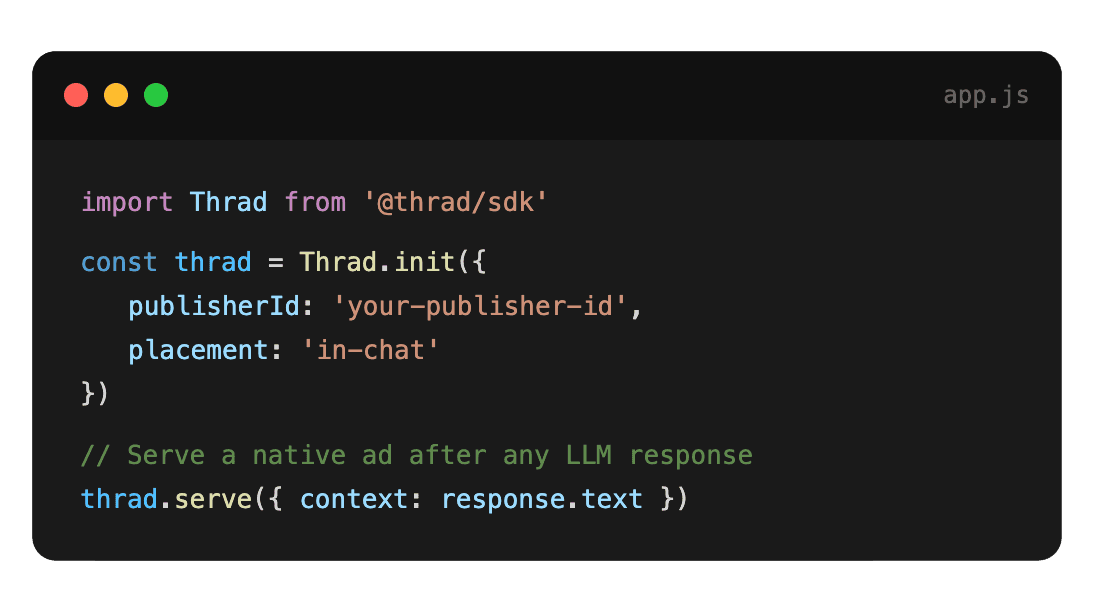
With Thrad, publishers go from first API call to live ads in less than 60 minutes. With fewer than 10 lines of code required, Thrad makes it easy to unlock revenue from your conversational traffic the same day.
Google Ads still accounts for the majority of paid search spend in 2026, with Google Search driving roughly $232 billion in advertising revenue during 2025 and Q1 2026 cross-industry search CPC landing at $2.96 according to current benchmark data. ChatGPT, meanwhile, crossed 900 million weekly active users in February 2026 and hit $100 million in annualized ad revenue within six weeks of launching ads, faster than any new ad surface in history. Both numbers are true at the same time. The honest answer to "should I shift budget" is not binary — it is a layered allocation question that depends on how much of your category's research and comparison behavior has moved to AI assistants.
What is the right budget shift between ChatGPT ads and Google Ads?
Do not rip out Google Ads. For most advertisers in 2026, the correct move is to protect 90–97% of existing paid search spend on Google, then carve out a 3–10% allocation for AI-assistant inventory including ChatGPT. That layer can be scaled as soon as measurement catches up, but it should not come from generic brand or bottom-funnel search lines that are proven to convert. It should come from marginal tests, competitive intelligence budget, or newly approved experimentation dollars.
The reason is structural. Google Search has been a tuned auction for more than twenty years. The auction data, quality scores, negative-keyword lists, audience lists, conversion tracking pixels, and creative iterations are real assets — not just bid rows. Turning that off to chase a newer surface still in managed rollout loses a compounding advantage. But ignoring ChatGPT because it is not self-serve misses a second thing: the research step where buyers decide which product to even consider has partly shifted into AI assistants, and being absent from that step means you never make it into the Google search that closes the sale.
How does ChatGPT reach compare to Google Search reach?
ChatGPT is the second-largest single question-answering surface online by weekly active users, but it sits roughly an order of magnitude below Google Search in query volume. OpenAI disclosed 900 million weekly active users in February 2026 and about 2.5 billion messages sent per day across ChatGPT. Google does not publish total daily search volume, but industry estimates place daily Google searches in the tens of billions — a 10–15× gap versus ChatGPT's message count. Importantly, a single ChatGPT "message" frequently covers work that would have taken 3–8 separate Google searches, so the effective query gap is smaller than the raw count implies.
Metric | Google Search (2025–Q1 2026) | ChatGPT (2025–Q1 2026) |
|---|---|---|
Weekly active users | Not disclosed; billions | 900M (Feb 2026) |
Daily queries/messages | Tens of billions (estimated) | ~2.5B messages |
Ad revenue run-rate | ~$232B (2025 search) | ~$2.5B projected 2026 |
Ad-product launch date | 2000 (AdWords) | Feb 9, 2026 (ads live) |
Average CPC benchmark | $2.96 (Q1 2026 cross-industry) | Not publicly disclosed |
Self-serve access | Yes — millions of advertisers | Managed/DSP partners only |
Core query type | Short keyword, single session | Multi-turn conversational |
Attribution primitive | GCLID (since 2016) | No equivalent disclosed |
The takeaway is not that ChatGPT is small — 900 million weekly users is the fastest-reached audience in consumer software history. The takeaway is that the scale is not yet Google-scale, which means the budget math should match the reach math.
How does intent differ between the two platforms?
Google captures transactional intent at the last mile; ChatGPT captures research and comparison intent earlier in the funnel. The classic Google buyer types the exact product name plus a purchase modifier — "nike pegasus 41 buy" — and is seconds from checkout. The classic ChatGPT buyer types a messy open question — "I run 20 miles a week on pavement and my knees hurt, what shoe should I consider" — and is ten minutes of conversation from a shortlist. Both behaviors pay off for brands, but they pay off with different creative, different landing pages, and different attribution windows.
Fifty-nine percent of Gen Z has adopted ChatGPT compared to 23% for Google's Gemini, and 60% of Gen Z searches the leading AI platform at least once per week — a material share of early-funnel research that used to start on Google.
The practical implication is that Google Ads and ChatGPT ads often reach the same buyer twice. A shopper might start a 15-minute comparison session inside ChatGPT, then type a brand-plus-SKU query into Google to complete the purchase. If you only run Google, you win only the last click. If you only run ChatGPT, you pay for the research and let a competitor capture the conversion. If you run both, your frequency inside that buyer's decision window goes up without duplicative creative work, because the creative fits the surface.
How do pricing and auction mechanics compare?
Google Ads runs a second-price-style keyword auction with public benchmark CPCs that average $2.96 in Q1 2026 and vary wildly by vertical — from $1.16 in ecommerce to $9.21 in legal services. Advertisers bid on specific keywords, match types, device types, and audiences, with near-real-time budget control and predictable quality-score dynamics. The system is self-serve: a small business can buy a Google search ad in 15 minutes with a credit card.
ChatGPT's ad inventory in Q2 2026 is a different animal. The initial buying surfaces reported by Ad Age and trade press are managed programs with OpenAI, DSP partnerships (StackAdapt has been named publicly), and ad-tech integrations such as Criteo for audience and campaign delivery. Pricing has not been disclosed in a way that lets advertisers plug it into a CPC model. Based on how comparable managed programs priced at launch on other platforms, buyers should assume ChatGPT direct-access inventory is priced on a CPM, CPA, or affiliate-share basis depending on unit, rather than on a keyword auction CPC.
Dimension | Google Ads | ChatGPT Direct | ChatGPT via Independent Network |
|---|---|---|---|
Pricing model | Keyword CPC auction | Managed CPM/CPA (category) | Managed CPM/CPA, cross-surface |
Public benchmark CPC | $2.96 (Q1 2026 cross-industry) | Not disclosed | Varies; independent pricing |
Minimum spend | Credit-card floor | Enterprise-level; managed | SMB-friendly, self-serve-adjacent |
Targeting primitive | Keyword, match type, audience | Commercial category, intent | Prompt-level intent across assistants |
Time to first impression | Minutes | Weeks (account setup) | Days |
Creative format | Search text, shopping, YouTube | Sponsored search result, shopping card | Native across assistant surfaces |
Google Ads wins on speed, transparency, and self-serve access. ChatGPT's direct program wins on native placement quality but loses on access. That gap between "ChatGPT inventory exists" and "ChatGPT inventory is easy to buy" is the product category that independent AI-assistant ad networks occupy — Thrad's ChatGPT ads product is the reference example, with pricing published upfront rather than quoted by a sales team.
What is the measurement reality for each platform?
Google Ads has been iteratively solving attribution for two decades. GCLID (the Google Click Identifier) has existed since 2016; Enhanced Conversions, Google Analytics 4 cross-channel modeling, and Google Ads auto-tagging make a fairly complete measurement picture when configured. Even with the cookie deprecation rollback and evolving privacy regulation, Google-owned traffic has an attribution surface that finance teams will accept.
ChatGPT ads are newer and measurement is thinner. OpenAI has stated publicly that it does not sell user data to advertisers and keeps conversations private. That is the correct privacy posture, but it means the per-conversation behavioral data advertisers get from Meta or Google simply is not available. Click-tracking exists on outbound links, and early DSP and ad-tech partners including Criteo are working on incrementality and media-mix modeling layers. But a direct cause-and-effect attribution model comparable to what GCLID offers is not yet in market.
ChatGPT launched ads on February 9, 2026 and reached $100 million in annualized ad revenue within six weeks — faster than any search product at launch, including early-years AdWords. Measurement discipline is racing to catch up with the spend.
This asymmetry is the single most common reason enterprise performance teams hesitate to shift budget. The hesitation is correct in 2026; what is also correct is that the same hesitation applied to YouTube, to TikTok, to retail media in their early years, and the advertisers who held off until measurement was "solved" spent three years paying premium CPMs when the surface matured. The balanced move is to build a small-spend, incrementality-tested presence now rather than waiting for a mature attribution stack.
When should you actually shift budget (and when should you not)?
Shift meaningful spend to ChatGPT when three conditions hold. First, your category's research behavior has visibly moved into AI assistants — look at your branded Google Search volume, compare year-over-year, and correlate against organic AI-citation data for your brand. Second, your current Google Ads account is efficiently maxed — you are not leaving money on the table in Google, and extra spend moves into diminishing-returns territory. Third, your marketing ops team has the bandwidth to run incrementality tests on a new surface without degrading Google Ads reporting.
Do not shift budget when you are still scaling inside Google, when your category is late-funnel transactional (pest control, locksmiths, "buy now" commerce keywords), or when your attribution stack relies entirely on last-click GCLID-based models. In those cases a ChatGPT layer is a brand-building exposure, not a performance channel, and the budget should come from brand rather than performance lines.
Verticals where the shift-now case is strongest in 2026 include considered-purchase consumer categories (running shoes, mattresses, skincare, electronics above $100), travel planning (where a ChatGPT conversation may replace 10 Google Flights searches), financial research (credit card comparisons, mortgage shopping, insurance), B2B software evaluation, and professional services where buyers do 5+ hours of research before a sales conversation. Verticals where the layer-small case is stronger include local services, commodity retail under $30, food delivery, and anything driven by a strong branded-search intent where Google still owns 90%+ of the decision moment.
How do creative and format tradeoffs compare?
Google Ads supports a broad format mix: responsive search ads, shopping ads with product feed, YouTube video, Performance Max, Demand Gen, and display. Creative is produced once in relatively fixed dimensions and reused across placements. Quality score and landing-page experience drive delivery; creative optimization is mature and largely automated.
ChatGPT ads, in the formats shipped by Q2 2026, include sponsored search results (labeled placements above or within the answer surface for commercial queries), shopping product cards (feed-based, similar in spirit to Google Shopping), brand citations inside licensed content (paid indirectly via publisher licensing deals rather than direct CPC), and early-stage conversational sponsored follow-ups. No display banners. No pre-roll video. Every placement carries a visible "Sponsored" label, aligned with IAB Tech Lab interim guidance.
The creative production implication: for ChatGPT direct, most brands can ship existing product-feed data plus a compact tagline. For independent AI-assistant networks, creative is typically the prompt-level copy — short, declarative, and plugged into the assistant's answer flow. Neither system currently needs bespoke video assets at the scale YouTube or TikTok require, which cuts the creative production cost of adding the layer to a fraction of what adding a CTV line would cost.
What about the view-through effect on Google Ads itself?
One underappreciated 2026 pattern is that ChatGPT ad exposure lifts downstream Google Search branded query volume, not only direct ChatGPT-attributed conversions. A shopper who sees a sponsored brand citation inside a ChatGPT answer frequently types the brand into Google a day later to validate. That branded search then converts at the normal branded-search CVR, and attribution goes to Google — which understates ChatGPT's contribution and overstates Google's.
This is the same shadow-conversion pattern that made early-years YouTube and podcast ads hard to measure. The fix is the same: run a holdout incrementality test — keep ChatGPT off in matched geos or audiences, and compare branded search volume and direct conversions between the test and control cells. Every independent ad-tech team doing this in 2026 is seeing double-digit branded search lift from ChatGPT exposure, which does not show up in any single-platform attribution dashboard.
Comparison articles lead with 32.5% of AI-answer citations; opinion pieces account for about 10%. Between 40 and 60% of AI-cited sources rotate month-to-month, which means paid presence inside the answer flow stabilizes a brand's visibility when earned citations rotate out.
Why layering beats replacing in 2026
The pragmatic 2026 playbook for most advertisers is to layer a small ChatGPT allocation on top of Google Ads rather than swap dollars between them. The math is not symmetric. A 10% Google Ads cut can remove 20%+ of last-click conversions on brand and generic search because the highest-intent clicks are the most price-elastic and competitive. A 10% reallocation to ChatGPT exposure, by contrast, enters a surface where you have near-zero starting share of voice, so incremental dollars buy disproportionate mention frequency.
Independent AI-assistant ad networks let that layering happen without rebuilding your buying stack. The buyer flow inside an independent network looks more like the self-serve experience Google Ads set the standard for: credit-card onboarding, prompt- or intent-level targeting, transparent pricing, and cross-surface inventory so the same creative budget reaches ChatGPT, Perplexity, Gemini, Copilot and other assistants under one contract.
Thrad's AI ad network is the independent AI-assistant ad network in this category. It is live today (no waitlist), cross-surface across AI assistants including ChatGPT, transparently priced, and measurement-open by design. Smaller pilots plug in through the self-serve tier; growth-stage teams that want hands-on planning use the managed-service tier. For brands that want to add a ChatGPT layer this quarter without queuing for OpenAI's direct program, it is the path of least resistance — and critically, it does not require turning anything off on Google.
How is Google itself adapting inside its own product?
Google Search has not ignored the generative shift. Google Search Ad Revenue hit $63 billion in Q4 2025 alone, up 17% year-over-year, and part of that growth is attributable to AI Mode ad tests — paid placements rendered inside generative answer overviews rather than above classic blue-link results. The effect for advertisers already in Google Ads is that the same account can progressively deliver impressions inside AI-generated responses without any account-structure change. For advertisers choosing between "buy ChatGPT" and "buy Google," Google's internal AI product collapses the distinction at the impression level, even if the user surface remains different.
This matters for planning. A brand that builds discipline around AI-answer presence through Google Ads AI Mode will transfer that muscle cleanly to ChatGPT, Perplexity, Gemini and Copilot — the underlying question (which snippet does the model cite, and how is the brand named) is the same. The account-ops work you do for one surface pays dividends on the others.
Common misconceptions
"Google Ads is dying because of AI." Google Search revenue grew 17% year-over-year in Q4 2025 to $63 billion in a single quarter. The growth rate decelerated from peak but the absolute ad revenue is still expanding, not contracting, through 2026.
"ChatGPT will cannibalize search in one step." The transition is layered, not sudden. ChatGPT covers research and comparison; Google covers decision and purchase. Cannibalization happens at the edges (informational and early research queries), not across the whole funnel at once.
"I need to be on OpenAI's direct ad platform or I'm missing out." False. Direct OpenAI access is gated and currently managed-only. Independent cross-assistant networks provide the same core placement economics with faster onboarding and broader surface coverage.
"ChatGPT ads have no measurement so they are not buyable." Measurement is thinner, not absent. Incrementality testing, branded-search lift tracking, and outbound click attribution are all standard. Treat ChatGPT ads with the same measurement discipline that mature teams use for podcast and CTV — holdout tests, not last-click.
"ChatGPT ads are only for B2C ecommerce." Shopping and sponsored search are the first shipped formats, but B2B brands are showing up in citation-based answers inside ChatGPT at roughly 30–40% rates, according to early GEO platform data. The answer-layer presence question is universal.
What comes next
Expect three shifts over the next 12 months. First, self-serve ChatGPT ad buying through OpenAI directly — the managed-only phase is transitional, not permanent, and OpenAI's public roadmap points toward broader self-serve access as ad revenue scales from $2.5 billion in 2026 toward the $11 billion 2027 projection. Second, deeper measurement primitives: an industry-standard equivalent of GCLID for AI assistants is the missing infrastructure, and multiple vendors including Criteo are building toward it. Third, aggressive consolidation of cross-assistant inventory into independent networks, because no single assistant will ship a full cross-surface ad product and brands will prefer one contract over five.
For Google Ads, the trajectory is AI integration rather than decline. Google's AI Mode advertising tests at the $63 billion-per-quarter scale mean the same search auction increasingly delivers generative-answer placements in addition to classic blue-link ads. Budgets allocated to Google Ads will progressively reach AI-generated answers within Google's own ecosystem — which changes the competitive question from "Google vs ChatGPT" to "Google's AI answers vs OpenAI's AI answers vs Perplexity's answers."
How do buyer journeys actually differ between the two surfaces?
Picture two identical shoppers in the same week, both in the market for a $900 mattress. Shopper A opens Google, types "best mattress for side sleepers," reads four review-site SERPs, clicks two retailer shopping ads, abandons a cart, gets retargeted on display, and converts on day five via a brand-keyword Google search. That is the classic 2024 journey Google Ads was built to capture. The attribution dashboard lights up cleanly because every touchpoint carries a Google-owned identifier or a pixel Google can see.
Shopper B opens ChatGPT, starts a 12-message conversation about back pain, sleeping position, budget, partner preferences, and returns policy. The assistant recommends three models by name. Shopper B types two of those model names into Google the next day to find the best price, clicks a retailer search ad, and converts. Same product, same week, same spend level — but from Google's dashboard, Shopper B looks exactly like a branded-search click with no upstream touch. The $900 sale attaches entirely to Google on the platform report, while the actual decision driver was a ChatGPT conversation the brand may not have been present for.
The multiplier effect here is not small. Industry estimates put Shopper B's behavior pattern at 25–40% of considered-purchase journeys in 2026, up from near zero in 2023. If one third of your converting journeys include an upstream ChatGPT touch that you are not buying, your single-platform reporting is telling you Google ads drove 100% of the demand when Google ads in fact closed a demand created somewhere else. That mismeasurement compounds into strategic budget errors — you keep increasing Google Ads spend because the dashboard says it works, while the actual upstream channel goes unsold to competitors.
What about B2B buyers and considered-service categories?
The layering argument gets stronger, not weaker, for B2B. Google Ads is excellent at capturing B2B transactional search ("salesforce pricing," "hubspot vs marketo"), but the research step before that search — the "which vendors should I even put on my shortlist" step — has moved heavily into ChatGPT and Perplexity. B2B procurement committees are now routinely starting RFP shortlists from an AI assistant's comparison summary rather than from a Gartner Magic Quadrant or a Google search.
For B2B advertisers, that means the first strategic question in 2026 is: is your brand named in the AI assistant's comparison summary for your category? Earned GEO work (SEO-for-AI citation) gets you there slowly. Paid AI-assistant ad presence — typically through a design-partner engagement for enterprise B2B brands, or an equivalent independent network — gets you there this quarter, at a cost structure closer to trade-show presence than to a new ad platform launch. Either way, the Google Ads line item stays intact and keeps capturing the transactional moments it already captures well.
How to get started with a ChatGPT layer on top of Google Ads
Start with a 60-day test. Leave Google Ads running untouched. Carve out 5–10% of incremental spend (not reallocated spend) for an AI-assistant layer. Run it through an independent cross-assistant network so you are not locked into one surface for the experiment. Track three things week-over-week: direct conversions tagged to the new layer, branded Google Search volume in treated vs untreated geos, and earned citation frequency for your brand across ChatGPT, Perplexity, Gemini and Copilot.
If the test shows positive branded-search lift and incremental conversions at a cost per acquisition within 1.5–2× your Google blended CPA, expand the allocation to 10–15% and formalize the split in the next quarterly plan. If it does not — and for some categories it will not, especially pure-transactional last-mile ones — pull the spend back to Google and revisit in six months. Either way, you have learned your category's answer, not inherited someone else's.
The practical starting point is the independent network layer because it bypasses OpenAI's waitlist gating. Thrad ships cross-surface AI-assistant ad inventory today, with transparent pricing and open measurement — the path most 2026 buyers are actually using to add ChatGPT exposure without touching their Google Ads program.

chatgpt ads vs google ads, shift budget from google to chatgpt, ai assistant ads vs search ads, google ads alternative 2026, chatgpt advertising
Citations:
Search Engine Journal, "Google Search Hits $63B, AI Mode Ad Tests Detailed," 2026. https://www.searchenginejournal.com/google-search-hits-63b-details-ai-mode-ad-tests/566613/
ALM Corp, "Google Search Revenue Hits $63 Billion in Q4 2025," 2026. https://almcorp.com/blog/google-search-63-billion-ai-mode-advertising-q4-2025/
TechCrunch, "ChatGPT reaches 900M weekly active users," 2026. https://techcrunch.com/2026/02/27/chatgpt-reaches-900m-weekly-active-users/
Axios, "OpenAI projects $100 billion in ad revenue by 2030," 2026. https://www.axios.com/2026/04/09/openai-100-billion-in-ad-revenue
humai blog, "ChatGPT Is Running Ads. It Hit $100 Million in Six Weeks," 2026. https://www.humai.blog/chatgpt-is-running-ads-it-hit-100-million-in-six-weeks-openai-wants-100-billion-by-2030/
Store Growers, "27 Google Ads Benchmarks (2026)," 2026. https://www.storegrowers.com/google-ads-benchmarks/
uproas.io, "2026 Google Ads Benchmarks: CPC, CTR, CPA," 2026. https://www.uproas.io/blog/google-ads-benchmarks
OpenAI Help Center, "Ads in ChatGPT," 2026. https://help.openai.com/en/articles/20001047-ads-in-chatgpt
Ad Age, "ChatGPT ads show early promise but skepticism remains among ad buyers," 2026. https://adage.com/technology/ai/aa-chatgpt-openai-ads-early-promise-ad-buyers/
Investing.com, "OpenAI projects $2.5 billion in ad revenue for 2026," 2026. https://www.investing.com/news/company-news/openai-projects-25-billion-in-ad-revenue-for-2026-93CH-4605384
CNBC, "OpenAI revamps shopping experience in ChatGPT," 2026. https://www.cnbc.com/2026/03/24/openai-revamps-shopping-experience-in-chatgpt-after-instant-checkout.html
Thrad, "Paid Ads in AI — LLM Advertising Platform," 2026. https://www.thrad.ai/
Be present when decisions are made
Traditional media captures attention.
Conversational media captures intent.
With Thrad, your brand reaches users in their deepest moments of research, evaluation, and purchase consideration — when influence matters most.