Yes — ChatGPT runs ads in 2026. OpenAI has rolled out clearly labeled
sponsored search results, shopping partnerships with retailers, and
revenue-share deals with publishers. The pace is deliberately
conservative to protect UX — ads appear on roughly 10-20% of
commercial-intent queries and effectively none of informational
queries — but advertising is now a permanent part of ChatGPT's revenue
mix rather than an experiment.


Start monetizing your AI app in under an hour
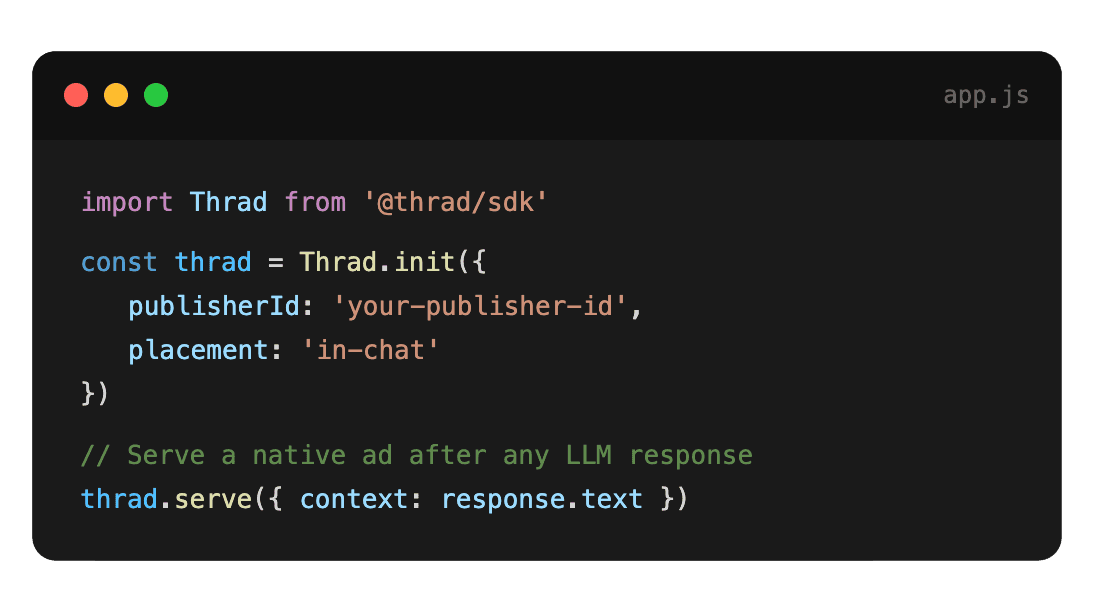
With Thrad, publishers go from first API call to live ads in less than 60 minutes. With fewer than 10 lines of code required, Thrad makes it easy to unlock revenue from your conversational traffic the same day.

Will ChatGPT Run Ads? — 2026 Answer | Thrad
"Will ChatGPT run ads?" stopped being a hypothetical in 2025 and became
a product roadmap in 2026. Sponsored search, shopping placements, and
revenue-share publisher deals are live or in pilot. The real question
now is what form ads take — and how brands show up inside them.
Yes — ChatGPT runs ads in 2026. Sponsored search results, shopping
placements tied to retailer partnerships, and revenue-share deals with
publishers are all live or in pilot. The "will they or won't they"
question is settled; the live question is what form those ads take, who
sees them, how brands earn placement with integrity, and how fast the
inventory expands. This article walks through the direct 2026 answer:
what's live, what's in pilot, who buys it, and what it tells brands
about the shape of the advertising business emerging inside the
world's largest AI assistant.
What does "ChatGPT running ads" actually mean in 2026?
It is not a display-ad network bolted onto chat. ChatGPT's advertising
footprint splits into three distinct live surfaces plus one pilot
surface — each with its own pricing model, buyer, and user experience.
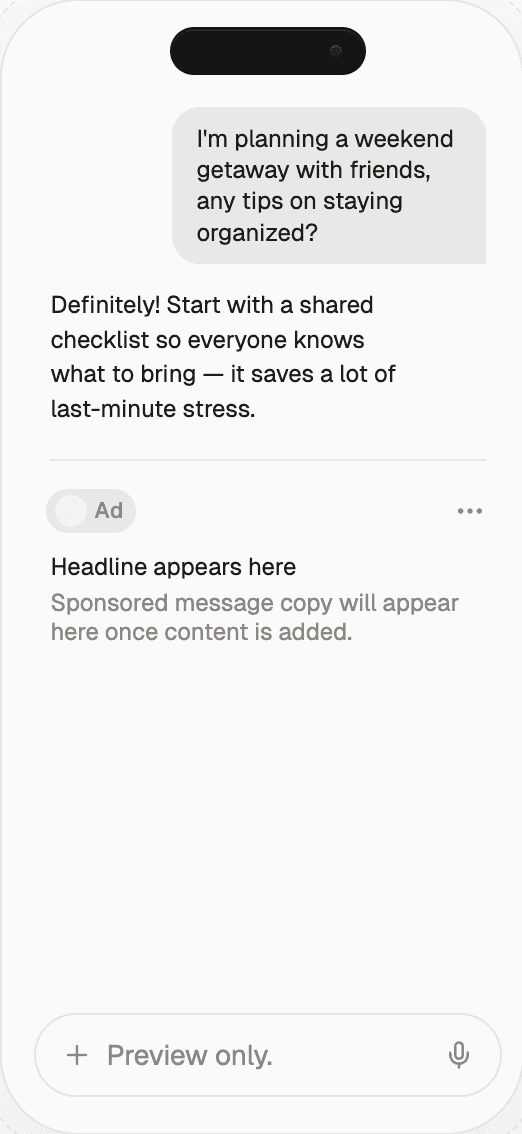
First, sponsored search results: when a user prompt carries clear
commercial intent, ChatGPT can surface one or two labeled paid results
above or inside its organic answer. Second, shopping placements:
retailer-integrated product recommendations inside prompts like "what
laptop should I buy for video editing," priced per click or per
conversion through affiliate networks. Third, content licensing with
revenue share: publisher deals where ChatGPT pulls paid or licensed
content into answers, paying both a fixed license fee and a share of
downstream monetization. Fourth (pilot), conversational sponsored
placements: a small pilot footprint of sponsored follow-ups inside
answers, reportedly on less than 5% of eligible commercial queries.
Surface | Status in Q1 2026 | Query share | Revenue contribution (estimated) |
|---|---|---|---|
Sponsored search | Live | 10-20% of commercial-intent queries | Largest ad line |
Shopping placements | Live | Most product-recommendation queries | Second-largest |
Publisher licensing | Live (since 2023-2024) | Variable, content-driven | Steady, deal-driven |
Conversational sponsored | Pilot | <5% of eligible | Small but growing |
Where do ads appear today?
Ads appear today primarily on two surfaces: ChatGPT's search results UI
and shopping-adjacent product recommendation answers. Both free and
paid users see ads in commercial-intent queries, though paid tiers see
fewer sponsored search placements. Informational queries — medical,
legal, educational — are explicitly off-limits under OpenAI's interim
ad policy.
The ChatGPT search surface is the primary ad surface. It looks
deliberately different from the conversational home screen: users who
click the search affordance (or whose prompt is routed to search by
intent detection) land in a results-like UI that accommodates sponsored
placements without disrupting chat flow.
Shopping placements appear inside product-recommendation conversations
on both free and paid tiers, but with more limits on paid. Publisher
content shows up in cited answers across surfaces, with attribution and
in some cases visible license badges. The conversational sponsored
pilot surfaces in a small fraction of commercial answers, with rate
limits and category restrictions to cap exposure.
How does this compare to Google Search?
Two key structural differences stand out. First, Google sells inventory
at query time through a real-time self-serve auction; ChatGPT sells
access through managed relationships and partnerships. Second, Google
allows up to four text ads per SERP; ChatGPT caps at one or two
sponsored results per query to preserve answer clarity.
Surface | Ad format | Labeling | Buyer | Auction type |
|---|---|---|---|---|
ChatGPT sponsored search | 1-2 paid results per query | Explicit "Sponsored" tag | Managed programs | Managed / negotiated |
ChatGPT shopping | Product cards from retailer feeds | "Sponsored" + retailer badge | Affiliate + retail media networks | Partnership-driven |
ChatGPT publisher licensing | Cited content in answers | Source attribution | Licensing deals | Deal-negotiated |
Google Search ads | Up to 4 text ads per SERP | "Sponsored" tag | Self-serve auction | Real-time auction |
Google Shopping | Product cards auction-priced | "Sponsored" tag | Self-serve auction | Real-time auction |
The structural difference: Google sells inventory at query time via
auction. ChatGPT sells access via managed relationships. That will
change — but for 2026, the managed model is the dominant reality, and
brands need to plan around a different procurement pattern than Google
Ads.
The question brands should ask in 2026 isn't whether ChatGPT has ads.
It's whether your category's highest-intent queries already pull
sponsored results, what those results look like, and what buying
program surfaces them — because by the time self-serve ships, the
category leaders will already own the position.
Why did OpenAI say "no ads" and then run ads anyway?
Sam Altman publicly expressed skepticism about advertising several times
between 2023 and 2024, framing ads as a potential misalignment between
user interest and revenue. Two things changed between 2024 and 2026.
One: free-tier unit economics. Serving more than 800 million weekly
free users with GPT-4o-class compute created a gap that subscription
conversion couldn't close. Ads are the standard solution in consumer
software when free usage scales faster than paid. The compute math
forced the policy shift.
Two: commercial-intent queries are genuinely useful with ads. A
user asking "best noise-canceling headphones under $300" is already in
a buying posture. A well-targeted sponsored result is arguably closer
to the user's goal than an answer that refuses to acknowledge commerce.
The "ads always hurt the user" framing doesn't hold at commercial
intent — only at informational intent, which is exactly where OpenAI's
policy excludes ads.
The reversal looked dramatic from the outside but made economic and
product sense from the inside. Ads shipped first in the surface where
user intent is explicitly transactional and the alternative (refusing
to engage with commerce) was worse for users.
Who sees ChatGPT ads?
All tiers — free, Plus, Pro, Team, Enterprise — see some ad surfaces
in 2026, but the distribution differs. Free users see the full ad
inventory on commercial-intent queries. Plus and Pro subscribers see
fewer sponsored search placements in borderline-commercial queries but
still see shopping cards and licensed content citations because those
provide direct utility. Enterprise users typically operate in
controlled workspaces where ads are further restricted by policy.
Tier | Sponsored search | Shopping cards | Publisher citations | Conversational sponsored |
|---|---|---|---|---|
Free | Yes, full | Yes | Yes | Yes (pilot scope) |
Plus | Reduced | Yes | Yes | Yes (pilot scope) |
Pro | Reduced | Yes | Yes | Yes (pilot scope) |
Team | Reduced | Reduced | Yes | Rare |
Enterprise | Minimal/policy-controlled | Minimal/policy-controlled | Yes | Rare |
Worth noting: a fully ad-free tier has been publicly discussed but not
shipped as a standalone SKU as of Q1 2026. The rationale is that ads
in commercial queries add value; an ad-free SKU would forgo that
utility, not just the revenue.
What are the trust-cost guardrails?
ChatGPT ad rollout is paced deliberately to protect UX. The guardrails
are not temporary "launch-phase" caution — they appear to be permanent
features of the product. Five specific mechanisms:
Intent scoping. Ads appear only on commercial-intent queries.
Medical, legal, educational, sensitive informational, and
regulatory-heavy queries are explicitly excluded from ad
eligibility.Inventory caps. Maximum 1-2 sponsored placements per eligible
query. No 4-10 ad SERP packs.Visible labeling. Every paid placement carries a "Sponsored"
tag, a source domain, and clear separation from organic answer
text.No retargeting. No cross-session user tracking, no audience
pixels, no third-party DSP integrations that would enable
behavioral retargeting.Publisher rev-share mitigation. Where publisher content is
used in answers, the publisher receives a share of downstream
revenue — reducing the perception that OpenAI is free-riding on
licensed content.
The single clearest signal that OpenAI views advertising as a
long-term product rather than a short-term experiment is the
investment in trust-cost guardrails — intent scoping, labeling
standards, retargeting exclusion, publisher revenue share. These are
expensive constraints that only make sense if ads are permanent.
What about publisher deals — are those ads?
Publisher licensing deals function as an ad-adjacent revenue line
rather than traditional advertising. OpenAI has signed deals with AP,
News Corp, Axel Springer, Financial Times, Vox Media, Time, Condé
Nast, and others since 2023. Reported deal sizes range from $50M to
$250M+ annually per major publisher, typically covering content
licensing plus a revenue share on relevant citations and downstream
monetization.
From the user's perspective, this is closer to an editorial sourcing
arrangement than an ad — answers cite licensed publishers with visible
attribution. From the brand's perspective, licensing deals create an
indirect placement path: brands that advertise in licensed publishers
can carry through into ChatGPT citations without buying an OpenAI ad
directly.
What does the ad revenue ramp look like?
Public estimates put 2026 ChatGPT ad revenue below $500M — small
relative to the $12B total OpenAI run rate, but growing faster than
any other line. Analyst models project the trajectory roughly as
follows, with substantial uncertainty on the 2028+ numbers:
Year | Estimated ad revenue (directional) | Primary drivers |
|---|---|---|
2025 | <$100M | Early pilots, publisher deals |
2026 | $200-500M | Sponsored search at scale, shopping expansion |
2027 | $1-2B | Self-serve rollout, broader inventory |
2028 | $3-5B | Category maturity, format expansion |
2029 | $5-10B | Auction economics, global rollout |
At the high end of the 2028-2029 range, advertising becomes a material
revenue line — roughly comparable in size to current API revenue. Even
at the low end, ads become the fastest-growing piece of the consumer
P&L and the one that makes free-tier unit economics workable.
Common misconceptions
"ChatGPT ads will look like banner ads." No. The design pattern
is native — sponsored results formatted like organic answers, with
labeling. Display ads have not shipped and are unlikely on the
conversational surface."If I pay for ChatGPT Plus, I'll never see an ad." Partially
wrong. Paid tiers see fewer ad surfaces but shopping and licensed
content still appear in commercial queries."OpenAI killed its ad plans." The opposite. The 2026 rollout is
slower than Google's 2003 AdWords push, but it is active and
expanding, not on pause."Ads will corrupt answers." The current design keeps sponsored
placements out of information queries — medical, legal, educational
— and restricts them to commercial-intent surfaces with
unambiguous labeling."ChatGPT ads are just Google Ads with a chat UI." Structurally
different. No self-serve auction, no real-time bid, no keyword
targeting as the primary signal, no retargeting. Different product,
different market dynamics."Self-serve is coming in 2026." Most likely 2027 for mid-market
advertisers, with enterprise-managed programs continuing as the
dominant procurement path through 2026.
What comes next
Expect self-serve buying to ship in stages — first for large retailers
and brands through managed partnerships, then an auction-based system
for mid-market advertisers likely in 2027. Expect ad formats to
diversify: comparison placements, in-answer product carousels, and
eventually conversational sponsored responses where a brand-aligned
follow-up is surfaced inside a chat. Expect the labeling standard to
tighten as the IAB and regulators finalize generative-surface
guidance.
A second-order dynamic worth watching: the interplay between OpenAI's
ad business and publisher licensing deals. As ad revenue scales,
publishers will negotiate higher revenue-share percentages, which will
compress OpenAI's ad margin on licensed-content surfaces. That's a
healthy ecosystem outcome but a margin-management challenge for
OpenAI through 2027-2028.
How to get started as a brand
The advertising surface is real, but self-serve buying isn't universal
yet. The near-term move for brands is to audit: what commercial-intent
queries in your category already return generative answers in ChatGPT,
Perplexity, and Gemini? Which brands show up? What does a sponsored
result in your category look like, and who is buying it?
After the audit, pick one of the four buying paths and run a pilot:
Managed OpenAI program — best for brand advertisers with
$100K+ commit and 4-6 week setup time.Retail media network — best for CPG, electronics, and home
goods brands already in retailer networks.Affiliate network — best for long-tail ecommerce and
performance-first buyers.Publisher licensing and PR — best for brands with existing
publisher relationships looking for citation-style placement.
Thrad helps brands measure their visibility inside generative surfaces
and place managed ad inventory where it exists — so you're not waiting
on a public auction to show up in the answer your customers are already
reading.
chatgpt advertising, openai ads, chatgpt sponsored results, chatgpt ads 2026
Citations:
The Verge, "OpenAI begins testing paid search placements in ChatGPT," 2026. https://theverge.com
The Information, "OpenAI revenue hits $12B annualized in Q1 2026," 2026. https://theinformation.com
Reuters, "OpenAI expands commercial partnerships with retailers," 2026. https://reuters.com
IAB, "Generative AI advertising standards — interim guidance," 2026. https://iab.com
Axios, "Inside OpenAI's slow, deliberate ad rollout," 2025. https://axios.com
Bloomberg, "Altman's reversal on ads — what changed," 2026. https://bloomberg.com
Wired, "Publishers, ChatGPT, and the new content economy," 2026. https://wired.com
Be present when decisions are made
Traditional media captures attention.
Conversational media captures intent.
With Thrad, your brand reaches users in their deepest moments of research, evaluation, and purchase consideration — when influence matters most.
Date Published
Date Modified
Category
Advertising AI
Keyword
will chatgpt run ads