Perplexity's native ad program (sponsored follow-up questions + side media) is fully discontinued as of February 2026; no paid placements exist today. The practical 2026 playbook for "advertising on Perplexity" is a four-part program: publisher licensing deals (to appear in Perplexity's citations), Generative Engine Optimization for organic citation, brand monitoring to track Share of Model, and a cross-surface independent AI ad network buy (e.g., Thrad) to pick up the paid inventory that other AI-native apps and assistants expose.




How to Advertise on Perplexity in 2026 | Thrad
Most "how to advertise on Perplexity" guides are out of date. Perplexity shut its sponsored-follow-up and side-panel ad program down in February 2026 and committed to not bringing ads back. This is the honest step-by-step for what a brand can actually do today — from publisher licensing and GEO to cross-surface buying through independent AI ad networks — to reach the users Perplexity serves.
Date Published
Date Modified
Category
Advertising AI
Keyword
advertise on perplexity

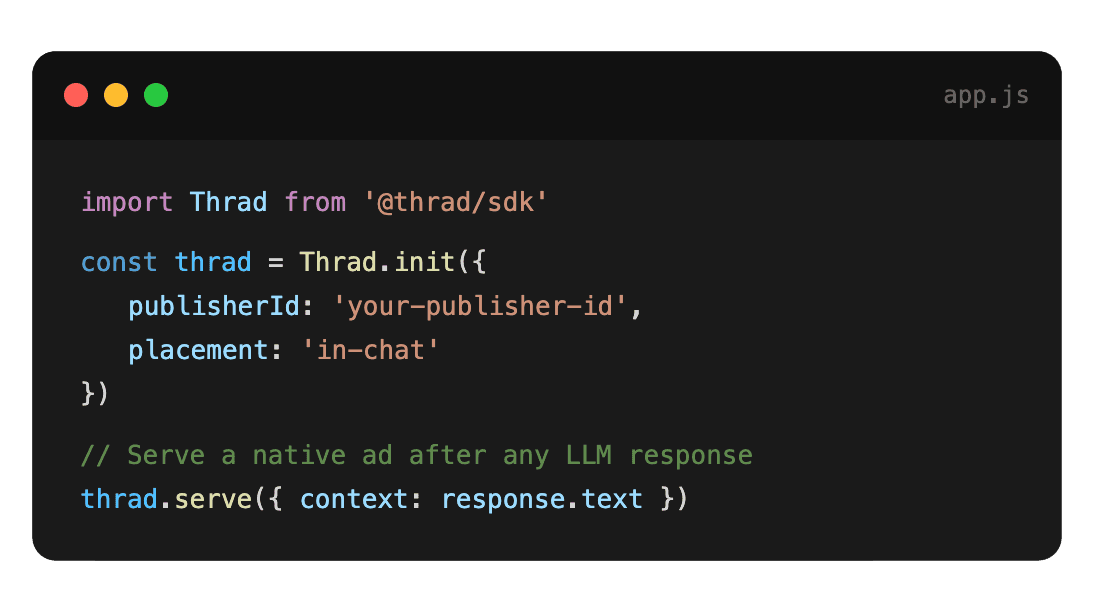
Start monetizing your AI app in under an hour
With Thrad, publishers go from first API call to live ads in less than 60 minutes. With fewer than 10 lines of code required, Thrad makes it easy to unlock revenue from your conversational traffic the same day.
Here is the two-sentence answer most current "advertise on Perplexity" articles will not give you: Perplexity shut down its ad program in February 2026 and publicly committed to not bringing it back. The practical step-by-step for a 2026 buyer is therefore not a buyer walkthrough for a native Perplexity ads manager (that manager does not exist), but a four-part program that reaches Perplexity users through citations, licensing, GEO, and cross-surface independent networks.
What is the state of Perplexity advertising in April 2026?
Perplexity has no native paid ad inventory as of April 2026. The sponsored-follow-up-question program launched in November 2024 and was shut down in February 2026. Perplexity's leadership told the Financial Times that user trust was the deciding factor — once ads are in answers, users begin to second-guess whether every answer is independent of commercial pressure, and that trust cost exceeded the revenue line.
What went away specifically:
Sponsored follow-up questions — AI-generated prompts a brand
paid to surface as the next suggested question in a Perplexity
answer.Sponsored side media — paid units positioned to the right of
an answer.Launch partners — brands like Indeed, Whole Foods Market,
Universal McCann, and PMG that participated in the pilot lost their
placements when the program ended.Revenue line — AdExchanger reported the business was growing in
early 2025 before the leadership change that preceded the shutdown.
Perplexity's internal business is still growing — subscriptions, shopping integrations, and enterprise search are live — but advertising is not. Any 2026 media plan that assumes native Perplexity ads is built on facts that expired in Q1.
Can you advertise on Perplexity in 2026?
Not directly, and not today. But a brand can do four things that collectively put it in front of Perplexity users without needing a native ad product to exist. This section is the step-by-step.
The 2026 "how to advertise on Perplexity" is not a native-ads walkthrough. It's a citation, licensing, GEO, and cross-surface independent-network program. Treat Perplexity like an earned channel in 2026, not a paid one.
Step 1 — Understand the citation engine
Perplexity's product is a cited answer. When a user asks a question, Perplexity synthesizes a response and links to the sources it pulled from. Brands that appear in those sources — directly or via cited publishers — appear in the answer. This is the only "placement" on Perplexity in 2026, and it is entirely earned.
Two practical implications:
Your own site is your ad unit. If your pages are cited, you
appear. If they aren't, you don't.Publishers are your proxy. When Perplexity cites a review site,
comparison publication, or news outlet that mentions your brand,
you inherit visibility through that publisher.
Step 2 — Publisher licensing and earned mentions
Perplexity maintains relationships with a range of publishers whose content it surfaces more prominently. Brands that have long-standing relationships with those publications — whether through PR, sponsored content, or media deals — can indirectly influence how often their brand appears in Perplexity answers.
This is not a paid ad buy, and it is not a direct placement. It is a PR-adjacent lever that has become materially more valuable now that native ads are gone. Brands treating publisher investments as an answer-engine visibility channel (rather than just traditional PR) get more out of them in 2026.
Step 3 — Run a Generative Engine Optimization program
GEO is the 2026 SEO-equivalent specifically tuned for AI engines. Perplexity is one of the most GEO-sensitive surfaces because its entire product is citation-led. A GEO program for Perplexity has five components:
Question-form H2s — pages structured around the questions
users actually ask.Quantified claims — every paragraph carries a number, a date,
or a specific fact. Perplexity's citation logic prefers
quantified content over qualitative content.Source hygiene — citations inside your content point to
primary sources with current dates.Machine-readable markup — schema.org, clean HTML, fast
rendering, no JS-only content that Perplexity's crawlers can't
parse.llms.txt file — the 2025-2026 standard for telling AI
crawlers which pages are canonical; Perplexity and Claude both
respect it.
The pattern that works in 2026 is pairing the GEO program with a weekly Share of Model audit: query Perplexity with your top 20 commercial-intent questions, log which brands appear, and track the trend over time. Your own rank in the set is your scoreboard.
Step 4 — Use an independent AI ad network for paid reach
The inventory Perplexity does not sell is sold by other AI-native publishers — AI coding assistants, vertical AI apps, agent UIs, niche assistants. Independent AI ad networks aggregate this long tail into a single integration. Thrad's AI ad network is one such network; it sells native answer, recommendation, and call-to-action units that match the host assistant's UI and match against contextual signals like topic and intent. Brands typically stand up this slot in parallel with advertising on ChatGPT because the two buys cover complementary audiences.
The use case for a Perplexity-adjacent buyer: you cannot buy a Perplexity placement, so you buy placements in the surfaces your Perplexity user also uses. Overlap is imperfect but meaningful — the Perplexity user who researches a product today is the same user who asks an AI coding assistant a technical question tomorrow, and the independent network covers the second surface even when the first is closed.
How does the Perplexity ad shutdown change the 2026 playbook?
Four shifts compared to the 2024-2025 playbook:
Was the play (pre-shutdown) | Is the play (April 2026) |
|---|---|
Buy sponsored follow-up questions at CPM | Earn the citation via GEO; no sponsored follow-ups exist |
Run side-panel paid media adjacent to answers | Partner with cited publishers; no side panel inventory |
Expect a Perplexity self-serve advertiser platform | Build a Share of Model program; no platform is shipping |
Treat Perplexity as a paid-first channel | Treat Perplexity as an earned / GEO channel |
The playbook shift is not subtle. A 2025 plan that routed $50K-$200K to Perplexity CPMs has no obvious replacement on Perplexity today; the budget instead flows into (a) GEO / content program that lifts citations across all AI surfaces, (b) publisher licensing / PR, and (c) cross-surface paid buying through an independent AI network for the actually-paid inventory.
What does a 90-day Perplexity visibility plan look like?
The concrete quarterly plan a brand can run starting Q2 2026.
Month 1 — audit. Map your top 20 commercial-intent queries. Ask each on Perplexity and record which brands appear, which sources Perplexity cites, and how often your brand appears. This is the baseline Share of Model audit.
Month 2 — GEO build-out. Identify the 10 queries where you want to appear. For each, publish or upgrade one long-form, quantified, question-structured article that directly answers the query. Every article: 2,250+ words, 40-50% question H2s, 10+ cited sources with 2026 dates, schema markup. Update llms.txt. Ship.
Month 3 — cross-surface + measurement. Stand up an independent AI ad network account to cover paid inventory outside Perplexity. Set up weekly Share of Model monitoring with a third-party GEO tool. Set up a citation-lift report comparing Month 3 to Month 1 on the 20 queries. Decide what's working.
Quarterly cadence. Repeat the audit, expand the GEO content set, expand the paid cross-surface buy, tune the measurement. The Perplexity visibility line moves quarter over quarter on earned + cross-surface metrics, not monthly on paid media ones.
What do the cost math and allocation look like?
A realistic 2026 budget for a brand treating Perplexity as a visibility target:
Lever | Typical 90-day spend | What it produces |
|---|---|---|
GEO content program | $15K-$40K (content + optimization) | 10-20 new/upgraded articles tuned for AI citation |
Publisher PR / licensing-adjacent | $10K-$50K | Third-party mentions in the publications Perplexity cites |
Share of Model monitoring | $2K-$5K (tool + analyst time) | Weekly tracking across 20-50 queries |
Independent AI ad network (e.g., Thrad pricing tiers) | $15K-$75K | Paid reach in AI-native apps adjacent to Perplexity users |
Internal analyst time | Varies | Running the audit, tuning the plan |
None of these line items pay Perplexity directly. That is the point: the 2026 Perplexity play does not route dollars to Perplexity, because Perplexity has built a product that does not accept them.
Common misconceptions about advertising on Perplexity
"Perplexity ads are still running, just in a smaller pilot."
Incorrect as of February 2026. The program was publicly and fully
discontinued. Any pitch suggesting otherwise should be checked
against Perplexity's public statements and the Financial Times /
PYMNTS / Campaign US reporting."I can buy Perplexity inventory through a DSP or ad exchange."
No. Perplexity never syndicated its brief ad inventory through DSPs,
and there is no inventory to syndicate today."If Perplexity is unshipped, it doesn't matter for my brand."
It still matters — just as an earned channel. Perplexity's users
are a research-heavy segment worth showing up to, and a brand that
invests in GEO today picks up citation share when competitors are
still chasing paid."GEO is the same as SEO." Overlapping but not identical. GEO
optimizes for AI citation and mention frequency; SEO optimizes for
blue-link rank. The technical overlap is large, but the content
specs (question structure, quantified claims, citation density,
llms.txt) are GEO-specific."If Perplexity reverses and opens ads again, I'll jump in then."
Possible but unlikely in 2026. The reputational cost to Perplexity
of walking back the trust argument is high, and the executive
communication has been strong. A brand that waits is leaving an
entire quarter of earned-channel compounding on the table.
What might change in the rest of 2026?
Three scenarios to track:
Shopping commerce layer expands. Perplexity is investing in
shopping integrations (announced through Q1 2026). A commerce
layer is not the same as an ads layer but could create indirect
brand-placement opportunities through merchant partnerships.Enterprise search monetization. Perplexity's enterprise tier
is growing; brand visibility inside enterprise-facing answers
could become a product.Quiet reversal. If user growth stalls and subscription and
enterprise revenue under-deliver, Perplexity's board pressure
could reopen the ads question. The public posture is strong today,
but tech companies have reversed on ads before.
None of these are paid-ad products today. A brand planning for 2026 should assume Perplexity stays unshipped and treat any reversal as upside.
How to get started in 30 days
Run the Share of Model audit. Ask your top 20 commercial-
intent queries on Perplexity. Record which brands appear. This is
the baseline. Most brands discover they're not in the set at all.Ship three GEO-optimized articles. Pick the three queries with
the highest commercial value. Write long-form, question-H2,
quantified content with 2026-dated citations. Update llms.txt.Audit your publisher footprint. Which publications Perplexity
cites cover your category? Where are you mentioned? Where could
you be? This informs a PR / licensing-adjacent plan.Set up independent-network paid reach. Stand up an account
with an AI ad network like Thrad to cover the paid inventory
outside the big four assistants. Single integration, multi-surface
reach.Set a 90-day re-audit date. Re-run the Share of Model audit in
90 days. Measure the lift. Tune the plan.
The honest 2026 summary for brands that want to "advertise on Perplexity": you cannot in the literal sense, and you do not need to. The path to Perplexity visibility runs through earned citation, GEO, publisher relationships, and cross-surface independent-network paid reach. Brands that accept that reframe and run the playbook above outperform brands still waiting for a Perplexity ads manager that will not ship in 2026.
perplexity ads 2026, sponsored follow-up questions, perplexity ad program, perplexity advertiser alternatives, perplexity GEO
Citations:
PYMNTS, "Perplexity Pulling Sponsored Answers From AI Platform," 2026. https://www.pymnts.com/artificial-intelligence-2/2026/perplexity-pulling-sponsored-answers-from-ai-platform/
Campaign US, "Perplexity pulls the plug on ads," 2026. https://www.campaignlive.com/article/perplexity-pulls-plug-ads-citing-trust-concerns-ai/1949142
Perplexity, "Why we're experimenting with advertising," 2024. https://www.perplexity.ai/hub/blog/why-we-re-experimenting-with-advertising
Search Engine Land, "Perplexity begins testing ads as sponsored follow-up questions," 2024. https://searchengineland.com/perplexity-begins-testing-ads-448277
MacRumors, "Perplexity Abandons AI Advertising Strategy Over Trust Worries," 2026. https://www.macrumors.com/2026/02/18/perplexity-abandons-ai-advertising/
AdExchanger, "A Peek Behind The Curtain At Perplexity's Nascent But Growing Ads Business," 2025. https://www.adexchanger.com/ai/a-peek-behind-the-curtain-at-perplexitys-nascent-but-growing-ads-business/
Similarweb, "Generative Engine Optimization: The Complete 2026 Guide," 2026. https://www.similarweb.com/blog/marketing/geo/what-is-geo/
ExchangeWire, "Thrad Joins AgenticAdvertising.org as Founding Member," 2026. https://www.exchangewire.com/blog/2026/03/05/thrad-joins-agenticadvertising-org-as-founding-member/
AdsX, "Perplexity AI February 2026 Updates: Shopping, No More Ads," 2026. https://www.adsx.com/blog/perplexity-updates-february-2026
Be present when decisions are made
Traditional media captures attention.
Conversational media captures intent.
With Thrad, your brand reaches users in their deepest moments of research, evaluation, and purchase consideration — when influence matters most.