ChatGPT needs advertising revenue in 2026 because subscription and API
income cannot cover the cost of serving more than 800 million weekly
free users. Free-to-paid conversion is under 5%, inference costs are
falling slower than usage is rising (roughly 35% efficiency gains per
year against 70%+ query volume growth), and enterprise gross margin
can't stretch to subsidize consumer free traffic. Ads are the only
revenue engine that grows with free-tier engagement.



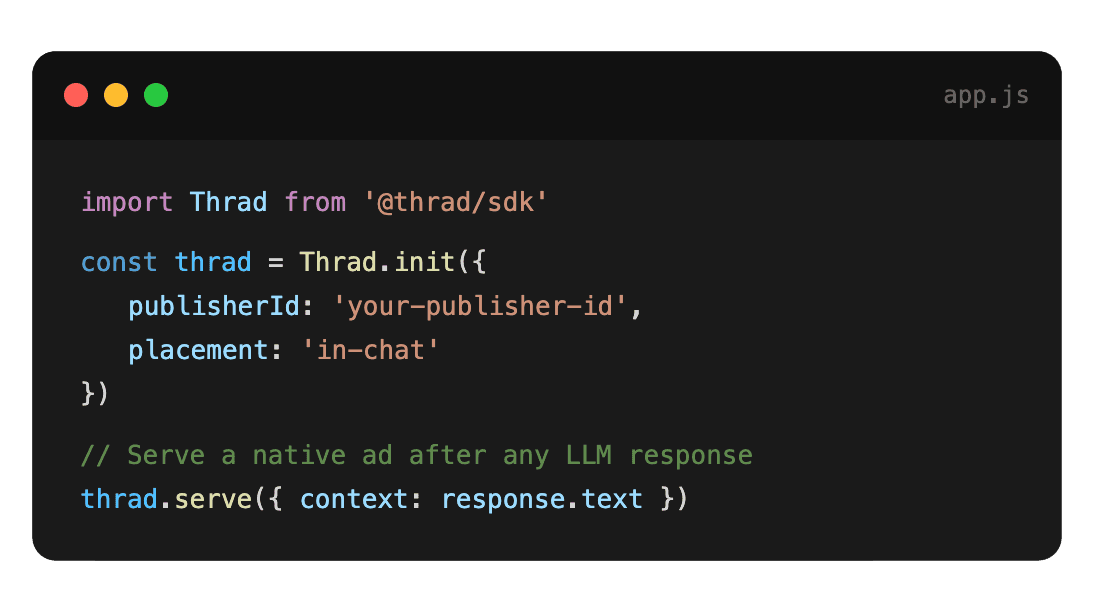
Start monetizing your AI app in under an hour
With Thrad, publishers go from first API call to live ads in less than 60 minutes. With fewer than 10 lines of code required, Thrad makes it easy to unlock revenue from your conversational traffic the same day.

Why ChatGPT Needs Ad Revenue — 2026 | Thrad
The pivot to advertising was not a strategy choice — it was forced by
arithmetic. Free-tier usage grew faster than paid conversion, inference
costs stayed stubborn, and API margins are structurally thin. Ads are
the only additive revenue engine that scales with free traffic.
ChatGPT needs advertising revenue because the cost of serving more than
800 million free users every week now outstrips what subscriptions and
API revenue can cover on their own. It's an arithmetic problem, not a
philosophical one — free-tier compute is real money, conversion to paid
is low single digits, and the only additive revenue engine that scales
with free traffic is ads. This article walks through the structural
math: the compute gap, the conversion ceiling, the API margin squeeze,
and why 2026 was the year arithmetic forced a decision that had been
deferred since 2023.
What is the structural problem?
ChatGPT runs a two-sided economy where one side pays and the other
doesn't. The paid side — Plus at $20/mo, Pro at $200/mo, Team,
Enterprise, API — generates roughly $12B of annualized revenue in
2026. The free side generates the majority of usage, nearly all of the
compute cost, and none of the direct revenue. In 2023 this gap was
manageable because free-tier usage was small relative to paid. In 2026,
with free-tier users above 800 million weekly actives, the gap has
inverted: free usage is the dominant cost driver.
The revenue math has to balance somehow. OpenAI's realistic options
reduce to four:
Cut free usage — damages growth, trust, and the consumer
moat that justifies the valuation in the first place.Raise paid prices — suppresses conversion more than it
raises revenue at the $20 price point, based on public modeling.Monetize free users directly — advertising, the subject of
this article.Hope inference costs fall faster than usage grows — the bet
most optimists made in 2023-2024. It didn't pay off.
Option three is the arithmetic answer. The rest of this article
explains why.
How big is the free-tier compute bill actually?
Public estimates put OpenAI's 2026 free-tier serving cost in the
$3-5B annualized range — larger than any other operating line item.
A GPT-4o-class answer costs roughly 1-4 cents in marginal inference,
with fully-loaded cost (including GPU depreciation, electricity,
network, and R&D amortization) typically 2-3× that. Multiply by the
low-billions of weekly free-tier queries and you get a serving bill
that rivals or exceeds OpenAI's total subscription revenue.
The cost structure decomposes roughly like this (directional, based on
public analyst modeling):
Cost component | Share of total inference cost | Notes |
|---|---|---|
GPU compute (H100/H200/Blackwell class) | 45-55% | The dominant line; amortized over usage |
Electricity | 10-15% | Rising with datacenter scale and heat density |
Datacenter overhead | 10-15% | Cooling, networking, physical plant |
R&D amortization | 10-20% | Training runs spread over inference revenue |
Storage and networking | 5-10% | KV cache, model weights, egress |
Inference cost is falling — GPUs get faster, models get more efficient,
quantization and caching improve. But that trend runs against the
other dynamic: usage is rising faster. Per-query cost trends down
roughly 30-40% per year; total queries have been rising 70%+ per year.
Net: total cost is still trending up. That's the dynamic that breaks
the optimistic 2023 thesis that "inference will get cheap faster than
usage grows."
The moment that dynamic became undeniable — inference efficiency
gains of ~35% per year against query volume growth of ~70% per year —
was the moment advertising moved from "someday, maybe" to "2026
roadmap." The crossover isn't philosophical. It's a spreadsheet.
Why won't subscription revenue close the gap on its own?
The fundamental limit is conversion. Freemium products across a
generation of consumer software land somewhere between 2% and 8%
free-to-paid conversion at scale — Spotify, Dropbox, LinkedIn, YouTube
Premium, Evernote, and Notion all cluster in that band. ChatGPT is in
the same range, reportedly 3-5%. That ceiling is not a product problem;
it's a consumer-behavior constant.
Which means every new free-tier user added to the top of the funnel
brings marginal cost immediately and has roughly a 3-5% chance of ever
converting. The cost-to-conversion ratio cannot be closed by better
marketing. It can only be closed by a second revenue engine that
monetizes the 95%+ who won't upgrade.
Raising the $20/mo price is similarly limited. The $20 anchor is
deliberately calibrated to sit alongside Netflix, Spotify Premium,
Google One, and Apple One — subscriptions consumers treat as
below-friction. Public elasticity modeling suggests that raising to
$25/mo would suppress new paid conversions by 15-25%, leaving OpenAI
with either roughly flat revenue or slight decline. A move to $30/mo
fares worse in the models. The $20 price point is probably optimal
on a revenue-maximizing basis.
Why isn't the API the answer either?
API revenue is growing fast — likely 100%+ YoY in 2026, reaching an
estimated $1.5-2B annualized — but carries a different economic
problem: margin compression. OpenAI competes on API pricing with
Anthropic, Google, open-weights models from Meta/Mistral/DeepSeek, and
a long tail of inference providers that host open weights at 60-90%
below frontier pricing. To stay competitive, gross margin per API
token is compressed — high volume, low unit contribution.
The API margin profile looks something like this:
API tier | Approx gross margin | Notes |
|---|---|---|
Premium (GPT-5, o-series) | 60-70% | Small volume share, high unit contribution |
Workhorse (GPT-4o, 4o-mini) | 40-50% | Largest volume, margin squeezed by open-weights |
Commodity (4o-mini, embeddings) | 20-35% | Race to bottom vs open-weights hosts |
Useful revenue, but not enough to cross-subsidize billions of free-tier
consumer queries on its own. And the competitive dynamic means the
spread only compresses from here.
How does each revenue stream scale with free users?
This is the decisive table. Only advertising grows with free-tier
engagement. Every other revenue line is indifferent to or negatively
correlated with free usage scale.
Revenue stream | Growth rate (2026) | Gross margin profile | Scales with free users? |
|---|---|---|---|
Consumer subs (Plus/Pro) | Plateauing, 20-30% YoY | Healthy per user (~70%) | No — capped by conversion ceiling |
API | Fast, 100%+ YoY | Thin (40-50% blended) | No — different audience |
Enterprise seats | Steady, 50-80% YoY | Highest (~75-85%) | No — separate P&L |
Advertising | Fastest, 300%+ YoY from a low base | TBD — likely 70%+ at scale | Yes — linearly |
Licensing deals | Moderate, 40-60% YoY | Mixed | Partial — indirect |
The last column is the decisive one. The free-tier cost problem needs
a revenue line that grows with free usage. Advertising is the only one
on the list that qualifies.
Every consumer internet company that reached ChatGPT's free-tier
scale eventually landed on an ad-supported model — not because the
founders wanted ads, but because advertising is the only known way
to monetize billions of people who use a service and never pay.
ChatGPT is following the same gravity.
What changed in 2025 and 2026 to force the decision?
Three concrete shifts made the advertising decision inevitable in
2026 rather than 2027 or 2028.
Usage scale crossed an inflection point. Weekly free-tier users
crossed 500 million in mid-2025 and 800 million in early 2026, making
the serving bill impossible to absorb without either ads or material
rate-limit cuts. At 500M WAU the serving cost is uncomfortable; at
800M+ it becomes a dominant line that forces a strategic response.
Frontier-model costs stayed stubborn. GPT-5 and its tier of models
did not produce the step-change reduction in serving cost that some
analysts projected. Efficiency improved roughly 30-40% year over year,
but not fast enough to offset the 70%+ growth in query volume.
Architectural improvements (MoE, caching, speculative decoding)
delivered real but incremental gains.
Investor pressure solidified. Moving toward a public offering or
a higher private valuation required a credible path to positive
consumer-tier unit economics, and advertising is the only lever that
delivers it inside a reasonable timeframe. Discussions around tender
offers and potential IPO structures through 2025-2026 made the
unit-economics conversation urgent in a way it hadn't been when OpenAI
was purely private and funded by strategic capital.
What does the free-tier unit economics math look like?
The easiest way to see why ads became inevitable is a per-user
contribution math. Consider a hypothetical weekly free-tier user in
2026.
Average weekly queries per free user: estimated 10-30.
Average cost per query (fully loaded): 1.5-4 cents.
Weekly cost per free user: 15-120 cents, midpoint ~50 cents.
Annualized cost per free user: $8-60, midpoint ~$25.
Multiplied by 800M weekly actives, the midpoint implies roughly $20B
annualized in serving cost across all free users — clearly higher than
the $3-5B often-cited figure because this math ignores the roughly 4×
efficiency OpenAI achieves through caching, routing to smaller models,
and batching. Apply that efficiency discount and the real number
rounds to $3-5B — the commonly cited estimate.
Against that $3-5B annual cost, OpenAI needs an incremental revenue
line of similar magnitude to move consumer-tier economics into the
black. Advertising at even $5-10 per free user annualized would close
the gap. That's comparable to what Google and Meta extract from free
users on less-engaged surfaces, making it plausible but not trivial.
Why was "no ads" not a sustainable position?
Sam Altman publicly expressed skepticism about advertising several
times between 2023 and 2024, framing ads as potentially misaligned
with user interest. The position was defensible while OpenAI's free
tier was small relative to paid. It stopped being sustainable when
free became the dominant cost driver.
Two reframes made the policy shift easier. First, commercial-intent
queries are genuinely useful with ads — a user asking "best
noise-canceling headphones under $300" is already in a buying posture,
and a well-targeted sponsored result is arguably closer to the user's
goal than an answer that refuses to acknowledge commerce. Second,
the ads-vs-no-ads binary was never the real choice — the real
choice was ads vs harder rate limits, shrinking free access, or
converting toward a Claude-like enterprise-heavy mix that would
forfeit the consumer brand.
Common misconceptions
"OpenAI is profitable, so ads are just greed." Not accurate at
the consolidated product level. Subscription + API margin does not
cover training, free-tier serving, and R&D combined as of early 2026.
Reported operating losses in the single-to-low-double-digit billions
persist."Microsoft's investment covers the costs." Microsoft funds
compute capacity and equity, not operating expenses. Revenue still
has to pay for serving users."If they just raised Plus to $30/mo this would be fixed." Modeling
doesn't support this. The price elasticity kills more upgrades than
the extra $10 generates in most scenarios."Ads betray the original mission." The mission-vs-economics
tension is real, but the alternative to ads is a smaller, more
gated ChatGPT — which arguably conflicts more with the mission of
broad access than advertising does."Inference will just get cheap enough to make ads unnecessary."
Thirty-plus months of empirical data say otherwise. Usage growth
outstrips efficiency gains; the crossover point where inference
becomes a non-factor is not visible in the current trajectory.
What comes next for the ad business?
Expect ad revenue to grow fastest through 2026 and 2027, compounding
from a sub-$500M base toward single-digit billions by 2028 on analyst
models. Expect the free tier to remain genuinely useful rather than
being gated harder — because ads make a generous free tier sustainable.
Expect API pricing to keep compressing, which reinforces the need for
advertising as the consumer-side engine. And expect sponsored search
and shopping to be the first large formats, with conversational
placements emerging more slowly because of trust-cost concerns.
Two second-order effects worth anticipating. First, the ad revenue
will likely fund a more generous free tier, not a more restricted one
— the opposite of what some critics predicted. Second, an advertising-
funded free tier changes OpenAI's strategic posture toward Google: the
two companies are now revenue-model peers, competing for commercial-
intent queries with similar monetization.
How to act on this as a brand
The structural argument matters for brand planning because it tells
you ads aren't a reversible experiment. They are now a permanent layer
of how generative surfaces make money, which means visibility inside
ChatGPT, Perplexity, and Gemini is a durable channel — not a fad.
Brands that start building measurement and placement capability now
will have a 12-24 month lead when self-serve auctions ship and the
category opens up.
Thrad helps brands measure that visibility and place ad inventory
inside generative surfaces where paid formats exist today. If the
economics aren't going away, the measurement infrastructure to work
with them shouldn't be improvised.

openai economics, chatgpt free tier cost, chatgpt ad model, openai profitability
Citations:
The Information, "OpenAI revenue hits $12B annualized in Q1 2026," 2026. https://theinformation.com
SemiAnalysis, "GPU economics of frontier model serving," 2025. https://semianalysis.com
CNBC, "OpenAI free-tier usage crosses 800M weekly users," 2026. https://cnbc.com
The Verge, "OpenAI begins testing paid search placements in ChatGPT," 2026. https://theverge.com
Stratechery, "The inevitability of ad-supported generative AI," 2025. https://stratechery.com
Bloomberg, "OpenAI's consumer unit economics under pressure," 2026. https://bloomberg.com
Wall Street Journal, "Inside OpenAI's free-tier serving cost," 2026. https://wsj.com
Be present when decisions are made
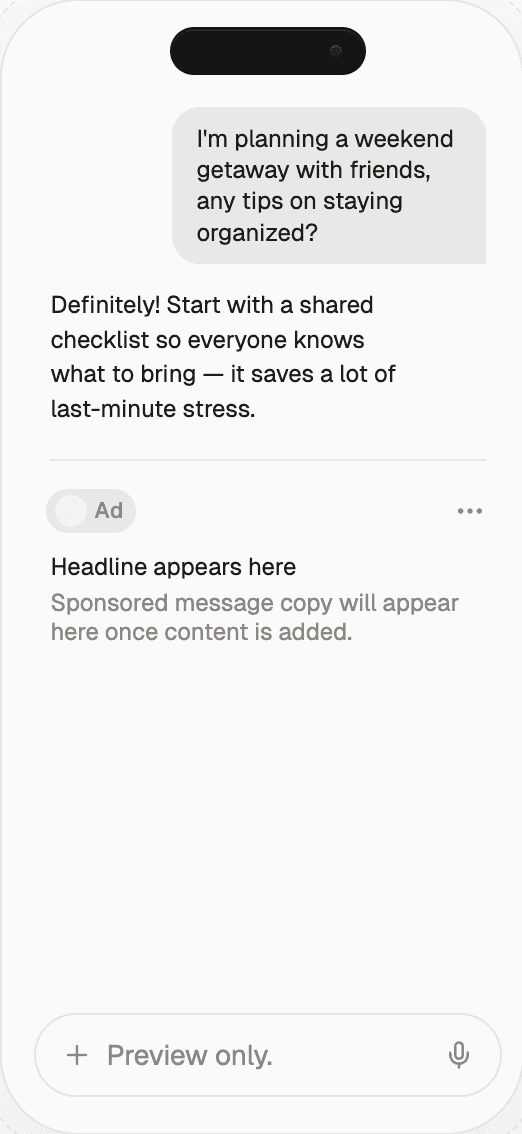
Traditional media captures attention.
Conversational media captures intent.
With Thrad, your brand reaches users in their deepest moments of research, evaluation, and purchase consideration — when influence matters most.
Date Published
Date Modified
Category
Advertising AI
Keyword
why chatgpt needs advertising revenue