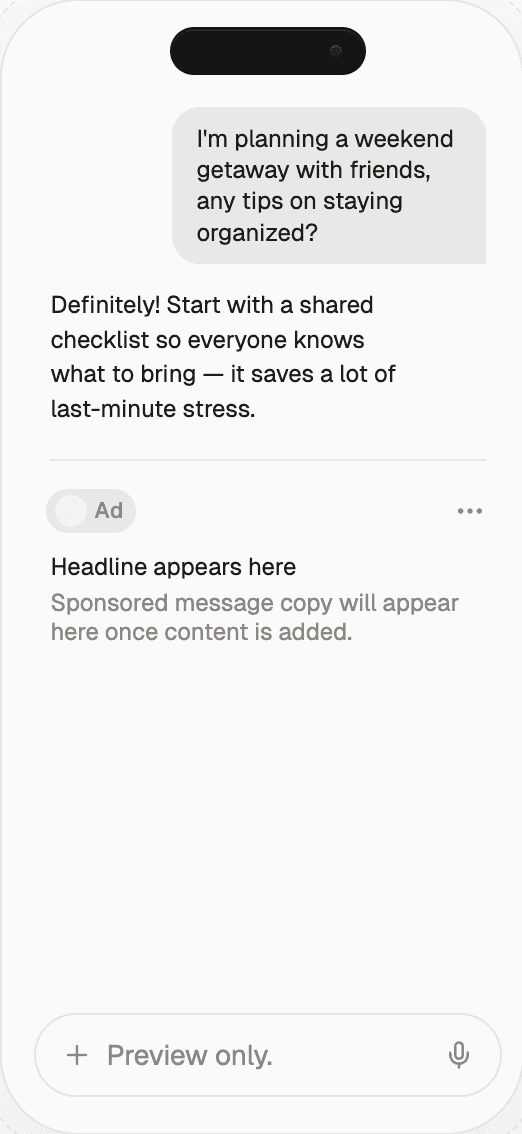
Prompt advertising targets placements based on the user's prompt to an
AI assistant. The prompt is classified for intent and category; ads
auction against that signal; the winning placement renders inside the
assistant's answer. It's adjacent to search keyword advertising but
runs on generative surfaces and uses conversational-native creative.
eMarketer estimates roughly $1.6B in global prompt-advertising spend
in 2026, with ~60% concentrated on the top three assistants.


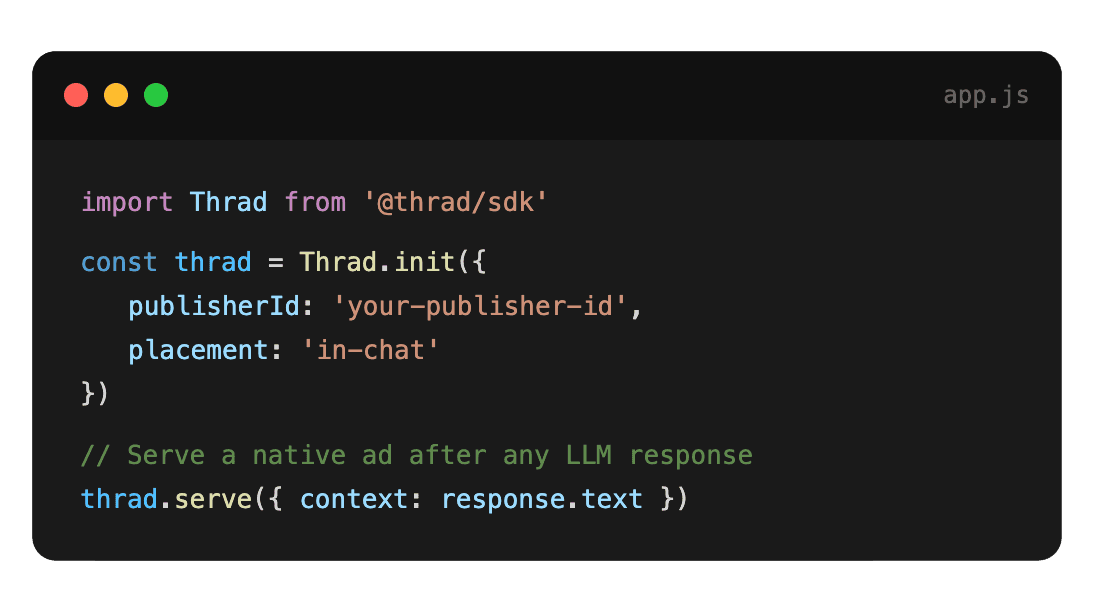
Start monetizing your AI app in under an hour
With Thrad, publishers go from first API call to live ads in less than 60 minutes. With fewer than 10 lines of code required, Thrad makes it easy to unlock revenue from your conversational traffic the same day.
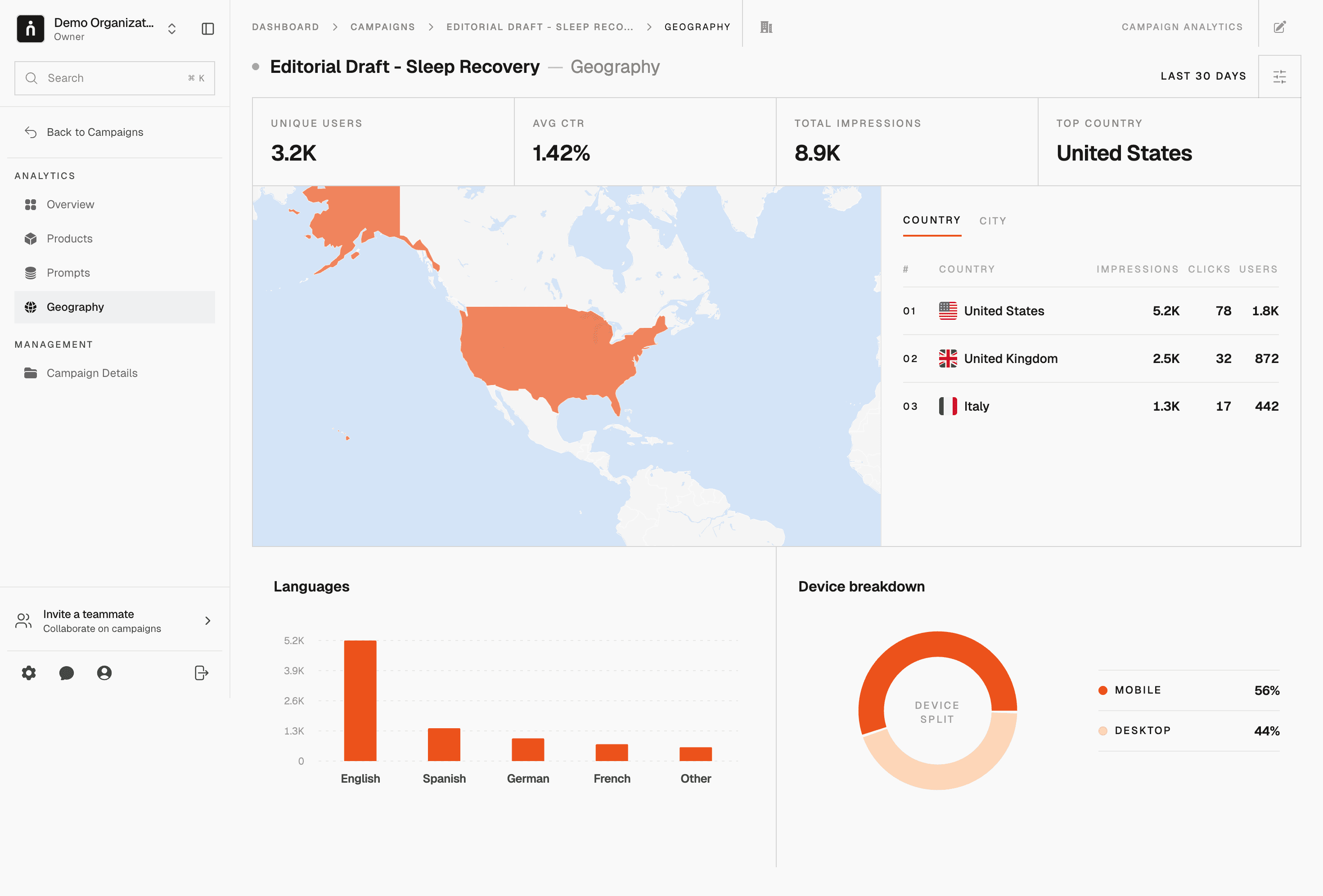
Prompt Advertising Explained — 2026 | Thrad
Prompt advertising is the practice of treating a user's AI-assistant
prompt — typed or spoken — as the targeting and bidding unit. It's the
conversational equivalent of keyword advertising, but the signal is
richer and the creative is conversational-native. Here's how it works
and why it's a distinct discipline.
Prompt advertising is the practice of treating a user's AI-assistant
prompt as the unit of targeting and bidding. When someone asks an
assistant "what's the best project-management tool for a 20-person
agency," the prompt itself carries commercial intent, category signal,
and context — and advertisers bid to place a labeled sponsored unit
alongside the answer. It's the next buying primitive after the keyword,
and eMarketer puts its global 2026 scale at roughly $1.6B — about 42%
of all LLM advertising spend and the fastest-growing subset of the
channel.
What is prompt advertising?
Prompt advertising is the buying pattern where a user's full AI-
assistant utterance becomes the targeting and bidding signal. The
prompt is embedded, classified for intent and category, matched to an
advertiser's campaign target, and — if the bid wins — serves a
conversational-native sponsored unit inside the answer. Every render
is independently governed for disclosure and brand safety.
Prompt advertising has four defining properties:
Prompt as unit. Each user utterance is the buying primitive —
not a keyword list, not an audience segment. IAB Tech Lab's Prompt
Targeting Specification v1 (2026) codifies the prompt as the atomic
unit for a cross-assistant auction.Embedding-based matching. Advertisers target intents and
categories via embeddings, so variations in phrasing all match
cleanly to one campaign target. Benchmark match recovery is 3–5x
better than exact-match keyword per WARC.Native creative. The ad renders inside an assistant's answer
and reads like conversational text with a labeled sponsored tag.Per-render governance. Disclosure and brand-safety checks run
each time an ad fires, because every render is against a different
prompt. GARM's 2026 per-render framework is becoming the de facto
governance standard.
The practice sits inside the broader category of conversational AI ads
and overlaps heavily with AI chatbot ads as a placement surface.
What differentiates prompt advertising specifically is that the
prompt itself drives the buy — not the user's profile, not the
publisher's page, not the session history.
How does prompt advertising work step by step?
Prompt advertising runs as a six-step real-time pipeline: ingest,
classify, auction, check policy, render, measure. Each prompt flows
through in under 500 milliseconds on production systems at ChatGPT and
Perplexity. The auction typically closes in under 80ms, which is why
the pipeline doesn't visibly slow the assistant.
Prompt arrives. A user asks an AI assistant a question. The
prompt is captured as text (or transcribed speech) and tokenized.Classification. The assistant's ad system runs intent and
category classifiers, plus sometimes a raw embedding lookup against
a vector index of advertiser-declared intent clusters. Confidence
scores are computed per label.Auction. Eligible advertisers bid against matching intents —
typically a second-price or similar auction with bid + relevance
scoring. OpenAI's 2025 developer notes describe a bid-times-quality
score ranker with a reserve price per category.Policy check. Per-render disclosure, brand-safety, and
regulated-category checks fire before render. A winning bid can
still be blocked here — GARM reports ~4–6% of winning bids
post-blocked across 2026 categories.Render. The winning unit renders inside the assistant's
answer with clear sponsored labeling. Render is conversational-
native: the ad appears as a paragraph, a card, or a follow-up
suggestion, depending on surface.Measurement. Impression, click, citation, and post-action
conversion flow back to the advertiser's reporting pipeline.
Signed server-side receipts are becoming standard per IAB Tech Lab
spec.
Pipeline step | Latency budget | Failure mode |
|---|---|---|
Ingest + tokenize | < 20ms | Rarely binds |
Classify + embed | 40–80ms | Low-confidence → no ad |
Auction | 30–80ms | Timeout → no ad |
Policy check | 20–60ms | Category violation → bid voided |
Render | 10–30ms | Disclosure missing → blocked |
Measure | Async | Dropped events rare |
Why is prompt advertising its own discipline versus keyword advertising?
Prompt advertising is a distinct discipline because the signal, the
auction unit, and the creative form all diverge from keyword
advertising simultaneously. Keyword ads match surface text to surface
text; prompt ads match embedded intent to embedded intent. Keyword
creative fits a 90-character slot; prompt creative has to read as a
useful sentence inside an answer. Each of those differences alone
would justify specialization; together they force it.
Two things made prompt advertising real in 2025-2026. First, prompt
classifiers became reliable in 2025 as part of the same foundation-
model progress that improved everything else. Precision on intent
classification crossed roughly 92% on public benchmarks by early 2026,
up from 74% in 2023. Second, major assistants opened prompt-level
inventory — directly or through AI ad networks — so the auction had
a venue to run in.
Axis | Keyword advertising | Prompt advertising |
|---|---|---|
Unit | Keyword / phrase match | Full utterance |
Signal | Surface terms | Embedding + classifier |
Match recovery | Exact + broad match | 3–5x more variants via embedding |
Surface | SERP | Assistant answer |
Creative | Headline + description + URL | Conversational text + link |
Auction unit | Query | Prompt (one per render) |
Pricing | Mostly CPC | CPM / hybrid / CPC |
Disclosure | "Ad" label | IAB-spec sponsored label |
Governance | Campaign-level | Per-render |
Specialist hire | SEM manager | Prompt buyer + prompt copywriter |
Prompt advertising isn't "keyword advertising with vibes." The
matching signal is different, the auction is different, and the
creative requirements are different — and the gap will keep widening
as prompt-conditioned generation lets ad text adapt to each exact
utterance, which keyword ads cannot do.
How is prompt targeting different from behavioral or contextual targeting?
Prompt targeting is distinct from both behavioral and contextual
targeting on the input signal. Behavioral targets the user's history;
contextual targets the surrounding page or query topic; prompt
targets the user's live utterance in an AI assistant. The prompt is
closer to declared intent than either alternative — the user literally
just said what they want — which is why per-prompt CPMs run 30–60%
above equivalent-intent CPMs on behavioral or contextual display.
Behavioral and contextual still have their places, and most mature
2026 plans stack all three. Behavioral wins on logged-in first-party
retargeting. Contextual wins on open-web placement and on the
placement decision inside an AI answer. Prompt wins on direct intent
capture in the assistant itself.
What does prompt advertising creative look like?
Prompt advertising creative is conversational-native: it renders as a
sentence, a paragraph, or a labeled follow-up question, not as a
banner. The craft is closer to editorial copy than to display or
SEM. Adweek's 2026 agency survey reported "prompt copywriter" as the
fastest-growing specialist role since 2024, with average salaries 20%
above traditional SEM copy roles.
Three creative archetypes dominate in 2026:
Sponsored recommendation sentences. A paragraph-style
recommendation that reads as if the assistant is highlighting one
answer, with a sponsored label attached. Best for commerce,
software, and services.Sponsored follow-up prompts. A suggested next question the
user is likely to ask, labeled as sponsored. Perplexity's inventory
of this form runs 8–11% click-through rates, well above display
averages.Sponsored cards. A structured card with headline, short copy,
and a link, rendered alongside the answer. Copilot defaults to this
format.
Good prompt creative reads as a useful answer first and an ad
second. If the user wouldn't have minded reading the sentence in an
organic response, the creative is working. If it reads as
interruption, the creative is wrong.
What does prompt advertising cost in 2026?
Prompt advertising pricing in 2026 is mostly CPM-based, with CPC
emerging on high-click intents and CPA-citation hybrids appearing at
the frontier. eMarketer's 2026 channel model puts average commercial
prompt CPMs in the $18–$32 range, with shopping and B2B software
categories running 2–3x higher because of concentrated buyer intent.
Category | Typical CPM range (2026) | Primary pricing model | Minimum entry |
|---|---|---|---|
B2B software eval | $45–$95 | CPM + CPA hybrid | $25K |
Consumer shopping | $25–$60 | CPC on sponsored cards | $10K |
Financial services | $35–$70 | CPM | $50K |
Travel | $18–$35 | CPC | $10K |
Health (non-Rx) | $20–$40 | CPM | $15K |
General services | $12–$25 | CPM | $5K |
Digiday's reporting on the first prompt-level first-price auction
pilots (Q1 2026) found clearing prices ran 12–18% higher than the
old second-price equivalents, consistent with first-price auction
dynamics in other channels. The net effect for most buyers was a
~10% cost increase in exchange for cleaner price discovery.
What are the most common misconceptions about prompt advertising?
Most misconceptions trace back to treating prompt ads as a flavor of
keyword advertising. The surface similarity is deceiving; under the
hood the inputs, auction, creative, and governance layers all behave
differently. The most common and costly misreads:
"Prompt ads are just keyword ads on a new surface." The
matching is embedding-based, so a prompt and the ad's target don't
need to share words. The signal and craft are different, and the
match recovery is 3–5x higher per WARC."The user won't notice ads inside an answer." Governed
disclosure standards make sponsored units visually and semantically
distinct. Users notice. IAB 2026 research showed clearly-disclosed
sponsored answers drove 10–15% higher downstream brand trust than
hidden placements — good creative earns the click; bad creative
gets ignored."A single brand term is enough to run prompt ads." The unit of
effort is an intent cluster, not a term. Think "users asking how
to compare PM tools" rather than "users typing 'Asana.'""The auction works like AdWords." It doesn't. Prompt auctions
score bid × relevance × brand-safety confidence, and a per-render
policy check can void a winning bid. Pure bid maximization is a
broken strategy."Prompt copy is a sub-skill of SEM copy." Adweek's agency
survey explicitly found the opposite — prompt copy is closer to
editorial, and agencies promoting SEM leads into prompt roles
reported 20–30% higher rewrite rates than hires from editorial
backgrounds.
What comes next for prompt advertising in 2027?
Three forward shifts to watch across 2026 into 2027:
Prompt-level first-price auctions at scale. Higher-resolution
auction designs that price each utterance individually, rather than
pooling intents. Digiday reports ChatGPT and Perplexity piloted
first-price auctions in early 2026; full rollout is expected by Q1
2027. Clearing prices will rise 10–15% and price discovery will
improve.Prompt creative engines. Systems that compose the ad's text
dynamically to fit the exact user utterance while respecting
brand guardrails. Early pilots by agency holdcos show 15–25% lift
in citation-weighted CTR versus static creative.Agent-prompt targeting. As AI agents issue prompts on behalf
of users, a layer of agent-facing prompt ads will emerge — with
different disclosure and UX rules. Expect an IAB Tech Lab working
group specification in H2 2027.
A fourth trend, less discussed but real: cross-assistant prompt
portability. IAB Tech Lab's 2026 Prompt Targeting Specification v1
is the first attempt to standardize intent clusters across ChatGPT,
Perplexity, Copilot, and Gemini so a single campaign target can run
across all four. Adoption is partial; full portability probably lands
in 2028.
How to get started with prompt advertising
Inventory your top commercial intents as prompts, not keywords.
Cluster them into 10–20 meaningful groups. Pick one cluster with real
query volume — SimilarWeb and assistant-native tools now report prompt
volume at the intent level — and a clear CTA. Test a single-surface
prompt campaign with native creative, and measure against a full
citation-click-conversion stack over at least 30 days to get statistical
significance.
One sequencing tip that shows up repeatedly in successful 2026
programs: hire the prompt copywriter before the prompt buyer. The
creative is the binding constraint; running a media program with
display-style copy produces low citation rates regardless of spend.
Agencies that pay the 20% creative premium up front outperform those
that don't in every Adweek 2026 case-study tear-down.
Thrad's prompt-advertising tooling is built to give brands that loop
on generative surfaces — prompt-cluster intake, conversational-native
creative review, per-render measurement, and cross-assistant
reporting. The category is new enough that the early operators are
still writing the playbook.
prompt targeting, ai prompt ads, llm ad targeting, chatgpt prompt ads, generative ad targeting
Citations:
IAB Tech Lab, "Prompt Targeting Specification v1," IAB Tech Lab, 2026. https://iabtechlab.com
eMarketer, "Prompt-level auction dynamics on AI assistants," eMarketer, 2026. https://emarketer.com
WARC, "From keyword to prompt: the new buying unit," WARC, 2025. https://warc.com
OpenAI, "Developer notes on prompt-level ad inventory," OpenAI, 2025. https://openai.com
Princeton University, "GEO: Generative Engine Optimization," ACM SIGKDD, 2024. https://arxiv.org
Digiday, "Inside the first prompt-level auctions," Digiday, 2026. https://digiday.com
Adweek, "Why prompt copywriting is its own craft," Adweek, 2026. https://adweek.com
GARM, "Per-render brand safety framework for generative advertising," GARM, 2026. https://gar-m.org
Be present when decisions are made
Traditional media captures attention.
Conversational media captures intent.
With Thrad, your brand reaches users in their deepest moments of research, evaluation, and purchase consideration — when influence matters most.
Date Published
Date Modified
Category
Advertising AI
Keyword
prompt advertising