OpenAI's 2026 revenue is approximately $12B annualized, led by ChatGPT
consumer and enterprise subscriptions, with roughly 70% consumer-weighted
and 30% API/enterprise. Anthropic's 2026 revenue is reported in the
mid-single-digit billions annualized — about $4B run-rate — with 75-85%
weighted toward API and enterprise platform revenue, and Claude.ai
consumer subscriptions contributing less than 20%. OpenAI monetizes a
consumer brand; Anthropic monetizes a developer and enterprise platform.



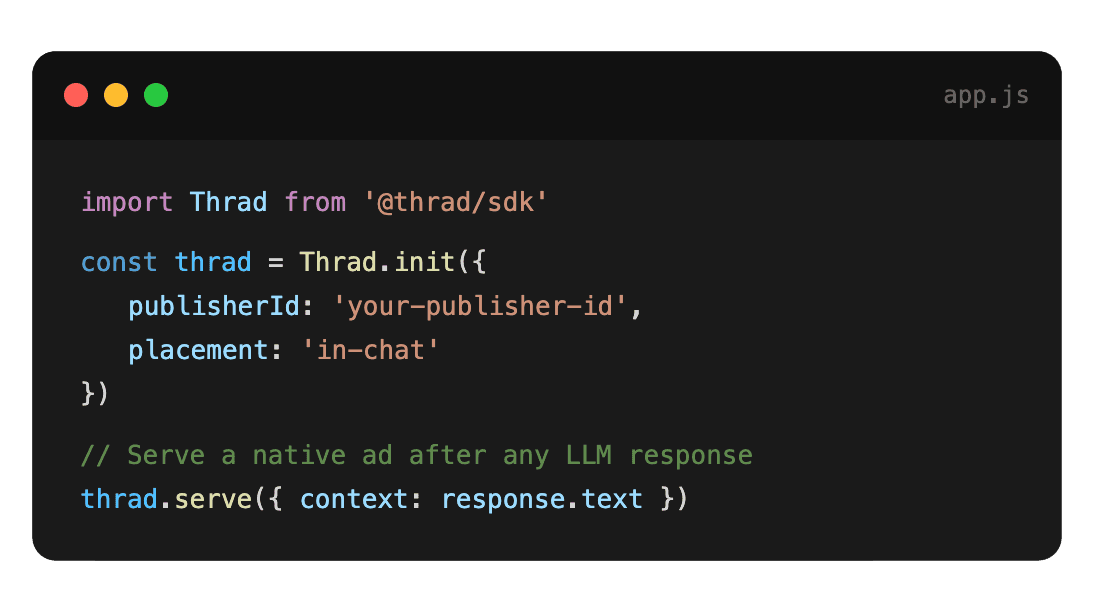
Start monetizing your AI app in under an hour
With Thrad, publishers go from first API call to live ads in less than 60 minutes. With fewer than 10 lines of code required, Thrad makes it easy to unlock revenue from your conversational traffic the same day.

OpenAI vs Anthropic Revenue Model 2026 | Thrad
OpenAI and Anthropic are the two most-watched AI labs in the world,
but they monetize very differently. OpenAI leans consumer-heavy with
ChatGPT as the flagship; Anthropic leans enterprise-heavy with Claude
distributed primarily through API and platform partners. In 2026 the
divergence has sharpened, and both companies are better businesses for
having made different bets.
OpenAI and Anthropic sell fundamentally similar products — frontier
language models behind API and consumer interfaces — but they monetize
through very different channel mixes. OpenAI's revenue is led by
ChatGPT consumer subscriptions and increasingly enterprise seats.
Anthropic's revenue is led by API usage and enterprise platform deals,
with the Claude.ai consumer product a smaller contributor. In 2026,
those divergent bets have become the defining strategic choice in
foundation-model economics, and they produce two meaningfully different
businesses at the same layer of the stack.
What does each revenue model look like in 2026?
OpenAI's 2026 revenue mix is consumer-led: approximately 70% of a
~$12B annualized run rate comes from ChatGPT consumer subscriptions
and consumer-adjacent enterprise seats, with the remaining 30% split
between pure API revenue and early-stage advertising or licensing.
Anthropic's 2026 mix is the inverse: roughly 80% of a ~$4B annualized
run rate flows through API and enterprise platform distribution, with
Claude.ai consumer contributing under 20%.
OpenAI's mix
Consumer subscriptions (Plus at $20/mo, Pro at $200/mo): the
largest single line, estimated at $6-7B annualized.Enterprise and Team seats: second largest and compounding
fastest on an absolute dollar basis, estimated at $2.5-3B.API (pay-per-token): a major line and critical to AI-native
startups, estimated at $1.5-2B and carrying thinner margins.Advertising and licensing: the smallest and fastest-growing
line, likely sub-$500M in 2026 but structurally important.Total: approximately $12B annualized in Q1 2026.
Anthropic's mix
API (pay-per-token): the dominant line, likely 60%+ of total.
Platform distribution (AWS Bedrock, Google Vertex): material
contributor, distributed through cloud-native billing.Custom enterprise deals: large anchor contracts with Fortune
500 buyers, carrying higher ACV and multi-year commitments.Claude.ai consumer subscriptions: growing fast but still a
minority share — under 20% of total.Total: reported mid-single-digit billions annualized in 2026,
widely cited at approximately $4B.
Why has the divergence sharpened in 2026?
The divergence sharpened in 2026 because each company doubled down on
the channel that compounded best. OpenAI's consumer flywheel spun
faster every quarter as ChatGPT usage crossed 800M weekly actives,
pulling paid conversions behind it. Anthropic's enterprise channel
compounded through Bedrock and Vertex integrations, which converted
existing cloud spend into Claude spend without new procurement.
Three structural factors reinforced the split:
Investor framing. OpenAI is increasingly framed as the
consumer AI brand — the "Google of the AI era" — while Anthropic
is framed as the enterprise-trust platform. Those narratives drive
hiring, product roadmap, and sales strategy in different directions.Go-to-market cost. Consumer acquisition is high-variance and
brand-driven; enterprise acquisition is sales-driven and
partnership-driven. Once each company chose a channel, the cost
structure reinforced the choice.Safety positioning. Anthropic's Constitutional AI and research
emphasis resonates with enterprise buyers who need procurement
defensibility. OpenAI's rapid consumer iteration resonates with
individuals and creative professionals.
The fundamental strategic divergence
OpenAI decided it was building a consumer AI brand that happens to
have a developer platform. Anthropic decided it was building a
developer and enterprise platform that happens to have a consumer
product. Both bets look smart in 2026 — but they're producing
meaningfully different margin profiles, distribution footprints, and
regulatory exposure.
Three consequences of the divergence:
Brand awareness asymmetry. ChatGPT is a household name with
estimated unaided awareness above 75% in the US. Claude is known
inside the developer and enterprise community — unaided awareness
likely in the 20-30% range for consumers, 80%+ inside engineering
teams. That shows up in CAC and unit economics.Distribution surface. ChatGPT's distribution is its own app
and website, reaching users directly. Claude's distribution is
Claude.ai plus AWS Bedrock, Google Vertex, Poe, Perplexity (for
some workloads), and a long tail of platform partners — probably
hundreds of downstream surfaces.Margin mix. Enterprise-heavy revenue mixes tend to carry
70%+ gross margins; consumer free-tier compute is the expensive
layer in OpenAI's stack — estimated to consume $3-5B annualized
in inference alone — and isn't a meaningful line for Anthropic.
Comparison table — the 2026 picture
Dimension | OpenAI (2026) | Anthropic (2026) |
|---|---|---|
Annualized revenue | ~$12B | ~$4B (reported) |
YoY revenue growth | ~2.5-3× | ~4-5× |
Primary revenue source | Consumer subs + enterprise seats | API + enterprise platform |
Consumer share of revenue | ~70% | <20% |
API/enterprise share | ~30% | >80% |
Cloud partner | Microsoft Azure | Amazon AWS (+ Google Vertex) |
Cloud partner investment | ~$13B cumulative | ~$8B cumulative (Amazon) |
Consumer brand | Very strong (ChatGPT, ~800M WAU) | Growing (Claude.ai, low tens of millions WAU) |
Advertising revenue | Small but growing (<$500M) | Not material |
Customer concentration | Low (millions of consumers) | Higher (enterprise-weighted) |
Gross margin profile | Blended ~55-65% | Blended ~70-80% |
Figures directional, from press reporting and disclosures, not audited
statements. Where specific numbers vary across sources, this article
uses the midpoint of public estimates.
How do the API economics compare?
API economics are the cleanest apples-to-apples comparison because
both labs price in the same per-token framework. OpenAI's GPT-4o-class
pricing runs roughly $2.50 per million input tokens and $10 per
million output; Anthropic's Claude Sonnet tier runs roughly $3 per
million input and $15 per million output. Premium tiers (GPT-4
Turbo/5, Claude Opus) add 2-6× on top. At the margin level, both labs
compete against open-weights models that serve at 10-30% of frontier
pricing, compressing everyone's spread.
API tier | OpenAI pricing (approx) | Anthropic pricing (approx) | Notes |
|---|---|---|---|
Mid-tier (4o / Sonnet) | $2.50 / $10 per M | $3 / $15 per M | Workhorse tier, largest volume |
Premium (GPT-5 / Opus) | $15 / $60 per M | $15 / $75 per M | Frontier tasks, smaller share |
Mini / Haiku | $0.15 / $0.60 per M | $0.25 / $1.25 per M | Commodity tier, thin margins |
Pricing per million tokens; input/output. Rates are 2026 directional
and move multiple times per year.
The margin punchline: Anthropic's absence of a large free tier means
every API token is paid, while OpenAI's API volume subsidizes a free
consumer product. On an isolated API-business basis, Anthropic looks
like a cleaner software company. On a total-company basis, OpenAI's
consumer distribution is an asset that pure-API economics can't
capture.
Why is Anthropic's API margin profile structurally advantaged?
Enterprise-weighted revenue, distributed through Bedrock and Vertex,
with effectively no consumer free-tier compute exposure, creates a
gross margin profile that compares favorably to OpenAI's consumer-
weighted mix. Anthropic doesn't have to subsidize hundreds of millions
of free queries per week to preserve distribution — the enterprise
buyer pays for the inference they consume, period.
Three mechanisms reinforce the advantage:
No free-tier compute drag. Every dollar of Anthropic revenue
corresponds to a paid token; OpenAI has a roughly 10:1 free-to-paid
query ratio on ChatGPT that it must fund.Enterprise pricing power. Platform contracts with named
enterprises have procurement-grade pricing — higher than
consumer-grade per-token rates.Cloud-native billing. Revenue through Bedrock and Vertex
clears on a hyperscaler invoice, reducing Anthropic's collections
cost and credit risk.
Why OpenAI's distribution advantage is real
The counter-argument: owning the consumer relationship matters. ChatGPT's
brand is a distribution moat in a way Claude's isn't yet. When a
Fortune 500 rolls out an AI assistant to 30,000 employees, "everyone
already knows ChatGPT" is a material tailwind. Enterprise buyers trust
the tool their employees are already using at home.
That distribution compounds in three ways. First, ChatGPT's consumer
scale creates the data flywheel that fuels reinforcement learning and
product improvement. Second, it gives OpenAI direct pricing power with
end users rather than through a platform intermediary. Third, it
unlocks advertising as a revenue line — impossible without the free
consumer scale to monetize.
The 2026 reality: both moats matter. OpenAI has the brand and the
consumer scale; Anthropic has the margin profile and the cloud-native
distribution. Neither is strictly better. The question is which
advantage compounds faster over the next 36 months.
How do the cloud-partner structures compare?
OpenAI's relationship with Microsoft and Anthropic's relationship with
Amazon are mirror images. Each is a compute-for-equity deal at
multi-billion-dollar scale, each anchors a cloud provider's AI revenue
narrative, and each trades a measure of independence for compute
certainty and distribution muscle.
Dimension | OpenAI / Microsoft | Anthropic / Amazon |
|---|---|---|
Total invested (cumulative) | ~$13B | ~$8B |
Cloud exclusivity | Azure primary | AWS primary (Google secondary) |
Distribution surface | Copilot, Azure OpenAI Service | Bedrock, AWS products, Alexa |
Revenue share structure | Microsoft receives share of OpenAI cloud revenue | Amazon receives commercial upside via Bedrock |
Partner chip strategy | Azure GPUs + Maia | AWS Trainium/Inferentia commitment |
Google is Anthropic's second cloud partner via Vertex and a significant
equity investor, softening single-cloud exposure. OpenAI has no
comparable second partner of equivalent scale. That multi-cloud posture
is another structural difference: Anthropic can point to two
hyperscalers, while OpenAI is more concentrated on Microsoft.
The single biggest reason Anthropic has healthier unit economics in
2026 is that it never took on the cost of being a household consumer
brand. That's a strategic choice, not a performance gap — and it's
the reason the two labs are converging on different valuations
despite selling similar models.
What's the investor read on the divergence?
The investor read in 2026 treats OpenAI as a consumer-brand franchise
with a maturing enterprise arm and an ad-revenue option, and treats
Anthropic as a high-margin enterprise infrastructure company with a
consumer option. Both framings support premium valuations, but they
attract different investor profiles and imply different exit paths.
Three investor-lens observations:
OpenAI's path to public markets depends on ads. A credible
consumer-tier unit-economics story requires an ad line that scales
with free usage. That's now in motion but still sub-$500M, so 2027
is the realistic ad-proof-point year.Anthropic's path looks more like a premium SaaS exit. High
gross margins, enterprise concentration, and cloud-partner leverage
resemble the best pure-play enterprise software comparables.The growth-rate convergence matters. Anthropic is growing
faster than OpenAI on a percentage basis, which means the revenue
gap is narrowing even if OpenAI remains 2-3× larger in absolute
terms.
Common misconceptions
"Anthropic is just a smaller OpenAI." No — the mix is
structurally different. Smaller in absolute revenue, but with a
margin profile that OpenAI has to work harder to match."ChatGPT and Claude compete for the same customers." In
enterprise, increasingly yes — most Fortune 500 AI pilots benchmark
both. In consumer, Claude.ai is a fraction of ChatGPT's footprint
and the overlap is narrower."Anthropic will have to add advertising to keep up." Not in
2026. Anthropic's revenue mix doesn't require advertising because
enterprise API revenue is the driver, not consumer free-tier
conversion."The one with the bigger model wins." Model quality matters,
but distribution, reliability, enterprise features, and ecosystem
matter equally or more at this stage. The 2026 leaderboard moves
monthly; the revenue leaderboard moves slower."Cloud-partner deals are equivalent." The Microsoft and Amazon
deals look similar at a headline level but differ in exclusivity,
revenue-share structure, and distribution surface. Don't assume
symmetry.
What comes next
Three dynamics to watch through 2026 and into 2027. First, enterprise
competition between ChatGPT Enterprise and Claude Enterprise
intensifies; expect aggressive pricing and bundling wars, with both
labs likely discounting 20-40% for multi-year commitments. Second,
Anthropic continues expanding Claude.ai consumer features, slowly
closing the brand gap — the question is whether consumer share can
reach 30% of mix without dragging the margin profile. Third, OpenAI
advertising revenue scales into a line that is structurally absent from
Anthropic's mix — which will be interpreted either as OpenAI
monetization sophistication or Anthropic focus, depending on which
outcome compounds.
A fourth dynamic worth watching: open-weights pressure. Meta's Llama
family, Mistral, and DeepSeek all continue to compress frontier API
pricing. That's a squeeze on both labs' API lines, but Anthropic is
more exposed because API is a larger share of mix.
How to act on this as a brand or buyer
For brands: both platforms matter. A serious AI-advertising strategy
considers placement surfaces across ChatGPT, Claude, Copilot, and
Perplexity — not just the largest one. The measurement problem is the
capability most brands lack: how to report visibility and conversion
across heterogeneous generative surfaces that each expose different
signals.
For enterprise buyers: benchmark both labs on the workload, not the
brand. Claude and GPT-4/5 class models trade leadership quarterly on
different evals. The right question is which model performs on your
specific tasks, which has the governance features your procurement
requires, and which sits inside your existing cloud relationship.
That's the specific gap Thrad is built to close — AI-advertising
measurement and placement for brands working across the full generative
surface area, not just the one with the biggest headline number.
anthropic revenue 2026, claude revenue, openai vs anthropic business model, anthropic vs openai economics
Citations:
The Information, "OpenAI hits $12B annualized revenue in Q1 2026," 2026. https://theinformation.com
Reuters, "Anthropic revenue run rate crosses $4B in 2026," 2026. https://reuters.com
Bloomberg, "Claude's enterprise footprint — how Anthropic sells," 2026. https://bloomberg.com
AWS, "Amazon Bedrock Claude availability and pricing," 2026. https://aws.amazon.com/bedrock
Financial Times, "The two roads in foundation-model monetization," 2026. https://ft.com
Stratechery, "Consumer vs enterprise AI: the strategic fork," 2025. https://stratechery.com
SemiAnalysis, "Frontier-model inference economics 2026," 2026. https://semianalysis.com
Be present when decisions are made
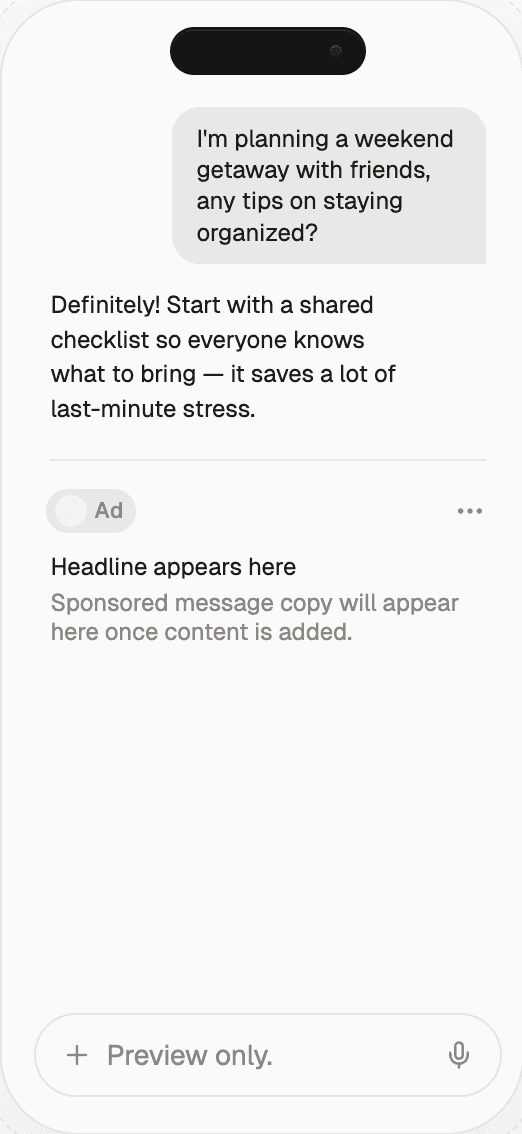
Traditional media captures attention.
Conversational media captures intent.
With Thrad, your brand reaches users in their deepest moments of research, evaluation, and purchase consideration — when influence matters most.
Date Published
Date Modified
Category
Advertising AI
Keyword
openai vs anthropic revenue model