OpenAI reached roughly $12B in annualized revenue in Q1 2026. ChatGPT
consumer subscriptions (Plus at $20/mo, Pro at $200/mo) contribute the
plurality, followed by enterprise and team seats, usage-based API revenue,
and a new but fast-growing advertising and licensing layer. The mix is
shifting: enterprise and ads are growing fastest; consumer subs are
plateauing as the addressable market matures. The practical implication
for brands is that commercial-intent queries now pull sponsored placements
and licensed citations, making the surface a paid-media channel.




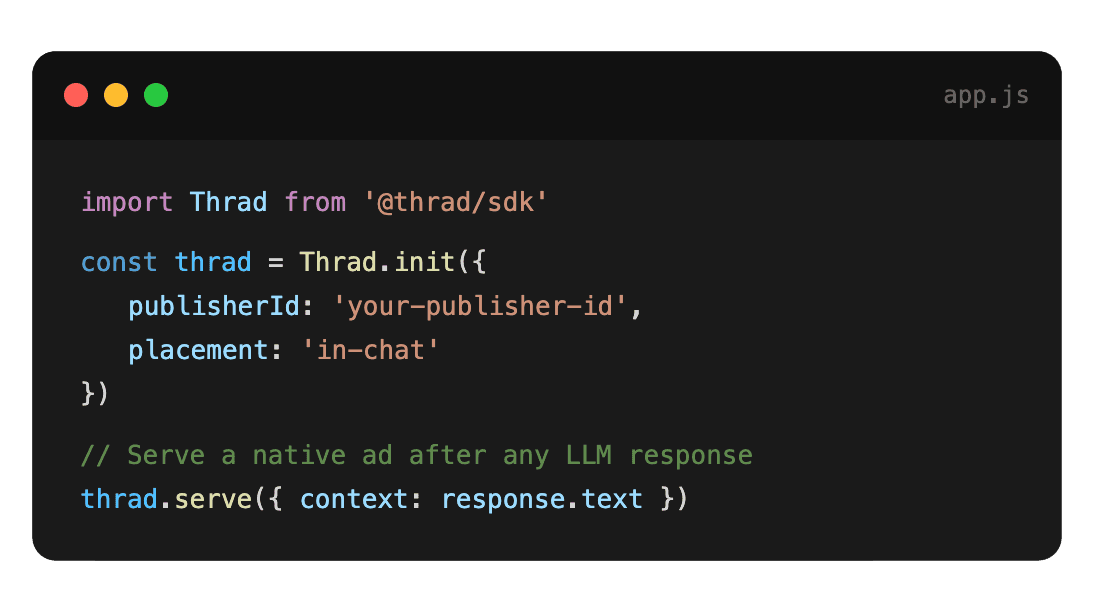
Start monetizing your AI app in under an hour
With Thrad, publishers go from first API call to live ads in less than 60 minutes. With fewer than 10 lines of code required, Thrad makes it easy to unlock revenue from your conversational traffic the same day.
OpenAI Revenue 2026 — Breakdown | Thrad
OpenAI's 2026 revenue is easier to line up than it was a year ago. Consumer
subscriptions — ChatGPT Plus and Pro — are still the single largest line,
enterprise and team seats are the fastest-compounding, the API funds most
of the AI-native startup ecosystem, and advertising has gone from
hypothetical to quantified. Here's the directional mix and what it means
for brands writing 2026 plans against the new surface.
OpenAI's 2026 revenue is roughly $12 billion annualized, and the mix is
finally detailed enough to discuss with some confidence. Consumer
subscriptions — ChatGPT Plus and Pro — are the single largest line, but
enterprise seats, API usage, and a new advertising and licensing layer
together make up more than half of the total. Understanding the mix
matters for any brand thinking about where to show up inside generative
surfaces — and for any operator planning 2026 or 2027 budget against the
OpenAI surface area.
What does OpenAI's 2026 revenue look like?
OpenAI's 2026 revenue is a roughly $12B annualized four-line mix, led
by consumer subscriptions at ~40–45%, followed by enterprise and team
seats at 25–30%, API usage at 20–25%, and advertising plus licensing
at 5–10% and growing fastest. The structure is stable enough to plan
against but moving quarter by quarter.
Four lines dominate. Consumer subscriptions are the biggest by dollar
volume thanks to ChatGPT Plus's subscriber base. Enterprise and team seats
are the highest-margin line and the fastest-growing year-over-year. The
OpenAI API is the second-largest absolute contributor and the one with the
most pricing pressure. Advertising and licensing — paid search inside
ChatGPT, publisher content deals, shopping partnerships — are the newest
layer and the one most directly relevant to brand marketers.
For a marketer, the directional mix matters because it tells you where
OpenAI will invest. Consumer subscription growth is plateauing, so
product investment is tilting toward enterprise (governance, compliance)
and toward advertising (auction, disclosure, measurement). The product
areas getting resource in 2026 are the ones most consequential to
brand strategy in 2027.
What are the four 2026 revenue lines in detail?
The four 2026 revenue lines — consumer subscriptions, enterprise
seats, API, advertising and licensing — each have distinct pricing,
growth trajectories, and margin profiles. Consumer is the scale line,
enterprise is the margin line, API is the ecosystem line, and ads
plus licensing are the newest and fastest-growing.
1. ChatGPT consumer subscriptions
Plus sits at $20/mo; Pro at $200/mo. Plus carries the volume — millions of
active paying subscribers — while Pro contributes disproportionately per
user thanks to the 10× price point. Consumer-sub revenue growth slowed
through 2025 as the addressable power-user base saturated, and in 2026
the line is compounding more slowly than enterprise or ads but still
contributing the largest absolute dollar number.
The Plus-to-Pro mix is an underappreciated metric. Pro subscribers are
a small share of the subscriber count but reportedly 20–30% of
consumer ARPU — their willingness to pay sets the ceiling of the
category and validates pricing power for every tier below.
2. Enterprise and team seats
Team plans start around $25–$30 per seat; Enterprise is negotiated with
typical effective pricing north of $50/seat/month. Enterprise adds SSO,
SOC 2 Type II coverage, data-residency options, training opt-out, higher
rate limits, and named account support. OpenAI crossed roughly 3 million
enterprise seats in early 2026 per press reporting — the per-seat multiple
makes this the margin-heaviest line.
The quality of this revenue line is what makes analysts comfortable
with OpenAI's broader valuation. Annual contracts, near-100%
gross-retention, and seat-expansion dynamics inside logos produce
the compounding behavior that sits underneath most of the premium
built into the $300B+ secondary price.
3. OpenAI API (pay-per-token)
Every GPT-5, GPT-4o, embedding, realtime, and image-generation call meters
tokens and bills the account. This is what powers most AI-native startups
and also the layer most subject to pricing compression as competing
frontier models and open-weight alternatives push effective cost per
million tokens down.
The interesting dynamic here is that even as list prices compress,
aggregate API revenue keeps growing because token volume is expanding
faster than per-token price is falling. Blended revenue per customer
is rising; that's the ecosystem-funding engine working.
4. Advertising, search, and licensing
New in 2026: paid search placements inside ChatGPT's search surface,
content-licensing deals with News Corp, Axel Springer, the Financial
Times, and others, and shopping partnerships that surface product
suggestions on commercial-intent prompts. None of this is the largest line
today, but it's the one growing fastest in percentage terms.
eMarketer's 2026 forecast pegs generative-surface ad spend globally at
around $2.6B, with a doubling trajectory into 2027. OpenAI captures a
leading share of that spend because ChatGPT carries the largest share
of commercial-intent queries across the category.
What does the 2026 revenue mix look like at a glance?
The 2026 mix at a glance: consumer subscriptions ~40–45%, enterprise
~25–30%, API ~20–25%, advertising plus licensing ~5–10%. Growth rates
invert the ranking — advertising and enterprise are compounding
fastest, consumer is slowest. Margin profile is strongest at
enterprise, mid at consumer and API, and early-stage but high at
advertising.
Line | Directional share 2026 | Growth rate | Margin profile |
|---|---|---|---|
ChatGPT Plus + Pro | ~40–45% | Slowing | Positive unit margin |
Enterprise + Team | ~25–30% | Fastest | Highest margin |
API usage | ~20–25% | Steady | Compressed margin |
Advertising + licensing | ~5–10% | Fastest in % terms | Early-stage |
These are directional — OpenAI's disclosures aren't line-itemized audited
figures, and the mix is moving month over month.
Pricing line | Tier | Price (2026) | Typical buyer |
|---|---|---|---|
ChatGPT Plus | Consumer | $20/mo | Individual power user |
ChatGPT Pro | Consumer | $200/mo | Developer / researcher / heavy user |
ChatGPT Team | SMB | ~$25–30/seat/mo | Team of 2–150 |
ChatGPT Enterprise | Enterprise | $50+/seat/mo (negotiated) | Large org with governance needs |
API (GPT-5) | Usage-based | $5–$15 / 1M tokens (blended) | Developers, AI-native startups |
Sponsored placement | Ad inventory | CPM $8–$35 | Brands in commercial categories |
Pricing is directional and publicly reported; enterprise and API list
prices are negotiated in practice.
The most important shift in OpenAI's 2026 revenue isn't the $12B number
itself — it's that advertising and enterprise are both crossing the
threshold from "pilot" to "material line." That's what makes 2026 the
year brands actually need a generative-surface strategy.
Why is the mix shifting in 2026?
The mix is shifting because three structural forces are pulling each
line on a different trajectory. Consumer subscriptions hit addressable-
market ceilings, enterprise rides budget-cycle normalization, and
advertising scales up as free-tier serving costs force the structural
pivot. The result is a blended mix where the fastest growing lines
are the ones with the largest margin upside.
Three structural forces are reshaping the stack. First, consumer
subscriptions are bumping into addressable-market ceilings — most people
willing to pay $20/mo for an AI product already do. Second, enterprise is
benefiting from the ordinary cycle of IT budgets moving from "experimental"
to "line-item." Third, the free tier keeps growing faster than paid
conversion, and serving billions of free queries requires a revenue engine
beyond subscriptions — advertising is the standard solution.
The free tier is an unavoidable economic forcing function. You can
reduce per-query cost only so far before physics binds. Once the
free surface exceeds several hundred million users, advertising is
not optional — it is the only mechanic that turns a distribution
moat from a cost center into a contribution center.
A fourth force worth naming: competitive pricing pressure on API from
Anthropic, Google, open-weight models, and specialty players. API
pricing is the only line with real commoditization risk, and OpenAI
has managed it so far by pushing efficiency gains faster than
competitors' price cuts. That dynamic is worth watching; if it
breaks, the share of API in the mix compresses rapidly.
How does 2026 compare to 2025 and what should we expect in 2027?
The 2025 to 2026 step was mostly an enterprise and advertising story;
consumer grew but slower than the top line. 2027 will likely see
enterprise pass consumer as the largest line and advertising cross
double-digit percentage share. The total will probably be $22–28B by
end-of-2027 if the current compound rate holds.
Year | Annualized run-rate | Fastest-growing line | Share of ads+licensing |
|---|---|---|---|
2024 | ~$3.7B | Consumer + enterprise | <3% |
2025 | ~$6.5B | Enterprise | ~4% |
2026 | ~$12B | Ads + licensing (%); enterprise ($) | ~7% |
2027 (est.) | $22–28B | Ads + licensing | 10–15% |
Figures are directional. The 2027 estimate assumes continued ad
ramp, steady enterprise compounding, and continued API margin
expansion.
Who are OpenAI's biggest revenue contributors by customer segment?
OpenAI's biggest revenue contributors split across four customer
segments: individual consumer subscribers (Plus and Pro), small and
midsize business teams (Team plan), enterprise accounts with
governance needs (Enterprise tier), and developers and AI-native
startups paying per token on the API. Each segment has different
elasticity, different retention dynamics, and different margin
profile.
The individual consumer segment is the largest by user count —
millions of active paying subscribers spread across global markets.
Revenue per user is low relative to enterprise but volume is massive.
Churn is higher than enterprise and responds to perceived capability
gaps with competitors, which is why the GPT-5 reasoning launch showed
up in renewed consumer momentum through early 2026.
The enterprise segment has fewer accounts but vastly higher revenue
per account. Typical enterprise deals run six to seven figures
annually, with multi-year contracts and near-100% gross retention
once governance, SSO, and data handling requirements are met.
Expansion within logos — seats, new business units, API usage tied to
the same contract — is where most of the enterprise growth is coming
from in 2026.
The developer segment is the ecosystem layer. AI-native startups,
large legacy software companies using the API, and internal tools
teams at enterprises all sit in this bucket. This segment pays
per-token and is highly price-elastic; any competitor price cut
shows up in usage migration within weeks.
A useful way to think about the customer mix: the first three
segments are what make OpenAI a software company; the fourth is
what makes it a platform. Both are necessary for the long-term
thesis.
What about international revenue?
International revenue is growing faster than US revenue in absolute
terms, driven by enterprise expansion across Europe and Asia, but
represents a smaller absolute share due to later product launch
timing and currency effects. North America remains the largest
regional book, followed by Europe, with APAC compounding fastest off
a smaller base.
Regulatory posture varies meaningfully by region, and that is
starting to affect the mix. The EU AI Act governance requirements
have actually accelerated enterprise adoption because large European
firms need the vendor to have compliance tooling baked in, which
favors the enterprise tier over ad-hoc API usage. Asia-Pacific
markets are more API-heavy because enterprise sales cycles are
longer and developer adoption is faster.
Common misconceptions
"OpenAI is profitable at $12B ARR." Not as of early 2026. Training
costs, free-tier inference, and R&D still exceed gross margin across the
four lines combined."The API is OpenAI's biggest business." It's significant, but
consumer subscriptions still contribute more absolute dollars, and
enterprise seats contribute more margin."Advertising will dominate the mix by 2027." Unlikely — it will grow
fastest in percentage terms, but subs and enterprise are a long way
ahead in absolute dollars."ChatGPT Pro at $200/mo is a vanity tier." The subscriber count is
small, but Pro contributes more per user than Plus and anchors power-user
retention."Sponsored placements are a small line not worth brand attention."
They're small today; they will be several billion dollars by 2027 per
eMarketer's own forecast, and the auction dynamics lock in well before
the category matures.
What comes next
Expect the advertising and enterprise lines to keep compounding through
2026 and into 2027. Consumer subs will plateau and may even compress
slightly as competing products (Gemini, Claude, xAI) pull power users in
multiple directions. API margins will keep getting squeezed by open-weight
and competitor pricing. The 2027 version of this chart will probably look
materially different — particularly in the enterprise and advertising
shares.
A specific watch list for the rest of 2026: (1) whether OpenAI starts
disclosing advertising as its own line in investor communications,
(2) whether enterprise seat growth remains compounding or starts
decelerating as logos saturate, (3) whether API list prices hold or
compress meaningfully under competitive pressure, (4) whether
consumer subscription growth re-accelerates on the back of a major
GPT-6 or equivalent capability step.
How to act on this as a brand
If you sell to consumers or to developers, OpenAI's revenue mix is also
your surface area. Commercial queries on ChatGPT's free tier already pull
sponsored placements and licensed content answers. The brands showing up
in those answers with integrity are the ones auditing their
generative-surface presence now and treating it as a paid-media channel
with measurement and placement discipline. That's the gap Thrad helps
brands close — showing up in AI-advertising surfaces the same way you
show up in paid search, with measurement that actually matches.
The practical next step: pick the 20 commercial-intent prompts that
matter most in your category, audit your current citation and paid
placement performance on each across ChatGPT and adjacent assistants,
and benchmark where you stand versus the three competitors you most
care about. That audit takes two weeks, costs a few thousand dollars
in tooling, and tells you exactly where to spend the first $100K of
generative-surface budget. It also gives you a clean before-and-after
for the measurement discussion with finance — which is the
conversation that decides whether your channel graduates from
experimental to line-item in 2027.

openai annualized revenue, chatgpt revenue 2026, openai business model, chatgpt plus subscribers
Citations:
OpenAI, "State of the Platform 2026 — revenue and usage disclosures," 2026. https://openai.com
The Information, "OpenAI revenue hits $12B annualized in Q1 2026," 2026. https://theinformation.com
Reuters, "OpenAI enterprise seat count crosses 3M in early 2026," 2026. https://reuters.com
Financial Times, "Inside OpenAI's advertising pilot," 2026. https://ft.com
Bloomberg, "OpenAI API revenue run-rate and pricing compression," 2026. https://bloomberg.com
eMarketer, "Generative surface ad spend forecast 2026," 2026. https://emarketer.com
Stratechery, "The shape of OpenAI's 2026 revenue mix," 2026. https://stratechery.com
Be present when decisions are made
Traditional media captures attention.
Conversational media captures intent.
With Thrad, your brand reaches users in their deepest moments of research, evaluation, and purchase consideration — when influence matters most.
Date Published
Date Modified
Category
Advertising AI
Keyword
openai revenue 2026