OpenAI licensing deals generate revenue through two structures:
upfront license fees paid by OpenAI to publishers for content access
and training rights, and revenue-share agreements where publishers
earn when their content is cited or referenced in ChatGPT answers.
The combined layer sits between subscriptions and advertising in
2026's revenue mix, with publisher shares reportedly ranging from
30% to 55% of the attributable retrieval revenue.


Start monetizing your AI app in under an hour
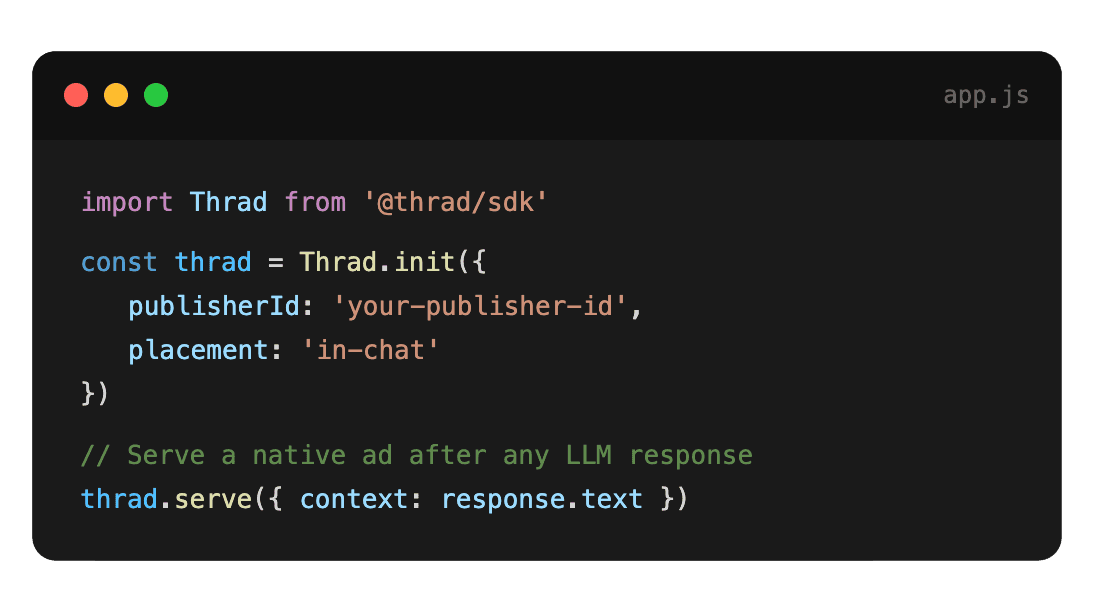
With Thrad, publishers go from first API call to live ads in less than 60 minutes. With fewer than 10 lines of code required, Thrad makes it easy to unlock revenue from your conversational traffic the same day.
OpenAI Licensing Deals & Revenue — 2026 | Thrad
OpenAI's publisher licensing deals are the quiet engine of its
advertising-adjacent revenue. Upfront fees plus revenue-share on
generated answers turn licensed content into both a training asset
and a distribution surface — and reshape how brand visibility works
inside ChatGPT. Here's the 2026 map of who signs what, and what it
means for brands.
OpenAI licensing deals generate revenue for publishers through a
two-part structure: upfront license fees for content access and
training rights, and revenue-share agreements tied to how that content
appears in ChatGPT answers. Together they form a fast-growing layer of
OpenAI's 2026 revenue mix — structurally distinct from subscriptions,
economically adjacent to advertising, and increasingly the primary
route brands take toward presence inside ChatGPT answers.
What are OpenAI licensing deals?
OpenAI licensing deals are multi-year contracts between OpenAI and
major publishers granting OpenAI rights to train on and cite the
publisher's content, in exchange for upfront fees and revenue-share
tied to how often that content is referenced in ChatGPT answers. The
deals replaced the 2023-era unlicensed scraping pattern with a
compensated distribution model.
Contracts between OpenAI and major publishers (news organizations,
reference publishers, stock-media providers, community platforms)
that grant OpenAI rights to use the publisher's content in both
training and answer generation, in exchange for payment. The payment
structure has evolved from simple one-time fees in 2023 to layered
contracts in 2025-2026 that combine:
Upfront license fees — a predictable cash payment, often multi-
year, tied to content volume and brand value.Revenue share — variable payments tied to how often and where
the publisher's content appears in ChatGPT answers.Product integration rights — in some deals, the publisher's
brand appears directly inside answers with attribution, links, or
branded surfaces.Training data carve-outs — specific clauses governing what can
be used for model training versus live retrieval, often separately
priced.
The distinction between training rights and retrieval rights matters
commercially. Training rights are a one-time-for-the-model-generation
transaction; retrieval rights are ongoing and volume-tied. Modern
deals price these separately, which is why headline numbers from
different partnerships aren't directly comparable.
Which publishers have signed OpenAI licensing deals?
OpenAI has signed deals with most major Western news and reference
publishers since 2023, with announced partners including News Corp,
Axel Springer, Financial Times, Le Monde, Prisa Media, Dotdash
Meredith, Reddit, Shutterstock, The Atlantic, Vox Media, and Hearst.
The list has grown roughly quarterly, with European and vertical
expansion accelerating through 2025 and 2026.
The publisher partnership list has grown roughly quarterly since 2023.
Signposts:
Associated Press (2023) — early anchor deal, content-access
focused.Axel Springer (2023) — early comprehensive deal with upfront
payment and attribution rights for brands like Politico and
Business Insider.Financial Times (2024) — licensing deal combining training data
access with citation attribution in answers.News Corp (2024) — one of the largest disclosed deals, reportedly
valued in the nine figures over five years, covering WSJ, New York
Post, The Times (London), and others.Le Monde and Prisa Media (2024) — European expansion.
Dotdash Meredith (2024) — added lifestyle, home, and finance
verticals.Reddit (2024) — community content at scale.
Shutterstock (2023, renewed 2025) — images and stock content.
Vox Media, The Atlantic, Hearst (2024-2025) — additional
premium publisher coverage.Conde Nast, Hearst expansion, TIME (2025-2026) — lifestyle,
fashion, and general interest coverage.
By 2026, OpenAI's publisher partnership list covers most of the major
Western news and reference brands. Gaps remain in parts of Asia and
Latin America, where negotiation cadence has lagged European and North
American markets.
How does the revenue flow between OpenAI and publishers?
Revenue flows in three directions: OpenAI pays upfront for training
and citation rights, OpenAI pays ongoing rev-share on retrieval
volume, and publishers get in-kind value through attribution and
distribution surface inside ChatGPT. The rev-share piece is the
fastest-growing component and the one most structurally similar to
advertising.
Component | How it's paid | Who benefits |
|---|---|---|
Upfront license fee | Multi-year lump sum or annual | Publisher (cash) |
Revenue share | Variable, tied to usage in answers | Publisher (growth-tied) |
Attribution surface | In-kind — publisher logo, link, brand in answer | Publisher (distribution) |
Training rights | Embedded in license | OpenAI (model quality) |
Citation access | Embedded in license | OpenAI (answer cleanliness) |
Reduced legal risk | Embedded in license | Both (avoids copyright disputes) |
The rev-share piece is the one that looks most like advertising. When
ChatGPT surfaces a licensed article as the basis of an answer, the
publisher earns a fractional payment — structurally similar to how
programmatic ad revenue is distributed through impressions.
The publisher licensing layer is advertising's cousin. Upfront fees
resemble traditional media buy structures; revenue-share payments
resemble programmatic CPM distribution. The legal boundary between
"licensing" and "advertising" will get thinner through 2026 and
2027 as these deals grow and as paid brand placements inside
licensed content start to flow through to ChatGPT answers.
Deal type | Typical upfront | Typical rev-share | Duration |
|---|---|---|---|
Tier 1 news (News Corp, Axel Springer) | $30–75M+ | 30–40% of attributable revenue | 3–5 yrs |
Tier 2 news (FT, Le Monde, Vox) | $5–25M | 35–50% | 2–4 yrs |
Reference / lifestyle (Dotdash Meredith) | Varies | 35–50% | 3–5 yrs |
Community (Reddit) | Tens of millions reported | Volume-tied | 3+ yrs |
Images (Shutterstock) | Small, high-margin | Volume-tied | Rolling |
Figures are directional and drawn from press reporting, not audited
disclosures. Every deal is bespoke; these ranges show the pattern, not
the exact number for any single partnership.
Why is this deal structure good for both sides?
The structure is good for both because it converts an adversarial
scraping relationship into a compensated partnership while giving
OpenAI legal cover and cleaner training data. Publishers capture
revenue and distribution inside the new surface; OpenAI reduces legal
risk and improves answer quality on news, finance, and reference
topics.
For OpenAI: legal protection plus content quality. Licensed content
sidesteps the copyright lawsuits that dogged the industry in 2023-2024,
and access to high-quality publisher content materially improves answer
accuracy for news, finance, health, and reference topics.
For publishers: compensation for content that was already being used
to train AI models. Rather than fighting a losing battle over
unlicensed training data, publishers with deals capture a revenue
stream and maintain visibility inside the new distribution surface.
The Axel Springer deal, for example, reportedly pays in the low tens
of millions annually with additional rev-share upside — meaningful
against a print-plus-digital publisher P&L.
For brands advertising with those publishers: a new visibility path
into ChatGPT answers. Brands citing their sponsorship in premium
publisher content now have an indirect route to appearing inside
ChatGPT citations — not a direct ad buy, but a real effect.
Licensing deals monetize the publisher's archive twice — once as
training data up front, once as live retrieval in perpetuity. No
prior digital-media monetization mechanic pays a rightsholder in
both directions. That is the structural innovation, and it is why
the best publisher negotiators are pricing both halves separately.
How does licensing differ from advertising?
Licensing differs from advertising in three ways: the payer (OpenAI
pays the publisher, versus advertisers paying the platform), the
trigger (content retrieval versus ad impression), and the legal
framing (copyright license versus ad inventory). All three boundaries
are softening as rev-share grows and as brands start paying for
placement inside licensed content.
Licensing pays rightsholders for the use of content; advertising pays
platforms for access to audiences. Licensing compensates the input
to an answer; advertising compensates the placement in an answer.
The two mechanics sit at different ends of the value chain, and both
flow through the same product surface.
Where the lines blur:
Some licensing deals include attribution slots that look like ad
units but are paid by OpenAI rather than by advertisers.Some sponsored brand placements sit alongside licensed content in
the same answer, blending the two revenue sources from the user's
perspective.Some publishers use licensing revenue to subsidize editorial
operations that feed content the assistant retrieves — a virtuous
loop that doesn't map cleanly onto either category.
Expect regulators, accounting bodies, and industry groups (IAB Tech
Lab, WFA, ANA) to sharpen the distinction through 2026 and 2027, but
the practical line is going to keep moving.
What does a licensing deal typically include in its contract terms?
A licensing deal typically includes four contractual components:
scope of content, rights grant, payment schedule, and governance.
Each component has a meaningful commercial implication, and the
specific wording determines how much upside a publisher captures as
retrieval volume grows.
Scope of content defines which archives are in the deal — often
excluding paywalled content that the publisher wants to retain as a
subscriber-only asset. Some deals carve out specific titles (a big
holding company might include the flagship daily but exclude a
premium business daily, priced separately). Scope also includes
language editions, with non-English content often in a separate
schedule.
Rights grant distinguishes training rights from retrieval rights,
often separately priced and separately durable. Training rights
typically apply to a specific model generation; retrieval rights run
for the deal term. A strong publisher negotiator will price these
components separately and insist on re-negotiation rights when a new
model generation launches.
Payment schedule usually combines a multi-year upfront commitment
with quarterly rev-share reconciliation. Some deals include minimum
guarantees on rev-share to protect the publisher from surprise
volume compression. Others include caps that protect OpenAI from
runaway retrieval on a single publisher.
Governance covers audit rights, data usage reporting, brand-safety
guarantees, and exit conditions. Most 2025–2026 deals include
quarterly usage reports showing where the publisher's content was
retrieved; some include audit rights on the underlying telemetry.
Exit conditions matter because the publisher needs an off-ramp if
the assistant changes in ways that damage the publisher's brand or
audience relationship.
How should publishers think about negotiating these deals?
Publishers should negotiate with three priorities: price both rights
types separately, insist on quarterly usage reporting, and secure
exit rights tied to material changes in the assistant. The negotiators
who ignored any one of these in 2023 now look at 2026 retrieval
volumes and know what they left on the table.
The public record of these deals shows a clear pattern: earlier deals
are cheaper per citation and shorter in scope than later deals. The
pricing mechanism is learning by doing, and publishers that signed
after mid-2024 have captured materially better terms than the anchor
deals from 2023. Smaller publishers who can wait another 12 months
and join a collective will likely do better than mid-size publishers
who rush into a bespoke deal.
Common misconceptions
"Licensing deals are the same as advertising." They aren't — no
brand is directly buying placement inside a licensed answer. But
the rev-share piece has the economic character of ad inventory, and
the distinction is blurring."Only big publishers get paid." Mostly true today. Smaller
publishers are exploring collective licensing vehicles, but the
direct deal economics favor scale and brand value."Publishers that decline deals are blocked from ChatGPT." Not
automatically — OpenAI still respects robots.txt for some crawlers,
but operating without a deal leaves the content less likely to be
cited and the publisher without revenue-share upside."Licensing will replace advertising." No — they're additive.
Licensing generates revenue from content; advertising generates
revenue from commercial intent. Different engines."The deals are primarily about copyright settlement." Settlement
is a bonus. The primary commercial logic is distribution: publishers
need presence inside AI surfaces to preserve audience reach as
classical search traffic compresses.
What comes next
Expect three extensions through 2026-2027. First, broader vertical
coverage — deals with more finance, health, legal, and technical
publishers. Second, collective licensing structures — mechanisms
for mid-size publishers to access similar economics without the
overhead of direct deals. Third, formal rev-share programs — a
standardized layer resembling programmatic ad revenue distribution,
possibly integrated with the emerging sponsored-placement infrastructure.
A fourth development likely before end-of-year 2026: cross-assistant
licensing templates. Publishers are now negotiating similar deals
with Anthropic, Google, and Perplexity; deal terms are starting to
converge as the market learns what a fair rev-share looks like. The
convergence compresses negotiation cycles and sets a pricing floor
that lifts mid-size publishers who otherwise lacked leverage.
A fifth: revenue-only contracts for publishers unwilling to accept
upfront terms. A few publishers have begun exploring structures with
no upfront but higher rev-share percentages, betting that retrieval
volume will outpace what they could have negotiated as a guarantee.
This is a longer-dated bet on the surface maturing; early data
suggests the math favors the revenue-only structure for strong
retrieval performers.
How to act on this as a brand
The practical takeaway for advertisers: your existing publisher
relationships may already be a path into ChatGPT visibility. Content
you sponsor or co-produce with licensed publishers can carry through
as citations inside answers. That's not a substitute for direct
placement — but it's an often-overlooked asset.
Three things to do this quarter:
Audit the licensed publishers in your media plan. Which of
your current partners are in a direct or collective OpenAI deal?
That coverage is a free visibility channel into ChatGPT answers
that you're already paying for through traditional media.Push structured content to licensed publishers. Branded
content, original research, or co-authored explainers that land
inside a licensed publisher's archive have a durable retrieval
path into ChatGPT.Track citation share by surface. Separate ChatGPT, Perplexity,
Copilot, and Gemini. Different assistants weight different
publisher partnerships differently; your visibility can be strong
in one and absent in another.
Thrad helps brands measure citation visibility inside generative
surfaces and identify where licensing-derived appearances supplement
direct ad placements. The licensing layer is growing fast; seeing
where your brand already shows up is the necessary first step, and
the cheapest way to find leverage before the direct-placement market
fully matures.

openai publisher deals, chatgpt licensing revenue, news corp openai, openai content deals
Citations:
Reuters, "OpenAI-News Corp licensing deal details," 2025. https://reuters.com
The Information, "Inside OpenAI's publisher deal structure," 2025. https://theinformation.com
Axios, "OpenAI expands European publisher partnerships," 2026. https://axios.com
The Verge, "Financial Times OpenAI licensing deal," 2024. https://theverge.com
Digiday, "The emerging rev-share model for AI publisher deals," 2026. https://digiday.com
Wall Street Journal, "News Corp's multi-year OpenAI pact," 2024. https://wsj.com
Bloomberg, "Axel Springer's OpenAI deal economics," 2024. https://bloomberg.com
Be present when decisions are made
Traditional media captures attention.
Conversational media captures intent.
With Thrad, your brand reaches users in their deepest moments of research, evaluation, and purchase consideration — when influence matters most.
Date Published
Date Modified
Category
Advertising AI
Keyword
openai licensing deals revenue