OpenAI's path to profitability depends on four levers: API gross-margin
expansion, enterprise seat growth, advertising and licensing revenue,
and training-compute amortization. In 2026 the company is gross-margin
positive on most product lines but unprofitable overall due to R&D and
next-generation training runs. Analyst models put operating break-even
between 2027 and 2029 depending on advertising ramp. SemiAnalysis and
bank models both cluster the base case at 2028, with wide variance.




Start monetizing your AI app in under an hour
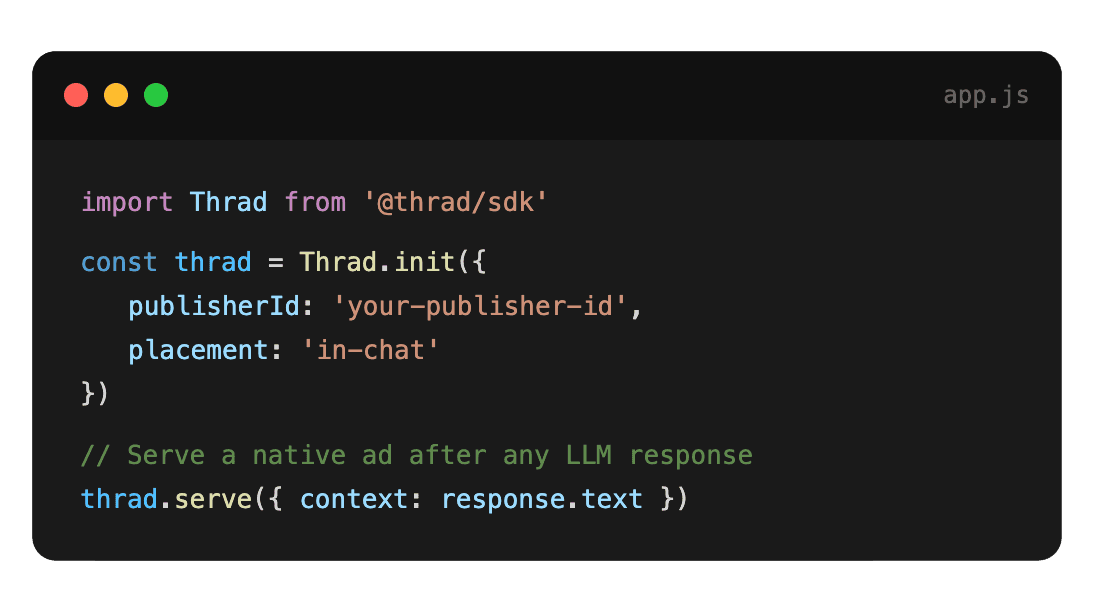
With Thrad, publishers go from first API call to live ads in less than 60 minutes. With fewer than 10 lines of code required, Thrad makes it easy to unlock revenue from your conversational traffic the same day.

OpenAI Path to Profitability — 2026 View | Thrad
OpenAI in 2026 is the world's fastest-growing software business and also
one of its most unprofitable — by design. Revenue is compounding north of
100% year over year, but training compute, free-tier inference, and R&D
still run ahead of gross profit. The path to profitability isn't a
mystery; it's a question of which lever moves fastest, and whether
advertising pulls operating break-even forward by 12–18 months.
OpenAI's path to profitability in 2026 runs through four simultaneous
improvements: API gross-margin expansion, enterprise seat growth,
advertising and licensing revenue coming online, and better amortization
of training compute across more model-months in production. None of them
alone closes the gap; together they plausibly do, on a 2027–2029 timeline.
The question is which levers move fastest — and whether the advertising
ramp compresses the timeline from "plausible by 2028" to "probable by 2027."
What is OpenAI's current financial position?
OpenAI runs at roughly $12 billion annualized revenue in early 2026
with revenue growing faster than 100% year over year, but operating
losses remain in the multi-billion-dollar range due to training
compute, free-tier inference, and R&D. Gross margin on each product
line is positive; corporate-level profitability is not. This is a
structural posture, not a failure mode.
As of early 2026, OpenAI runs at roughly $12 billion in annualized
revenue, with consumer subscriptions (ChatGPT Plus and Pro), enterprise
and team seats, API usage, and a fast-growing advertising/licensing line
as the main contributors. Revenue is compounding north of 100% year over
year. Operating losses are multi-billion-dollar annually, funded through
equity raises, compute commitments from hyperscaler partners, and debt
facilities.
The important distinction: gross margin at the product level is
positive on most surfaces. Consumer subscriptions clear compute cost
handily; enterprise seats are the fattest-margin line in the business;
most API endpoints run in the 55–75% gross margin range. The loss comes
from costs that don't flow into COGS per query — principally R&D salaries
and the training runs for next-generation models. The math is cleaner
than the reported P&L implies, because the P&L loads current-period
training cost against current-period revenue, which misattributes a
multi-year capability investment to a single quarter.
What are the four levers that determine profitability timing?
Four levers determine when OpenAI reaches operating break-even: API
gross-margin expansion, enterprise seat growth, advertising and
licensing ramp, and training-compute amortization. Each contributes
independently; each has a different pace. The slowest lever sets the
floor timing; the fastest sets the ceiling.
1. API gross-margin expansion
Every efficiency gain in inference — better hardware utilization,
continuous batching, speculative decoding, smaller distilled models —
directly expands API margin, because OpenAI passes some but not all of
those gains through to customers. A 10-point gross-margin improvement on
API, at 2026 volumes, is worth hundreds of millions in annual operating
income. The curve compounds faster than most commoditization stories
because model efficiency gains are hard-won and slow to copy even when
the pricing signal is fully public.
2. Enterprise seat growth
Enterprise is the highest-margin product in the portfolio. Each new seat
is essentially pure gross margin on top of already-paid fixed compute
capacity. The 2026 picture shows enterprise seats growing faster than
consumer subs in dollar terms, and the growth is sticky — enterprise
contracts renew at near-100% rates once SSO, governance, and custom
data handling are in place. Net dollar retention inside the enterprise
book is reportedly running above 120%.
3. Advertising and licensing revenue
The free tier's compute bill is the structural reason OpenAI can't
subscription-fund its way to profitability alone. Advertising changes
the arithmetic. Paid search placements, sponsored shopping suggestions,
and publisher licensing deals don't have to be huge to matter — they
need to cover the incremental cost of serving the free tier, which
turns every free user from a loss leader into a break-even user. A
$3–5B advertising run-rate by late 2027, which eMarketer's forecasts
suggest is within range, would single-handedly erase the free-tier
drag on the company P&L.
4. Training compute amortization
This one is less-discussed but important. Training costs hit P&L when
they happen, but the capability they buy serves revenue for 18–36 months.
The more model-months OpenAI can run each trained checkpoint in
production, the better the amortization looks. Slower training cadence
accelerates profitability; faster, more capital-intensive model rollouts
delay it. The paradox: capability leadership costs near-term profit,
but is what protects the multiple the company is underwritten against.
What is the 2026 revenue mix and its margin profile?
The 2026 revenue mix is led by consumer subscriptions at ~40% of the
top line, enterprise at 25–35%, API at 20–25%, and advertising plus
licensing at 5–10% and growing fastest. Margin profile is strongest at
enterprise, mid-tier at consumer and API, and early-stage but high at
advertising. The mix is shifting quarterly as advertising scales.
Revenue stream | ~Share of revenue | Gross margin profile |
|---|---|---|
Consumer subs (Plus, Pro) | 35–45% | Positive; strongest at Pro tier |
Enterprise + Team seats | 25–35% | Highest in the business |
API (usage-based) | 20–25% | 55–75% depending on endpoint mix |
Advertising + licensing | 5–10% and growing fastest | Very high once at scale |
Shares are directional and based on press reporting plus investor-letter
leaks, not audited disclosures.
Cost bucket | ~Share of total cost | Trend 2024→2026 |
|---|---|---|
Inference compute | 30–40% | Falling per query |
Training compute | 20–30% | Lumpy, rising with GPT-6 |
R&D salaries | 20–25% | Rising with hiring |
GTM + sales | 10–15% | Rising with enterprise push |
G&A + infra | 5–10% | Stable |
The structural question for OpenAI's 2026–2027 finances isn't whether
any individual product is profitable — most are, at gross margin. It's
whether the company can grow advertising and enterprise fast enough to
absorb the fixed costs of training the next generation of models before
investor patience shifts.
Why is the free tier the pivot point?
The free tier is both OpenAI's distribution moat and its largest
structural cost. Billions of free queries per week create the user base,
the training data, and the brand gravity — and cost real GPU-seconds.
Fixing the math requires reducing per-query cost and monetizing free
users directly; OpenAI is executing both simultaneously.
The free tier is OpenAI's moat and its millstone. Billions of free
queries per week create the user base, the training data, the
distribution footprint, and the brand gravity that make ChatGPT the
default AI product. They also cost real GPU-seconds, and only a low
single-digit percentage of free users ever upgrade to Plus or Pro.
Two ways to fix that math: reduce the cost of serving a free query, or
monetize the free user directly. OpenAI is doing both. Inference costs
per query have dropped meaningfully year over year — SemiAnalysis puts
the aggregate decline at roughly 75% since 2023 across the blended
product mix. Simultaneously, 2026 saw the rollout of labeled sponsored
placements in ChatGPT's search surface, shopping pilots with retailers,
and expanded content-licensing deals. The advertising ramp is the new
variable; inference efficiency was already trending the right direction.
Free-tier monetization is the only structural fix. You can compress
inference cost only so far before physics binds. Advertising turns a
cost center into a contribution center, which is what every ad-supported
consumer surface in the last 30 years has done at some point in its
maturity.
What are the analyst scenarios for profitability timing?
Analyst scenarios cluster into three buckets: aggressive (2027 break-
even if advertising ramps fast and training slows), base case (2028
with steady execution across four levers), and slower (2029+ if
training cadence accelerates or advertising hits regulatory
headwinds). The base case is the modal view.
Aggressive (break-even 2027): Advertising ramps to 15–20% of
revenue within a year, enterprise accelerates, training cadence
slows one generation. Inference efficiency compounds. This scenario
depends on a GPT-6 delay or a decision to skip a generation.Base case (break-even 2028): Advertising grows but doesn't
dominate; enterprise compounds; training cadence continues on current
rhythm; inference efficiency continues dropping per-query cost. This
is the modal analyst view as of mid-2026.Slower (break-even 2029+): Training cadence accelerates for GPT-6
and GPT-7, advertising hits regulatory or UX headwinds, enterprise
growth decelerates as market saturates. This scenario also includes
any meaningful competitive displacement from Anthropic, Google, or
open-weight alternatives.
Scenario | Break-even year | Ad revenue 2027 | Training cadence | Enterprise NDR |
|---|---|---|---|---|
Aggressive | 2027 | ~$6B | Slow (GPT-6 delayed) | 130%+ |
Base case | 2028 | ~$3–4B | On schedule | 115–125% |
Slower | 2029+ | ~$1–2B | Accelerated | <110% |
The base case is the modal analyst view as of mid-2026. It assumes
continued execution across four levers, no major competitive shock, and
an advertising rollout that keeps pace with eMarketer's current forecast.
How does OpenAI's path compare to peer AI labs and legacy software?
OpenAI's path is structurally different from both peer AI labs and
legacy SaaS. Anthropic is pursuing a tighter, enterprise-first model
with lower capital intensity. Legacy SaaS companies reached profit at
smaller revenue because they didn't carry training capex. OpenAI
carries hyperscaler-scale capex on a software-company P&L, which is
the source of both the unique opportunity and the unique pain.
Company | Revenue stage | Path to profit | Key lever |
|---|---|---|---|
OpenAI | ~$12B, pre-profit | 2027–2029 | Ad ramp + enterprise |
Anthropic | ~$4B, pre-profit | 2028–2030 | Enterprise ARR compounding |
Legacy SaaS (peer ARR) | $12B, profitable | Already profitable | Opex discipline |
Hyperscaler AI segment | Bundled, profitable | Already profitable | Infrastructure gross margin |
The comp set implies that OpenAI's path is a hybrid: software-like
revenue behavior, hyperscaler-like capex. That combination is what makes
both the optimistic case and the cautious case defensible. The
optimist says the revenue ramp outpaces the capex. The cautious analyst
says capex grows as fast as revenue and compresses the window.
Common misconceptions
"OpenAI has to raise forever because the business doesn't work."
Product-level unit economics work. Corporate-level unprofitability is
a choice to keep investing aggressively in R&D and next-gen training."Microsoft's investment means OpenAI doesn't care about profitability."
Microsoft's compute commitment funds capacity, not operating expenses.
Revenue still has to cover serving cost over time."Advertising is a nice-to-have, not a need." At current free-tier
scale, advertising is structural — without it, inference efficiency
alone doesn't cover the cost of serving billions of free queries per
week."The $12B run-rate means profit is imminent." Run-rate and
profit are different problems. The gap isn't revenue; it's the
composition of costs that don't flow through COGS."Open-weight alternatives collapse the thesis." They pressure
API pricing but don't affect enterprise or consumer pricing
materially, both of which are priced on product experience, not
token cost.
What comes next
Expect three shifts through 2026 and 2027. First, advertising revenue
becomes a reported line in OpenAI's disclosures rather than a sub-footnote
— its size will matter for how investors value the business. Second,
enterprise will pass consumer subs as the largest revenue line. Third,
the "free tier as loss leader" framing will quietly change as ads and
sponsored placements move free users toward contribution-margin positive.
A fourth, less-discussed shift: the market will stop scoring OpenAI
against pure software comps and start scoring it against hyperscaler
comps. The compute footprint is too large for software multiples to
make sense, and the capability moat is too real for infrastructure
multiples to hold. A hybrid comp structure will emerge, probably
anchored on enterprise ARR plus a discount for training capex.
How to act on this as a brand
If you're a brand, the financial path to profitability is your cue:
the advertising ramp is not optional for OpenAI, which means it is not
optional for brands that want to appear in front of ChatGPT's users. The
placements exist today in limited form and will expand. Thrad helps
brands measure and activate AI-advertising presence across ChatGPT,
Perplexity, and the other generative surfaces that are racing through
the same monetization curve.
Three concrete moves before the auction matures: (1) audit your
citation share on the 25 commercial-intent prompts that most shape your
category, (2) instrument generative-surface referral tracking so your
analytics stack can see the traffic, (3) commit a small budget to paid
placement as inventory opens, if only to learn the auction dynamics
before they stabilize. These are the same kind of first moves brands
made into paid search in 2003 and into social in 2009 — the cost of
being early is small; the cost of being late is structural.
For finance leaders watching the broader AI category, the OpenAI
profitability timeline is the anchor that sets expectations for the
rest of the cohort. If OpenAI reaches operating break-even by 2028,
analyst models re-rate the whole category around a tangible profit
horizon. If it slips, the capital cost of the industry rises and weaker
players consolidate faster. The timing isn't just OpenAI's problem — it
sets the discount rate for every AI lab and every AI-native startup
underwritten against a category-wide profitability assumption. Watch
the quarterly cadence, not the headlines.

openai profitability, openai financials, openai revenue growth, chatgpt unit economics, ai company profit
Citations:
The Information, "OpenAI annualized revenue tops $12B in Q1 2026," 2026. https://theinformation.com
Financial Times, "OpenAI operating loss and investor commitments," 2026. https://ft.com
SemiAnalysis, "The Cost Structure of Foundation Model Companies," 2026. https://semianalysis.com
Bloomberg, "Microsoft-OpenAI compute agreement economics," 2025. https://bloomberg.com
Stanford HAI, "AI Index 2026 — Industry Finance," 2026. https://hai.stanford.edu
Stratechery, "The capital of compute and the path to profit," 2025. https://stratechery.com
eMarketer, "Generative surface ad spend forecast, 2026," 2026. https://emarketer.com
Be present when decisions are made
Traditional media captures attention.
Conversational media captures intent.
With Thrad, your brand reaches users in their deepest moments of research, evaluation, and purchase consideration — when influence matters most.
Date Published
Date Modified
Category
Advertising AI
Keyword
openai path to profitability