LLM advertising is the practice of getting a brand, product, or
message to appear inside the text a large language model generates in
response to a user query. It includes sponsored placements
(explicitly labeled), licensed content (behind partnership deals),
and organic presence (through generative engine optimization). It's
distinct from search advertising because there are no ten blue links
— one synthesized answer wins the impression. eMarketer pegs global
LLM ad spend at roughly $3.8B in 2026, up from under $400M in 2024,
a ~9.5x jump in 24 months and the fastest-growing new ad channel
since retail media.



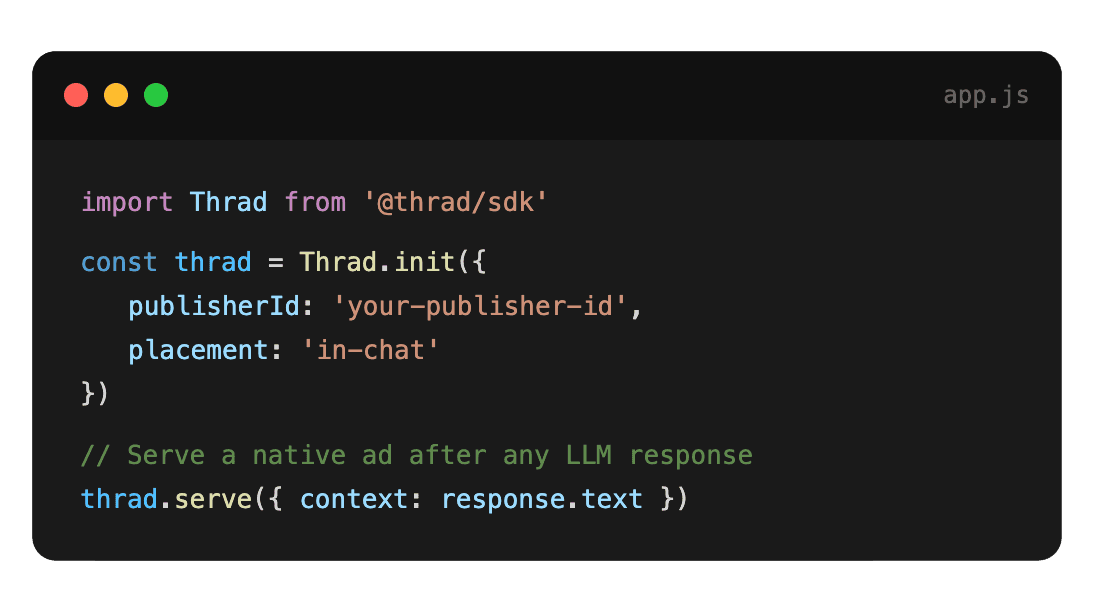
Start monetizing your AI app in under an hour
With Thrad, publishers go from first API call to live ads in less than 60 minutes. With fewer than 10 lines of code required, Thrad makes it easy to unlock revenue from your conversational traffic the same day.

LLM Advertising Fundamentals 2026 | Thrad
LLM advertising is how brands appear inside the answers of ChatGPT,
Perplexity, Copilot, and Gemini — through sponsored placements,
licensed content, or organic presence optimization. It is not a
variant of search advertising. The mechanics, pricing, and success
metrics are different, and most 2026 marketing teams are still figuring
out the basics.
LLM advertising is how brands show up inside the answers that ChatGPT,
Perplexity, Copilot, and Gemini generate. It sounds like search
advertising. It isn't. The mechanics, pricing models, creative
requirements, and success metrics are each different enough that most
marketing teams trying to treat it as a variant of paid search in 2026
end up measuring the wrong things and buying the wrong inventory. This
primer lays out, from the ground up, what the category actually is —
starting with a clean definition, moving through the three modes of
appearance, the mechanical pipeline that runs between a user prompt and
a rendered answer, and the measurement framework that replaces
click-through rate as the center of gravity.
What is LLM advertising?
LLM advertising is the set of practices by which a brand, product, or
message appears inside the text a large language model produces in
response to a user query. That appearance can be explicit and paid (a
labeled sponsored answer), contractual and unlabeled (a licensed
content partnership), or organic (the model surfaces the brand because
of its training data and real-time retrieval signals).
All three count as LLM advertising in the broad sense because all three
are routes by which a brand competes for presence in the generative
surface. eMarketer estimates the combined channel at $3.8B globally in
2026, up from $2.1B in 2025 and under $400M in 2024 — roughly a 9.5x
expansion in 24 months and the fastest-growing new ad channel of the
2020s after retail media. Gartner places LLM advertising on the
"Slope of Enlightenment" phase for the first time in its 2026 Hype
Cycle, meaning the category has exited pure hype and is producing
measurable, repeatable results.
The definitional move worth holding onto: LLM advertising is about
presence inside a generated answer, not about buying a banner next to
one. That framing rules in sponsored answer inventory, licensed content
deals, and the full GEO discipline. It rules out generic AI-assisted
display advertising, which belongs to programmatic and generative-
creative budgets.
The three modes of LLM advertising
LLM advertising in 2026 divides cleanly into three modes. The rough
spend split across the category, per eMarketer's channel model, is 45%
sponsored, 20% licensed, and 35% organic/GEO-driven programs.
Sponsored placements
An AI platform sells inventory — usually a labeled answer, card, or
sidebar — to advertisers who bid on queries or query categories. OpenAI
and Perplexity both offered variants of this in 2025, and Google's
sponsored AI Overview slot matured through 2026. Clear disclosure is
required; the IAB Tech Lab and regional regulators have converged on
labeling standards. Entry budgets have fallen from $50K pilots in 2024
to $5K–$10K self-serve minimums on most networks in 2026, which is why
SMB participation roughly doubled year-over-year.
Licensed content
The AI platform signs a commercial agreement — sometimes called a
publisher deal, sometimes a content license — that gives preferential
treatment to a partner's content in relevant answers. The brand's
material is surfaced because the platform has a contractual reason to
surface it. OpenAI's publisher licensing agreements, disclosed in 2024
and expanded through 2025-2026, reportedly range from $1M to $25M+ per
partner depending on scale, with a revenue-share layer on top.
Disclosure here is more ambiguous than sponsored and is a regulatory
frontier in 2026.
Organic presence
The model names a brand in its answer because its training data,
real-time retrieval, and authority signals indicate the brand is a
relevant answer to the user's query. No money changes hands directly;
the brand earns presence through the practices collectively called
generative engine optimization (GEO): structured content, authoritative
citations, schema, recency, and clean brand descriptions across the
web. The 2024 Princeton / ACM SIGKDD GEO study showed that adding
statistics and quotations to a page boosted citation rates by roughly
30–40% across ChatGPT, Perplexity, Gemini, and Bing Chat.
How does LLM advertising actually work mechanically?
Mechanically, LLM advertising runs on a four-step pipeline that every
major assistant implements in some variant: ingest the prompt, rewrite
and classify it, retrieve and score candidate sources, and synthesize a
final answer with optional ad inventory merged in. A brand can be
surfaced at the retrieval step (organic or licensed) or at the
ad-merging step (sponsored). Knowing which step you're competing on is
the first literacy move.
When a user types a query into a consumer LLM, the assistant typically
does four things in sequence: rephrases the query internally, retrieves
candidate sources (web, partner content, internal indices), synthesizes
an answer, and optionally appends citations or sponsored slots. A
brand's chance of appearing is determined at each stage — by whether
retrieval surfaces its content, whether the model's generation step
weighs it into the answer, and whether any paid inventory is sold
against that query.
Step | What happens | Where advertising intersects |
|---|---|---|
Prompt ingest | Tokenize + classify user intent | Classifier determines ad eligibility |
Rewrite | Expand to search-style sub-queries | Rewritten queries trigger retrieval |
Retrieval | Pull 10–40 candidate sources | Organic + licensed content compete here |
Ranking | Score candidates by relevance + authority | Authority signals determine citation odds |
Synthesis | Compose the answer with citations | Licensed content gets preferential weight |
Ad merge | Insert sponsored answer or card | Sponsored inventory renders with disclosure |
Render | Ship to user with labels | Disclosure compliance is enforced here |
Surface | Primary inventory | Primary pricing model | Primary unit of value |
|---|---|---|---|
ChatGPT | Sponsored answer + cited source | CPM / CPC hybrid | Citation + click |
Perplexity | Sponsored follow-up questions | CPM | Citation + follow-up engagement |
Copilot | Sponsored card in answer | CPC | Click |
Gemini | Sponsored AI Overview slot | CPC | Click |
All four | Organic citation | (earned) | Mention + sentiment |
An LLM answer is not a SERP. One response wins the impression, and
the question is whether your brand is inside it — not whether it
ranked third.
The retrieval step deserves separate attention. In 2024 the major
assistants retrieved between 5 and 15 candidate sources per answer;
by Q1 2026, Perplexity and ChatGPT Search routinely retrieved 20–40
sources per complex query, per The Information's platform teardown.
That expansion matters because it means more brands get a shot at the
citation stage — but it also means authority signals matter more, not
less, because the ranker has more competing candidates to sift.
Why does LLM advertising matter in 2026?
Three 2026-specific dynamics make LLM advertising the fastest-moving
part of most media plans. First, user behavior shifted: SimilarWeb put
AI-assistant share of informational queries at ~18% in Q1 2026, up from
6% in Q1 2024. Second, the ad rails matured: every major assistant now
has a disclosed, stable sponsored inventory. Third, measurement stopped
being a black box; citation-monitoring tools are reliable enough to be
defensible inside finance review.
The channel's growth rate is the highest in digital: eMarketer's global
forecast puts 2026 at $3.8B, 2027 at $6.9B, and 2028 at ~$11B — a
roughly 80% compound annual growth rate across the window. At the same
time, the inventory is still under-bought. Gartner's 2026 enterprise
marketing buyer survey found that 62% of Fortune 500 brands had not yet
run a sponsored LLM campaign, even though 71% reported that they were
"monitoring organic citation rate" at least informally. That gap
between awareness and action is the exact condition every mature ad
channel has passed through before pricing doubled.
The cheapest any new ad channel ever gets is right before the top 50
advertisers in the category all arrive at once. In 2026, sponsored
LLM inventory is in exactly that window — per eMarketer, effective
CPMs are running 35–45% below search's comparable-intent CPMs on a
citation-weighted basis.
What does measurement look like for LLM advertising?
Measurement in LLM advertising replaces CTR-first dashboards with a
citation-first framework. The core metric is citation rate (share of
category-relevant queries that name the brand); the second is share of
generated voice (your citation rate divided by the competitive set's).
Click-through still matters where a sponsored link exists, but it
captures only 20–40% of the channel's incremental value, per IAB 2026
benchmarks.
Classical metrics partially apply. Impressions still make sense if you
define them as instances of your brand appearing in an answer. Clicks
apply when a sponsored or cited link is present and tracked. What
breaks is everything that assumes a list of results: position, click-
through rate on a specific rank, bounce-back. What's new:
Citation rate — the share of answers on category-relevant queries
that name the brand. Benchmark: top-decile brands in B2B SaaS run
15–25% citation rates on their core category queries in 2026.Share of generated voice (SGV) — the brand's citation rate
divided by the combined citation rate of the competitive set.Grounded attribution — attribution models that count
generative-surface exposure as a channel feeding conversion. Thrad
customers report 12–18% lift on last-touch conversions once grounded
attribution replaces last-click.Citation sentiment — positive, neutral, or negative framing
inside the answer. A neutral cite is worth roughly 60% of a positive
cite in downstream intent per WARC's 2026 creative benchmark.Recency-weighted citations — a citation decays; the metric
captures how often the brand appears in answers to queries asked
last week, not last year.
How does LLM advertising compare across the four major assistants?
The four major assistants — ChatGPT, Perplexity, Copilot, and Gemini —
share a surface pattern (one synthesized answer) but diverge in
inventory, audience, and maturity. ChatGPT has the largest reach;
Perplexity has the most ad-native inventory; Copilot rides Microsoft's
enterprise distribution; Gemini sits closest to classical search via
AI Overviews. A buyer should pick by audience and category fit, not by
raw reach.
Assistant | Monthly active users (Q1 2026, est.) | Sponsored inventory maturity | Disclosure standard | Best-fit category |
|---|---|---|---|---|
ChatGPT | ~800M | High — sponsored answer + cite | Sponsored label + cite badge | Research, commerce, B2B eval |
Perplexity | ~90M | Highest — follow-up prompts, cards | Sponsored follow-up badge | Research, shopping |
Copilot | ~220M (Microsoft-bundled) | Medium — sponsored card | "Ad" label inline | Enterprise, productivity |
Gemini | ~450M | Medium-high — AI Overview slot | "Sponsored" marker | Broad consumer, travel |
ChatGPT's sponsored answer inventory reached disclosed commercial
availability in late 2025 and expanded through 2026, with pricing in
the $15–$40 CPM range on high-intent commercial categories per The
Information's reporting. Perplexity's sponsored follow-up prompts
(labeled "Related") have the highest engagement rate in the category
at roughly 8–11% click-through, partly because the ad masquerades as a
useful question the user was likely to ask next. Copilot's
Microsoft-bundled enterprise distribution means it captures a
disproportionate share of B2B eval queries. Gemini's AI Overview ads
are the easiest bridge for brands with existing Google Ads programs
because they re-use account structure and audience lists.
What are the most common misconceptions about LLM advertising?
Most of the expensive mistakes in 2024-2025 came from treating LLM
advertising as a flavor of search, a flavor of display, or a flavor of
SEO. It borrows something from each but behaves differently from all
three. The misconceptions below are the ones that most often show up
in a first quarter of program operation.
"LLM advertising is just SEO with a chatbot in front of it." The
SEO overlap is real at the organic layer, but sponsored and licensed
modes are distinct inventory types with their own buying motions.
Programs that try to run LLM exclusively through their SEO team miss
the sponsored and licensed layers entirely."There's no measurement, so it can't be bought." Measurement is
younger than in search but is real. Citation and share-of-voice
metrics are trackable across the major assistants, and IAB's 2026
benchmarks give category-level baselines for the first time."Wait until it matures." The land-grab phase of any new ad
channel — from search in 2003 to social in 2010 to retail media in
2020 — is when cost-per-impression is lowest and presence is
stickiest. Waiting is expensive in retrospect; Digiday's 2026
reporting found first-mover brands pay roughly 40% less per citation
than brands that wait 18 months."One vendor will handle the whole thing." No vendor has deals or
coverage across all the major assistants. Expect a specialist layer —
citation-monitoring vendors, GEO consultancies, and sponsored-
inventory buying specialists are all emerging as distinct segments."Disclosure will kill conversion." The opposite has been true in
2026 trials: IAB benchmarks show clearly-labeled sponsored answers
driving 10–15% higher downstream brand trust than hidden placements,
because users treat disclosure as a signal of quality.
What comes next for LLM advertising through 2027?
Three developments are worth watching through 2026 and into 2027.
First, the first large-scale sponsored answer auctions in ChatGPT and
Gemini are maturing and will start producing auction-level pricing
data, probably by Q4 2026. Second, IAB Tech Lab's buyer's guide and
associated standards are being adopted by agency trading desks, which
will make cross-assistant measurement a commodity rather than a custom
build. Third, measurement specialists are consolidating — expect two or
three citation-monitoring vendors to emerge as de facto standards by
mid-2027, with the rest acquired or sunset.
A fourth shift is worth flagging because it's less discussed: agent-
initiated queries. As consumer AI agents (Operator-class products)
start issuing prompts on behalf of users, a layer of agent-facing LLM
advertising will emerge. The disclosure and UX rules for that layer
are unsettled. Expect a dedicated IAB working group to publish
specifications in 2027; brands with existing sponsored LLM programs
will port over first.
How to get started with LLM advertising
Four concrete steps. First, baseline your current organic presence
across the major assistants with a representative basket of 30–50
category queries — run the same prompts monthly and track which brands
get cited. Second, identify the five or ten queries where your brand
should be cited and isn't — these are your priority targets. Third,
allocate a small test budget ($10K–$50K per quarter is a realistic
starter) to sponsored inventory on one assistant, with clear citation-
rate and share-of-voice KPIs. Fourth, instrument measurement across
organic and paid modes so you can compare apples to apples.
One sequencing note: run organic baselining for at least 30 days
before you buy sponsored inventory. The baseline tells you which
queries are worth paid presence (because your brand is invisible or
badly positioned) and which aren't (because your brand already wins
organically). Paying for presence you already earn is the most
common budget waste in 2026 programs, per Digiday interviews with
agency trading desks.
Thrad helps brands measure and place inside generative assistants
specifically — giving marketing teams a unified view of where they
appear, where they don't, and where paid presence is worth buying. The
category is still early, the auctions are thin, and the pricing
reflects it. That window closes when the top 50 advertisers in each
category arrive, which is happening on a roughly 18-month timeline.

llm ads, ai assistant advertising, chatgpt advertising basics, generative ai ads
Citations:
OpenAI, "ChatGPT Advertising Program Overview," 2025. https://openai.com
Perplexity, "Sponsored Answers — Advertiser Guide," 2025. https://perplexity.ai
eMarketer, "LLM Advertising Spend Forecast 2026," eMarketer, 2026. https://emarketer.com
IAB Tech Lab, "Generative AI Advertising Buyer's Guide," IAB, 2026. https://iabtechlab.com
Princeton University, "GEO: Generative Engine Optimization," ACM SIGKDD, 2024. https://arxiv.org
Gartner, "Hype Cycle for Digital Advertising 2026," Gartner, 2026. https://gartner.com
The Information, "OpenAI ad revenue inside ChatGPT," The Information, 2026. https://theinformation.com
Digiday, "How brands are testing LLM ad inventory," Digiday, 2026. https://digiday.com
Be present when decisions are made
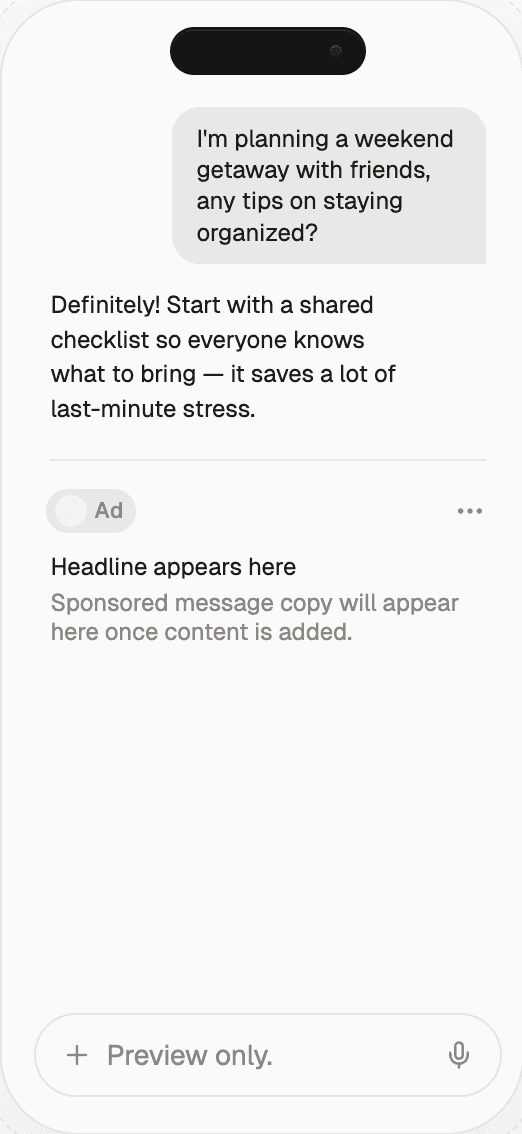
Traditional media captures attention.
Conversational media captures intent.
With Thrad, your brand reaches users in their deepest moments of research, evaluation, and purchase consideration — when influence matters most.
Date Published
Date Modified
Category
Advertising AI
Keyword
llm advertising