LLM ads and search ads both monetize user intent but differ
structurally. Search ads bid for ranked positions with click-through
as the primary KPI. LLM ads compete for citations and sponsored
slots inside a synthesized answer with citation rate and share of
generated voice as the primary KPIs. In 2026, search is a $317B
global channel and LLM advertising is ~$3.8B — budget should shift
gradually (10–20%), not wholesale, toward LLM surfaces as they earn
their share of high-intent queries.





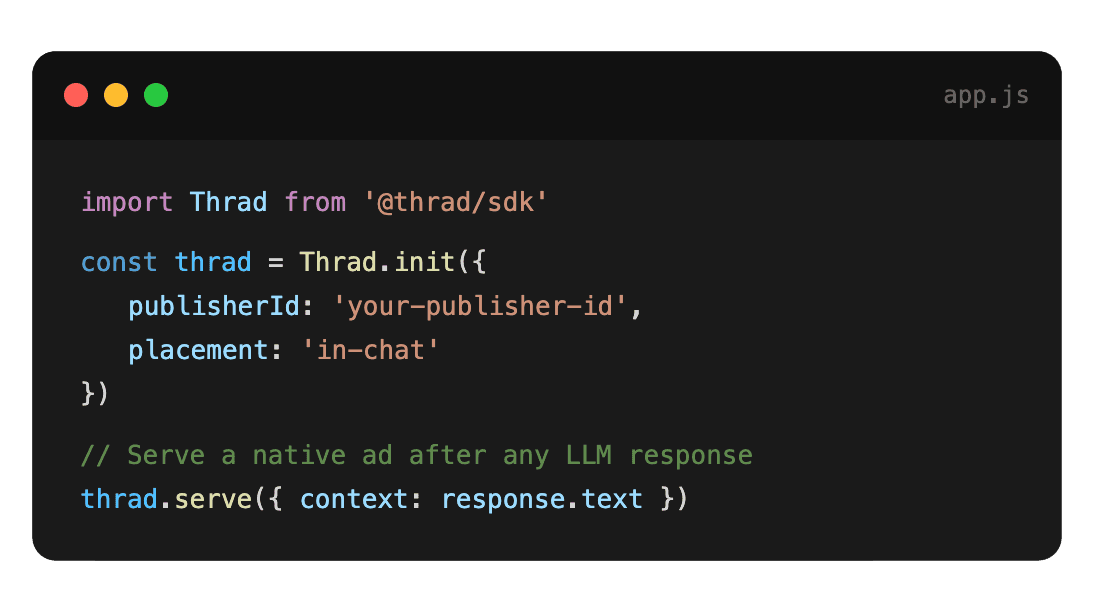
Start monetizing your AI app in under an hour
With Thrad, publishers go from first API call to live ads in less than 60 minutes. With fewer than 10 lines of code required, Thrad makes it easy to unlock revenue from your conversational traffic the same day.

LLM Ads vs Search Ads 2026 Comparison | Thrad
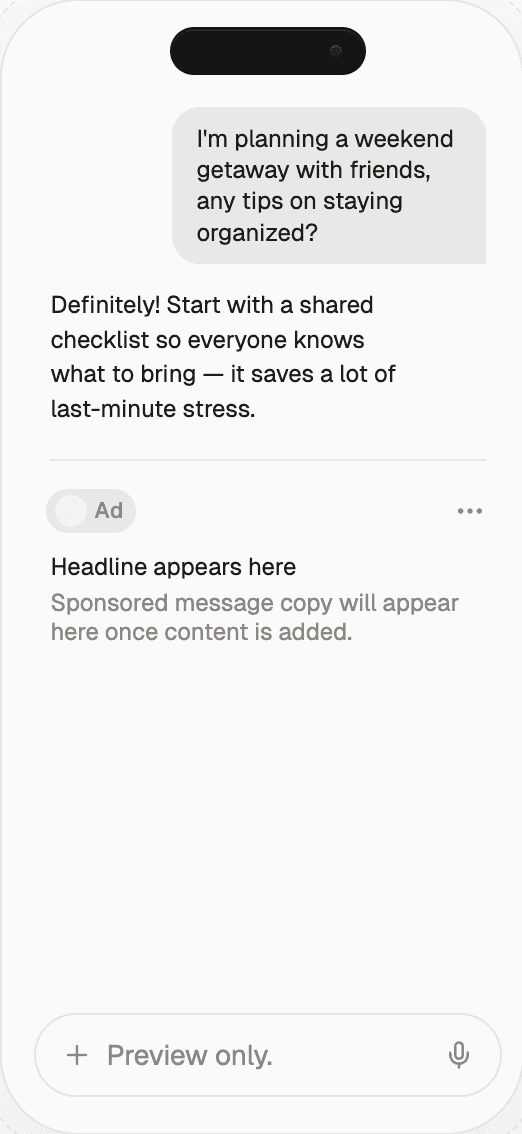
Search ads and LLM ads look adjacent because both sit at the moment
of user intent. Under the hood they are different products. Search
ads compete for position in a ranked list; LLM ads compete for
presence inside a single synthesized answer. The mechanics, pricing,
and measurement diverge from there.
Search ads and LLM ads both monetize user intent. That's where the
similarity ends. Treating LLM advertising as "search ads inside
ChatGPT" has been the most common expensive mistake of 2025, and it
continues into 2026. The surfaces differ in mechanics, pricing,
creative requirements, and measurement — and understanding the
specifics is the prerequisite to deciding how much budget to move.
This comparison runs through all six dimensions, quantifies the gap in
2026 dollars, and lays out a defensible budget-reallocation framework.
What is the actual difference between LLM ads and search ads?
The actual difference is structural: search ads compete for position
in a ranked list of results for a keyword, while LLM ads compete for
presence inside a single synthesized answer an AI assistant produces
for a user prompt. A user sees ten or more search results; a user
sees one LLM answer. Every downstream divergence — pricing, targeting,
creative, measurement — flows from that single fact.
Search ads bid for a position in a ranked list of results returned for
a query. The user sees the list, scans, and sometimes clicks. LLM ads
compete for appearance inside a single synthesized answer that an AI
assistant produces for the same query. The user sees one response.
Either the brand is in it, or it isn't. That structural difference —
ranked list versus synthesized answer — cascades into every other
dimension of the comparison.
You cannot rank third in an LLM answer. You are in it or you are
not. That asymmetry is why the channel rewards presence over
position and punishes brands that treat it as a search variant.
How big are the two channels in 2026?
Search advertising is a ~$317B global channel in 2026 per WARC's
forecast; LLM advertising is ~$3.8B per eMarketer. Search is growing
at roughly 7% year-over-year, LLM at ~80%. The absolute scale gap is
83x, but the growth-rate gap is inverted — at current trajectories,
LLM advertising crosses 10% of search spend around 2029.
Channel | 2024 spend | 2026 spend | 2028 forecast | YoY growth (2026) |
|---|---|---|---|---|
Global search advertising | $285B | $317B | $348B | ~7% |
Global LLM advertising | $0.4B | $3.8B | $11B | ~80% |
Ratio (search : LLM) | 713:1 | 83:1 | 32:1 | — |
SimilarWeb's Q1 2026 consumer usage data adds nuance to the pure
dollar comparison. AI assistants handled roughly 18% of informational
queries in Q1 2026, up from 6% two years earlier, but the share of
commercial queries (where money actually gets spent) was only ~11%.
That usage gap is why LLM advertising lags search in monetization
even as it surges in raw query count. Commercial intent is still
dominated by search, but the gradient is unmistakable.
Side-by-side: the six dimensions that matter
Six dimensions cover the substantive differences between the two
products: inventory, targeting, pricing, creative, measurement, and
disclosure. Each breaks differently enough that a team running both
needs distinct operating playbooks.
1. Inventory
Search inventory is a set of positions above and alongside organic
results — typically 3–4 top slots plus bottom-of-page slots per query.
LLM inventory is a mix of sponsored answers, sponsored follow-up
prompts, sponsored cards, and earned citations. Four or five distinct
inventory types per major assistant, with different mechanics for
each. The density of inventory per query is also lower: a search
page shows multiple ads; an LLM answer rarely shows more than one
sponsored unit per render, per The Information's 2026 teardowns.
2. Targeting
Search targeting is keyword-centric, augmented by audience signals.
LLM targeting in 2026 is mostly query-category and intent-cluster —
you bid on the kind of question, not the exact phrase. This is partly
because LLM queries are longer (prompt length averaged 12 words in
2026 versus 4 words for search queries per SimilarWeb) and more
variable, and partly because the assistants do the rephrasing before
inventory is matched.
3. Pricing
Search advertising is predominantly CPC, with auction dynamics that
have been refined for twenty-plus years. LLM advertising in 2026 is
mostly CPM or CPM-hybrid, reflecting the fact that the primary unit of
value (a citation inside an answer) isn't always a click. Expect
CPC-style pricing to emerge where click intent is clear — sponsored
product cards in shopping queries, for instance. eMarketer pegs 2026
average sponsored LLM CPM at $22 across categories versus $38 for
comparable search CPM.
4. Creative
Search creative is short, templated, and dominated by headline and
description variants. LLM creative includes that but adds structured
content designed to be cited and re-synthesized — paragraphs with
clean facts, schema-marked product data, and brand descriptions that
survive paraphrase. Good LLM creative reads as reference material, not
as advertising copy. The Princeton / ACM SIGKDD 2024 GEO study found
that structured content with stats and quotations boosted citation
rates by 30–40% in ChatGPT, Perplexity, Bing Chat, and Gemini.
5. Measurement
Search measurement is mature: impressions, clicks, CTR, conversion,
cost per acquisition, and return on ad spend. LLM measurement is
younger and asymmetric — impressions and clicks exist but are
supplemented by citation rate, share of generated voice, sentiment
inside the cite, and grounded attribution. Brands that rely on
search-style KPIs alone under-measure LLM value by roughly 30–50% in
incrementality tests, per IAB 2026 benchmarks.
6. Disclosure and brand safety
Search ads are labeled to a long-established standard. LLM ads in 2026
have newer, more varied disclosure conventions — sometimes a label,
sometimes a citation with a sponsored badge, sometimes a distinct card
format. Brand-safety controls also differ because the adjacency risk
is inside the generated text, not on a publisher page. Per-render
policy checks (run on every ad fire rather than at campaign level)
are the emerging 2026 standard.
Dimension | Search ads | LLM ads (2026) |
|---|---|---|
Inventory | Ranked positions in SERP | Sponsored answers, cards, cites; earned citations |
Targeting | Keyword + audience | Query category + intent cluster |
Avg query length | ~4 words | ~12 words |
Pricing | CPC auction | CPM / hybrid, early auction dynamics |
Avg effective CPM (2026) | ~$38 | ~$22 |
Creative | Headline + description variants | Structured content + sponsored asset |
Primary KPI | CTR, CVR, ROAS | Citation rate, share of voice, grounded attribution |
Disclosure | Standardized "Sponsored" label | Evolving — labels, badges, card formats |
Policy enforcement | Campaign-level | Per-render |
Typical minimum spend | $0 (self-serve) | $5K–$25K |
The user sees one answer. Everything else about how LLM advertising
works flows from that fact — the pricing model, the creative form,
the measurement stack, and the policy model all adapt to that one
structural reality.
Does LLM advertising cannibalize search advertising?
LLM advertising partially cannibalizes search, but only on a
well-defined slice of query intent: informational and comparative
research queries ("best X for Y," "compare A and B," "is C worth
it"). Transactional queries stay dominated by search. The midsection
is contested. Gartner's 2026 analysis puts the cannibalization
pressure at ~18% of search query volume in 2026, growing to ~28% by
2028.
High-intent research queries are the first category to shift, because
users prefer a synthesized answer over a list of links for that kind
of question. Transactional queries — "buy X," "X near me" — remain
dominated by search and retail media in 2026, because the click-to-
cart path is faster. The midsection — "how much does X cost,"
"reviews of X" — is the battleground, and it's where most of the 2026
budget reallocation between the two surfaces is happening.
A second dynamic sits under the cannibalization numbers: search
queries themselves are getting more AI-inflected. Google's AI
Overview now renders on an estimated 55% of informational queries per
SimilarWeb, which means the user sees a synthesized answer inside
what is nominally a search page. That blurs the line enough that
calling any query "pure search" or "pure LLM" is increasingly
misleading.
Which budget should shift — and by how much?
A defensible 2026 budget reallocation is 10–20% of current search
spend into LLM surfaces, held under test conditions for 90 days
before scaling. Digiday reports the agency holdco median test
allocation sits at 14%. Brands skipping the test entirely give up
roughly 40% lower per-citation costs versus late movers, per
Digiday's first-mover analysis.
Category | Recommended reallocation (% of search) | Rationale |
|---|---|---|
B2B SaaS | 15–25% | Research-heavy category; AI assistants handle eval queries |
Ecommerce | 8–12% | Transactional intent stays in search |
Travel | 10–15% | Mixed informational and transactional |
Financial services | 12–20% | High research intent; regulated disclosure matters |
Healthcare (non-Rx) | 8–12% | Compliance constraints limit exposure |
Local services | 5–10% | "Near me" queries stay in search |
What are the most common misconceptions about LLM ads vs search ads?
The misconceptions below show up repeatedly in 2026 program
retrospectives. Most reflect a search-native team importing search-
native assumptions into an LLM program without adjustment.
"If I rank well in search, I'll be cited in LLMs." Correlated
but not deterministic. LLMs weight authority, recency, and structured
clarity differently than search engines; the Princeton GEO study
showed citation rate correlated with SERP rank at only ~0.48 — a
meaningful but far from perfect relationship."LLM ads don't work because CTRs are low." CTR is the wrong
metric. A citation that isn't clicked still often drives downstream
intent — measure it with surveys and incrementality tests, not CTR
alone. Thrad's 2026 benchmarks show citation rate correlates ~0.7
with downstream conversion, much higher than CTR alone does on the
same cohorts."Move all my search budget into LLMs now." Premature. The right
move in 2026 is a controlled shift of 10–20% with instrumentation to
prove value, then scale what works."Google's AI Overview is just search with AI paint." In terms of
user experience, increasingly not — the synthesized answer often
satisfies the query without a click, making it functionally an LLM
surface for many intents. SimilarWeb's 2026 data puts the no-click
rate on AI Overview-rendered queries at ~38%, roughly double the
no-click rate on classic SERPs."Search is dying." No. Search grew ~7% YoY in 2026. It's
compressing in share-of-intent on research queries, but the category
as a whole is still expanding in absolute dollars.
What comes next for LLM ads vs search ads through 2027?
Three shifts are likely through 2026 and into 2027. First, LLM ad
auctions will mature enough to produce stable CPC pricing in the
highest-intent categories — expect ChatGPT sponsored commerce answers
to be first, with CPCs converging to ~60–80% of equivalent-intent
search CPCs by late 2027. Second, measurement standards will converge
— citation rate and share of voice will become boardroom metrics
alongside CTR and ROAS, with IAB Tech Lab's 2026 Buyer's Guide as the
anchor spec. Third, budget reallocation will accelerate from roughly
5% of digital in 2026 to something closer to 15% by late 2027 per
eMarketer's forward forecast.
A fourth trend worth naming: unified buying across surfaces. The
early 2026 bridge products letting a single campaign target both
Google Ads and Perplexity sponsored inventory are primitive but
rapidly improving. By 2027, expect the major agency trading desks to
offer cross-surface campaigns that treat "intent clusters" as the
atomic unit and route spend to whichever surface (search or LLM)
offers better incrementality in real time.
How to act on this as a marketer
Three concrete moves in priority order. First, audit your current
search program and identify the query clusters where an LLM answer is
likely replacing the click — that's where to test LLM ad spend first.
SimilarWeb's no-click rate per query is the cleanest proxy. Second,
set up parallel measurement across both surfaces with shared audience
IDs so you can compare on common ground — don't measure search in
last-click and LLM in incrementality; use the same framework on both.
Third, resist binary reallocation; the right answer in 2026 is almost
always "both, weighted by measured incrementality."
One operational recommendation: assign a single paid-media owner to
both surfaces for the first year. Running search and LLM through
separate teams invites misaligned KPIs and duplicated bidding on the
same intents. A unified owner forces the reallocation conversation
to happen weekly, in dashboard review, rather than quarterly as a
budget fight.
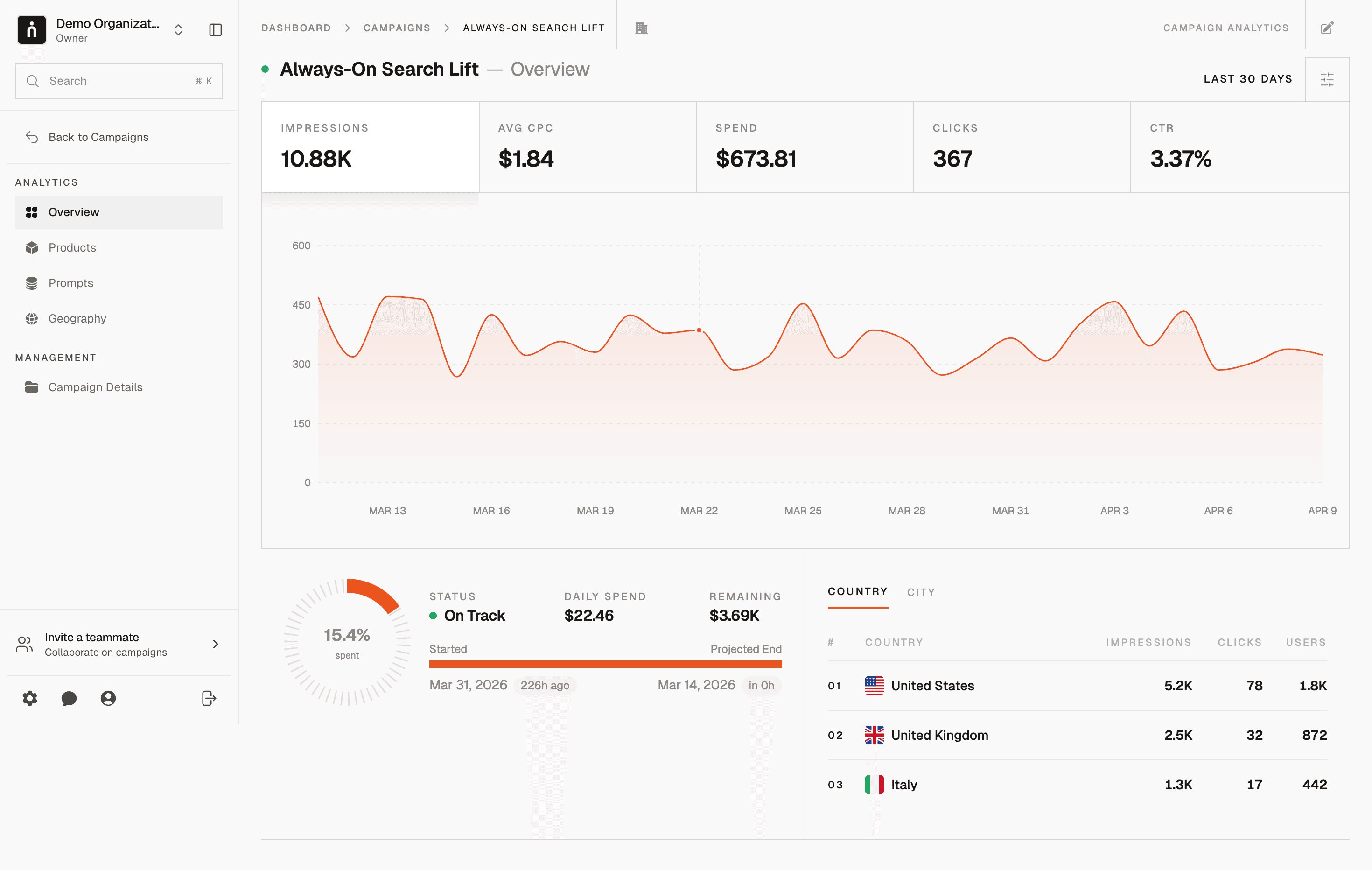
Thrad helps brands measure and place inside LLM surfaces specifically,
with metrics that map onto the same dashboards as classical search
advertising — so the comparison stops being apples-to-oranges and
starts being a grounded, quantitative budget decision that survives
finance review.
llm advertising vs search, chatgpt ads vs google ads, ai search ads, generative search advertising
Citations:
eMarketer, "US Digital Ad Spending by Channel 2026," eMarketer, 2026. https://emarketer.com
Gartner, "Search Advertising in the AI Era," Gartner, 2026. https://gartner.com
SimilarWeb, "Consumer AI Assistant Usage Report Q1 2026," SimilarWeb, 2026. https://similarweb.com
IAB Tech Lab, "Generative AI Advertising Buyer's Guide," IAB, 2026. https://iabtechlab.com
WARC, "Global Ad Spending Forecast 2026," WARC, 2026. https://warc.com
Digiday, "Agency holdco budget reallocation to LLM surfaces," Digiday, 2026. https://digiday.com
The Information, "Sponsored answer economics inside ChatGPT," The Information, 2026. https://theinformation.com
Princeton University, "GEO: Generative Engine Optimization," ACM SIGKDD, 2024. https://arxiv.org
Be present when decisions are made
Traditional media captures attention.
Conversational media captures intent.
With Thrad, your brand reaches users in their deepest moments of research, evaluation, and purchase consideration — when influence matters most.
Date Published
Date Modified
Category
Advertising AI
Keyword
llm ads vs search ads