You monetize ChatGPT output by earning when a model answer mentions, cites,
or routes a user to your brand or content. The main surfaces are sponsored
brand placements inside answers, paid citations, affiliate-tagged outbound
links, and upstream data-licensing deals with OpenAI and partners. In
2026, measurement is citation- and exposure-first, not click-first. The
economics are material: eMarketer puts generative-surface ad spend at
~$2.6B in 2026, doubling again by 2027.




Start monetizing your AI app in under an hour
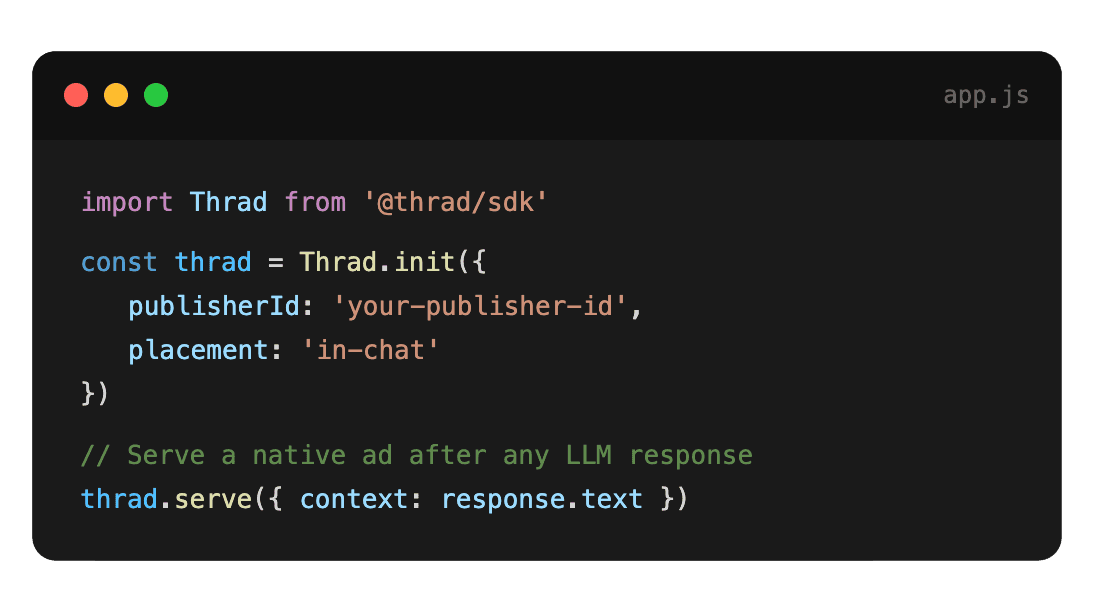
With Thrad, publishers go from first API call to live ads in less than 60 minutes. With fewer than 10 lines of code required, Thrad makes it easy to unlock revenue from your conversational traffic the same day.

How to Monetize ChatGPT Output — 2026 | Thrad
Monetizing ChatGPT output is no longer theoretical. In 2026, brands and
publishers are earning from model answers through licensed references,
sponsored placements inside the answer, affiliate routing on outbound
links, and data licensing. Here's the stack, the economics, and where
revenue actually lands — plus how to measure it.
Monetizing ChatGPT output means earning revenue when a model answer
surfaces your brand, your content, or a link to you. It's a real category
in 2026 — not a hypothetical — and the economics run through four main
paths: sponsored answer placements, paid citations, affiliate routing,
and data licensing. This piece maps the stack, quantifies the opportunity,
and walks through what to do on Monday.
What does it mean to monetize ChatGPT output?
Monetizing ChatGPT output means capturing commercial value when an
assistant's answer mentions, cites, or routes a user to your brand.
Four paths are established in 2026: sponsored answer placements, paid
citations for licensed content, affiliate routing on outbound links,
and upstream data-licensing deals. Each flows money differently; all
four can run in parallel.
You're monetizing the generative surface itself. When a user asks ChatGPT
a question and the answer names your brand, cites your article, or links
to your product, something commercially valuable happened — and there
are now four established ways to capture revenue from that event:
Sponsored answer placements. Paid brand mentions or adjacent slots
within the ChatGPT answer UI, clearly labeled as sponsored.Paid citations. Publishers receive payment when their content is
retrieved and cited in answers, typically via a licensing deal.Affiliate routing. Outbound links the assistant provides carry
affiliate parameters; conversions pay out on the back end.Upstream data licensing. Publishers license content to OpenAI and
partners for training or retrieval, paid in advance or on volume.
The conceptual shift worth internalizing: the unit of monetization on a
generative surface is the answer, not the page. Classical web
monetization sells space next to content. Generative monetization sells
placement inside synthesized content. That small change breaks most
historical ad-tech pricing logic and rebuilds it around a different
exposure unit.
How does the revenue stack actually work?
The revenue stack works like any two-sided media marketplace — advertisers
pay to appear, rightsholders get paid for source material — but with a
new middle layer: the assistant that synthesizes the answer. Money flows
upstream (licensing), at serve time (sponsored slots), and downstream
(affiliate routing), with a measurement layer wrapping all three.
The mental model is simple: the AI assistant is a new surface, and like
every surface before it (search, social, video), money flows in two
directions — advertisers pay to appear, and content rightsholders get
paid for the underlying material.
Upstream. Assistants sign licensing agreements with large
publishers and content platforms. Money flows to rightsholders as
flat fees plus usage-based components.Serve time. When a user asks a commercial-intent question, the
assistant runs an auction or lookup against its paid inventory and
may include a sponsored slot in the answer.Outbound. When the answer includes a link, that link can be
tagged with affiliate parameters; clicks and conversions are tracked
downstream.Measurement. A new layer of tools tracks citations, brand
mentions, and outbound-link performance across generative surfaces —
feeding the data back to optimize bids and content strategy.
Each step in this flow carries its own commercial logic. Upstream
licensing is relationship-priced and contract-anchored. Serve-time
placements are auction-priced and bid-anchored. Outbound routing is
conversion-priced and tracked through standard affiliate networks.
Measurement is subscription-priced to brands and publishers who need
a single view of all three.
Why is monetizing ChatGPT output mainstream in 2026?
It's mainstream because query volume crossed the threshold where
monetization became unavoidable and because disclosure standards gave
advertisers and agencies the governance cover to commit budget. The
result in 2026 is a category that moved from experimental to committed
within 18 months.
Two things changed in 2025. First, AI assistants reached meaningful
query volume — billions of commercial-intent prompts per month — and
monetization became unavoidable. Second, disclosure and measurement
standards shipped from IAB Tech Lab and major assistants, which gave
brands and agencies the governance they needed to commit budget.
Revenue path | Who earns | Billable event | Typical rev share |
|---|---|---|---|
Sponsored placement | Brands / ad networks | Answer-slot impression or click | Assistant keeps majority |
Paid citation | Publishers | Content retrieved into answer | Publisher takes a share per citation |
Affiliate routing | Brand or publisher | Conversion on outbound link | Standard affiliate economics |
Data licensing | Publishers | Training or retrieval volume | Flat + variable blend |
The shift from impression-billing to citation-billing is the most
underrated pricing change in ad-tech this decade — it moves value
from "did the user see this" to "did the model name this."
eMarketer estimates 2026 generative-surface ad spend at roughly $2.6
billion globally, with a doubling trajectory into 2027. That number
is still a fraction of Google search ads, but the slope is what
matters — the category is compounding faster than any digital ad
category since mobile in-app.
What are the four revenue paths in detail?
The four paths — sponsored placement, paid citation, affiliate
routing, data licensing — each have distinct billing events, margin
profiles, and eligibility requirements. Knowing which path fits your
position (brand vs. publisher, large vs. niche, commerce vs. content)
is the first practical decision.
Path | Billing event | Payout cadence | Who eligible | Typical CPM/CPC |
|---|---|---|---|---|
Sponsored placement | Impression or click in labeled slot | Monthly | Brands with budget | $8–$35 CPM |
Paid citation | Retrieval into answer | Monthly or quarterly | Licensed publishers | $0.002–$0.02 per citation |
Affiliate routing | Downstream conversion | 30–90 day | Any brand/publisher | Standard network rates |
Data licensing | Flat + volume tier | Annual or quarterly | Scaled publishers | Bespoke |
The numbers are directional, pulled from eMarketer benchmarks and
reported deal structures. Variance is high because every deal is
bespoke, but the shape is repeating across assistants.
In WARC's late-2025 benchmark, brands with top-of-category organic
citation visibility saw effective earned CPMs at $4–$8 — competitive
with premium display inventory before any paid placement. Citation
share is compounding value the same way organic search share did
from 2005 to 2015.
Which path is right for which kind of business?
The right path depends on what you sell and how you produce content.
Brands with commerce intent should lead with affiliate routing and
sponsored placement. Publishers with scaled editorial should lead
with data licensing and paid citation. Small specialty players should
start with content optimization for organic citation, layer on
affiliate, and add paid placement only where the auction math works.
For a DTC commerce brand, the sequence is usually: (1) audit citation
share on the top 20 commercial prompts in your category, (2) tag
outbound links with affiliate parameters where the network allows, (3)
bid on sponsored slots for the prompts where you're losing to
competitors, (4) measure incremental conversion weekly. The first
three steps take roughly two weeks of work; the measurement is the
ongoing discipline.
For a publisher, the sequence is different: (1) sign a direct
licensing deal or join a collective, (2) instrument retrieval tracking
so you know which articles are being cited, (3) optimize content
structure for extraction (headings, citations, concrete claims, fresh
dates), (4) push revenue growth through structure and volume rather
than through paid inventory. The revenue ceiling is much higher for
publishers who get this flywheel right.
For B2B service companies, the path is narrower: organic citation is
usually the only viable route because paid inventory is oriented
toward commerce-intent queries rather than research-intent ones. The
lever is content that a model will preferentially extract when a
decision-maker asks "what's the best vendor for X?"
How do you measure the revenue you earn from ChatGPT?
You measure it by combining three layers: citation presence in
answers, outbound-click tracking on routed links, and incrementality
testing against a matched holdout. Classical last-click underreports
generative-surface influence; a blended model is closer to truth. This
measurement stack is what separates teams that can defend the spend to
finance from teams that can't.
Three measurement primitives that every 2026 program uses:
Citation share. What percentage of target queries return your
brand, domain, or content in the ChatGPT answer? This is the
exposure analog and the closest thing to an impression count.Outbound attribution. When the assistant includes a link, is
the parameter preserved, and does your analytics stack detect
traffic originating from generative referrers?Incrementality. A matched-holdout test comparing conversions
among users exposed to a generative surface versus a control.
This is where the "citation-to-revenue" function gets calibrated.
Budget allocators who show up with all three survive the finance
review. Teams that show up with only last-click data get their budget
cut at the next planning cycle — the classical stack literally cannot
see most of the value the generative surface creates.
Common misconceptions
"You need to be a giant publisher to benefit." No. Brands with a
single commercial-intent prompt can place a paid slot, and small
publishers with niche authority content see outsized retrieval per
visit because assistants pull specific, well-structured answers."Sponsored placements hurt answer quality." They don't have to.
Well-governed disclosure standards and a separate slot — not mixed
into the model's reasoning — keep the answer honest and make the
paid layer explicit."If ChatGPT changes the model, the revenue disappears." The
mechanics sit one layer above the model. Ads, citations, and
affiliate routing are part of the product surface, not the model
weights. Upgrades don't vaporize the business model."Organic citation is enough — I don't need paid." For narrow
categories, maybe. For contested ones with multiple brands chasing
the same prompts, paid placement is the only way to guarantee the
slot when it counts."Affiliate tagging is trivial to set up." The mechanical part
is simple; the hard part is ensuring the assistant preserves the
parameter through synthesis. Not every assistant does, and the
behavior changes across model updates.
What comes next
Expect three forward moves for the rest of 2026 and into 2027. First,
unified measurement across assistants — brands currently track ChatGPT,
Perplexity, Copilot, and Gemini in silos, and the standards to collapse
those silos are in draft now. Second, creator-level monetization at
scale, not just enterprise media deals. Third, answer-side ad formats
that render inside the answer with proper disclosure.
Unified measurement across assistants. Brands currently track
exposure across ChatGPT, Perplexity, Copilot, and Gemini in silos.
Expect cross-assistant measurement standards to consolidate,
probably anchored by IAB Tech Lab with pressure from the major
agency holding companies.Creator-level monetization. Smaller publishers and individual
creators getting paid per citation, not just enterprise media deals.
Collective licensing vehicles are the most likely delivery format.Answer-side ad formats. New units that render inside the answer
with proper disclosure, not just in a sidebar slot — higher
effective CPMs, higher disclosure-compliance burden.Commerce-native formats. Shopping cards, product carousels, and
transaction flows that complete inside the answer rather than
routing out — a formats shift that changes affiliate economics
materially.
How to get started
Pick one high-intent query in your category and audit what ChatGPT
currently says about you. If your brand isn't mentioned, the lever is
content and paid placement. If you are mentioned but the link doesn't
route, the lever is affiliate tagging and structured data. Test one
change, measure citation lift, iterate. That 30-day loop is the cheapest
research you can run on the new surface.
Then expand to the ten queries that most shape your funnel. Audit each
across ChatGPT, Perplexity, Gemini, and Copilot. Track citation share
weekly. Measure outbound routing where links are served. Layer an
incrementality test once you have enough volume to run one cleanly.
That's the minimum program that takes you from anecdotal to
underwritable.
Thrad gives brands placement and measurement for generative surfaces
so that loop runs in days, not quarters. If the task ahead is turning
ChatGPT output into a measurable revenue line, the tool set exists in
2026 — and the cost of waiting another quarter is that you're bidding
against competitors who already have 90 days of optimization data.
What are the most common monetization mistakes in 2026?
The dominant mistake is measuring generative-surface presence with
search-era attribution and deciding the channel doesn't work. The
second is treating sponsored placement as the first move when organic
citation is cheaper and compounding. The third is under-investing in
content structure — assistants extract from well-structured pages and
ignore unstructured ones, regardless of how good the underlying
research is.
Three other mistakes worth naming: running creative that is optimized
for display rather than for extraction (the model won't pull a
billboard-style headline); ignoring the fact that affiliate parameters
are not always preserved through synthesis; and treating each assistant
as the same surface when Perplexity, ChatGPT, Copilot, and Gemini have
meaningfully different retrieval behaviors and different auction
mechanics. The teams doing this best in 2026 treat each assistant as
its own channel with its own playbook.
A final note on timing. Brands that wait for the category to "settle"
are making the same mistake advertisers made waiting for mobile in-app
to settle from 2011 to 2014 — the auction dynamics lock in before the
category looks mature. By the time a category feels stable, the brands
already inside it have compounded measurement data and placement
relationships the latecomers can't catch up to in a single quarter.
chatgpt monetization, ai answer ads, chatgpt ad revenue, llm monetization, chatgpt sponsored placements
Citations:
IAB Tech Lab, "AI Answer Advertising: Disclosure and Measurement Specs," 2026. https://iabtechlab.com
eMarketer, "Generative surface ad spend and publisher revenue share, 2026," 2026. https://emarketer.com
WARC, "Brand earned presence inside LLM answers: benchmarks," 2025. https://warc.com
OpenAI, "Publisher and advertiser partnerships overview," 2025. https://openai.com
The Information, "Inside OpenAI's sponsored placement pilots," 2026. https://theinformation.com
Digiday, "Affiliate programs adapt to AI-driven commerce," 2026. https://digiday.com
SemiAnalysis, "Cost-per-answer economics in 2026 assistants," 2026. https://semianalysis.com
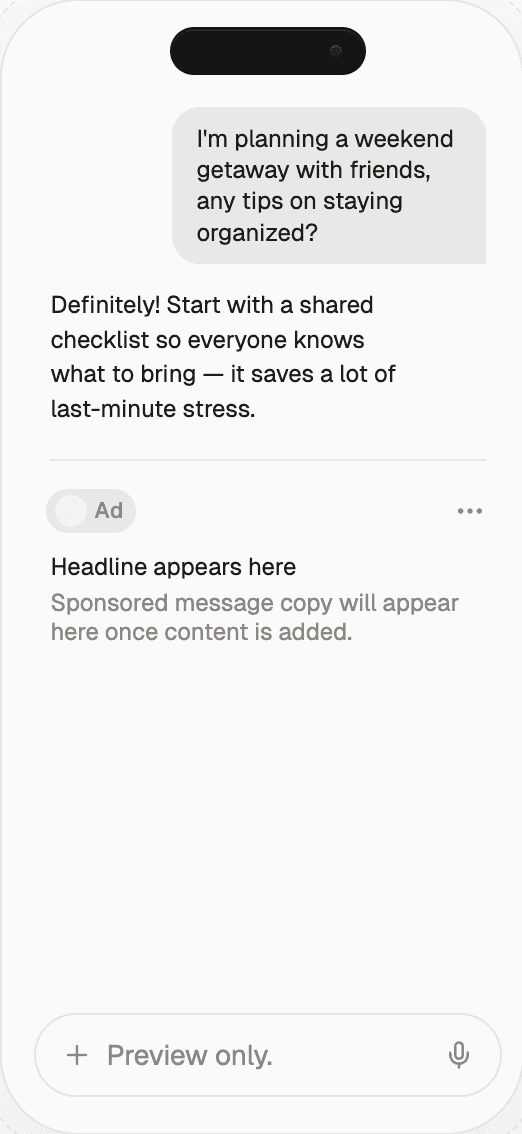
Be present when decisions are made
Traditional media captures attention.
Conversational media captures intent.
With Thrad, your brand reaches users in their deepest moments of research, evaluation, and purchase consideration — when influence matters most.
Date Published
Date Modified
Category
Advertising AI
Keyword
how to monetize chatgpt output