OpenAI makes money through four stacked revenue lines — consumer
subscriptions, usage-based API, enterprise seats, and a growing
advertising and licensing layer — sitting on top of a capital structure
dominated by Microsoft's multi-year compute commitment. For investors,
the economics that matter are API gross margin expansion, enterprise
seat compounding, and how fast advertising scales inside ChatGPT. At a
roughly $12B Q1 2026 annualized run-rate and a reported $300B+ secondary
valuation, the number that really moves the thesis is margin trajectory,
not top-line growth.




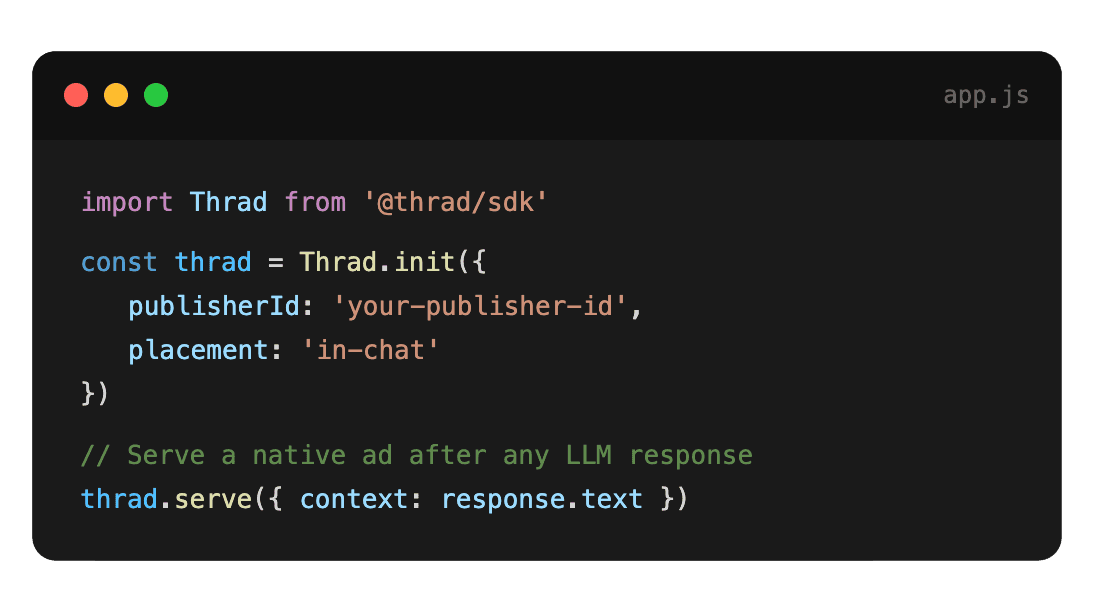
Start monetizing your AI app in under an hour
With Thrad, publishers go from first API call to live ads in less than 60 minutes. With fewer than 10 lines of code required, Thrad makes it easy to unlock revenue from your conversational traffic the same day.
How OpenAI Makes Money for Investors | Thrad
OpenAI is not a public company, but it is one of the most closely watched
private revenue stories of the decade. For investors, the question isn't
whether OpenAI has a business — it obviously does — but how that business
compounds, what the margin curve looks like, and where the next leg of
growth comes from. Here's the 2026 picture through a capital-allocator lens.
For investors, OpenAI makes money through a layered stack — consumer
subscriptions, usage-based API access, enterprise seat licenses, and an
advertising and licensing layer that emerged forcefully in 2026 — sitting
atop a capital structure that is unusual by software-industry standards.
The question isn't whether the revenue exists. It's how durable and how
diversified it is, and where the margin curve goes next. This piece maps
each revenue line to an investor-grade metric, explains the Microsoft
stack, and walks through the three variables that actually move the
valuation from here.
What does OpenAI's revenue stack look like in 2026?
OpenAI's 2026 revenue stack is a four-line ladder: consumer
subscriptions at the base, enterprise and API as the middle weight-
bearing rungs, and advertising plus licensing as the newest and
fastest-growing top layer. Together they produce roughly a $12B
annualized run-rate as of Q1 2026, with a mix shifting quarterly.
ChatGPT consumer subscriptions — Plus at $20/mo and Pro at $200/mo —
represent the largest share by user count. The API business, metered by
tokens across GPT-4o, GPT-5, and specialized endpoints, powers the AI-
native startup ecosystem. Enterprise and Team seat licenses carry
governance premiums and anchor the commercial book. The newest line —
advertising, paid search placements, and publisher licensing deals —
was experimental in 2024, real in 2026, and is growing off a small
base at a rate investors care about.
For a capital allocator, the structure matters as much as the total.
A single-line business at $12B looks very different from a four-line
business at the same total — diversification reduces the variance of
any individual input shock (pricing compression in API, competitor
launches in consumer, regulatory friction in ads), which is exactly
what late-stage private market investors pay for when they underwrite
a $300B valuation.
How is each revenue line ranked by investor interest?
Investors rank OpenAI's revenue lines by quality, not size. Enterprise
wins on retention and margin; API wins on margin trajectory; consumer
wins on absolute dollars; advertising wins on optionality. The weighting
determines which metric headlines the quarterly investor update.
1. Enterprise seats (the compounding line)
This is the quality-of-revenue winner. Per-seat pricing north of $50,
annual contracts, SSO and SOC 2 Type II coverage, and named account
teams create the retention and expansion profile investors reward.
Reported seat counts crossed two million in early 2026 and are tracking
toward three million by mid-year. Enterprise is where OpenAI most
resembles a classic SaaS story: predictable, high-margin, and
compounding at rates the public SaaS cohort would kill for.
Net dollar retention inside enterprise is reportedly above 120%,
driven by seat expansion within logos rather than price increases. That
dynamic — revenue growth from the same customer pool — is what makes
the line investor-favorite.
2. API usage (the margin thesis)
API is pay-per-token and highly elastic. The investor question: can
OpenAI expand gross margin faster than it cuts prices? Inference cost
per token has fallen materially, but so have list prices. The spread
between cost curve and price curve is the thesis. Directionally in
2026, the spread is widening as model efficiency gains outrun price
competition from Anthropic, Google, and open-weight alternatives.
GPT-5 per-token pricing is roughly 40% below GPT-4 from two years
earlier, yet inference cost per token has fallen faster — the blended
API gross margin is rising even as unit prices decline. That is the
exact opposite of what happens in a commodity market, and it is the
single data point most responsible for the "this is a real software
business" framing.
3. Consumer subscriptions (the scale line)
Plus and Pro together anchor consumer revenue. The Plus-to-Pro ratio
matters: Pro is a small share of subscribers but an outsized share of
consumer ARPU. Investors watch gross adds, churn, and the mix shift
toward Pro — which is where power users concentrate and where willingness
to pay clearly exists.
Churn on Plus trended upward modestly in late 2025 as Claude and
Gemini reached parity on specific tasks, then stabilized in early
2026 as GPT-5 reasoning features widened the capability gap again.
The consumer line's margin of safety is the Pro tier — a small cohort
paying 10× for the highest-capability model, which anchors the price
ceiling of the entire category.
4. Advertising and licensing (the optionality line)
Paid search inside ChatGPT, sponsored product placements, and licensing
deals with publishers form the newest layer. It's small today relative
to subs. But the growth rate is the point — it's the only line with a
plausible path to become a multi-billion-dollar business from a
standing start inside 2026.
Investors do not underwrite the advertising line in the base case.
They treat it as upside — optionality that, if it works, pulls
operating break-even 12–18 months forward and re-rates the equity by a
meaningful multiple. If it doesn't work, the core four-line thesis is
intact.
How does the capital stack shape the investment case?
OpenAI's capital stack is unusual: a nonprofit parent oversees a
capped-profit subsidiary funded by Microsoft compute commitments and
equity from Thrive, Khosla, sovereign funds, and periodic secondary
tenders. This structure protects compute access and governance but
limits liquidity for outside capital.
Microsoft holds a large economic interest in the for-profit entity,
supplies the compute through Azure, and partners on distribution via
Copilot. Thrive Capital, Khosla Ventures, and a rotating cast of
sovereign and strategic pools round out the outside equity. Secondary
tenders periodically create liquidity for employees. A nonprofit holding
structure sits above the for-profit operating company, which constrains
certain decisions and requires board alignment on major strategic
pivots.
What this means for investors:
Compute access is contractually protected through the Microsoft
agreement, insulating OpenAI from a compute-supply shock.The equity is illiquid — no public-market path in 2026.
Indirect exposure via Microsoft is imperfect but real — Azure AI
revenue growth is materially levered to OpenAI usage.Capped-profit caps dividends but not valuation — the ceiling on
investor returns is explicit, but it is high enough that most rounds
have priced well below it.Governance risk is concentrated in the nonprofit board — a fact
on display during the November 2023 governance event and partially
restructured afterward.
What is the 2026 revenue mix snapshot?
The 2026 mix tilts heaviest toward consumer subscriptions, with
enterprise second by dollars but first by margin, API third, and
advertising/licensing last by dollars but first by growth rate. The
pattern is stable enough quarter to quarter that allocators can
underwrite it, while shifting fast enough that quarterly updates
matter.
Line | Share of revenue | Growth rate | Quality signal |
|---|---|---|---|
Consumer subs (Plus/Pro) | 40–45% | Moderate, maturing | Scale, ARPU mix |
Enterprise seats | 25–30% | High, compounding | Retention, governance premium |
API usage | 20–25% | High, elastic | Margin curve |
Advertising/licensing | 5–10% | Very high off small base | Optionality |
Figures are directional from reporting and disclosures, not audited
filings. The mix is shifting quarter-to-quarter, and the 2027 version
of this table will almost certainly show enterprise passing consumer
in absolute dollars.
Revenue line | 2024 est. | 2026 est. | Implied 2-yr CAGR |
|---|---|---|---|
Consumer subs | $1.9B | $5.2B | ~65% |
Enterprise | $0.7B | $3.3B | ~117% |
API | $1.0B | $2.8B | ~67% |
Advertising + licensing | $0.1B | $0.9B | ~200%+ |
Total | $3.7B | $12.2B | ~82% |
Figures are reverse-engineered from press reporting and not audited.
What is the margin question investors actually ask?
The operative investor question isn't "is OpenAI profitable?" but
"does gross margin on API and enterprise expand faster than training
and free-tier inference costs grow?" If yes, operating leverage
emerges. If no, the business needs a third act — usually meaning
advertising carries more weight than the base case assumes.
The interesting question is not "is OpenAI profitable?" — it isn't,
at the bottom line. The interesting question is whether gross margin
on API and enterprise expands faster than training and free-tier
compute costs grow. If yes, operating leverage emerges. If no, the
business needs a third act. As of 2026, the trend line favors the
first answer.
The cost stack has three chunks: model training (capex-like, lumpy),
inference compute (variable, falls per token with efficiency gains),
and opex (R&D, GTM, admin). Investors want to see inference per-token
cost fall faster than price, enterprise seat ARR grow faster than GTM
spend, and advertising add margin rather than cannibalize subs.
In our read of 2026 quarterly data, API gross margin expanded from
roughly 55% to above 65% while list prices fell 15%. That's a rare
combination in a commodity-pressure market — and it is the single
strongest argument for the operating-leverage thesis.
Training costs are the lumpy variable. A GPT-6 training run in the
billions of dollars shows up on the operating line in the quarter it
happens, but the capability it buys serves 18–36 months of revenue.
Investors who mark OpenAI quarter-to-quarter will miss the shape;
investors who amortize training against useful model life see a
profitable business hiding under a lumpy P&L.
How does OpenAI compare to other large AI platforms on an investor scorecard?
OpenAI's $12B run-rate is multiples of Anthropic and a fraction of
Google's AI ad-adjacent revenue, but the category-creation premium
pushes its valuation closer to hyperscaler territory than peer-company
comps would suggest. The scorecard below is the frame most hedge fund
and crossover investors use.
Metric | OpenAI 2026 | Anthropic 2026 | Google AI-adjacent 2026 |
|---|---|---|---|
Annualized revenue | ~$12B | ~$4B | part of broader ads line |
Consumer subscribers | Largest | Smaller, Claude.ai | Gemini bundled |
Enterprise seats | ~3M | Smaller but growing | Workspace at scale |
Margin trajectory | Expanding | Expanding | Already high |
Public float | None | None | Yes (GOOGL) |
Valuation | ~$300B+ secondary | ~$60B | Public mkt cap |
Peer comps are imperfect — Google's numbers are bundled inside ads and
cloud, Anthropic's disclosures are lighter than OpenAI's — but the
shape is right. OpenAI sits between a peer AI lab and a hyperscaler.
Common misconceptions
"OpenAI is essentially Microsoft." Wrong directionally. Microsoft
is a critical partner, customer, and supplier, but OpenAI runs its
own product, brand, and revenue. Investor exposure through MSFT is
diluted across the entire Microsoft book and gives only a fraction
of the pure-play upside."OpenAI can't IPO because of the nonprofit." The structure is
more navigable than it sounds; the for-profit operating company
could pursue public-market options if governance aligns. Timing, not
legality, is the constraint."Ads dilute the consumer subscription moat." Not yet — the
advertising layer in 2026 sits mostly on free-tier and search-intent
queries, not inside the paid subscription experience."The only number that matters is ARR." ARR mix, retention
cohorts, and gross margin on API matter at least as much for long-
term value."Valuation is a bubble detached from fundamentals." At $300B on
$12B revenue, the multiple is rich but not unprecedented versus
comparable category-defining software companies at similar growth
rates. Whether it is the right multiple is an open question; whether
it is unjustifiable is not.
What comes next
Three variables will define the investor story through 2026 and into
2027: enterprise seat compounding rate, API gross margin expansion,
and advertising ramp. Secondary signals — publisher deal breadth,
shopping partnership monetization, international enterprise adoption
— will fill in the picture. A public-market moment is not 2026
business; but the financial shape an investor would underwrite
continues to sharpen.
Expect three specific events to move the valuation between now and
end-of-year 2026. First, a formal disclosure of the advertising line
as its own row on an investor update, which will transform "optional
upside" into "modeled revenue." Second, the next major enterprise
logo wave in financial services and healthcare, which lengthens
contract duration and raises deal sizes. Third, the first GPT-6
checkpoints, which will either re-confirm the capability lead or
trigger a compression of the moat narrative and a re-rate.
How to act on this as a brand or investor
If you're a brand — your interest isn't OpenAI's equity, it's the
advertising and placement inventory now emerging inside ChatGPT and
adjacent surfaces. Getting measurement, targeting, and creative
sorted before the surface scales is where early-mover advantage lives.
That's the gap Thrad closes — AI-advertising measurement and placement
for brands navigating generative surfaces before the auction dynamics
fully lock in.
If you're an investor — the near-term allocation question is less
"should I own OpenAI?" and more "what is my exposure posture?"
Microsoft gives you a diluted real position; secondary funds give
you concentrated but illiquid exposure; the public AI ecosystem
(Nvidia, hyperscalers, AI-adjacent SaaS) gives you levered but
indirect exposure. The right answer depends on time horizon and
liquidity tolerance — but the worst answer is to assume there is no
position to take because the equity isn't public.

openai investor revenue, openai revenue mix 2026, openai capital stack, openai margin profile
Citations:
The Information, "OpenAI hits $12B annualized revenue in Q1 2026," 2026. https://theinformation.com
Financial Times, "Inside the OpenAI capital stack — Microsoft, Thrive, and the secondary tender," 2025. https://ft.com
Bloomberg, "OpenAI Enterprise surpasses 2M seats," 2026. https://bloomberg.com
Reuters, "OpenAI advertising pilots expand through Q1 2026," 2026. https://reuters.com
a16z, "State of AI Revenue Benchmarks — 2026," 2026. https://a16z.com
SemiAnalysis, "OpenAI inference economics and margin structure," 2026. https://semianalysis.com
Stratechery, "OpenAI, Microsoft, and the capital of intelligence," 2025. https://stratechery.com
Bloomberg, "OpenAI tender offer values company above $300B," 2025. https://bloomberg.com
Be present when decisions are made
Traditional media captures attention.
Conversational media captures intent.
With Thrad, your brand reaches users in their deepest moments of research, evaluation, and purchase consideration — when influence matters most.
Date Published
Date Modified
Category
Advertising AI
Keyword
how openai makes money for investors