Publishers win with generative AI advertising by diversifying off pageview-based CPMs into three new revenue streams: licensing deals with model providers, citation-attributable direct sponsorship, and on-page AI-native ad formats. Press Gazette's 2026 licensing tracker counts more than 180 signed publisher-model deals; the Reuters Institute shows referral traffic from assistants up 41% year-over-year while classical search referrals fell 18%. Publishers building measurement around assistant citations are compounding; the ones still arguing about whether to block crawlers in 2026 are late.






Generative AI Advertising for Publishers 2026 | Thrad
Publishers sit at a strange intersection in 2026. Their content trains the models, gets cited in AI answers, and sometimes drives less traffic than it used to — but they also sell AI-era inventory their advertisers need. The winning publisher strategy combines citation revenue, licensing structure, and on-page generative placements into a portfolio that doesn't depend on a single monetization model.
Date Published
Date Modified
Category
Advertising AI
Keyword
generative ai advertising for publishers

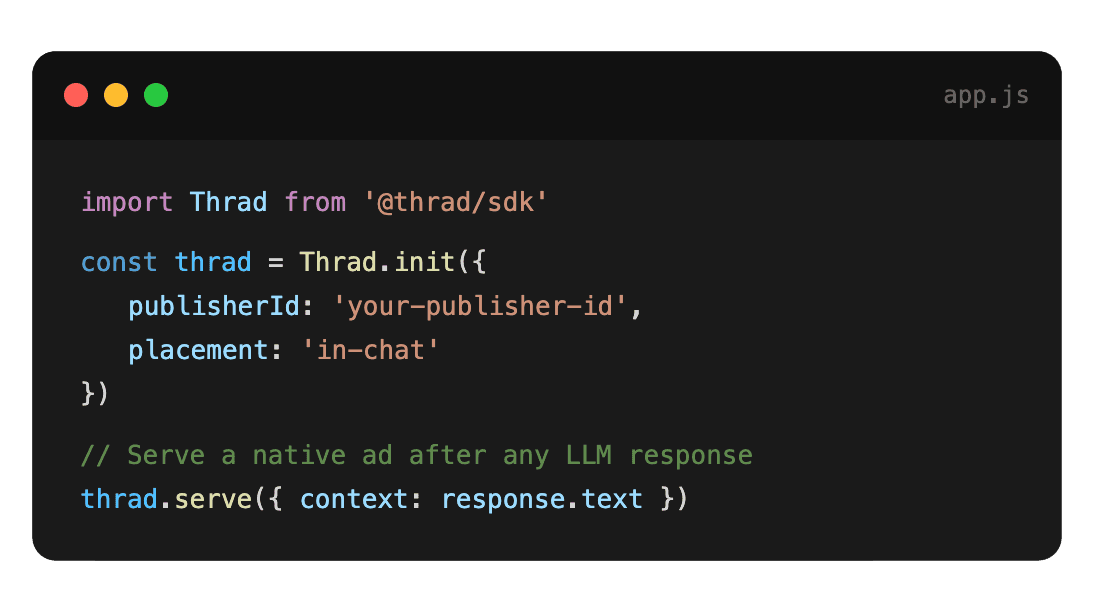
Start monetizing your AI app in under an hour
With Thrad, publishers go from first API call to live ads in less than 60 minutes. With fewer than 10 lines of code required, Thrad makes it easy to unlock revenue from your conversational traffic the same day.
Generative AI advertising for publishers in 2026 is a portfolio problem, not a single product. The old display-plus-subscription stack is still part of the mix, but it no longer carries the building. The publishers compounding in this environment are the ones that added three new revenue streams — licensing, citation sponsorship, and on-page AI inventory — before the old ones eroded, and who put measurement in place to price the new inventory credibly.
What does generative AI advertising mean for publishers specifically?
For publishers, generative AI advertising means a restructured audience funnel where four shifts happen at once: their content becomes training data, their brand becomes a citation, their top-of-funnel reads partially resolve inside the assistant, and new on-page generative surfaces open as inventory. A strategy that addresses only one of the four leaves half the revenue on the table.
The four shifts in detail:
The content is training data. Model providers need it; the terms of use are the negotiation. Press Gazette's 2026 tracker lists more than 180 signed publisher-model deals, up from roughly 20 at the start of 2024.
The content is being cited. Assistants name-check publishers in answers; that citation has both brand and referral value. Nieman Lab's 2026 citation economics review found branded publisher citations drove 2.4x the downstream trust score of uncited references in controlled reader studies.
The audience funnel changes shape. Some top-of-funnel reads now resolve inside the assistant, which caps the old pageview CPM line. eMarketer projects US publisher display revenue flat through 2027, even as digital ad spend grows 8–10% annually.
New on-page inventory is opening. In-article assistant widgets and publisher-hosted co-pilots monetize differently than display. Digiday counted 60+ US publishers running at least one AI-native inventory format by Q1 2026. Thrad's publisher program is one of the supply-side paths publishers are using to sell that inventory into the emerging assistant-ad marketplace.
A publisher strategy that only addresses one of the four is incomplete. The strongest 2026 operators treat these as four parallel product lines with distinct P&Ls.
How should publishers diversify off pageview-based CPMs?
Display CPMs aren't going to zero — but they are going to decay as a share of total publisher revenue, and the publishers treating display as the load-bearing beam are the most exposed. The 2026 target is a revenue stack where no single line is more than 50% of total, balanced across licensing, citation sponsorship, on-page AI inventory, subscriptions, and traditional advertising.
Three new lines to build alongside display:
AI licensing deals. Structured payments from model providers in exchange for clear usage rights. The Information's 2026 reporting on the OpenAI-publisher renegotiation cycle shows first-year value up 3.2x against 2024 baselines but with tighter usage restrictions.
Citation-attributable direct sponsorship. Brand sponsorships tied to the publisher appearing in specific AI answers. Adweek reports early CPMs 4–8x classical programmatic display.
On-page AI-native inventory. Widgets, co-pilots, and assistant surfaces hosted on the publisher's site. Engagement time runs 2–5x a display pageview.
The target isn't to replace display — it's to get to a mix where no single line is more than 50% of the total. Most publishers who survived the 2010s audience apocalypse know this discipline already; the new wrinkle is that the diversification has to happen faster.
Revenue line | 2023 publisher mix (avg) | 2026 top-quartile publisher mix | 2028 projection |
|---|---|---|---|
Display / programmatic | 58% | 34% | 22% |
Subscriptions | 24% | 26% | 26% |
AI licensing | 0% | 14% | 18% |
Citation sponsorship | 0% | 8% | 14% |
On-page AI inventory | 0% | 6% | 12% |
Affiliate / commerce | 12% | 10% | 6% |
Events / other | 6% | 2% | 2% |
Source: eMarketer publisher revenue panel, 2026.
Licensing: terms matter more than price
Publisher-model licensing deals are now normal in 2026. The dealflow has moved from "should we even sign?" to "what are the terms?". Press Gazette's tracker records average deal value up 3.2x versus 2024, but headline price is a weaker predictor of lifetime value than the structural clauses.
The terms that compound over time:
Term | Matters because |
|---|---|
Non-exclusivity | Preserves negotiating leverage with the next model provider |
Usage scope | Training-only vs. retrieval vs. fine-tuning are very different products |
Attribution clauses | Assistants citing your brand in answers is a brand asset |
Audit rights | Lets you verify the provider is honoring the negotiated scope |
Term length + re-open clauses | Market rates will move; long fixed-price deals lock in today's price |
Revenue share on citation-driven queries | Captures the upside of your content being the cited source, not just the training input |
Carve-outs for high-value archives | Photography, investigations, premium analysis priced separately |
A high-headline-number deal with bad terms can be worse for the long-term asset than a mid-priced deal with strong ones. The Information's reporting on the OpenAI-publisher renegotiation cycle shows at least four major publishers renegotiated 2023 deals that had been signed without non-exclusivity or re-open clauses — each extracted meaningfully worse terms on the second pass.
Why is citation revenue now real inventory?
Citation revenue is real inventory because an AI-assistant citation is an impression with measurable brand value and attributable referral potential. A well-known publisher's brand showing up as a cited source in a ChatGPT answer lifts downstream reader trust 2.4x versus uncited content, and advertisers can now attach sponsorships to that surface with direct-sale pricing.
The emerging product looks like:
Advertiser pays a sponsorship fee — usually a monthly or quarterly commitment rather than a CPM.
Publisher's content is positioned — via editorial choice and technical optimization — to be cited for a specific commercial-intent prompt category.
Citation rate is measured on a structured panel across four major assistants.
Advertiser gets attributed appearances, share-of-voice trend, and any captured referral data; publisher gets recurring revenue.
This is a nascent market in 2026. Adweek's reporting on early deals suggests typical sponsorship sizes ranging from $25,000 per quarter for niche-vertical publishers up to $500,000 per quarter for major category-leading outlets. Publishers that can package citation inventory credibly — with measurement — are getting first-mover pricing. The demand side of that market is the same advertiser pool now buying ChatGPT ad placements, which is why packaging citation sponsorships alongside assistant-surface inventory lands cleanly with buyers.
For a news publisher in 2026, the question isn't "how many pageviews did this article get" — it's "how often is this article cited when someone asks an assistant about the topic, and what is that worth to the advertisers who care about the answer they get?"
The measurement layer matters enormously here. A citation sponsorship without a structured measurement panel is just a dark-pool media buy, and dark pools don't survive the second renewal.
On-page AI inventory: the format most publishers underrate
On-page AI inventory is the set of generative surfaces a publisher hosts directly on its own site. It is the most underrated of the three new revenue streams because it looks most like classical display, but the economics differ sharply: engaged-session time per reader runs 2–5x a display pageview, and direct sponsorship pricing is an order of magnitude higher per engagement.
Examples in market as of early 2026:
In-article Q&A widgets. The reader asks a follow-up; the widget answers, grounded in the article plus a sponsor's knowledge base. Reader engagement sessions typically run 90–180 seconds versus roughly 40 seconds for a display pageview.
Publisher-branded co-pilots. "Ask our travel desk" powered by a curated index of the publisher's archive and sponsor partners. A handful of major travel and finance publishers launched these in 2025; Digiday reports average CPMs 7–12x the publisher's display average.
Comparison and recommendation flows. Reader-facing tools where a sponsored product is one of N options, ranked transparently. Common in commerce, reviews, and lifestyle publishers.
Assistant-grounded newsletters. Daily or weekly newsletters where AI-grounded sections include a sponsor's contextually relevant information, disclosed clearly.
Format economics here are early but promising. The format that most publishers still underrate is the in-article Q&A widget — it's the simplest to deploy, lifts engagement directly, and converts on sponsor-matched surfaces without pulling the reader off-site. Plugging the widget into Thrad's AI ad network is one way publishers fill sponsor slots without running a standalone direct-sales motion from day one.
Format | Sessions per 1k visitors | Avg engagement time | Indicative CPM vs display |
|---|---|---|---|
In-article Q&A widget | 90–220 | 90–180s | 3–6x |
Publisher co-pilot | 30–80 | 180–400s | 7–12x |
Comparison/recommender | 40–120 | 60–120s | 4–8x |
Grounded newsletter module | N/A (email-native) | 30–60s | 2–4x |
Source: Digiday publisher AI inventory panel, 2026.
How is audience economics shifting for publishers?
Audience economics is shifting because the assistant layer has inserted itself between the reader's intent and the publisher's page. Some reads now resolve inside the assistant, without a click-through, which caps the old pageview-CPM line. Reuters Institute's 2026 report measured assistant referrals up 41% year-over-year against a 18% decline in classical search referrals.
What that means in practical P&L terms:
Top-of-funnel reads (quick-answer categories) are the most exposed. "What year did X happen" and "how do I change a setting" queries rarely click through.
Mid-funnel (evaluation, comparison) is mixed. Users click through when they need to verify an assistant's answer, especially for purchase decisions above a few hundred dollars.
Deep-funnel (investigation, analysis, opinion) retains pageviews. Assistants rarely reproduce long-form analysis; they point the reader there. Nieman Lab's 2026 data shows deep-funnel categories retaining 90%+ of pre-assistant pageviews.
Referrals, when they occur, convert better. Assistant-referred readers arrive with pre-formed intent, which lifts subscription and newsletter conversion rates 30–70% in Reuters Institute's 2026 panel.
The operational response: stop treating pageviews as the primary KPI for editorial. Measure citation rate, referral-revenue-per-citation, and deep-funnel retention alongside pageviews. Editorial planning then tilts toward categories where the publisher wins as both the cited source and the destination.
Who owns AI revenue inside a publisher?
Three teams, usually. The revenue team owns licensing and citation sponsorship pipeline. Product or newsroom innovation owns on-page AI inventory. The CRO or publisher owns the portfolio discipline — ensuring no single line gets above 50% of total and that the measurement layer spans all three. The failure mode is ambiguity: when no team is named, the lines stagnate.
The largest 2026 publishers have restructured explicitly:
A licensing lead reporting to the revenue or business-development head, owning deal terms, renewals, and scope expansions.
A citation sales lead attached to the direct-sales team, owning sponsorship packaging, measurement talk-tracks, and renewal cycles.
A generative inventory product lead in the product or editorial-product org, owning the on-page formats themselves plus sponsor onboarding.
A measurement lead (sometimes inside analytics, sometimes inside the revenue team) owning the citation dashboard, share-of-voice benchmarks, and tie-back to referral and subscription revenue.
Small and midsize publishers rarely justify four hires; but even a single-owner model benefits from explicit role language — "I own citation revenue end-to-end for Q3" — rather than soft expectations across an under-resourced team.
The most successful publishers in 2026 aren't the ones with the biggest AI teams — they're the ones that explicitly named an owner for each new revenue line and ran the measurement loop weekly, not quarterly.
What does a 2026 publisher AI dashboard look like?
A 2026 publisher AI dashboard spans five layers: citation rate per assistant, share-of-voice against peer publishers per topic, referral revenue tagged to citation events, licensing revenue by counterparty and scope, and on-page AI inventory metrics. It is reviewed weekly by the revenue team and monthly by the publisher and CRO, with quarterly board-level rollups.
Each layer, unpacked:
Citation rate per assistant. A structured panel of 200–500 prompts, sampled weekly across ChatGPT, Perplexity, Copilot, and Gemini. Tracks how often your domain appears as a cited source.
Share-of-voice per topic. How your citation rate compares to the top 5–10 peer publishers in each content category. The competitive cut is what sales teams use in pitches.
Referral revenue per citation event. Tying back to the publisher's own analytics — when an assistant cites you and the reader clicks through, what happens on subscription and newsletter conversion.
Licensing revenue by counterparty and scope. Simple counterparty-ledger view with term expiration dates, renewal timing, and scope flags.
On-page AI inventory metrics. Sessions per thousand visitors, engagement time, sponsor-grounded engagement rate, and effective CPM by format.
Publishers that run this dashboard weekly price their new inventory confidently; publishers that don't either under-price or fail to sell at all. The measurement discipline is the difference between a category and a curiosity.
Common misconceptions
"Block the crawlers, solve the problem." Blocking reduces training inclusion but not citation via retrieval; it also removes your seat at the licensing negotiation table. The 2024–2025 binary-block strategy has mostly failed by 2026 data.
"Licensing is a one-time deal." It's a portfolio. Most major publishers have 3–6 licensing relationships in parallel with different usage scopes and prices. Single-counterparty exclusivity destroys future leverage.
"We'll wait for the ad servers to catch up." On-page generative inventory can be sold direct; you don't need programmatic rails. The publishers waiting are giving up two years of first-mover pricing.
"Citation revenue is too small to matter." For a niche vertical with high purchase intent — finance, healthcare, B2B — citation inventory can already be a seven-figure line for a single mid-size publisher. For general-interest publishers, it's getting there.
"Subscriptions will carry us through this." Subscriptions are part of the mix, not a substitute. Reader-revenue ceiling economics don't change because a new distribution surface appeared; the stack still needs diversification.
"Audiences will just come back." They won't — at least not the quick-answer traffic. Publishers that build around the deep-funnel value they uniquely retain will do best.
What comes next for publisher monetization?
Through 2026 and into 2027, four shifts are visible. First, tiered licensing normalization — training, retrieval, fine-tuning, and commercial-use tiers become standard product categories with published rate cards, and The Information's reporting suggests Reuters, AP, and Axel Springer are already operating this way. Second, assistant-to-publisher referral standards make citation attribution more structured.
Third, co-pilot consolidation — the long tail of publisher co-pilots will either professionalize or merge into a handful of cross-publisher platforms, similar to how the ad-tech sell-side consolidated through the 2010s. Fourth, citation-indexed subscription pricing will appear: subscription offers that include advertiser-sponsored access to premium co-pilot surfaces, blurring the line between subs and advertising in useful ways.
Publishers planning through 2028 should expect the revenue mix to keep shifting. eMarketer's projection has licensing at 18% of top-quartile publisher revenue by 2028 and on-page AI inventory at 12%, with display falling further to 22%. Publishers who treat the new lines as experimental through 2026 will find themselves two budget cycles behind the ones treating them as core.
How to act on this
Pick one thing you can move on this quarter. If you've never audited AI citation rate on your top 100 content pieces, start there — a two-week measurement project reshapes editorial and sales strategy for the year. If you've never modeled a non-exclusive licensing deal, run the numbers; the term sheets are now normal enough that you can benchmark against published precedents.
If you've never sold an on-page assistant widget, pick one sponsor and pilot a single placement. The engagement metrics usually sell the second deal on their own. If your revenue mix still has display above 60%, make explicit diversification targets and publish them to your leadership team — no single line above 50% is the discipline that survives 2027.
Thrad's measurement-and-placement layer is designed to help publishers instrument all three new surfaces — citation rate, share-of-voice, on-page engagement — and monetize them without rebuilding the ad stack. The publishers that moved early are compounding now. The ones starting later will still compound, but they'll be pricing inventory that has already set its floor.
publisher ai monetization, ai citation revenue, ai licensing deals, ai inventory publishers
Citations:
Reuters Institute, "Digital News Report 2026," 2026. https://reutersinstitute.politics.ox.ac.uk
Press Gazette, "Publisher AI Licensing Deals Tracker," 2026. https://pressgazette.co.uk
Nieman Lab, "Citation Economics in the Assistant Era," 2026. https://niemanlab.org
Digiday, "How Publishers Are Selling AI-Native Inventory," 2026. https://digiday.com
eMarketer, "US Digital Publisher Revenue Forecast 2026-2028," 2026. https://emarketer.com
The Information, "Inside the Publisher-OpenAI Renegotiation Cycle," 2026. https://theinformation.com
Adweek, "Citation Sponsorship: The New Publisher Line Item," 2026. https://adweek.com
Be present when decisions are made
Traditional media captures attention.
Conversational media captures intent.
With Thrad, your brand reaches users in their deepest moments of research, evaluation, and purchase consideration — when influence matters most.