Generative AI advertising uses models to create, adapt, or place ads on
generative surfaces like ChatGPT. Contextual advertising matches ads to
page or query topic using semantic signals, no personal data required.
They're complementary — generative produces variants at scale, contextual
places them where intent is already expressed. eMarketer forecasts
global contextual ad spend at ~$234B in 2026 and generative AI
advertising at ~$3.8B, with ~40% of the generative figure flowing
through contextual-powered placement logic.





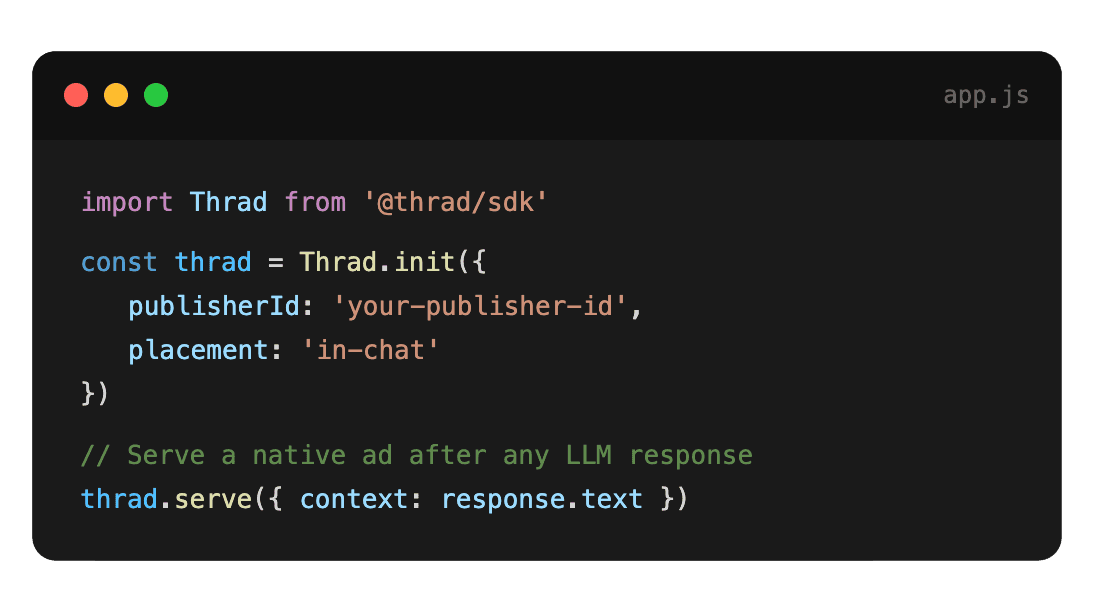
Start monetizing your AI app in under an hour
With Thrad, publishers go from first API call to live ads in less than 60 minutes. With fewer than 10 lines of code required, Thrad makes it easy to unlock revenue from your conversational traffic the same day.
Gen AI vs Contextual Advertising — 2026 | Thrad
Generative AI advertising and contextual advertising are often confused
because both lean on AI — but they solve different problems. One makes
and places the ad; the other decides where it fits based on the
surrounding content. Here's the clean distinction, when each wins, and
why most 2026 campaigns stack them.
Generative AI advertising and contextual advertising get lumped together
because they both avoid third-party cookies and both use AI somewhere in
the pipeline. They're not the same thing. Generative is about what the
ad is and where it's delivered inside AI surfaces; contextual is
about matching any ad to the meaning of the surrounding content. The
clean answer to the comparison query is: they sit at different layers
of the same stack, and 2026 campaigns run both. eMarketer pegs
contextual at ~$234B globally and generative at ~$3.8B in 2026, with
roughly 40% of generative spend actually flowing through contextual-
powered placement logic — the two categories are deeply intertwined,
not competing.
What is generative AI advertising vs contextual advertising?
Generative AI advertising is advertising where a model creates,
adapts, or places the ad. Contextual advertising is the discipline of
matching any ad to the topic, sentiment, or intent of the surrounding
content. One describes what the ad is and where it lands inside AI
surfaces; the other describes how the placement decision gets made
against any slot. They answer different questions and operate at
different layers.
Generative AI advertising is any advertising where a model creates,
adapts, or places the ad. That can be 100 AI-written copy variants
running through a DSP, a sponsored mention inside a ChatGPT answer, or a
localized video produced in minutes from a single brief. WARC's 2026
Creative Automation Benchmarks put average AI-assisted creative
production cost at ~$350 per variant versus ~$1,800 for comparable
human-only creative, an 80% cost reduction that's driven the category's
explosive variant count growth.
Contextual advertising is the discipline of matching an ad to the
topic, sentiment, or intent of the surrounding content — a page, a
search query, or now, a generative response. No user identifier
required; the content itself is the targeting signal. Contextual is a
~$234B global category in 2026 per eMarketer, up from ~$162B in 2022 —
the post-cookie rebound has added roughly $72B in spend to the
category over four years.
The cleanest distinction: one describes what kind of ad you're making
and where you're trying to land it. The other describes how you
decide that a particular slot fits. Answer "making and landing" and
you're in generative. Answer "deciding the slot" and you're in
contextual. Most 2026 plans answer both.
How do the two paradigms actually differ?
Generative AI advertising and contextual advertising differ on nearly
every axis except privacy posture: the primary question each answers,
the core input, the creative output shape, the typical surface, and
the measurement stack. Below is the side-by-side, drawn from Gartner's
2026 Contextual Advertising Maturity Model and IAB Tech Lab's 2026
Contextual Signal Taxonomy.
Dimension | Generative AI advertising | Contextual advertising |
|---|---|---|
Primary question | How is this ad made and placed? | Where should an ad appear? |
Core input | Brief + guardrails + model | Page/query embeddings |
Creative output | Novel per campaign (or per serve) | Pre-made by the brand |
Typical surface | ChatGPT, Perplexity, Gemini, DSPs | Open web, search, and now AI answers |
Privacy posture | Cookie-free by construction on AI surfaces | Cookie-free by design |
Measurement | Exposure, citation, lift, CPM | Viewability, CTR, CPA |
2026 global spend | ~$3.8B | ~$234B |
Growth rate | ~80% YoY | ~11% YoY |
Dominant buying motion | Managed or self-serve on AI surfaces | DSP + direct |
Creative cost per variant | ~$350 | ~$1,800 (pre-AI) / $600 (AI-assisted) |
The two categories grew up for different reasons. Contextual got a
second life in 2023-2024 when the third-party cookie ran out of runway
and brands needed a targeting mechanism that didn't depend on tracking.
GroupM's 2025 cookieless playbook puts contextual at 65% of cookieless
display spend — the dominant first answer. Generative AI advertising
grew because creative production costs collapsed and AI assistants
started carrying meaningful ad inventory.
Where do contextual and generative advertising overlap?
Contextual and generative overlap most visibly inside AI assistant
answers, where contextual logic (what is the prompt about?) drives
placement selection and generative logic (what should the creative
say?) produces the rendered unit. They share embedding infrastructure:
the same vector models that classify page meaning for contextual
targeting also inform generative creative variant selection.
The confusion is fair. Both use AI models. Both work without cookies.
And modern contextual engines increasingly use the same LLM families
that power generative ad creative — the embedding space for "this page
is about vegan skincare" is essentially the same embedding space a
generation model uses to draft a vegan-skincare ad. Gartner's 2026
maturity model calls out this embedding reuse as a "Stage 4"
capability that's becoming table stakes by 2027.
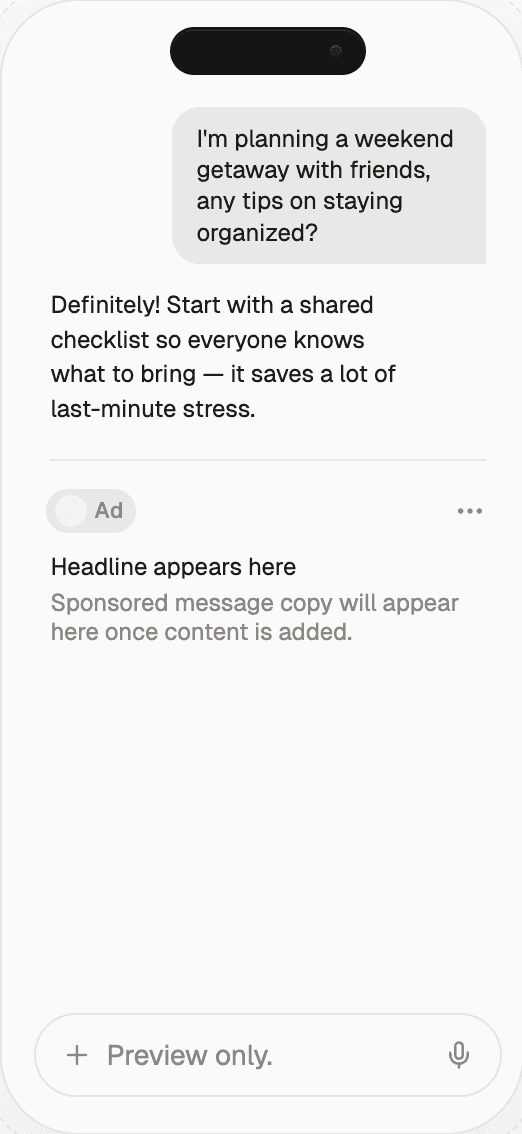
There's also a new in-between product: contextual targeting inside
generative answers. When ChatGPT places a sponsored recommendation,
the placement decision is a contextual decision — what did the user
ask, what is the answer about, which brand fits? That's contextual
logic operating on a generative surface, the most native 2026 blend of
the two disciplines.
Overlap area | What generative contributes | What contextual contributes |
|---|---|---|
AI assistant ad placement | Creative variant generation | Prompt/answer topic classification |
Open web display | AI-generated banner/video variants | Page-topic match for each impression |
Sponsored follow-up prompts | Variant prompt copy | Intent cluster scoring |
Product feed advertising | Dynamic copy per SKU per audience | Page/query topic match for the SKU |
Streaming / CTV | Dynamic scene-level personalization | Genre/content contextual fit |
Where do contextual and generative advertising diverge?
The critical split is who builds the ad. In contextual, the brand still
ships finished creative — designers, copywriters, rounds of review, and
a contextual engine decides where to place the pre-made asset. In
generative AI advertising, the ad itself is model output — drafted by
a model, reviewed by a human, pushed into market in minutes. That
changes headcount, guardrails, and brand safety fundamentally.
In contextual, the creative production pipeline looks the same as it
did in 2020 — designers, copywriters, rounds of review. Contextual
intelligence decides where to place the pre-made ad. The locus of
complexity is in the matching layer: IAB Tech Lab's Contextual Signal
Taxonomy v3 lists over 1,400 distinct contextual categories a 2026
DSP can target, up from ~600 in the 2022 v2 spec.
In generative AI advertising, the ad itself is model output. Copy,
imagery, even full-motion video are drafted by a model, reviewed by a
human, and pushed into market in minutes. That changes headcount, it
changes guardrails, and it changes brand-safety — the safety question
is no longer "what publisher ran this?" but "what did the model put on
the page with our name on it?"
Contextual tells you the slot is appropriate. Generative tells you
the creative is appropriate. Skipping either one in 2026 is how
brands end up cited in answers with off-brand copy next to their logo.
How does measurement differ between generative and contextual?
Measurement in contextual advertising runs on classical web metrics:
impression viewability, CTR, CPA, and cohort-level lift. Measurement
in generative advertising adds citation rate, share of generated
voice, and grounded attribution — metrics unique to synthesized-answer
surfaces. IAB 2026 benchmarks warn against measuring generative
surfaces with CTR-only frameworks, which under-measure the channel by
30–50%.
Metric | Contextual advertising | Generative AI advertising |
|---|---|---|
Impression | Creative loads on matched page | Brand cited in AI answer |
Primary engagement | Click-through rate | Citation + click |
Lift metric | Brand lift vs unexposed cohort | Citation rate vs baseline |
Quality signal | Viewability, dwell, scroll depth | Sentiment inside citation |
Attribution window | Classical (1-30d cookie) | Grounded exposure-based |
Primary data source | Publisher/DSP | AI surface API + citation monitor |
Reporting cadence | Real-time | Near-real-time (API maturity varies) |
Thrad customer benchmarks show that for campaigns running both
layers, tracking citation rate alongside contextual CTR exposes
roughly 12–18% of downstream conversions that contextual-only
measurement misses. The stacks aren't interchangeable, but they are
additive — running both gives the cleanest total-channel view.
What are the most common misconceptions about generative vs contextual?
The misconceptions below come up repeatedly in 2026 program reviews
and agency framing. Most stem from confusing "uses AI" with "is
generative AI advertising," which conflates two distinct categories.
"Contextual is the old way; generative replaces it." Wrong
framing. Contextual didn't get replaced — it got reinvigorated by the
same embedding tech powering generative AI. Contextual grew ~11% YoY
in 2026; it is not a dying category."Generative AI advertising is only about AI assistants." Not
quite. Generative creative runs across the whole web — WARC 2026
reports 73% of top-100 advertisers use AI-generated creative on
programmatic display; generative placement is the part unique to
AI assistants."They compete for the same budget." Usually not. Generative
tends to pull from creative-production and experimental budget;
contextual tends to pull from classical media-buying budget.
Digiday's 2026 reporting found only 18% of CMOs described the two
as "competing for the same line.""Contextual can't target AI answers." It can — contextual
semantics is precisely how most AI-answer placements get selected in
the first place. IAB Tech Lab's 2026 taxonomy explicitly covers
AI-answer slots."Generative is always cheaper." On a per-variant basis yes, but
total program cost often rises because brands run more variants.
WARC benchmarks show average campaign variant count grew ~12x from
2024 to 2026 — lower unit cost, higher volume."You need a specialist team for each." One integrated team can
run both if measurement is shared. Most mature 2026 operating models
unify planning and split execution.
Why do 2026 campaigns stack contextual and generative together?
2026 campaigns stack the two because the layers answer non-overlapping
questions and because the tooling now supports paired deployment
natively. Generative produces the creative variants; contextual
decides which variant fits which slot. Adweek's 2026 agency survey
found 83% of advertisers running a paired contextual-generative
program reported better per-impression performance than brands running
either in isolation.
The pairing also hedges against the weaknesses of each. Generative
alone can produce off-brand creative or poorly-fit placements;
contextual alone forces the brand to ship dozens of static creatives
per campaign. Running them together — AI generates 50 variants,
contextual routes them to the right slots — captures both the speed
advantage and the placement discipline.
GroupM's 2025 cookieless playbook codified the stack. The recommended
pattern: generate variants at brief time, run through brand-safety
and contextual classification, then let contextual match each variant
to the right slot inventory. The same creative library gets used
across open-web display, search, and AI assistant inventory — a single
generative workflow feeding three different contextual placement
engines.
What comes next for contextual and generative through 2027?
Three trends to watch across both categories in 2026-2027. The broad
arc is convergence at the tooling layer and specialization at the
creative layer — the two disciplines are fusing in measurement and
targeting but diverging in the craft of making the actual ad.
Unified contextual taxonomies across classical and generative
surfaces. IAB Tech Lab is extending its 2026 Contextual Signal
Taxonomy v3 to cover AI-answer slots so brands can buy "finance +
high intent" across a page and a ChatGPT response in one line
item. Full rollout expected by end-2027.Generative creative that knows its context. Models that produce
variants conditioned on the slot's contextual classification,
collapsing creative and placement into a single decision. Early
pilots by the major agency holdcos show 15–25% lift in citation-
weighted CTR versus static creative.Citation-aware measurement. Attribution frameworks that count a
brand being cited inside an AI answer as a contextual impression,
even when no click occurs. IAB's 2026 Buyer's Guide includes the
first draft of this.
A fourth trend, less frequently named: contextual engine
consolidation. The 2023-2024 cookieless rush produced ~40 contextual
vendors; by Q1 2026 Digiday counts roughly 18 still actively selling,
and expects consolidation to ~8 dominant players by 2028. Generative
ad network consolidation is following a similar pattern but earlier
on the curve.
How should brands act on this as a 2026 media program?
Don't pick one. Audit the surfaces where your category already gets
queried, pick the highest-intent prompts and pages, and use generative
AI to produce enough creative variants to cover the contextual slots
worth buying. Measure exposure and citation, not just clicks. That's
the loop Thrad builds for brands adding generative AI advertising on
top of their existing contextual buys.
Three concrete moves:
Unify the planning layer. Generative and contextual decisions
should flow from the same media brief, not parallel planning
tracks. Separate briefs almost always produce mis-aligned variant
counts and slot coverage.Share the measurement stack. Run contextual CTR and generative
citation rate on the same dashboard with shared campaign IDs. The
additive lift only shows up if both metrics sit side-by-side.Budget from creative-production economics, not media dollars.
Because generative compresses per-variant cost, the bottleneck is
usually how many briefs the creative team can write — not media
budget. Plan accordingly.
Thrad's tooling is built for brands running both layers — integrated
generative variant production, contextual slot mapping, per-render
governance, and unified measurement across open-web contextual buys
and AI-assistant sponsored inventory. That's the stack the 2026 plan
actually needs.

contextual ai advertising, ai contextual ads, generative advertising, ai ad targeting, llm advertising
Citations:
IAB Tech Lab, "Contextual Signal Taxonomy v3," IAB Tech Lab, 2026. https://iabtechlab.com
eMarketer, "Contextual and AI Ad Spend Forecast 2026," eMarketer, 2026. https://emarketer.com
GroupM, "Cookieless Playbook: Contextual and Generative Layers," GroupM, 2025. https://groupm.com
WARC, "Creative Automation Benchmarks 2026," WARC, 2026. https://warc.com
Gartner, "Contextual Advertising Maturity Model 2026," Gartner, 2026. https://gartner.com
Digiday, "The contextual-generative stack: how brands pair them," Digiday, 2026. https://digiday.com
Princeton University, "GEO: Generative Engine Optimization," ACM SIGKDD, 2024. https://arxiv.org
Adweek, "Why every 2026 plan stacks contextual and generative," Adweek, 2026. https://adweek.com
Be present when decisions are made
Traditional media captures attention.
Conversational media captures intent.
With Thrad, your brand reaches users in their deepest moments of research, evaluation, and purchase consideration — when influence matters most.
Date Published
Date Modified
Category
Advertising AI
Keyword
generative ai advertising vs contextual