Behavioral advertising uses a user's browsing history, purchases, and
cohort data to predict intent. Generative AI advertising uses the live
prompt and context of an AI conversation to place and adapt creative in
real time. Behavioral is identity-heavy and post-cookie-fragile;
generative is identity-light and native to AI surfaces. eMarketer
reports third-party-behavioral US display spend contracted ~18% in
2025 alone; generative AI advertising grew ~85% YoY in the same
period. The signal center of gravity is moving fast.







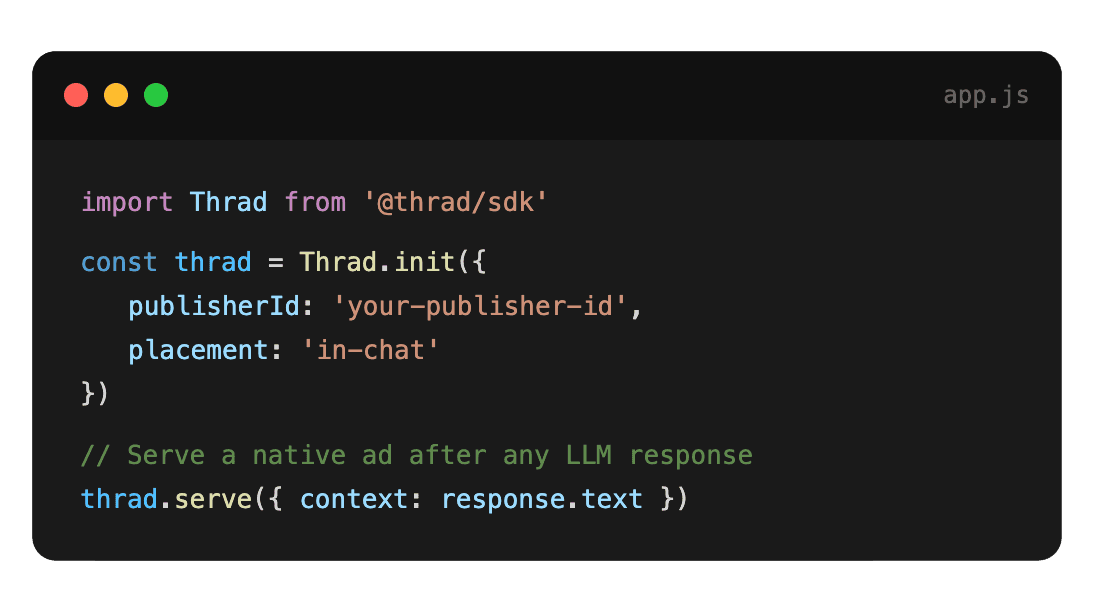
Start monetizing your AI app in under an hour
With Thrad, publishers go from first API call to live ads in less than 60 minutes. With fewer than 10 lines of code required, Thrad makes it easy to unlock revenue from your conversational traffic the same day.

Gen AI vs Behavioral Advertising — 2026 | Thrad
Behavioral advertising targets the user based on what they did before.
Generative AI advertising targets the moment — what the user is doing
now inside an AI conversation — and generates the creative to match.
The two paradigms come from opposite philosophies of audience signal,
and in 2026 the balance is tipping fast toward the moment.
Behavioral advertising was the dominant digital ad paradigm of the last
fifteen years: build a profile of the user, target the profile, serve
the creative. Generative AI advertising starts from a completely
different premise — the context of the moment is a richer signal than
a stitched-together history, especially when the moment is a live AI
conversation. That difference in signal philosophy is why the two
categories are diverging, and why the balance is moving. eMarketer
reports third-party-behavioral US display spend contracted roughly 18%
in 2025 while generative AI advertising grew ~85% — a rotation that
continues to accelerate through 2026.
What is generative AI advertising vs behavioral advertising?
Generative AI advertising targets the live moment — a prompt or
conversation inside an AI assistant — and produces or adapts the
creative to fit. Behavioral advertising targets a user's historical
profile — browsing history, purchases, cohort — and serves pre-built
creative. Generative works on declared intent; behavioral works on
inferred intent. That split is the difference in one sentence, and
every operational divergence flows from it.
Behavioral advertising targets users based on past actions: pages
visited, searches run, purchases made, apps opened. The signal is
identity-bound — a cookie, a device ID, a logged-in account — and the
creative is typically a pre-built asset served to whichever cohort that
identity lands in. The category's golden era was 2010–2020, when
third-party cookies and cross-site tracking made behavioral profiles
rich and cheap.
Generative AI advertising targets the moment. Inside an AI
assistant, the moment is the prompt and its context: "what's the best
noise-canceling headphone under $300 for calls?" The model, aware of
what the user is asking right now, decides which sponsored brand fits
and what copy to surface. No cookie, no cross-site profile — the
signal is the sentence the user just typed.
The philosophical split: behavioral predicts intent from the past;
generative reads intent directly from the present. WARC's 2026
"declared versus inferred intent" analysis quantified the gap: a live
prompt is roughly 3x more predictive of near-term (30-day) purchase
than a 30-day behavioral cohort constructed from browsing data.
How do the two paradigms differ across the stack?
The two paradigms differ at every layer of the ad stack: signal
source, identity dependency, creative flow, privacy posture, scale
mechanism, and best-fit use case. The differences aren't additive —
they compound, because a change in signal source forces a change in
creative, which forces a change in measurement, which forces a change
in governance.
Dimension | Generative AI advertising | Behavioral advertising |
|---|---|---|
Signal source | Live prompt + conversation context | Past browsing, purchases, cohort |
Intent type | Declared | Inferred |
Identity dependency | Low (AI surfaces have no cross-site ID) | High (cookies, device IDs) |
Creative flow | Generated or adapted per moment | Pre-built, served to cohort |
Privacy posture | Native privacy-friendly | Under regulatory pressure |
Scale (2026, US) | ~$1.8B and rising 85%+ YoY | ~$26B and contracting ~18% YoY (3P subset) |
Best for | High-intent AI queries | First-party retargeting, mid-funnel |
Failure mode | Poor prompt classification → wasted impression | Stale profile → irrelevant targeting |
Regulatory pressure | Emerging — disclosure rules | High — cookie deprecation + GDPR/CPRA |
Behavioral's scale advantage is fading as third-party cookies
disappear and mobile identifiers get locked down. Gartner's 2026
Identity Graph Deprecation Impact Report quantifies the hit: the
addressable third-party behavioral US audience shrank by roughly 34%
between 2022 and 2026, and the effective CPM for identifier-dependent
display rose 22% over the same window as inventory got scarcer.
Generative's scale is growing in step with AI assistant usage, which
has gone from novelty to everyday workflow across billions of queries
per day — SimilarWeb puts AI-assistant share of informational queries
at 18% in Q1 2026.
Why does the signal shift matter more than the cookie deprecation?
The underlying change isn't "AI replaces cookies" — it's that the
richest available signal is moving from "what did this user do
across 400 websites last month" to "what did this user just ask an AI
assistant." A prompt is declarative intent. A browsing history is
inferred intent. Declarative almost always wins, and 2026 is the first
year the declarative signal has meaningful scale.
That's why behavioral spend is compressing even when identifiers still
technically work. Advertisers prefer buying a slot next to a direct
question about their category over buying an impression for someone
who probably wants that category based on old data. Digiday reports
the five largest agency holdcos collectively cut third-party
behavioral US display line items by 22% YoY in Q1 2026 — not because
cookies vanished overnight, but because the declared-intent
alternatives outperformed on measured incrementality.
Behavioral advertising reads your past to guess your present.
Generative AI advertising reads your present sentence. One of those
is a lot more accurate in 2026, and measurement — not ideology — is
what forced the shift.
The broader framing, per Future of Privacy Forum's 2026 outlook:
behavioral advertising's entire value proposition assumed cross-site
identifier continuity. When that continuity weakens, the whole
construct loses resolution. Generative AI advertising never depended
on cross-site continuity in the first place; the signal is captured
at render time from the prompt itself.
Where does behavioral advertising still win?
Behavioral advertising retains clear advantages in three contexts:
first-party retargeting of logged-in users, deep-funnel personalization
with known customer history, and high-volume mid-funnel reach where
precision matters less than breadth. First-party behavioral is not
going anywhere; it's the third-party behavioral ecosystem that's
under pressure.
A brand that already has a logged-in user and an on-site behavioral
profile can deliver sharper mid-funnel experiences than a pure
generative-surface placement. Amazon's sponsored placements, Meta's
logged-in audiences, and Google's signed-in search remarketing all
fall into this category — they're technically behavioral, but the
identity is first-party and the regulatory risk is lower.
Three specific contexts where behavioral still outperforms generative
in 2026:
Logged-in retargeting inside owned properties. First-party
customer data produces the cleanest retarget. Generative surfaces
don't have a comparable signal for a known customer base.Long-cycle B2B nurture. A 9-month enterprise buying cycle
rewards identity-bound follow-up more than moment-in-time
generative placement.Loyalty and lifecycle marketing. Win-back, cross-sell, and
reactivation campaigns are inherently history-dependent; the
"past" is literally the feature, not the bug.
How does measurement differ between the two paradigms?
Measurement in generative AI advertising centers on citation rate,
share of generated voice, and grounded attribution. Measurement in
behavioral advertising centers on cohort lift, reach/frequency against
an identity graph, and last-click. The stacks aren't interchangeable;
running both means maintaining two analytic views or investing in a
unifying layer.
Metric | Generative AI advertising | Behavioral advertising |
|---|---|---|
Impression definition | Brand appears in AI answer | Creative loads for identified user |
Click metric | Click on cited/sponsored link | Click-through on served creative |
Primary lift metric | Citation rate vs baseline | Cohort-level conversion lift |
Attribution | Grounded / exposure-based | Last-click or multi-touch |
Reach unit | Share of generated voice | Unique identifiers reached |
Frequency | Per-intent render count | Impression count per identifier |
Signature failure mode | Under-measurement via CTR-only view | Identifier decay inflates CPM |
IAB's 2026 Post-Identifier Targeting Benchmarks explicitly recommend
citation-based metrics for generative surfaces and cohort-lift for
behavioral, with a caution against applying last-click attribution to
either — it undervalues both channels by an estimated 30–50%.
What are the most common misconceptions about generative vs behavioral?
Most misconceptions trace back to one of two assumptions: either that
generative needs behavioral data to work, or that behavioral is
already dead. Neither is accurate in 2026. The reality is a mixed
landscape where the dominant signal is shifting but not yet replaced.
"Generative AI needs behavioral data to work." It doesn't.
On AI surfaces, the prompt is the signal. Behavioral data can
complement but isn't required, and IAB 2026 explicitly classifies
generative-on-AI-surfaces as a valid post-identifier primitive."Behavioral ads are more accurate than generative placements."
Not in high-intent moments. A live shopping prompt beats a cohort
inference — WARC's 3x predictive advantage for declared intent is
the cleanest quantification."Without behavioral, you lose personalization." You don't lose
it — you move it. Generative creative personalizes per moment, not
per cookie."Privacy regulation only affects behavioral." It's starting to
affect generative too, around disclosure of synthetic creative and
AI-assisted recommendations. Different rules, same scrutiny. GARM's
2025 generative brand-safety framework is already binding on major
agency contracts."Cookie deprecation fixes itself with Privacy Sandbox." Google's
Privacy Sandbox materially narrows but does not restore the
pre-2020 behavioral signal quality; Gartner's 2026 assessment rates
it a "partial mitigation" rather than a replacement."Behavioral is dead." No. First-party behavioral advertising is
healthy; the US third-party behavioral subset is contracting but
still ~$26B in 2026. Reports of the category's death are about 3–5
years premature and conflate third-party with first-party.
What comes next for the signal shift through 2028?
Three forward-looking shifts are already visible in 2026 data and
will play out through 2027–2028. The trajectory is clear: behavioral
contracts to its first-party core, generative scales with AI usage,
and hybrids emerge where first-party data influences generative
placement under explicit consent.
Behavioral retreat to first-party. Most surviving behavioral
targeting will run off logged-in first-party data; third-party
behavioral will be a shrinking line item. Gartner forecasts the 3P
behavioral US display category at ~$11B by 2028, down from ~$28B
in 2024.Moment-first media plans. Planners will increasingly buy "high
intent moments in category X" rather than "users who look like Y."
Agency holdcos including WPP and Omnicom restructured planning
practices in 2025 around moment-first frameworks, per Adweek.Hybrid retargeting on AI surfaces. Early experiments with
letting first-party audiences influence which brand appears in an
AI answer, with clear disclosure. GARM's v2 framework is explicit
about the governance requirements — consent, disclosure, and
opt-out rails.
A fourth shift is under-discussed: regulators are starting to apply
identifier-era privacy rules to generative surfaces unevenly. The EU's
AI Act disclosure provisions (in force from 2025) require AI-generated
ad creative to be clearly labeled; California's CPRA amendments in
2026 extend opt-out rights to "automated decision-making" that
influences ad selection. Expect the compliance envelope around
generative to tighten through 2027, even as behavioral continues to
shrink from its own pressure.
How should brands act on this in 2026?
Audit how much of your 2026 media plan still assumes persistent
third-party identifiers. For everything that does, earmark a slice —
15–25% is a defensible range — to test generative AI advertising on
high-intent prompts in your category. Measure lift on AI-sourced
traffic, not just classical behavioral CTR. Build the measurement
framework before you scale spend; retrofitting measurement onto a
running program is where most 2026 programs under-measure their own
wins.
Three concrete actions in sequence:
Baseline organic presence across the major assistants for your
category's top 30–50 prompts. This tells you where behavioral
retargeting could be replaced with earned generative presence.Retain first-party behavioral, especially logged-in retargeting
and lifecycle programs. These are the parts of the behavioral
stack that survive the identifier shift intact.Shift third-party behavioral budget toward generative surfaces
in measured increments — 10–15% in year one, with instrumentation
to prove lift before scaling.
That's the migration path Thrad supports for brands moving weight from
behavioral budgets to generative AI surfaces — with the measurement
stack, creative craft, and governance rails that make the shift
defensible to finance and compliance both.
behavioral targeting, behavioral advertising, audience targeting, cookieless advertising, privacy-first advertising
Citations:
Future of Privacy Forum, "Behavioral Advertising After the Cookie: 2026 Outlook," FPF, 2026. https://fpf.org
IAB, "Post-Identifier Targeting Benchmarks," IAB, 2026. https://iab.com
eMarketer, "Behavioral vs Contextual vs Generative Spend Split 2026," eMarketer, 2026. https://emarketer.com
GARM, "Brand Safety in Generative Advertising v2," GARM, 2025. https://gar-m.org
Gartner, "Identity Graph Deprecation Impact Report," Gartner, 2026. https://gartner.com
Digiday, "Holdcos are cutting behavioral line items," Digiday, 2026. https://digiday.com
WARC, "Declared intent versus inferred intent: the 2026 split," WARC, 2026. https://warc.com
Princeton University, "GEO: Generative Engine Optimization," ACM SIGKDD, 2024. https://arxiv.org
Be present when decisions are made
Traditional media captures attention.
Conversational media captures intent.
With Thrad, your brand reaches users in their deepest moments of research, evaluation, and purchase consideration — when influence matters most.

Date Published
Date Modified
Category
Advertising AI
Keyword
generative ai advertising vs behavioral