Measure generative AI advertising ROI by combining a named baseline,
a chosen incrementality method (geo hold-out, ghost ads, or matched
markets), and full-cost accounting that includes prompt, review,
compliance, and tooling. Report lift, decay curve, and cost per
approved asset side by side. Brands that do this get finance to fund
pilot two; brands that report platform ROAS only get audited and
shelved by Q3.






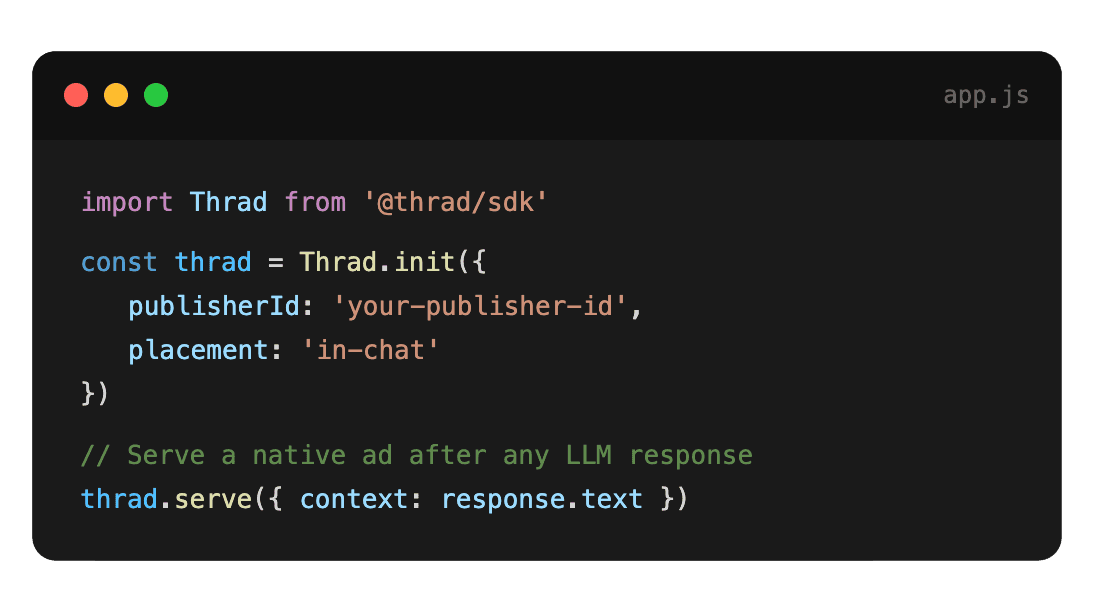
Start monetizing your AI app in under an hour
With Thrad, publishers go from first API call to live ads in less than 60 minutes. With fewer than 10 lines of code required, Thrad makes it easy to unlock revenue from your conversational traffic the same day.
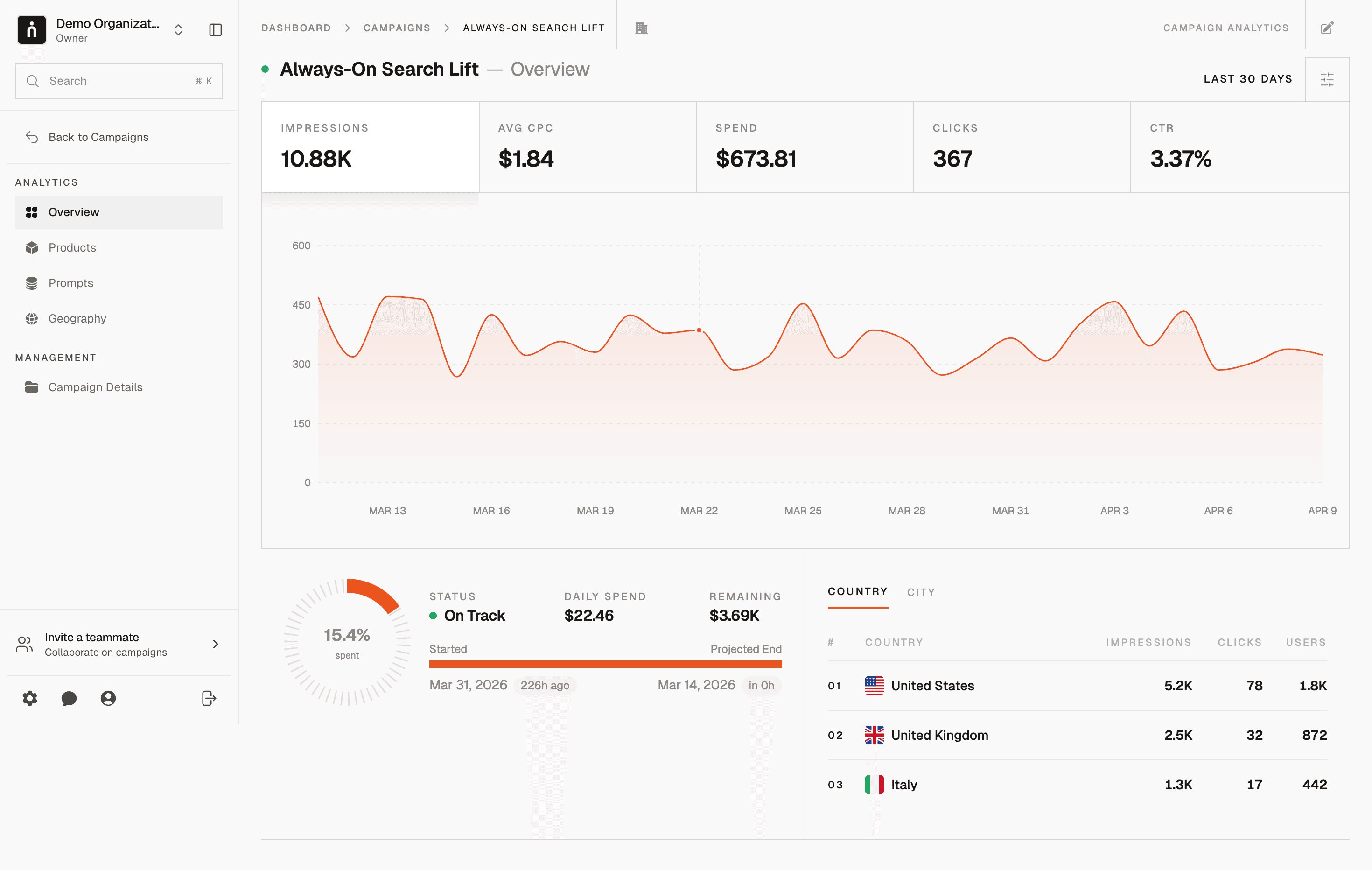
Generative AI Advertising ROI Measurement | Thrad
ROI measurement is what separates real generative AI advertising
programs from press releases. Honest measurement means naming the
baseline, picking an incrementality method, accounting for human-
in-the-loop cost, and reporting the decay curve — not the peak.
Generative AI advertising ROI measurement is where 2026 programs
succeed or fail internally. The technology works; the measurement
often doesn't. This article is a practical framework for measuring
ROI honestly enough to win finance funding for pilot two — covering
baselines, incrementality methods, full cost accounting, decay
analysis, and the specific reporting patterns that survive a CFO's
follow-up questions. The guidance below assumes you already have
generative creative shipping; it is the measurement layer that most
teams realize too late they under-built.
What does generative AI advertising ROI measurement mean?
ROI measurement for generative AI advertising is the practice of
answering three questions, clearly and repeatedly, with evidence a
finance organization will accept. Every honest program answers:
What lift did AI-assisted work deliver vs. non-AI work?
What did it cost, all-in, to produce and run that work?
Was the lift incremental to other channels, or did it cannibalize
them?
Teams that answer all three get funded. Teams that answer only the
first — the flashy lift number — get audited and stalled. The 2026
WARC survey of CFOs at top-200 advertisers found that 68% had
deprioritized or frozen at least one AI marketing pilot in the prior
twelve months specifically because measurement was "platform-only" or
"incrementality-silent." Honest measurement is not a nice-to-have;
it is a funding gate.
How do you name the baseline?
Before the campaign runs, name the baseline out loud. The baseline
is the counterfactual you will compare against — the question "lifted
versus what?" A strong 2026 program writes the baseline into the
campaign brief so it cannot be retrofitted after results are in. Four
common baselines:
Pre-period match. Same campaign, same audiences, previous
quarter. Weakest baseline but the most common. Vulnerable to
seasonality and market drift.Parallel non-AI cell. Half the audience gets hand-made creative,
half gets AI-assisted. Strongest baseline, highest operational cost
— you are running two campaigns in parallel.Hold-out geos. Some markets get AI; some don't. Clean when you
have enough markets (typically 20+ at the US DMA level).Randomized user hold-out. Within a single market, a control
group is excluded from AI-assisted exposure. Requires DSP or
platform cooperation and sufficient sample.
Document the baseline in writing, with numbers, before day one. The
2026 IAB Tech Lab attribution guidance explicitly flags
"post-hoc baseline selection" as the leading cause of measurement
disputes in AI advertising programs.
How do you pick an incrementality method?
Platform-reported ROAS is a starting point, not the finish line.
Choose one true incrementality method and pre-register it. Different
methods fit different campaign shapes:
Method | When it fits | Typical horizon | Power |
|---|---|---|---|
Geo hold-out | National brand, many markets | 8–12 weeks | High |
Ghost ads | Programmatic direct buy | 4–6 weeks | Medium-high |
Matched markets | Brand, limited geography | 10–14 weeks | Medium |
Converted control | Retail media, store-level | 6–10 weeks | High |
Conversion lift study | Platform-owned inventory | 4–8 weeks | Medium |
The method choice shapes everything downstream — sample size, duration,
cost, and the kind of claim you can make at the end. Don't change it
mid-campaign, because a mid-flight method change forfeits the
incrementality claim entirely. If you must switch, treat the first
leg as a planning pilot and start the clock over.
How do you account for human cost honestly?
Most inflated ROI numbers assume AI is "free." It isn't. The
Forrester 2026 creative-operations benchmark put all-in human cost
per approved AI-assisted asset at roughly 35–55% of the comparable
hand-made asset — real savings, but nothing like the "90% cheaper"
claims that appeared in vendor decks in 2024. Line items that belong
in the cost column:
Creative direction and brief writing (senior hours).
Prompt engineering and iteration (specialist hours).
Brand spec maintenance (ongoing ops hours).
Review and approval (creative lead, brand reviewer, legal).
Compliance and disclosure work (regulated categories).
Tooling amortization (generation, prompt library, audit-log
storage, measurement platforms).Model inference cost (if you pay per-token or per-image).
Opportunity cost of the humans sitting in the loop.
Divide total campaign cost by the number of approved assets, not
generated candidates. Most teams generate 5–10x what they ship; only
the shipped count matters for unit economics. Reporting cost per
generated candidate inflates apparent efficiency by an order of
magnitude and is a classic tell that a program hasn't survived
finance review.
Why should you separate creative lift from placement lift?
Generative AI creative (new variants, new formats) and generative-
surface placement (appearing inside ChatGPT, Perplexity, Gemini
answers) are different interventions with different mechanics,
different audiences, and different measurement methods. A campaign
using both should measure them apart:
Creative lift — A/B within the same surface, new AI-assisted
creative vs. hand-made baseline.Placement lift — new surface exposure vs. no exposure, typically
via geo hold-out or matched markets.
Blending them produces numbers no reviewer believes. If AI-generated
creative lifts a programmatic campaign 12% and a Perplexity placement
lifts awareness 18%, the honest report shows both. Summing the two
into "AI program lifted 30%" erases the mechanism and invites exactly
the finance follow-ups the number was supposed to avoid.
How do you report the decay curve?
Peak lift tells you the creative is fresh. The decay curve tells you
whether the program scales. A healthy 2026 generative AI program
typically shows a strong first 2–3 weeks, a tail at 30–60% of peak
through weeks 6–8, then a refresh step. The curve shape itself is the
deliverable, not a single number.
Week | Typical lift (% of peak) | Action |
|---|---|---|
1–2 | 100% | Launch, monitor |
3–4 | 75–90% | Steady state |
5–6 | 50–70% | Plan refresh |
7–8 | 30–50% | Refresh triggered |
9+ | Reset to new peak with new creative | New baseline |
Report lift, decay, and refresh cadence together. A 35% peak with a
steady 20% tail across 12 weeks is often more valuable than a 60%
peak that decays to zero by week four. Finance understands curves;
they distrust single numbers.
The difference between a well-measured generative AI advertising
program and a badly measured one isn't the number at the top of the
slide. It's whether finance can ask three follow-up questions and
get clean answers: baseline, incrementality, full cost.
How do you cut by generative surface?
Generative-surface inventory doesn't behave uniformly. Citation rates
and click-through patterns differ across ChatGPT, Perplexity, Gemini,
Copilot, and embedded AI formats in Meta and Google. The 2026
eMarketer surface-level benchmarks show citation rates varying 3–5x
across surfaces for the same brand in the same category. Report each
surface on its own line.
Surface | Dominant buying model | Typical measurement lag |
|---|---|---|
ChatGPT | Sponsored answer + shopping | 1–2 weeks to stable signal |
Perplexity | Sponsored answer + sources | 1 week |
Gemini | Sponsored card + presence | 2 weeks |
Copilot | Embedded assistant placement | 2–3 weeks |
Meta AI | In-feed generative creative | Near real-time |
Google AI Overview | Citation + deep link | 1–2 weeks |
Blend surfaces only for executive summaries — never for planning.
Planning requires surface-level detail because budget decisions differ
per surface.
Common misconceptions
"AI programs should show triple-digit lift." In well-measured
programs they usually don't. Mid-teens to mid-twenties lift against
a clean baseline is a good result. Triple-digit numbers are
typically baseline artifacts."Cost per generated asset is the right unit." It isn't. Cost
per approved, shipped asset is the only unit finance cares about."Platform ROAS plus vibes is enough." Not in 2026. Every major
brand now has a CFO-mandated incrementality cut, and Ad Age
reporting shows 40%+ of Fortune 500 advertisers added formal AI-ROI
audit lines to 2026 plans."Measurement can be wired after we launch." No — baselines set
post-hoc are uninterpretable. Wire before launch or don't claim
incrementality."Bigger lift means better program." Only against a clean
baseline. A 90% lift with a broken baseline is weaker evidence than
a 15% lift with a pre-registered hold-out.
What comes next
Three shifts are already visible and will reshape AI-ROI measurement
through 2026-2027. First, independent measurement providers are adding
native generative-surface tracking, so placement ROI can be cut
against the same standards as display and CTV. Second, boards and
audit committees are asking CMOs to show generative AI ROI as a
standing line item in quarterly reviews — the days of footnoted AI
pilots are ending. Third, the IAB Tech Lab's 2026 Attribution
Practices draft is pulling generative-surface metrics into the same
framework as classical channels, which will make cross-channel
measurement merely hard rather than impossible.
The operational consequence: measurement shifts from a post-campaign
report to a pre-campaign gate. A brand that cannot produce a
baseline, method, and cost plan at kickoff will increasingly find
budget blocked at that stage rather than funded and audited later.
What does a measurement stack that survives finance review look like?
A measurement stack survives finance review when each number in the
deck has a traceable source, a named method, and a counterfactual.
The reference 2026 stack has five components that talk to each other:
Experiment design — the baseline and method, pre-registered,
with the expected sample size and detectable effect written down.Data pipeline — unique IDs attached to every variant, flowing
end to end from generation to conversion.Incrementality engine — geo matching, synthetic controls, or
conversion-lift studies run on a schedule, not ad-hoc.Surface visibility layer — for generative surfaces, a monitor
that tracks brand citation and sentiment across ChatGPT,
Perplexity, Gemini, and Copilot on the queries that matter.Finance reconciliation view — full cost schedule tied to
approved-asset count, rolled up to campaign, program, and quarter.
When those five components share identifiers and time ranges, a
finance partner can reconstruct any claim in the deck without asking
you to pull another report. That reconstructability is what finance
reviewers actually mean when they ask for "rigor."
Common pitfalls in the first 90 days
Most programs fail measurement review in the first quarter for
predictable reasons. Naming them in advance shortens the learning
curve:
Wrong baseline. Picking the strongest pre-period instead of a
representative one.Shifting method. Promising a geo hold-out, running a platform
lift study instead.Incomplete cost. Leaving out legal review, spec maintenance,
and tooling amortization — the line items least visible to the
marketing team.Silent cannibalization. Not instrumenting whether AI creative
drew budget or attention from other channels.Single-surface thinking. Reporting a program as "AI advertising"
when spend splits across three surfaces with different dynamics.No refresh trigger. Letting decay erode lift without a
committed response, then blaming the model.
Each pitfall is a measurement discipline failure, not a creative
failure. Catching them at planning is trivial; catching them at the
Q3 review is expensive.
Finance partners do not reject AI advertising claims because the
numbers are small. They reject them because the numbers cannot be
reconstructed. Reconstructability — not magnitude — is the standard
a measurement stack has to hold itself to.
How do you stand up honest ROI measurement?
Pick one campaign. Name the baseline on paper before day one.
Pre-register the incrementality method in writing with the finance
partner. Account for every hour and every tool in a full cost
schedule, divided by approved assets. Report decay alongside peak
with a pre-committed refresh trigger. Cut by surface in the
dashboard. Separate creative lift from placement lift in the
reporting. Sit down with finance before launch to agree the three
questions — baseline, incrementality, full cost — and the answer
format you'll deliver.
Build the five-component stack described above even if parts of it
start as spreadsheets. The discipline of the stack matters more than
the sophistication of the tools. Programs that start with a
whiteboard experiment design and a finance-shared cost tracker
graduate to more advanced tooling in 6–12 months; programs that
start by buying a measurement platform without the discipline
underneath typically run the same bad measurement faster.
Thrad provides the generative-surface visibility cut — what an
audience sees about your brand inside ChatGPT, Perplexity, and Gemini
— which is the half of the measurement stack most brands still don't
have. Pair it with a DSP-side incrementality test and a full cost
schedule and you have the complete picture finance will actually fund.

ai ad roi, generative ai advertising measurement, ai marketing roi, ai ad incrementality
Citations:
WARC, "Incrementality and Generative Advertising," 2026. https://warc.com
IAB Tech Lab, "Attribution Practices for Generative Campaigns," 2026. https://iabtechlab.com
eMarketer, "AI Ad Spend Forecast 2026," 2026. https://emarketer.com
Ad Age, "CFOs are auditing AI ad claims," 2026. https://adage.com
Gartner, "Marketing Measurement Benchmarks," 2026. https://gartner.com
Forrester, "Incrementality Methods for AI Programs," 2026. https://forrester.com
Be present when decisions are made
Traditional media captures attention.
Conversational media captures intent.
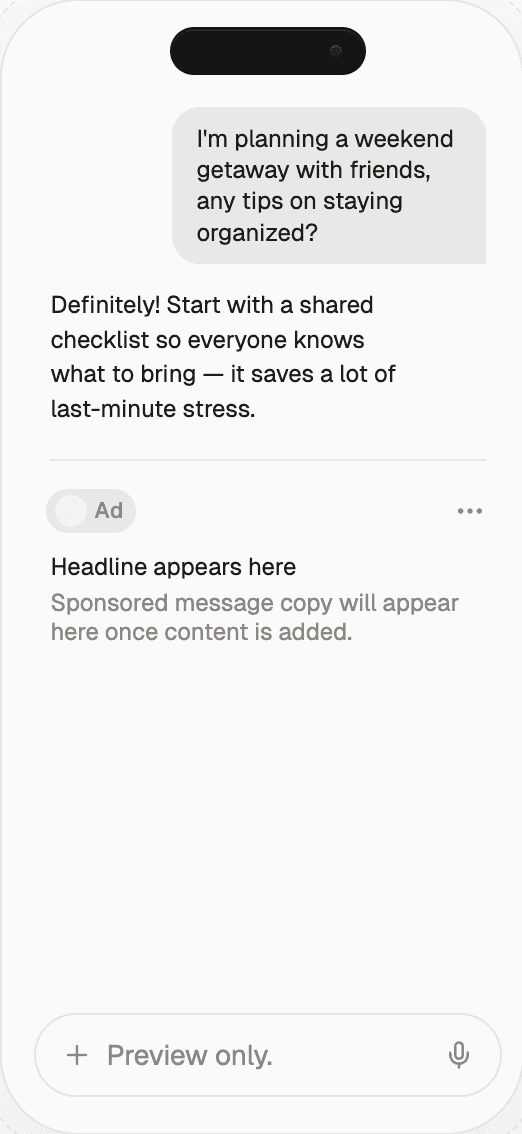
With Thrad, your brand reaches users in their deepest moments of research, evaluation, and purchase consideration — when influence matters most.
Date Published
Date Modified
Category
Advertising AI
Keyword
generative ai advertising roi measurement