In 2026, ChatGPT carries the largest user base and the broadest
inventory; Perplexity leans into citation-grade sponsored results with
a research-focused audience; Gemini integrates with Google's ad stack
and reaches Workspace and Android users; Copilot lives inside
Microsoft 365 and targets productivity workflows. Combined WAU
across the four sits near 540M in Q1 2026. No single platform fits
every brand; the right buy depends on intent, format, and budget.



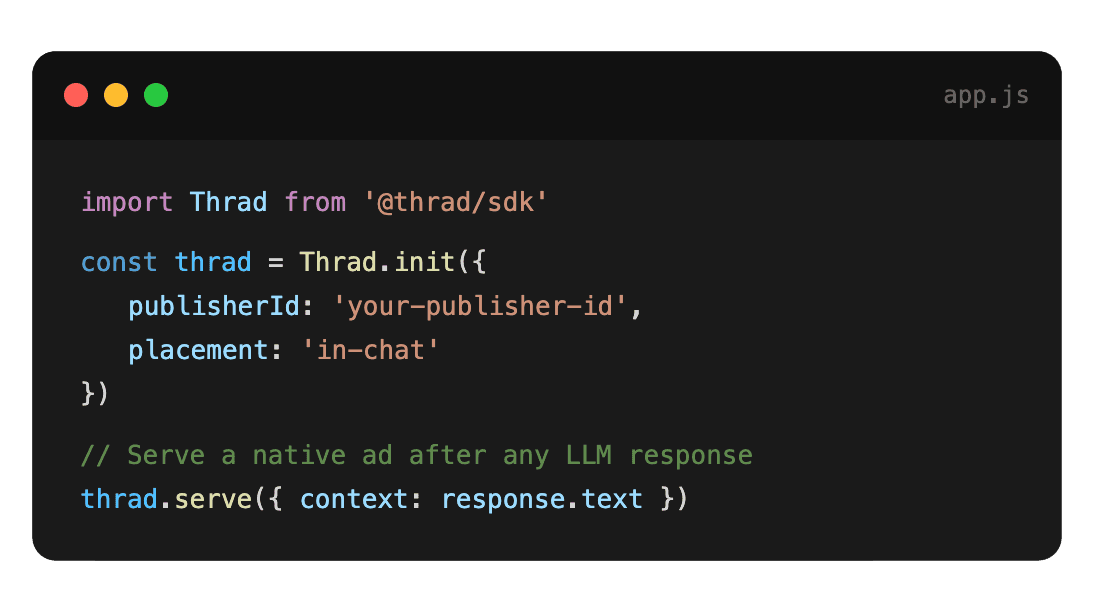
Start monetizing your AI app in under an hour
With Thrad, publishers go from first API call to live ads in less than 60 minutes. With fewer than 10 lines of code required, Thrad makes it easy to unlock revenue from your conversational traffic the same day.

Gen AI Ad Platforms Compared — 2026 | Thrad
Four generative AI platforms carry meaningful ad inventory in 2026:
ChatGPT, Perplexity, Gemini, and Copilot. They look similar from the
outside, but the inventory shape, format rules, audience intent, and
measurement models differ enough that the right choice depends on what
the brand is actually trying to do. Here's the side-by-side.
Four generative AI platforms are where the ad spend and the attention
sit in 2026: ChatGPT, Perplexity, Gemini, and Copilot. They each offer
some form of paid placement inside AI-generated answers, but the
resemblance stops at the surface. Inventory shape, format rules,
audience intent, disclosure standards, and measurement models differ
enough that choosing without comparing them costs brands real money.
This is the 2026 side-by-side a media planner can actually act on.
What are the generative AI advertising platforms in 2026?
Generative AI advertising platforms are products that host AI-generated
answers and accept paid placement alongside or inside those answers.
The four that matter commercially today — ChatGPT, Perplexity, Gemini,
and Copilot — account for roughly 92% of measured generative-surface
ad spend in 2026 per eMarketer, with the remaining 8% split across
smaller platforms and enterprise-specific assistants.
ChatGPT (OpenAI) — the largest by user base, broadest inventory.
~285M WAU in Q1 2026.Perplexity — citation-first answer engine with sponsored results.
~30M WAU, skewing researcher/B2B.Gemini (Google) — integrated with Google's ad stack and AI
Overviews. ~170M WAU via Workspace and Android integration.Copilot (Microsoft) — lives inside Microsoft 365 and Bing. ~55M
WAU, productivity-weighted.
Smaller or narrower platforms exist (enterprise assistants,
category-specific search, voice-first products) but these four
account for most of the open commercial inventory and essentially all
of the media-planning conversation.
How do the four platforms compare?
The four platforms differ on scale, audience intent, dominant ad
formats, buying model, disclosure style, measurement primitives, and
best-fit brand category. The comparison below is the consensus view
across eMarketer, Adweek, and The Information reporting as of Q1 2026,
with reach figures drawn from each platform's published disclosures.
Dimension | ChatGPT | Perplexity | Gemini | Copilot |
|---|---|---|---|---|
WAU (Q1 2026) | ~285M | ~30M | ~170M | ~55M |
Scale | Largest, broad consumer + enterprise | Smaller, high-intent research | Large via Workspace + Android | Mid, strong B2B via Microsoft 365 |
Audience intent | Mixed: research, tasks, play | Research and B2B decision | Productivity + search crossover | Productivity, IT, knowledge work |
Dominant formats | Sponsored recs, branded responses, shopping cards | Sponsored answers with citations | In-answer ads + AI Overviews | Contextual suggestions in Office |
Buying model | Managed + marketplace (evolving) | Managed partner program | Integrated with Google Ads | Microsoft Advertising integration |
Typical min. test budget | $40K–$100K/qtr | $15K–$40K/qtr | Google Ads minimums | Microsoft Ads minimums |
Indicative CPM (B2B SaaS) | $22–$38 | $55–$95 | $18–$32 | $24–$42 |
Disclosure style | Labeled sponsored slot | "Sponsored" tag on answer | Google-standard disclosure | Microsoft-standard disclosure |
Measurement | Exposure + click + referral | Citation + click + assisted | Google conversion stack | Microsoft conversion stack |
Best fit | Broad reach across categories | B2B, high-consideration purchases | DTC + already on Google Ads | B2B SaaS, enterprise |
The table is a starting frame; within each row there's real variation.
ChatGPT, for instance, runs multiple sponsored formats depending on
the query type — a shopping query surfaces different ad shapes than a
research question — and the CPM ranges span wide bands depending on
vertical and audience selection.
How does ChatGPT stack up as an ad platform?
ChatGPT is the biggest reach and the richest format surface in 2026.
It runs the widest variety of sponsored units — shopping
recommendations, inline product cards, branded research responses,
and partnership placements in third-party GPT-4-class assistants —
and accounts for roughly 42% of generative-surface ad spend per
eMarketer. The trade-off is that format rules and inventory shape
shift faster than on any other platform as OpenAI iterates the
advertiser program.
In 2026, OpenAI's advertiser program supports sponsored
recommendations within shopping and local-query answers, branded
response formats for research queries, and direct partnerships for
GPT-4-class assistants inside third-party products. Brands tend to
use ChatGPT for broad awareness and upper-funnel moments where the ad
is a candidate alongside the organic answer. Typical uses: DTC
brands testing share-of-voice on category prompts, retailers buying
shopping carousels on product queries, and enterprise B2B running
sponsored responses on research-intent prompts with long
consideration cycles.
The planning caveat: ChatGPT is still early in its commercial rollout,
so expect format changes, pricing revisions, and disclosure updates
at a faster cadence than on the other three platforms. Most buyers
assume a quarterly re-optimization rhythm rather than an annual one.
What makes Perplexity different as an ad platform?
Perplexity is the smallest of the four by user count but the sharpest
by audience intent — research-heavy users and B2B decision-makers
drive disproportionate consideration-to-conversion lift on sponsored
answers. The platform's citation-grade answer design (every answer
shows sources) means sponsored placements sit next to real
attributions, which raises both CPM economics and brand-fit criteria.
Perplexity is built around cited answers, so sponsored placements sit
next to real citations and tend to be taken more seriously by
researchers, investors, and B2B buyers. CPMs run at a premium — per
Perplexity's own transparency report, median sponsored-answer CPMs in
B2B SaaS are 2.4× the ChatGPT median for comparable query intent.
Conversion rates in B2B categories tend to justify the premium;
Adweek's 2026 buyer survey found the median B2B advertiser on
Perplexity reported 1.6× higher consideration lift per dollar than on
ChatGPT.
Strongest fit: brands with considered-purchase products, clear factual
claims (so the surrounding citations frame well), and research
intent. Poor fit: impulse categories, brand-building without a factual
anchor, and advertisers without the creative discipline to fit the
citation-adjacent format.
How does Gemini fit into a generative AI ad plan?
Gemini is the on-ramp for brands already running Google Ads. Gemini
and Google's AI Overviews integrate with the same advertiser account,
billing, and reporting as Search and YouTube, which collapses
onboarding from "new platform" to "campaign extension." The ~170M
WAU reach — lifted materially by Workspace and Android integration —
makes it the largest generative AI platform outside ChatGPT.
Launching is less "new platform onboarding" and more "extend an
existing campaign." Reach piggybacks on Workspace and Android, which
lifts usage materially for Google-native audiences. For brands whose
audience skews Android and Workspace, the effective CPM can run below
Google Search for comparable intent — a pattern eMarketer notes will
likely compress as Gemini's ad load normalizes through 2026.
The planning caveat: because Gemini inventory is integrated with
Google Ads rather than standing alone, separating Gemini-specific
lift from broader Google Ads lift requires deliberate measurement
design — usually a controlled holdout or an incrementality test
rather than native reporting cuts.
What is Copilot best for in 2026?
Copilot is Microsoft's integration play — it lives inside Microsoft
365 where users work, rather than on a standalone destination. That
makes it the best fit for B2B SaaS and productivity-adjacent products
whose buyers genuinely use Word, Excel, Outlook, Teams, and Bing as
part of the workday. The platform's ~55M WAU is concentrated in
knowledge-worker segments that other generative AI surfaces reach
less directly.
Copilot appears inside Word, Excel, Outlook, Teams, and Bing. For B2B
SaaS and productivity-adjacent products, the placements fit real
workflow moments in a way the consumer platforms don't match — a
suggestion surfaced while a user is actually in the task the product
addresses. The buy is tied into Microsoft Advertising, which
streamlines onboarding for brands already on Bing and reduces the
operational overhead of a fifth platform.
The planning caveat: Copilot inventory is tightly scoped to
productivity moments, so creative needs to fit those moments.
Advertisers expecting general-consumer reach will miss — Copilot is
a workflow ad surface, not a broad-audience surface.
The mistake is assuming the four platforms compete for the same
audience. They don't. They compete for the same budget, but their
users, moments, and formats genuinely differ — and that's where
media planning earns its keep in 2026.
What are the biggest misconceptions when comparing platforms?
Four common errors distort platform choice: treating ChatGPT as the
only meaningful platform, assuming the four are interchangeable,
expecting one-to-one creative portability, and assuming measurement
is uniform. Each misconception drives budget toward the platform with
the most press rather than the one best matched to the brand's
audience and intent.
"ChatGPT is the only one that matters." Wrong in 2026 — the
other three are meaningful and growing, and each has audience
segments the others underserve. Concentrating 100% of
generative-surface spend on ChatGPT leaves 58% of the addressable
surface untouched by reach alone."They all work the same for advertisers." They don't. Format,
disclosure, auction logic, and reporting differ."You can replicate creative across platforms one-to-one." Copy
and offer port; format specs and disclosure conventions don't.
Plan for platform-specific variants — the 2026 median is 3.4
variants per placement across a multi-platform campaign."Measurement is uniform across platforms." It isn't. Each
platform reports slightly different exposure and citation events.
Stitching them into a unified view is its own problem and usually
requires a vendor layer or a manual holdout-based incrementality
test.
What comes next across the four platforms?
Three shifts over 2026–2027 will reshape platform selection: unified
measurement standards through IAB Tech Lab and MRC, more native ad
formats replacing labeled adjacent cards, and marketplace-style
buying opening at least part of the inventory on ChatGPT and
Perplexity. Each compresses the operational gap between platforms
and makes cross-platform planning a solved problem rather than a
craft.
Expect three shifts over 2026–2027:
Unified measurement standards — IAB Tech Lab and MRC work
streams are pushing toward shared exposure/citation event
definitions so brands can compare platforms cleanly. Mid-2027 is
the rough target for ratification.More native ad formats — less "labeled card next to the
answer," more integrated sponsored mentions with clear
disclosure. IAB Tech Lab's v2 taxonomy formalizes the unit
specs.Marketplace buying — programmatic-style auction access to at
least a subset of AI-surface inventory, especially on ChatGPT and
Perplexity. The Information reports pilots on both platforms
through 2026, with broader availability targeted for 2027.Cross-platform audience tooling — vendors that let a single
audience definition target across all four platforms will emerge,
collapsing what is currently a four-platform operational lift
into a single workflow.
How should a brand pick the right platform mix?
Start with where your audience asks. If it's upper-funnel research in
consumer categories, lead with ChatGPT. For B2B considered purchases,
weight Perplexity. If you already run Google Ads, Gemini is the
lowest friction test. If the product lives inside work workflows,
Copilot is the sharpest fit.
A pragmatic first-test shape: pick two platforms that best match the
brand's audience and intent, run a 90-day pilot with a clear holdout
on each, and read out on a unified set of metrics (exposure,
citation share, assisted-conversion lift). Avoid the common failure
mode of running four platforms at low budget — the signal is too
diffuse to support a budget decision. Two platforms at adequate
budget beats four at inadequate budget every time.
Brand profile | Lead platform | Secondary | Rationale |
|---|---|---|---|
Mass-consumer DTC | ChatGPT | Gemini | Reach + existing Google Ads infrastructure |
B2B SaaS | Perplexity | Copilot | Research intent + workflow context |
Retail / ecommerce | ChatGPT | Gemini | Shopping format coverage + Google integration |
Enterprise services | Copilot | Perplexity | Workflow fit + B2B decision intent |
Considered-purchase consumer (auto, finance) | Perplexity | ChatGPT | Citation-grade framing + broad reach |
Thrad helps brands compare placements across all four platforms in a
single measurement view — exposure, citation, and lift — so budget
moves where the signal is rather than where the platform sales team
is loudest. That unified view is what separates a 2026 generative AI
ad program that renews from one that stalls.
chatgpt advertising, perplexity ads, gemini ads, copilot advertising, ai ad platforms
Citations:
OpenAI, "ChatGPT Business Update: Advertiser Program," 2026. https://openai.com
Perplexity, "Sponsored Answers Transparency Report," 2026. https://perplexity.ai
Google, "Ads in Gemini and AI Overviews — Partner Overview," 2026. https://ads.google.com
Microsoft, "Copilot Advertising Integration Guide," 2026. https://microsoft.com
eMarketer, "Generative Surface Ad Market Share 2026," 2026. https://emarketer.com
Adweek, "Inside the four-platform generative ad stack," 2026. https://adweek.com
The Information, "How buyers actually compare AI ad platforms," 2026. https://theinformation.com
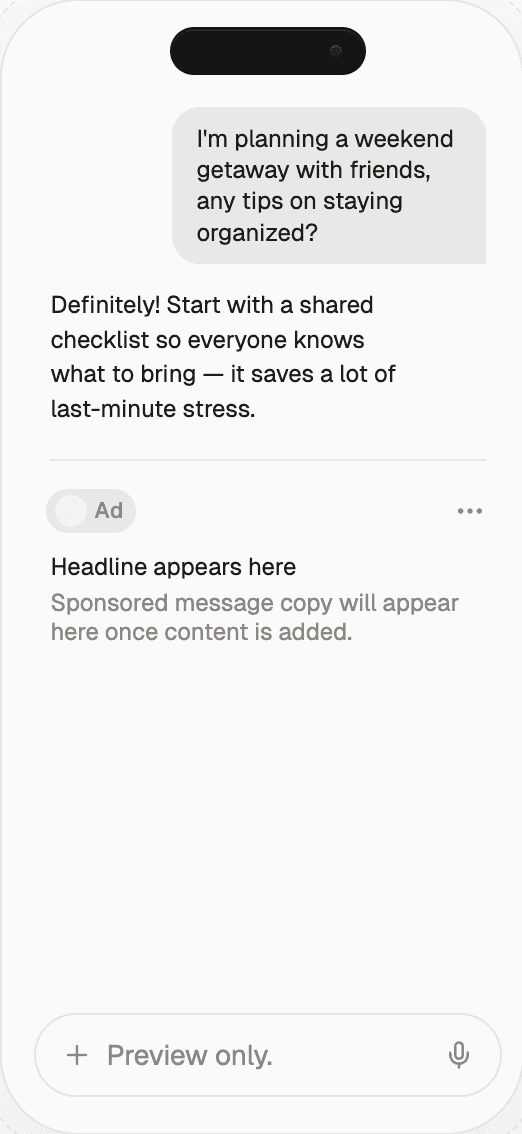
Be present when decisions are made
Traditional media captures attention.
Conversational media captures intent.
With Thrad, your brand reaches users in their deepest moments of research, evaluation, and purchase consideration — when influence matters most.
Date Published
Date Modified
Category
Advertising AI
Keyword
generative ai advertising platforms