Generative AI advertising will move from experimental to default by 2028. Expect native ad formats inside AI answers, standardized exposure-and-citation measurement, first-party brand voice models as a standard creative asset, and programmatic-style buying on at least part of AI-surface inventory. eMarketer projects global spend from roughly $18B in 2026 to $55B+ by 2028. The brands that win prepare now.




Start monetizing your AI app in under an hour
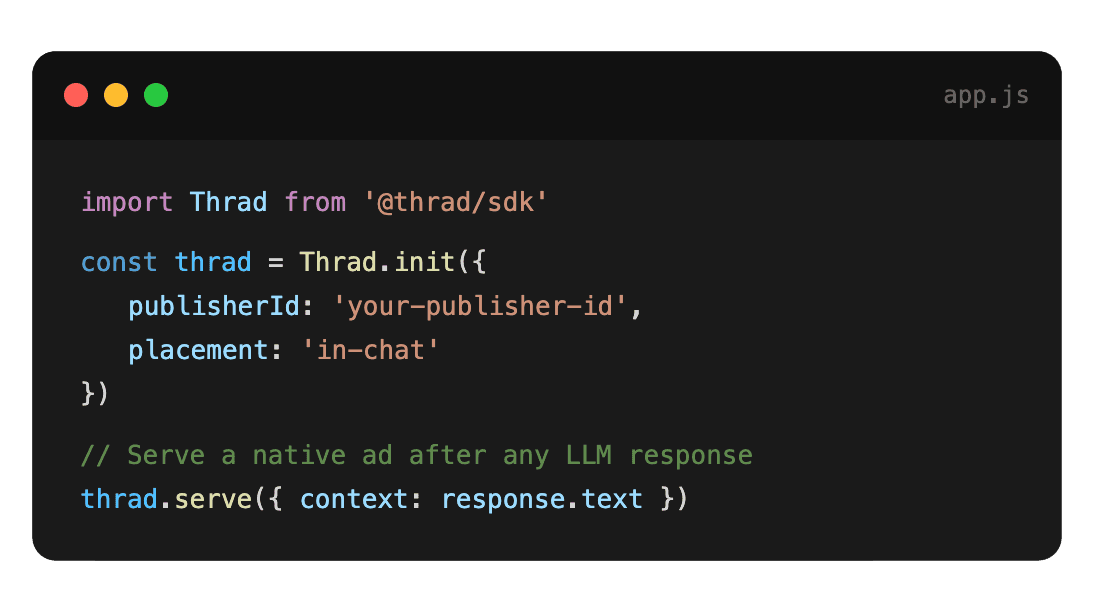
With Thrad, publishers go from first API call to live ads in less than 60 minutes. With fewer than 10 lines of code required, Thrad makes it easy to unlock revenue from your conversational traffic the same day.

Future of Generative AI Advertising — 2026 | Thrad
Generative AI advertising in 2026 is a real category with real revenue. The interesting question is what it looks like in 2027 and 2028 — when the formats settle, measurement standards harden, and every serious brand has a first-party AI voice model. Here's where the category is heading and what brands should plan for.
Generative AI advertising in 2026 is past the "will this be a real category?" stage. It is a real category with budget, inventory, and measurement products. The interesting question is what it looks like in 2027 and 2028 — the category matures fast, and the structures that harden over the next 18 months will shape media plans for a decade. Here's the honest view of where it's going, grounded in the forecasts and roadmaps published across eMarketer, Forrester, IAB Tech Lab, MRC, and Gartner through Q1 2026.
What is the future of generative AI advertising?
The future of generative AI advertising is standardization followed by defaulting. By 2027, format specs, measurement definitions, and disclosure rules converge through IAB Tech Lab and MRC; by 2028, generative AI stops being a line item and becomes infrastructure — the default way most creative gets produced and a meaningful share of media gets placed inside AI-native surfaces.
The near-term future (2026–2027) is about infrastructure hardening — the formats, measurement models, and disclosure rules that feel experimental in 2026 are headed for convergence. The mid-term future (2027–2028) is defaulting — generative AI advertising stops being a line item on a media plan and becomes the way most creative gets produced and much of the buy gets placed. The long-term future (2028 onward) is harder to predict because it depends on how AI assistants evolve as products, but the directional claim is safe: generative AI advertising becomes to the 2020s what programmatic became to the 2010s — infrastructure rather than a specialty.
What structural forces are shaping the category?
Five durable forces compound into the category's trajectory: collapsed creative costs, still-growing AI-surface usage, hardening measurement, catching-up regulation, and brand safety moving up-stack to cover what the model generated rather than what publisher carried it. Each of the five has been visible for at least 12 months and none are showing reversal through Q1 2026.
1. Creative cost has collapsed and stays collapsed. The production of a campaign variant now takes minutes and dollars rather than days and thousands of dollars. eMarketer measures an 82% drop in per-variant cost from 2023 to 2026. That economic fact isn't reversing; model inference cost continues to decline roughly 40% annually through 2026.
2. AI-surface usage is still growing. Weekly active user counts for ChatGPT, Gemini, Copilot, and Perplexity continue to compound in 2026. Adweek's 2026 tally puts the combined WAU at roughly 540M, up from ~210M in early 2024. Inventory grows with usage and with ad-load policies, both of which have expanded at each platform between 2025 and 2026.
3. Measurement is hardening. IAB Tech Lab and MRC are actively standardizing exposure and citation events. The AI-Surface Measurement Standards Roadmap published in 2026 targets a ratified event taxonomy and reporting spec by mid-2027. Once shared definitions land, buyers can compare platforms properly — which is when the category starts behaving like a normal market.
4. Regulation is catching up. Synthetic-media disclosure, AI advertising transparency rules, and data-provenance standards are moving through multiple jurisdictions — the EU AI Act, US state-level laws like California AB 2013, and platform-specific disclosure requirements. Expect more structure, not less, by 2027, with a likely convergence toward machine-readable provenance metadata on every shipped asset.
5. Brand safety moved up-stack. The safety question is no longer "what publisher ran this?" but "what did the model produce with our name on it?" That changes governance, tooling, and org structure on the brand side. GARM's v2 guidelines formalize the shift and make pre-flight model-safety review table-stakes by 2027.
How does the category evolve from 2026 to 2028?
The category evolves along six axes — ad formats, measurement, creative production, brand voice, buying model, and regulation — each moving from experimental in 2026 to structured in 2027 to default in 2028. The table below compresses the consensus roadmap across IAB Tech Lab, eMarketer, Forrester, and Gartner.
Area | 2026 (now) | 2027 | 2028 |
|---|---|---|---|
Ad formats | Experimental | Native in-answer, clearly disclosed | Default format for AI surfaces |
Measurement | Platform-specific | Shared event definitions | Unified cross-platform attribution |
Creative production | AI-assisted for many brands | AI-native for most brands | AI-native as default |
Brand voice | Style guides | First-party voice models | Voice models are standard assets |
Buying model | Managed + marketplace | Marketplace + early programmatic | Hybrid programmatic on AI surfaces |
Regulation | Emerging | Structured disclosure fields | Multi-jurisdiction compliance standard |
Global ad spend (eMarketer base case) | $18B | $32B | $55B |
Fortune 500 brands with voice model | 12 | ~180 | ~325 |
The table is a forecast, not a guarantee. What's defensible is the direction; the exact timing of each row may stretch or compress by a quarter or two depending on regulatory developments and platform roadmaps. The spend numbers are eMarketer base case; Forrester's range is $45B–$62B for 2028 and Gartner's is $48B–$58B.
What should brands plan for through 2028?
Brands should plan three specific investments that pay off across the 2027–2028 horizon: a first-party brand voice model, exposure-and- citation measurement infrastructure, and a generative-aware creative org. Each takes 12–18 months to build, so the brands that start in 2026 enter 2028 with two years of compounding data and organizational muscle that late movers cannot buy on a deadline.
First-party brand voice models. Fine-tuned or heavily-prompted models that encode voice, imagery constraints, tone, and do-not-say lists. By 2028 these become standard brand assets, no different from a logo or a typeface. The brands that start now spend 2026 and 2027 building a real one; late movers will be generating off-brand. Forrester's Q1 2026 survey found 12 Fortune 100 brands operating voice models today, projected to 85 by end of 2027 and 140 by end of 2028.
Exposure-and-citation measurement. Classical attribution doesn't capture being cited inside a ChatGPT answer. Brands that add exposure-and-citation tracking now get a year or two of data that late movers simply don't have. The measurement investment is modest — typically $80K–$250K annually for a mid-market brand — and the data compounds in value because it informs creative, competitive share-of-voice analysis, and negotiation with AI-surface partners.
Generative-aware creative orgs. The creative department of 2028 is smaller in production headcount and larger in prompt, brief, and judgment roles. Org changes take a year or two to land, so starting in 2026 is the honest timeline. WARC's 2026 creative-ops survey shows a 31% decline in production-only headcount and a 24% increase in strategy-and-brief headcount at AI-forward agencies between 2024 and 2026; the curve continues through 2028.
The winning brands of 2028 aren't the ones that had the best 2026 generative AI campaign. They're the ones that built the infrastructure — voice, measurement, governance — that compounds across 24 months of campaigns, renewals, and category shifts.
What are the biggest misconceptions about the future of the category?
The four most expensive misconceptions are that this is a cyclical hype wave, that generative AI advertising is one thing, that regulation will kill the category, and that waiting for standards to settle is a safe strategy. Each pushes brand leadership toward a passive stance that costs ground each quarter.
"This is hype; it'll settle back to normal." Unlikely. The cost
curves that drove the category inverted structurally, not
cyclically. Reversal would require model inference costs to triple,
AI-surface WAU to halve, or a coordinated advertiser walk-out —
none of which are on any credible roadmap."Generative AI advertising is one thing." It's three:
AI-generated creative, AI-surface placements, and AI
personalization. Each evolves on a different timeline and each has
different organizational owners."Regulation will kill the category." Regulation will shape
the category — mandatory disclosure, provenance, audit rails. That
slows but doesn't reverse adoption. The EU AI Act's advertising
provisions, fully in force by 2027, formalize disclosure rather
than banning synthetic creative."We can wait until the standards settle." You can — and
everyone in your category who doesn't wait will have two years of
data and tooling on you when you start."AI surfaces will consolidate to one platform." Unlikely within
the forecast window. Gartner's Predicts 2028 note explicitly argues
for durable multi-platform competition through the horizon, with
three to four platforms holding meaningful share.
What comes next for the category in 2027?
Three forward-looking signals will define the 2027 news cycle: the first large native ad format on a major AI assistant moving from "labeled experimental" to "default," a shared measurement standard that lets buyers compare platforms on the same metrics, and the first public earnings call where a major consumer brand attributes material revenue to generative AI ad surfaces. Each is a directional milestone, not a date-specific prediction.
The first large native ad format on a major AI assistant to
become "default" rather than labeled experimental. This is a
symbolic turning point and likely happens on ChatGPT or Perplexity
first, given the 2026 velocity of their ad programs.A shared measurement standard that lets buyers compare ChatGPT,
Perplexity, Gemini, and Copilot on the same metrics. Once this
exists, budget shifts become a market function rather than a
platform-by-platform negotiation. IAB Tech Lab's roadmap targets
mid-2027 ratification.First public earnings call where a major consumer brand
attributes material revenue to generative AI ad surfaces. This
shifts boardroom attention and accelerates budget allocation
across the Fortune 500. Expected in late 2027 or early 2028 given
the lag between campaign execution and investor communication.The first MRC-accredited AI-surface measurement product.
Accreditation is the signal that measurement has stabilized enough
for buy-side trust. Expected in 2027, potentially earlier.
What structural questions remain open?
Three questions are genuinely open and will shape the category's second half of the decade: whether AI-surface advertising ends up concentrated (one or two platforms) or fragmented (four or more); whether a standard for AI-agent commerce disclosure emerges before large-scale agent-mediated purchases or after; and whether first-party brand voice models become a commodity or a durable moat.
Open question | Concentration scenario | Fragmentation scenario | Current evidence |
|---|---|---|---|
AI-surface share | 1–2 platforms take 70%+ | 4+ platforms each hold 10–25% | Fragmented — 2026 share split roughly 45/25/20/10 |
Agent commerce disclosure | Retro-fit after scale | Pre-baked from the start | IAB working group formed Q3 2025 — retrofit likely |
Voice model durability | Commodity by 2029 | Durable moat through 2030+ | Durable-moat evidence stronger; training data and feedback loops compound |
The question isn't whether generative AI advertising will be a durable category. It is. The question is which of the open structural questions get resolved in ways that compound brand advantage versus commoditize it — and the time to place bets on that is now, not after 2027 standards harden.
How should brands act on this today?
Don't try to time the category. Build the three compounding assets — voice model, measurement, generative-aware org — and run meaningful tests on AI-surface inventory against your highest-intent prompts. Measure exposure and citation, not just clicks. That's the playbook Thrad is built for: giving brands the measurement and placement infrastructure to navigate generative AI advertising as it matures from experiment to default.
A concrete 24-month sequence: in 2026 Q2–Q3, build the voice-spec artifact and ship first variant-explosion tests; in 2026 Q4, stand up exposure-and-citation measurement against 50 priority prompts; in 2027 Q1–Q2, graduate to a formal first-party voice model and negotiate direct AI-surface placements; in 2027 Q3–Q4, integrate measurement into the main marketing-mix model and renegotiate agency scope; in 2028, operate as a default-generative brand with two years of compounding data that late movers cannot replicate on any timeline that matters.

generative advertising future, ai advertising forecast, ai ad market, generative ai ad trends, 2027 advertising
Citations:
eMarketer, "Generative AI Ad Spend Forecast 2026–2028," 2026. https://emarketer.com
IAB Tech Lab, "AI-Surface Measurement Standards Roadmap," 2026. https://iabtechlab.com
Forrester, "The 2027 Advertiser Outlook: Generative Defaults," 2026. https://forrester.com
GARM, "Synthetic Media and Disclosure Guidelines," 2025. https://gar-m.org
WARC, "Creative Automation at Enterprise Scale," 2026. https://warc.com
Gartner, "Predicts 2028: The Advertising Stack After Generative Defaults," 2026. https://gartner.com
Be present when decisions are made
Traditional media captures attention.
Conversational media captures intent.
With Thrad, your brand reaches users in their deepest moments of research, evaluation, and purchase consideration — when influence matters most.
Date Published
Date Modified
Category
Advertising AI
Keyword
future of generative ai advertising