SMBs win with generative AI advertising by focusing on three things:
showing up in assistant answers for local and commercial-intent
queries, producing far more creative variants than their budget used
to allow, and replacing generic landing pages with AI-personalized
ones. Gartner's 2026 SMB survey shows 63% of small businesses using
at least one generative AI marketing tool, but only 22% can
tie outputs to booked revenue. Skip the shiny tools; instrument the
outcomes.




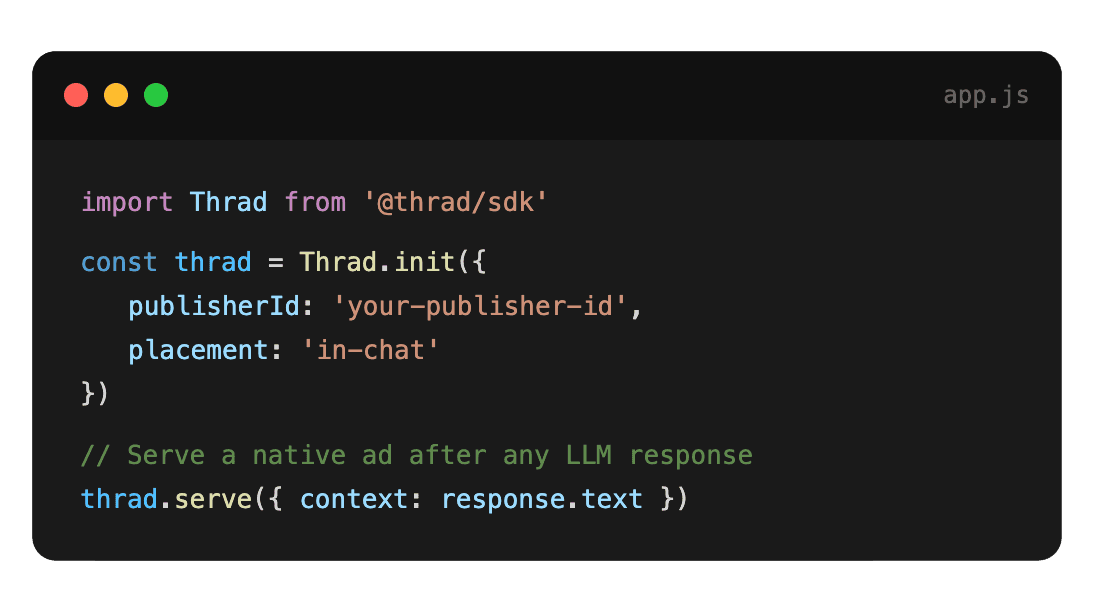
Start monetizing your AI app in under an hour
With Thrad, publishers go from first API call to live ads in less than 60 minutes. With fewer than 10 lines of code required, Thrad makes it easy to unlock revenue from your conversational traffic the same day.

Generative AI Advertising for SMBs 2026 | Thrad
Small and midsize businesses have the most to gain from generative AI
advertising — and the least room for waste. The SMBs winning in 2026
aren't the ones with the biggest tool stack; they're the ones that
picked two or three high-leverage pilots, grounded them in real
business data, and tracked booked leads, not impressions.
Generative AI advertising for SMBs in 2026 is mostly a scope problem. The technology is cheap and powerful; the mistake is buying too much of it and tracking too little. The small and midsize businesses pulling ahead are the ones that picked two high-leverage pilots, measured leads instead of impressions, and grew from there. Gartner's 2026 SMB AI Adoption Survey shows 63% of small businesses already use at least one generative AI marketing tool — but only 22% can tie outputs to booked revenue.
What does generative AI advertising mean for an SMB specifically?
For an SMB, generative AI advertising reduces to three shifts that matter more than any individual tooling choice: creative variants get cheap, assistants become the new local listings, and landing pages can finally personalize. An SMB that addresses any one starts winning; addressing all three is a business change. Tooling is downstream of this.
The three shifts in practical terms:
Creative variants get cheap. A $3,000/month budget can now support 20–50 creative variants instead of 2–3, which gives a small spend real optimization surface. Meta's self-serve Advantage+ and Google's Performance Max both now produce variant families from a single input, and the incremental cost per variant has fallen below $2 by early 2026.
Assistants are the new local listings. When a customer asks ChatGPT "best plumber near me" or "good dentist in Denver," the answer is the new top of the funnel. BrightLocal's 2026 Local Consumer Review Survey found 47% of local commercial queries in test categories resolved inside an assistant in Q1 2026, up from 19% the year before.
Landing pages personalize. Generic homepages convert poorly; generative page-builders let small sites match copy and offer to traffic source. HubSpot's 2026 panel measured 18–34% conversion lift on personalized landing pages versus a single shared homepage.
An SMB that addresses all three is doing real generative AI advertising. An SMB that picked one trendy tool and skipped the other two is running a creative experiment with no distribution story.
How can small businesses show up in AI assistant answers?
Small businesses show up in AI assistant answers by treating assistant visibility as the new local SEO — consistent directory listings, structured site content, review density in the training and retrieval corpora, and a weekly prompt panel that tests whether the work is paying off. BrightLocal's 2026 research shows 47% of local commercial queries now resolve inside an assistant.
The concrete 2026 checklist:
Consistent business listings across major directories. Name, address, phone, hours, and services identical across Google Business Profile, Apple Business Connect, Yelp, Bing Places, Apple Maps, and the assistant-specific directories where available. A single inconsistent listing is enough to drop a business from the assistant's candidate set.
Structured site content. Schema.org markup for LocalBusiness, Service, FAQPage, Review, and Location. Assistants rank retrieval candidates partly on structured-data density.
Review density and recency in the corpora. Assistants reflect recent public sentiment. A business with 40 reviews from 2022 is less visible than one with 15 from 2026.
A structured query panel. Twenty to thirty prompts your real customers would ask, sampled weekly across ChatGPT, Perplexity, Copilot, and Gemini. The panel is what most SMBs skip — and it's the only way to know whether any of the rest of the work is producing results.
A "we serve" page on your site. Plain-language, machine-readable description of services, service area, hours, and differentiators. Assistants cite pages they can parse cleanly.
Search Engine Land's 2026 local-search analysis shows the top-quartile SMBs in competitive local categories check their assistant visibility weekly and iterate on structured content monthly. The bottom quartile still treat the assistant layer as a "someday" project.
Variant explosion on a small budget
A small SMB ad budget used to buy a single good creative; in 2026 it buys a creative family of 20–50 variants with automated rotation. The old SMB creative model was to pick the best-performing single ad and run it until it fatigued. The new model, on the same budget, produces an order of magnitude more variants and lets the platform find the winners.
Creative layer | Old SMB model (2022) | Generative AI SMB model (2026) |
|---|---|---|
Ad concept | 1 concept, 1 variant | 1 concept, 20+ variants |
Audience cuts | 1 generic | 3–5 targeted |
Landing page | 1 generic | 3–5 source-matched |
Review cadence | Monthly | Weekly |
Cost per variant produced | $80–$200 | $1–$5 |
Creative fatigue window | 4–8 weeks | 2–3 weeks (per variant; the family runs longer) |
The concept still matters. A generative variant family from a weak concept produces 20 weak ads. But the production volume is what changes the economics, and every SMB marketer should be running at least 10 creative variants in parallel at any given time.
A practical rule: budget 10% of monthly ad spend toward variant generation and iteration, 5% toward landing-page variants, and leave the rest for media. If total spend is $3,000/month, that's $300 on creative iteration — enough to sustain an active variant pipeline with the modern self-serve tools.
Why should SMBs personalize the landing page, not just the ad?
SMBs should personalize landing pages because the decision happens on the landing page, not in the ad, and the lift from source-matched landing pages typically exceeds the lift from a second ad variant. HubSpot's 2026 panel showed 18–34% conversion lift on personalized landing pages versus a single shared homepage. An SMB that spends its entire generative AI budget on ad variants and sends everyone to the same homepage is leaving half the lift on the table.
A practical landing-page personalization plan for a single-location SMB:
Three variants per major channel. One for organic search, one for paid search/social, one for assistant referrals.
One variant per named campaign. If you run a seasonal promo, it gets its own page.
One variant per reviewer-targeted segment. "You searched for X, here's exactly that service."
Weekly review of conversion by variant. The losers get killed fast; the winners get iterated.
Generative page-builders — Webflow, Framer, and the self-serve tools inside HubSpot and Unbounce — let a non-technical SMB marketer produce five page variants in the same time it used to take to write one. The incremental conversion lift is usually larger than the ad variant lift because the landing page is where the decision is actually made.
The best SMB generative AI pilot in 2026 isn't a new ad tool — it's replacing one generic landing page with five source-matched variants and measuring what happens to booked leads. The ones who ran this pilot first are now running the playbook across every channel they have.
Track booked leads, not impressions
The single fastest way to waste money on generative AI advertising as an SMB is to buy a tool that reports impressions, CTRs, and "engagement score" but can't tell you how many leads it produced. The right measurement layer ties every dollar of spend to a booked appointment, a closed sale, or a contract signed — and rolls up by channel, creative variant, and landing-page variant.
Two questions to ask any tool before purchase:
Can it tie to my booking calendar, CRM, or POS?
Can it show cost per booked lead, not just cost per click?
If either answer is no, the tool is probably too expensive for what it delivers. Nielsen's 2025 SMB advertising effectiveness study found 74% of SMBs with integrated measurement tools hit or exceeded their ROAS targets versus 31% of SMBs with click-stream-only tools.
A minimum viable SMB measurement stack in 2026:
Layer | Tool examples | What it answers |
|---|---|---|
Booking / CRM | HubSpot, Pipedrive, Square Appointments | Did a lead turn into a booked appointment or sale? |
Channel attribution | UTM + GA4 + CallRail | Which channel drove the booking? |
Creative & page rotation | Meta, Google, Framer A/B | Which variant converted? |
Assistant visibility | Thrad, manual panel | Did the assistant cite or recommend us? |
Weekly P&L view | Spreadsheet or lightweight BI | Cost per booked lead by channel, trending |
You don't need all five on day one. You do need the first two before you start running generative AI ads, or you won't know whether they worked.
What does a 90-day SMB AI pilot plan look like?
A realistic 90-day SMB AI pilot plan runs two pilots in sequence — assistant visibility in month one, creative and landing-page variants in month two — and uses month three to measure results against the prior quarter's baseline. The plan should cost less than $500 on new tooling and require 4–6 hours per week of owner or manager time.
Month-by-month:
Month 1 — Assistant visibility audit and fix. Define 20–30 prompts real customers ask. Run them weekly across four assistants. Identify the three biggest gaps (usually: inconsistent directory listings, missing structured data, thin review presence). Fix them. Re-measure.
Month 2 — Creative and landing-page variant pilot. Pick one top-performing ad. Generate 20 variants with source-matched landing pages. Run them for four weeks with a clear measurement cut tied to booked leads.
Month 3 — Measure, decide, scale. Compare cost-per-booked-lead against the same period in the prior quarter. If lift is strong, scale; if not, run the postmortem and iterate. Publish the numbers to whoever funds the marketing budget.
The cheapest path is fastest. An SMB that runs this plan typically sees a 15–35% cost-per-lead improvement within 90 days without changing channels or budgets. SMBs that bought a tool stack first usually haven't seen results after 6 months.
Which 2026 AI tools actually earn their keep for SMBs?
The 2026 SMB AI tool market is noisy, but a small number of categories earn their keep: the major ad platforms' native generative features (free with spend), one integrated CRM with AI-assisted outreach, one lightweight landing-page builder with variant testing, and one assistant-visibility measurement layer. Beyond these four, most purchases underperform.
Category | Keep | Skip |
|---|---|---|
Ad platforms | Meta Advantage+, Google Performance Max (included) | Standalone "AI ad generators" duplicating these |
CRM | HubSpot Starter, Pipedrive, Attio | Niche "AI CRM" without integrations |
Landing pages | Framer, Webflow, Unbounce | Bespoke "AI funnel builders" at $199+/mo |
Assistant visibility | Thrad, a focused measurement layer | Generic "AI SEO" dashboards without assistant coverage |
Content | ChatGPT Team or one focused tool | Three overlapping generators |
Analytics | GA4 + a simple BI tool | Six-dashboard stack nobody opens |
Gartner's 2026 SMB AI Adoption Survey found 78% of respondents had underused or canceled at least one AI tool purchased in the prior 12 months. The cost of tool sprawl is real — and the cost is highest for the SMBs with the smallest margins, because every canceled subscription was a ceiling on how much of the budget could reach media.
Every SMB should audit its AI tool stack quarterly. Cancel anything that can't be tied to booked revenue or a measurable efficiency line. The cheapest marketing operation wins the longest race.
Common misconceptions
"Generative AI tools require a technical person to run." Modern self-serve platforms don't. What they require is someone who owns measurement and makes weekly calls. That role can be owner-led for businesses under ~$5M revenue.
"We're too small for answer placement to matter." Local businesses are exactly who answer placement matters most for. A plumber in one city competes with three others; being the cited answer in an assistant's response is worth more than any Google Ads bid in many categories.
"Pick the cheapest tool to start." The cheapest tool is usually the one that can't connect to your actual business data. Pick the tool that integrates, even if it's $50 more per month.
"We need to do everything at once." You don't. Two pilots, done well, outperform ten pilots done half-way. Gartner's 2026 data is explicit on this: SMBs with ≤3 tools beat SMBs with 8+ on lead-per-dollar.
"Classic SEO is dead." Classic SEO still drives 30–50% of local commercial traffic in 2026. The assistant layer is additive, not a replacement — measure and invest in both.
"Assistants will just route people to Google Maps anyway." Less and less true. The 2026 ChatGPT and Perplexity local experiences increasingly surface answers directly, with business-verified sources, and hand off to booking rather than back to search.
What comes next for SMB AI advertising?
Two shifts SMBs should plan for through 2027. First, platform consolidation — the sprawl of $49/month AI marketing tools is consolidating into a handful of integrated platforms, and picking a stack in 2026 that doesn't survive consolidation is a real cost. Second, assistant-native local intent — local commercial queries will increasingly resolve inside assistants without ever touching a search engine, and SMBs not measuring that layer will lose visibility they can't see.
Two additional developments worth watching:
Assistant-to-booking direct flows. ChatGPT, Copilot, and Perplexity are all piloting direct booking integrations. SMBs with clean booking APIs or OpenTable/Calendly-style integrations will be routed to first.
Local knowledge panels for assistants. BrightLocal and similar reputation-management platforms are building knowledge-graph layers that feed directly into assistant retrieval. SMBs that populate these early will have better visibility in late 2026.
eMarketer's forecast shows SMB digital ad spend on generative surfaces up 34% through 2026 against flat classical paid search. The money is moving — the SMBs that move with it will keep their customer acquisition cost under control; the ones that don't will watch it drift up.
How to get started
Pick two pilots for the next 90 days. Pilot one: run a 25-prompt assistant-visibility audit for your category and location, then fix the three biggest gaps. Pilot two: take your top-performing ad and generate 20 variants with source-matched landing pages. Measure booked leads, not impressions. Limit new tool spend to under $150/month combined, and kill any subscription that doesn't show a clear tie-back after 60 days.
If you can only do one thing this month, do the assistant-visibility audit. It costs nothing, takes half a day, and tells you whether your business is findable in the place your customers are increasingly asking. Everything downstream — creative variants, landing-page personalization, measurement investment — gets easier once you know where you stand on the new surface.
Thrad's measurement layer is built to help small and midsize teams instrument the assistant layer without adding headcount — citation tracking, competitive visibility, and lead tie-back in one dashboard. The SMBs that started measuring earliest have a compounding lead. The ones starting later will still catch up, but every week of delay is a week of competitors getting cited instead of them.

ai advertising small business, ai local seo, ai ads for smb, generative ai lead gen
Citations:
Gartner, "SMB AI Adoption Survey 2026," 2026. https://gartner.com
Search Engine Land, "Local Search in the Assistant Era," 2026. https://searchengineland.com
HubSpot, "State of Marketing for Small Business 2026," 2026. https://hubspot.com
Nielsen, "Small Business Advertising Effectiveness," 2025. https://nielsen.com
eMarketer, "US SMB Digital Ad Spend 2026-2028," 2026. https://emarketer.com
BrightLocal, "Local Consumer Review Survey 2026," 2026. https://brightlocal.com
Be present when decisions are made
Traditional media captures attention.
Conversational media captures intent.
With Thrad, your brand reaches users in their deepest moments of research, evaluation, and purchase consideration — when influence matters most.
Date Published
Date Modified
Category
Advertising AI
Keyword
generative ai advertising for smb