Choose a ChatGPT ads agency by weighting criteria that actually predict 2026 performance: cross-surface coverage (not ChatGPT-only), vendor independence, measurement discipline, transparent pricing, and an honest stance on what the category does and doesn't yet support. A ChatGPT-only agency with no Perplexity, Copilot, or Gemini execution experience is a weaker bet than a multi-assistant partner — OpenAI's beta gates at $200,000 minimum, so any serious agency has to offer alternative paths. The agencies winning retained accounts in 2026 run incrementality tests, publish honest pilot results, and have a point of view on brand safety and labeling.




How to Choose a ChatGPT Ads Agency — 2026 | Thrad
The "ChatGPT ads agency" category exploded in Q1 2026, and the quality gap between the best and the worst shops is enormous. This is a no-nonsense buyer's checklist: what criteria actually matter, what red flags to walk away from, and the 12 questions every brand should ask before they sign.
Date Published
Date Modified
Category
Advertising AI
Keyword
chatgpt ads agency
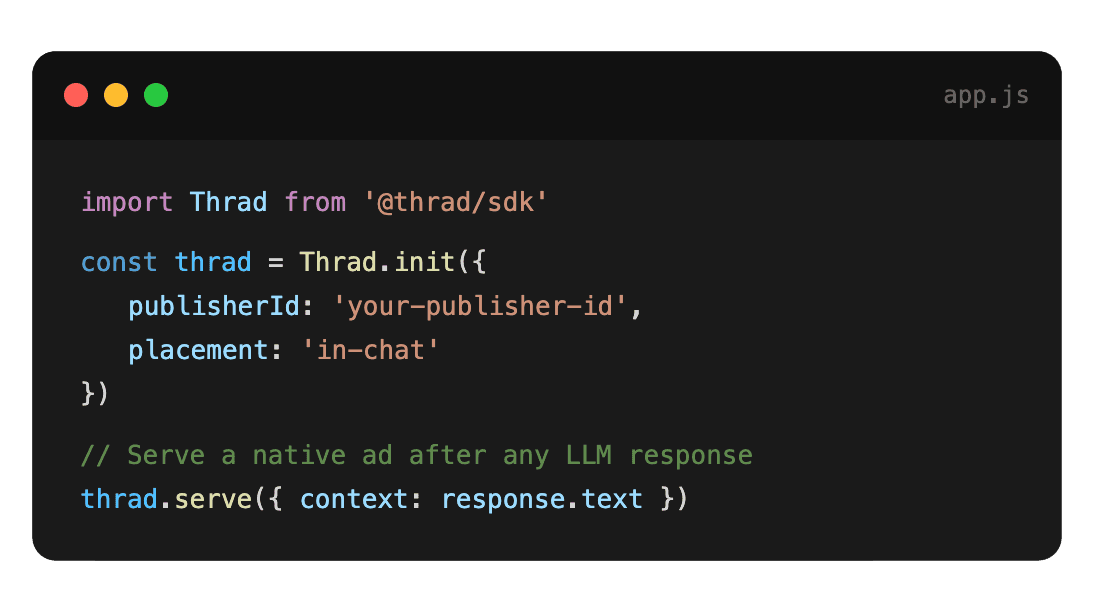
Start monetizing your AI app in under an hour
With Thrad, publishers go from first API call to live ads in less than 60 minutes. With fewer than 10 lines of code required, Thrad makes it easy to unlock revenue from your conversational traffic the same day.
The phrase "ChatGPT ads agency" barely existed 12 months ago. Today dozens of shops have rebranded around the category, new AI-native agencies have raised rounds, and the quality gap between the best and the worst of them is enormous. Buyers walking into that market in 2026 deserve a real checklist — not a "top 25 list" SEO article that ranks whichever shops paid for placement. This is the checklist we would use if we were hiring: the criteria that actually predict whether the agency will move numbers, the red flags that should end the meeting early, and the twelve questions every finance-approved RFP should contain.
What is a ChatGPT ads agency?
A ChatGPT ads agency is a services firm that plans, buys, optimizes, and measures paid advertising inside AI assistant surfaces — primarily ChatGPT today, but almost always across Perplexity, Google AI Overviews/Gemini, Microsoft Copilot, and in-app AI assistants as well. The best ones pair paid media execution with earned-visibility work (generative engine optimization) and with a brand-safety governance layer that traditional PPC shops never needed.
The category is narrow in a specific way. A ChatGPT ads agency is not a general digital agency that "has AI expertise"; almost every digital agency claims that. It is a shop whose core specialization is the answer surface — how queries route to AI responses, where sponsored placements appear inside those responses, how to target commercial intent in a prompt-driven medium, how to measure lift when the click doesn't land on your domain first, and how to keep a brand safe in a format that writes the creative itself.
In 2026 the honest scope looks like this:
Paid placements inside ChatGPT — sponsored search results and
shopping cards, typically via the closed OpenAI beta or through
retail-media integrations. OpenAI confirmed a $200,000 minimum
commitment for the beta and roughly $60 CPM pricing, per Adweek's
Q1 2026 coverage.Paid placements across other AI assistants — some agencies run
campaigns on DeepAI and other cooperative AI apps via independent
networks. ExchangeWire reported Thrad's partnership with DeepAI in
February 2026 as one such route.Sponsored placements inside licensed content — publisher
licensing deals that surface brand citations inside ChatGPT answers
through the licensed-content layer.Generative engine optimization (GEO) — the earned-citation work
that makes a brand more likely to be mentioned in AI answers without
paying per placement.Measurement and brand-safety governance — incrementality design,
citation tracking, answer-quality auditing, and the compliance work
around disclosure and claims.
If the agency's pitch covers only the first bullet, you're hiring a ChatGPT reseller, not an AI-assistant advertising partner.
Why does it matter who you pick in 2026?
The surface is new, the rules aren't finalized, and a mediocre agency partner can burn six figures of budget producing impressions inside query volume that never had commercial intent. The financial downside of a bad choice is large enough — and the signal value of early pilot data is valuable enough — that the hiring decision materially shapes whether your brand's 2026 AI advertising effort looks successful or wasted.
Three structural facts make the choice high-stakes:
Minimum spends are real. OpenAI's $200,000 floor means a brand
that wants access to the ChatGPT beta is effectively paying a six-
figure ticket before the first impression serves. If the agency
misallocates that ticket — wrong categories, wrong audiences,
untested creative — the sunk cost is not trivial.Measurement is still being defined. There is no universal
attribution standard for AI-assistant advertising. Agencies without
measurement discipline will report vanity metrics (impressions,
CTR) rather than business outcomes, and the finance team will have
no way to judge the spend.Cross-surface coverage is the funnel. B2B research cited by
Warmly and Forrester puts LLM usage during B2B buying at 94%.
Buyers don't stay inside one assistant — they toggle across
ChatGPT, Perplexity, Gemini, Claude, and Copilot. An agency that
can only buy on one surface leaves the rest of the funnel open.
ChatGPT ads start at a $200,000 minimum commitment and roughly $60 CPM — about three times Meta's average rates. Hiring the wrong agency to steward that spend is the most expensive mistake in 2026 AI advertising.
How should you weight the criteria?
The correct evaluation uses weighted criteria, not a checklist where every item counts equally. In 2026 the criteria that most predict whether the agency moves numbers are, in order: cross-surface coverage, measurement discipline, vendor independence, pricing transparency, brand-safety posture, and cultural fit. The table below is what a defensible scoring rubric looks like.
Criterion | Weight | What to look for | Dealbreaker |
|---|---|---|---|
Cross-surface coverage | 25% | ChatGPT + at least 2 other AI assistants live in current campaigns | ChatGPT-only with no plan for Perplexity, Copilot, Gemini |
Measurement discipline | 20% | Incrementality designs, holdouts, documented test-read cadence | "Impressions and CTR" is the reporting stack |
Vendor independence | 15% | No single-platform revenue dependence; independent ad network relationships | Agency's revenue model requires one platform's ongoing approval |
Pricing transparency | 15% | Itemized CPM pass-through, explicit agency fee, no hidden retail-media rebates | "We cannot disclose pricing" or refusal to show media-buy economics |
Brand-safety posture | 10% | Written labeling policy, answer-quality auditing, compliance reviews | No opinion on disclosure standards or IAB Tech Lab guidance |
Creative adaptation | 10% | Has shipped copy/creative specifically for AI answer surfaces | Repurposes Google Search ad copy into ChatGPT placements |
Cultural fit and bench | 5% | Named senior owners, clear escalation, retention of assigned team | Constant team turnover or "junior-heavy" staffing |
Why cross-surface coverage gets the highest weight
A buyer who asks ChatGPT a question at 9am often follows up in Perplexity at 10am and Gemini during their commute home. The research journey is cross-assistant by default. An agency that can buy only on ChatGPT sees the top of the funnel and misses the comparison stage. An agency that runs independent ad network relationships (including networks like Thrad that serve ads across multiple AI apps) can actually cover the funnel as it is, not as ChatGPT alone defines it.
Why measurement discipline gets the second-highest
Without measurement discipline, every other criterion collapses. Incrementality is the single metric that matters in 2026 — did the campaign generate business outcomes that wouldn't have happened otherwise? — and it requires holdouts, not last-click attribution. Agencies that treat measurement as "whatever the platform's dashboard shows" are telling you they cannot defend the spend when finance asks.
Why vendor independence matters more in 2026 than before
The AI advertising category is currently structured around one dominant surface (ChatGPT) run by one company (OpenAI). Agencies whose revenue depends on OpenAI's ongoing approval cannot give you honest advice when OpenAI changes its terms — and OpenAI has already changed pricing, minimums, and inventory structure multiple times in the past year. An independent agency that works with multiple networks (independent AI ad networks, retail media, affiliate networks, publisher partnerships) will tell you when it's time to pull budget off ChatGPT. A dependent one will tell you to keep spending.
What questions should you ask in the pitch?
Ask questions that force the agency to reveal what they actually know, what they don't know, and how they charge for the difference. Most pitch decks are calibrated to close you; a good buyer uses questions calibrated to open the real economics. The twelve below are the ones we would put in an RFP.
Which AI assistant surfaces do you currently buy on, and how many
active campaigns have you shipped on each? The specific campaign
count matters more than the list of logos.Show me a redacted measurement plan from a recent pilot,
including the holdout design. If there's no holdout, there's no
measurement.What's the CPM you paid on my behalf last quarter, and what
margin did you charge on top? Serious agencies can answer this.Which platforms do you have direct reseller or API relationships
with? Which do you buy through other agencies? Reselling through
another agency means another layer of margin.What's your position on incrementality vs. last-click
attribution, and how do you defend it to finance? Listen for a
point of view, not hedging.Walk me through a campaign where the creative had to be adapted
specifically for an AI answer surface. If they say "we use the
same copy as Google Search," that's your answer.What's your brand-safety policy for generative surfaces, and how
does it reference IAB Tech Lab guidance? If they have never read
it, walk away.Who specifically will be on my account — named people, not
roles? Pitch teams are famously not the execution team.What's your stance on GEO (earned citations) vs. paid
placements, and how do you split budget? Good agencies have a
view on the mix.Under what circumstances would you tell me to stop spending on
ChatGPT and move budget elsewhere? Independence test. A
dependent agency will never answer this.What's your termination clause, and what happens to the pilot
data if we leave? Data portability matters.What would you not recommend we do in 2026 AI advertising? A
shop with nothing to decline is selling whatever closes fastest.
What are the biggest red flags?
The red flags are specific, they recur across the weakest agencies, and every one of them is expensive if ignored. The top four are certainty without data, vendor lock-in hidden as partnership, opaque media economics, and "AI-ification" of a generic PPC deck. Any one of them should slow the meeting; any two should end it.
Certainty without data. "We know ChatGPT ads drive 3× ROAS" is
not a statement anyone can make honestly in early 2026. Serious
agencies say "Here's our pilot range, here's the sample size,
here's the holdout design." Certainty is a sales tactic, not
competence.Vendor lock-in dressed up as partnership. "We're a ChatGPT
specialist" often means "our revenue depends on OpenAI being
happy with us." A specialist is fine; a single point of failure
dressed as a specialist is not.Opaque media economics. If the agency won't show you the CPM,
won't separate media from service fees, and won't disclose
retail-media rebate structures, assume you're paying more than
you realize."AI-ified" generic PPC decks. Slides that swap "Google
keywords" for "ChatGPT prompts" without adapting the underlying
mechanics are a strong signal the agency has no real execution
experience on the answer surface. Ask for live screenshots of
current campaigns inside the actual surface, not dashboards.No point of view on labeling and disclosure. 2026 labeling
standards are still being set by IAB Tech Lab and by platform
policies. An agency without a written policy on labeling is one
FTC inquiry away from an embarrassing incident.Junior-heavy staffing masked by senior pitch. The senior
creative director in the pitch is not on your account after
signing. Ask who is.
Common misconceptions
"All ChatGPT ads agencies can buy on the beta." They can't. The
$200,000 minimum and closed invite list mean only a subset of
agencies have direct OpenAI access. Others resell through holding
companies or larger agencies and pass the margin along."A GEO agency and a ChatGPT ads agency are the same thing."
They are not. GEO is earned citation work; ads is paid placement.
The best 2026 partners do both, but the skills, tools, and
incentives are different."More spend = better results on ChatGPT." Not yet. Inventory is
scarce and commercial-intent query volume is still limited on some
surfaces. Past the commercial-intent ceiling, additional spend
buys impressions on non-commercial queries where lift is low."The agency can just port our Google Search campaigns." They
cannot usefully. ChatGPT's targeting model is category and prompt-
intent based, not keyword-bid based; the campaigns need to be
redesigned, not migrated.
What comes next for the agency category?
The 2026 shakeout will separate agencies with genuine cross-surface execution from those selling ChatGPT-specialist branding over generic PPC. Expect consolidation: specialist boutiques absorbed by holding companies, failed AI-native agencies shutting down after one bad pilot cycle, and a small number of independent AI-advertising networks becoming the default infrastructure underneath whichever agency you pick. Buyers who want optionality in 2027 should pick partners who already work with multiple networks today.
Three shifts worth tracking:
Self-serve access opens. OpenAI has said it will expand buying
formats as testing results mature. When self-serve arrives, the
minimum-spend barrier drops and the agency value proposition
shifts from "access" to "skill."Measurement standardizes. IAB Tech Lab's generative-advertising
guidance will iterate past v1, and attribution norms will
converge. Agencies with documented measurement discipline now will
be ahead; agencies without will have to rebuild methodology under
client pressure.The category boundary moves. "ChatGPT ads" as a category
label will likely become "AI-assistant advertising" or "answer-
surface advertising" once Copilot, Gemini, Perplexity, and in-app
assistants add comparable inventory. Pick an agency whose framing
already matches the wider category, not the narrow one.
How to run the selection process
Run a structured selection, not a vibes check. The brands that made good decisions in Q1 2026 ran the process in four phases: long list, rubric scoring, structured Q&A, and a paid pilot. The brands that regretted their pick made a gut call after one charismatic pitch. The extra two weeks of process are the cheapest insurance in the category.
Phase 1 — long list. Sources: trade press coverage, peer
recommendations, vendor-independent networks' partner directories.
Cap at 10 shops; anyone ranking agencies without disclosing paid
placement is not a useful source.Phase 2 — rubric scoring. Score the long list against the seven
weighted criteria above. Cut to the top four.Phase 3 — structured Q&A. Send all four the same twelve
questions. Compare answers side-by-side. The shops that answer the
"what would you tell me not to do" question honestly usually win on
retention.Phase 4 — paid pilot. A three-month paid pilot with a pre-
agreed measurement plan and a written success threshold. Pay
reasonable money; insist on reasonable rigor. The agency that
refuses a pilot with incrementality design is telling you the
answer.
Thrad's pitch, for transparency: we are the independent AI-assistant ad network underneath many of the agencies in this category. If your agency says they can only buy on ChatGPT, ask why they cannot serve ads across the other assistants users actually toggle through. A good agency will either have an answer or be willing to work with networks that do. You can read more at thrad.com.

chatgpt advertising agency, ai ads agency, ai assistant ads agency, llm advertising agency
Citations:
Adweek, "Exclusive: OpenAI confirms $200,000 minimum commitment for ChatGPT ads," 2026. https://www.adweek.com/media/exclusive-openai-confirms-200000-minimum-commitment-for-chatgpt-ads/
ALM Corp, "OpenAI ChatGPT ad pricing revealed: $60 CPM and $200,000 minimum commitment," 2026. https://almcorp.com/blog/chatgpt-ad-pricing-60-cpm-200000-minimum/
Single Grain, "Top ChatGPT advertising agencies in 2026," 2026. https://www.singlegrain.com/artificial-intelligence/top-chatgpt-advertising-agencies-in-2026/
Adventure PPC, "ChatGPT ads agency selection: 10 questions to ask before hiring in 2026," 2026. https://www.adventureppc.com/blog/chatgpt-ads-agency-selection-10-questions-to-ask-before-hiring-in-2026
OpenAI, "Powering product discovery in ChatGPT," 2026. https://openai.com/index/powering-product-discovery-in-chatgpt/
Ad Age, "How ChatGPT ads could lend brands an AI advantage," 2026. https://adage.com/technology/ai/aa-openai-ads-brands-agencies/
ExchangeWire, "Thrad partners with top-10 consumer AI app DeepAI to enable paid ads in LLMs," 2026. https://www.exchangewire.com/blog/2026/02/02/thrad-partners-with-top-10-consumer-ai-app-in-the-world-deepai-to-enable-paid-ads-in-llms/
Retail Dive, "ChatGPT launches shopping research feature," 2026. https://www.retaildive.com/news/openai-launches-chatgpt-shopping-research-feature/806656/
Be present when decisions are made
Traditional media captures attention.
Conversational media captures intent.
With Thrad, your brand reaches users in their deepest moments of research, evaluation, and purchase consideration — when influence matters most.