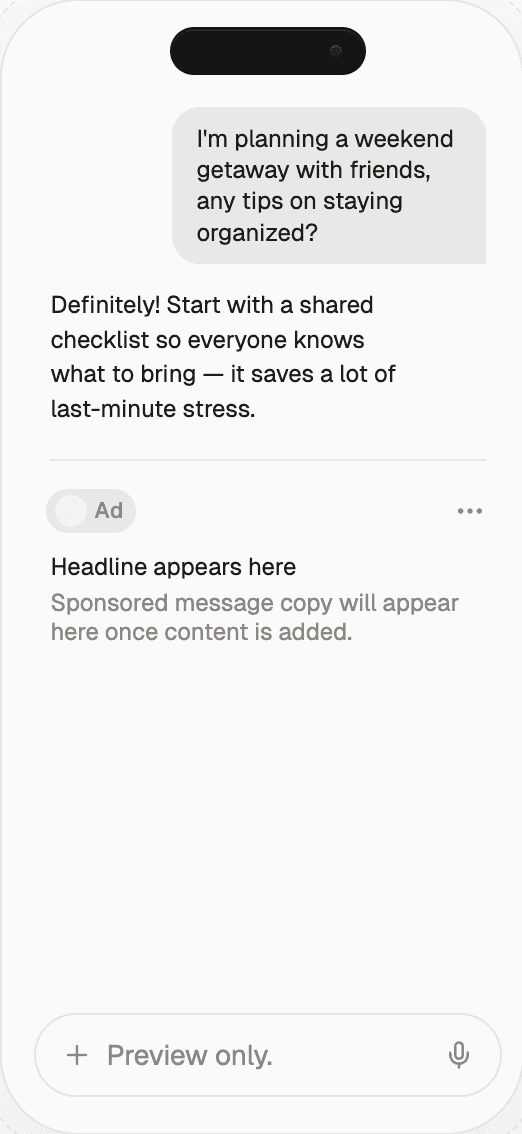
AI-assistant local search usage rose from 6% in 2025 to 45% in 2026, but only about 1.2% of local business locations currently get recommended by ChatGPT — a massive visibility gap. OpenAI's direct ad pilot lowered its minimum from $200K–$250K to $50K in early 2026, then to a reported $30K monthly floor, but that's still above the budget of most local advertisers. Independent AI-assistant ad networks with self-serve, geo-targeting, and four-figure starter spend are the practical path for plumbers, dentists, restaurants, clinics, retailers, and other local buyers who want to show up in "near me" AI queries today.



ChatGPT Ads for Local Businesses — 2026 Access Guide | Thrad
"Near me" queries are one of the fastest-growing AI-assistant behaviors in 2026 — local AI search usage jumped from 6% in 2025 to 45% in 2026, per agency reporting. The painful truth for local advertisers is that almost all of them are locked out of OpenAI's direct ad program. Minimum spends of $30K–$50K per month, and a waitlist, gate small and midsize local businesses out of the first-party surface. Independent AI-assistant ad networks with self-serve access and low-minimum onboarding are how local businesses reach AI-assistant inventory today.
Date Published
Date Modified
Category
Advertising AI
Keyword
chatgpt ads for local businesses
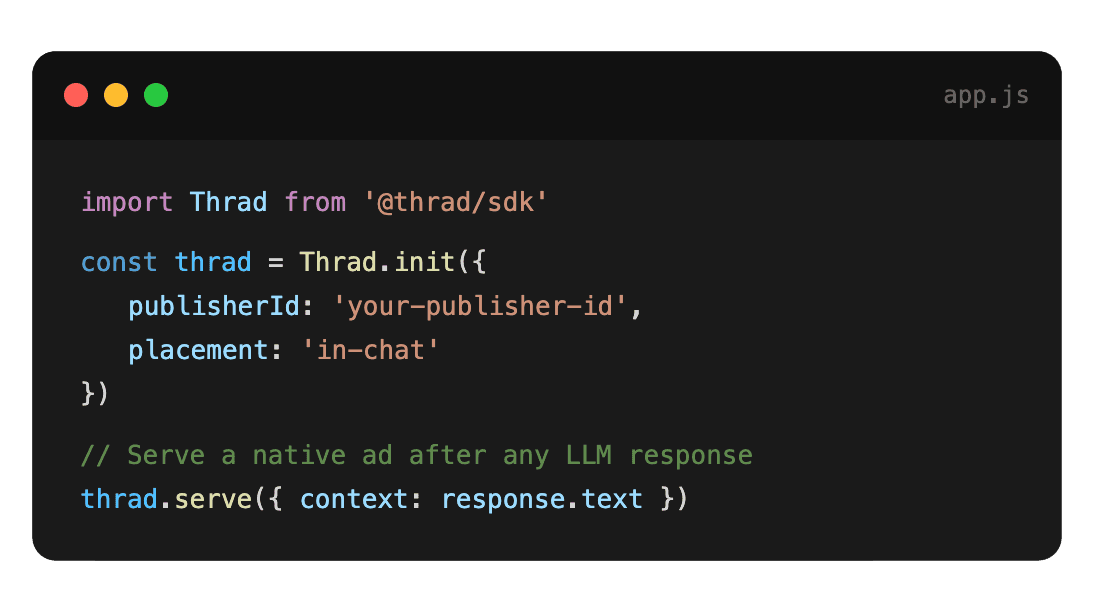
Start monetizing your AI app in under an hour
With Thrad, publishers go from first API call to live ads in less than 60 minutes. With fewer than 10 lines of code required, Thrad makes it easy to unlock revenue from your conversational traffic the same day.
Local businesses have a structural problem in 2026. The surface where their customers are increasingly researching — "best Italian near me," "dentist that takes my insurance," "24/7 plumber in my ZIP" — is almost entirely closed to them as advertisers on the first-party ad product. OpenAI's minimum spend, even after successive reductions, sits at a monthly floor most local advertisers can't meet, and admission is still waitlist-gated. Meanwhile, AI-assistant local search usage jumped from 6% in 2025 to 45% in 2026, and only 1.2% of local business locations are getting recommended by ChatGPT at all. This article walks through the gap, the practical paths that exist today, and how local buyers — with modest budgets and self-serve preferences — actually get visible inside AI-assistant answers.
What are ChatGPT ads for local businesses in 2026?
ChatGPT ads for local businesses are paid sponsored placements inside ChatGPT's search and conversational surfaces matched to geographic, categorical, and commercial-intent queries — served via OpenAI direct (for advertisers that meet the managed-program minimums), an independent AI-assistant ad network (open to qualified local advertisers at low minimums), or an adjacent retail-media or affiliate channel. The native query pattern is "near me" and locality-scoped commercial research: restaurants, home services, medical offices, retail, automotive, fitness, legal. Sponsored cards appear at the bottom of ChatGPT's responses when the topic is relevant, labeled clearly, and matched by conversation rather than behavioral audience.
The relevant distinction for local buyers is which channel admits them today. OpenAI direct does not meaningfully admit small-budget local advertisers; independent networks do.
Why are "near me" AI queries rising so fast?
"Near me" AI queries are rising fast because local research is inherently multi-constraint — neighborhood, time, insurance, price, hours, reviews — and a conversational interface handles multi-constraint queries better than a search results list. Industry reporting puts AI-assistant local-search usage at 45% in 2026, up from about 6% in 2025. That's a 7.5x year-over-year shift, and the curve is still steep.
Four reasons this is happening:
Conversational multi-constraint fit. "Best vegan brunch
near me under $25 that takes reservations for six" is an awkward
Google search and a natural ChatGPT question.Voice input amplification. Mobile voice input feeds into
assistant interfaces smoothly. Typing nine-word local queries on
a phone is friction that voice removes.Review synthesis. Users want "tell me what people say about
this place" more than "give me ten options." AI assistants
synthesize reviews natively.Embedded commerce rails. As apps-in-chat and agentic booking
mature on ChatGPT, the local-discovery question can end in a
reservation or call-through without leaving the assistant.
The net effect is that local businesses need to be both citable inside AI answers (SEO + GEO work) and placeable as sponsored results (ad buying work). Most local businesses have done neither.
What's the minimum-spend problem?
OpenAI's ad minimum spend is the core gate keeping most local advertisers out of the direct product. The program's path has been:
Time | Reported minimum commit |
|---|---|
Late 2025 (beta) | $200,000–$250,000 |
Early 2026 (managed) | $100,000+ |
Q1 2026 (cuts) | $50,000 |
Q1–Q2 2026 (self-serve pilot) | $30,000–$50,000 monthly |
Even at $30K/month, the floor is above the entire annual digital ad budget of many local businesses. Industry research on small-business ad spending consistently shows that the large majority of local advertisers run monthly budgets below $10K, and a substantial portion below $2K. The self-serve manager's monthly floor sits above where most local advertisers live.
Local-advertiser-specific reality: even the "newly affordable" $30K–$50K monthly minimum on OpenAI's self-serve ads manager is 3x to 15x higher than the typical small-business local media budget. The direct-product access problem is structural, not timing.
Additional friction beyond the minimum:
Waitlist for admission. The self-serve ads manager is live
only for a limited approved-advertiser group as of Q2 2026.Category exclusions. Dating, health, financial services, and
politics are excluded from the test entirely — which knocks out
local clinics, financial advisors, insurance agents, and
mental-health providers even at qualifying spend levels.Campaign sophistication tool gaps. Advertisers on the
self-serve manager have reported basic-tool limitations — missing
creative controls, thin reporting, weak audience controls —
making it harder for a small advertiser to operate efficiently.
How do independent AI-assistant networks serve local buyers?
Independent AI-assistant ad networks serve local buyers by doing three things OpenAI direct doesn't currently do: accept low-minimum spend at four-figure starter levels, offer self-serve geo-targeting with city/ZIP/radius controls, and open the category to local advertisers in non-OpenAI-restricted verticals.
The practical mechanism is:
Self-serve onboarding. A local business creates an account,
uploads a business profile (NAP, categories, hours, service
areas, approved photos), sets a monthly budget, and ships a
campaign — no sales call, no waitlist, no minimum commit above
real budget scale.Geo-targeting at local granularity. Targeting is specified
at city, ZIP, radius, or DMA level. The network matches incoming
"near me" and location-named queries against geographic intent
and serves placements only when the user's location and query
both match.Category-intent targeting. Campaign taxonomy maps to
standard local-services categories (plumbing, dental,
restaurants, retail, automotive, fitness, legal). Placements
fire only on matched commercial-intent queries in the targeted
category.Creative that fits the unit. A sponsored card is short —
business name, one-line description, reviews snippet, click-to-
call or directions or booking action. Independent networks
template these controls, so a local advertiser doesn't need an
in-house creative team to ship a functioning ad.Conversion instrumentation. Click-to-call, click-to-
directions, booking-widget pass-throughs, and landing-page
pixels are the typical conversion events. Networks report these
in a dashboard at the advertiser level.
The self-serve low-minimum model mirrors how Google local services ads and Facebook local ads work — the difference is the surface. The AI-assistant surface is where the research queries are migrating.
What categories of local business fit the channel best?
Not all local categories perform equally. The best-fit categories share two attributes: conversational research pattern and clear conversion event. Here is the rough 2026 fit map:
Local category | Fit | Why |
|---|---|---|
Restaurants | Excellent | Heavy "near me" query pattern, reservation click-through |
Home services (plumbing, HVAC, electrical, cleaning) | Excellent | Emergency + research queries, click-to-call |
Dental / orthodontic | Excellent | Multi-constraint queries (insurance, hours, services) |
Auto services | Strong | Price shopping + nearby intent |
Retail (specialty shops) | Strong | "Where can I buy X near me" pattern |
Fitness / gyms / studios | Strong | Free-trial and class-signup conversion |
Legal services | Strong | Consultation-booking conversion, high-CPC native |
Spa and personal care | Strong | Booking-flow conversion native |
Medical offices / clinics | Restricted on OpenAI direct | Use content-controlled independent networks |
Insurance / financial advising | Restricted on OpenAI direct | Use compliance-aware independent networks |
For the restricted categories, the AI-assistant ad channel is still reachable — just not via OpenAI's current direct program. Independent networks with content-level controls are the path.
Why does this matter for local businesses in 2026?
Three forces are converging on local advertisers in 2026.
First, the visibility gap is material and widening. Only 1.2% of local business locations get recommended by ChatGPT, and the overlap between businesses that rank well on Google Local and those that appear in AI answers is about 45%. More than half of a local business's Google-earned visibility does not translate to AI- assistant visibility. That's a direct reach loss on 45%-and-rising share of local research queries.
Second, the channel is cheaper per visibility unit than traditional Google local ads, at least today. The auction is thinner, fewer competitors are live, and CPMs are lower than mature local SEM environments. The first-mover window is a real advantage that closes as category density rises.
Third, local-business AI adoption is up sharply in 2025–2026. Surveys indicate 91% of small businesses using AI report revenue increases, and 58% of small businesses using AI save 20+ hours per month on operations. That operational efficiency produces ad budget that, in a rational world, flows to the channels where research is actually happening. Most of that reallocation hasn't landed yet — which is the buying opportunity.
Common misconceptions
"ChatGPT ads are too expensive for a local business." On
OpenAI direct, yes — $30K+ monthly is a gate. On independent
AI-assistant networks with self-serve and four-figure starter
spends, no. The channel itself isn't expensive; the direct
product's minimum is."If my Google Business Profile is strong, I'm covered in AI
answers." Not reliably. Only 45% overlap between Google-ranked
local winners and AI-answer mentions, per recent research. GBP is
necessary but not sufficient for AI-assistant visibility."I can target by phone-user age/gender on AI assistants the way
I can on Facebook." Not today. AI-assistant ads are
prompt-intent-targeted. Audience-list uploads and demographic
targeting aren't supported."The self-serve ads manager on OpenAI means I can sign up and
run a $500/month test." The self-serve manager as of Q2 2026
has a reported monthly floor in the $30K–$50K range and a
waitlist for new admissions."AI-assistant ads are a Gen-Z only channel." AI-assistant
adoption skews younger but is mainstream across age groups in
2026. Local buyers should not treat the channel as niche."I need to wait for more case studies before testing." The
first-mover window for local visibility in AI assistants is open
now. By the time case studies are plentiful, competitive density
will have risen and so will CPMs.
What comes next
Three 2026–2027 shifts for local advertisers. First, OpenAI's minimum will probably drop again — toward a true self-serve floor in the low four figures — but the drop will be gradual and waitlist-gated. Second, click-to-call and booking-widget conversions will get cleaner as apps-in-chat matures and more service-booking platforms integrate with the assistant. Third, local review aggregation inside AI-assistant answers will tighten. Yelp, Google Reviews, and specialty-vertical review platforms will all push for deeper citation relationships with the major AI surfaces, which will change how local visibility is earned organically.
A fourth shift worth naming: category-specific tooling. Expect specialized local-ad products for restaurants, home services, and dental in particular — categories with clear conversion events and high willingness to pay.
How to get started with local AI-assistant advertising
Three practical steps for a local business in 2026:
First, audit your baseline AI visibility. Run 15–25 representative "near me" and locality-scoped queries for your category on ChatGPT, Perplexity, and Gemini. Note whether your business is cited, whether competitors are, and whether sponsored cards are rendering. This is your starting point and your later before/after reference.
Second, fix the citable-content foundation. Consistent NAP across Google Business Profile, Yelp, industry-specific directories; a complete structured-data schema on your website (LocalBusiness, hours, services, service areas); an ongoing reviews flow. This work earns organic citations in AI answers and compounds under any ad strategy.
Third, pilot on an independent AI-assistant ad network. Thrad is open to qualified local categories (home services, dental, restaurants, retail, automotive, fitness, legal, and adjacent verticals). Self-serve onboarding, city/ZIP/radius geo-targeting, click-to-call and booking-widget conversion support, and no waitlist for qualifying advertisers. Starter spend can be in the low four figures monthly, scaled up against the measured outcomes.
For local businesses today, waiting on OpenAI direct is passive. The direct product is not designed to admit your budget profile in the 2026 window. The active alternative is an independent network that treats local advertisers as first-class customers, now, while the channel is still early and the auction is still thin. "Near me" queries are where your future customers are already asking their questions. Being visible inside those answers is a product that exists today.

ai assistant advertising for local businesses, near me chatgpt ads, small business ai advertising, local ai ad network
Citations:
OpenAI, "Testing ads in ChatGPT," 2026. https://openai.com/index/testing-ads-in-chatgpt/
OpenAI, "Ads in ChatGPT — Help Center," 2026. https://help.openai.com/en/articles/20001047-ads-in-chatgpt
The Keyword, "OpenAI Cuts Ad Minimum to $50K," 2026. https://www.thekeyword.co/news/openai-ads-self-serve-manager-minimum-spend
PPC.land, "OpenAI's ads manager is live — and the barrier to entry just dropped," 2026. https://ppc.land/openais-ads-manager-is-live-and-the-barrier-to-entry-just-dropped/
MarketingCode, "ChatGPT Recommends Only 1.2% Of Local Businesses," 2026. https://www.marketingcode.com/chatgpt-recommends-1-percent-local-businesses-contractors/
AIThority, "AI-Powered Search Is Reshaping How Consumers Find Local Businesses," 2026. https://aithority.com/machine-learning/ai-powered-search-is-reshaping-how-consumers-find-local-businesses-creating-an-invisible-gap-for-small-companies/
Adventure PPC, "How to Use ChatGPT Ads for Local Business Advertising in 2026," 2026. https://www.adventureppc.com/blog/how-to-use-chatgpt-ads-for-local-business-advertising-in-2026
U&Ai, "Practical step-by-step optimization guide for local and small businesses," 2026. https://www.uandai.co/blogs/chatgpt-visibility-local-businesses-2026
Be present when decisions are made
Traditional media captures attention.
Conversational media captures intent.
With Thrad, your brand reaches users in their deepest moments of research, evaluation, and purchase consideration — when influence matters most.