Generative AI advertising for CTV means three things in 2026:
household-level dynamic creative, QR-and-assistant hand-offs that
turn a big-screen moment into a measurable action, and outcome-
based measurement that replaces gross impressions. US CTV ad spend
is projected at roughly $42B in 2026 per eMarketer, and advertisers
are finally allowed to personalize the creative that spend buys.
The technology is ready; the creative supply chain is the
bottleneck, and the winners are the buyers who rebuild approval
workflows before they rebuild media plans.







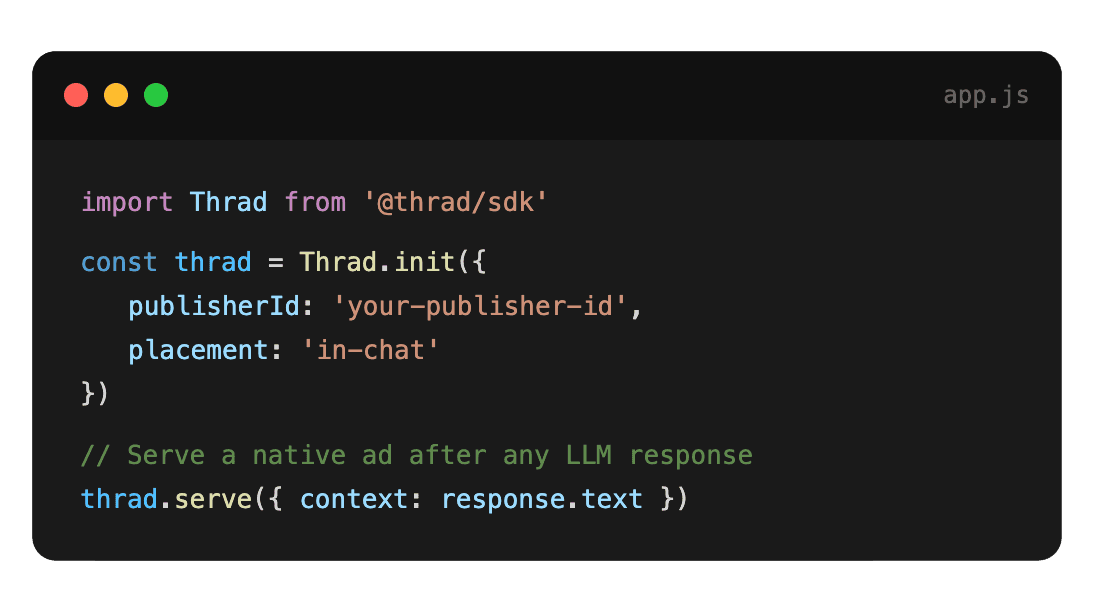
Start monetizing your AI app in under an hour
With Thrad, publishers go from first API call to live ads in less than 60 minutes. With fewer than 10 lines of code required, Thrad makes it easy to unlock revenue from your conversational traffic the same day.

Generative AI Advertising for CTV 2026 | Thrad
CTV is the best-funded, least-personalized ad surface in 2026.
Advertisers spend billions to show the same 30-second spot to every
household in a DMA — a state of affairs that generative AI is
dismantling. The CTV buyers pulling ahead are generating household-
relevant variants at scale, using QR and assistant hand-offs as the
measurable bridge, and replacing impression dashboards with real
response curves.
Generative AI advertising for CTV in 2026 is where the creative supply
chain finally catches up to the targeting. For years, advertisers
could buy a household — but then had to run the same 30-second spot
against every one of them. That constraint is gone. The buyers who
rebuilt their creative supply chain around household-level variants
are the ones compounding, and the buyers who treated generative AI as
an experimental line-item are watching performance gaps widen every
quarter. CTV is where the biggest ad budgets in the industry meet the
shallowest personalization today, and 2026 is the year that gap
closes materially.
What does generative AI advertising mean for CTV specifically?
For CTV specifically, generative AI advertising means four shifts
happening together: household-level dynamic creative becomes table-
stakes, QR and assistant hand-offs close the measurement gap between
impression and action, outcome-based measurement replaces gross
impressions, and creative supply chain becomes the new bottleneck
rather than the creative idea. Each shift is already visible in
in-market data; none of them is reversible.
Household-level dynamic creative is table-stakes. Platforms
can now stitch variants based on household signals; the limit is
the advertiser's variant library, not the platform. Roku,
Samsung, LG, Netflix, Disney+, Amazon Fire, and Hulu all support
variant stitching in some form by 2026.QR codes and assistant hand-offs turn a big-screen spot into a
measurable action. The missing middle between impression and
conversion is finally filled. QR scan rates on CTV average
0.6–1.8% in 2026 versus effectively zero click-through on
classical linear.Outcome measurement replaces gross impressions. Household-
level lift vs. matched control is what sophisticated buyers now
demand. Gross impressions become a reach-and-pacing metric, not
an outcome metric.Creative supply chain becomes the bottleneck. The technology
ships variants faster than most agencies and brand teams can
approve them. The approval bottleneck is the single largest
unlock in 2026 CTV programs.
A CTV plan in 2026 that doesn't address at least three of these is
leaving substantial performance on the table — and more importantly,
losing the pattern-learning that compounds into the 2027 plan.
How does household-level dynamic creative actually work?
Household-level dynamic creative works by producing many rendered
video variants from a single approved master and letting the
streaming platform stitch the right variant to the right household at
serve time. The master — concept, hero shots, music, brand framing —
stays intact; what varies are language, setting, product focus, offer,
and supporting shots conditioned on household signals. Generative AI
is the production engine that makes the variant library feasible
within a campaign budget.
The old CTV creative model was one master, maybe a Spanish-language
cut, maybe a regional-pricing cut. The new model:
Dimension | Old CTV model | Generative AI CTV model |
|---|---|---|
Master spots | 1–3 per campaign | 1 master + 100–800 variants |
Language cuts | 1–2 | 5–10 per market, including dialect |
Audience cuts | Demo + DMA | Household composition, prior purchase signals, genre context |
Offer variants | Flat across DMA | Tuned to household stage-of-funnel |
Scene customization | None | Setting, props, season, weather |
Brand safety review | Per spot, manual | Library + prompt + audit trail |
Critically, the master spot — the concept, the hero shots, the music,
the brand framing — doesn't change. Production work is what
compresses. The brand manager still approves one hero creative; the
rest of the library is generated within the guardrails that manager
sets up-front.
A practical variant plan for a Q4 retail campaign:
Variant axis | Options | Variants |
|---|---|---|
Language | EN / ES / FR / ZH / KO | 5 |
DMA group | North / South / Mid / West / Urban | 5 |
Household composition | Family / Couple / Single / Senior | 4 |
Offer | Price / Bundle / Free-shipping / Exclusive | 4 |
Stage | Awareness / Consideration / Conversion | 3 |
Total variant grid | 1,200 |
Not all 1,200 cells get filled — brands typically ship 200–400 of
them in market — but the grid is the planning artifact that didn't
exist before generative AI.
How do QR and assistant hand-offs close the measurement gap?
QR codes and assistant hand-offs close the CTV measurement gap by
giving the viewer a second-screen path that is trackable and
personalizable per variant. A scanned QR routes to a landing page
matched to the household and the offer; a viewer-triggered assistant
query produces a branded-query spike that is measurable within 30–60
minutes of airing. Together they recover much of the direct-response
signal that classical TV never had.
QR codes. Adoption is high enough in 2026 that scanning a code
from a TV is no longer an eccentric behavior. The pandemic trained
most households; the 2024–2025 QR-on-CTV campaigns normalized it.
Personalized QR destinations (landing page variants matched to
household and offer) lift conversion materially vs. a static URL
— 1.4–2.1× in Nielsen's 2026 benchmark.Assistant queries. A branded spot triggers a measurable spike
in assistant queries within 30–60 minutes, peaking around the
15-minute mark for prompt-friendly categories. Tracking
branded-query lift is a real measurement layer most CTV buyers
still ignore because most CTV measurement stacks weren't built
for it.Household-level match-back. Linking the impression to
downstream purchase behavior at the household level closes the
remaining gap for advertisers with clean data — retailer media
networks, loyalty-program data, or identity-graph partners.
Measurement layer | What it measures | Typical range |
|---|---|---|
Gross impressions | Reach, pacing | Baseline — no longer a KPI |
View-through rate | Attention proxy | 88–95% on streaming |
QR scan rate | Direct second-screen intent | 0.6–1.8% in 2026 |
Branded-query lift | Upper-funnel interest | +12–40% in the hour post-spot |
Assistant citation mentions | Passive brand salience | Quarterly lift signal |
Household match-back CVR | Bottom-funnel outcome | 1–6% depending on category |
A CTV spot in 2026 is not a one-way impression. It's the front end
of a second-screen journey — QR, assistant query, or app action.
Advertisers that instrument the full arc are the ones who can
actually defend their spend in a quarterly mix review.
Why is the creative supply chain the real bottleneck?
The creative supply chain is the real bottleneck on CTV generative
because most brand and agency approval workflows were built for one-
master-per-campaign volumes and collapse when asked to review 200
variants before an air date. The technology can produce the variants;
the organization can't approve them fast enough. Every CTV program
we've seen struggle in 2026 had a variant library ready to ship and
no credible way to approve it.
What works in 2026 approval workflow:
Library-and-prompt approval. The brand team approves the
master, the approved asset library, and the prompt constraints.
Variants that fall within the library + prompt + guardrails can
ship without individual sign-off.Sampled human review. A random sample of rendered variants is
reviewed weekly, typically 5–10% of what's in market. Issues
identified drive prompt-and-library updates for the next cycle.Audit trails. Every rendered variant has a traceable record of
which prompt and which library produced it — not just for brand
safety but for the post-campaign review when something does go
off-script.Legal review at the claim level, not the variant level. Legal
pre-approves claims, pricing rules, and exclusions; variants that
honor the claims library ship without re-review. Variant-by-
variant legal would kill the throughput gain.
This is an organizational redesign more than a tooling choice. The
CTV buyers still routing every variant through a six-person creative
review are shipping 20 variants a month; the buyers that redesigned
their workflow are shipping 400, and their performance shows the
difference.
What does a 2026 CTV measurement dashboard actually look like?
A 2026 CTV measurement dashboard drops gross impressions from its
outcome row, foregrounds three second-screen metrics, and reports
household-level lift against a matched control as the primary
outcome. The goal is to close the loop from "we aired the spot" to
"the exposed households bought more than the matched unexposed
households," and every metric above is a step in that chain.
Three KPIs worth adding to any 2026 CTV report:
Branded-query lift post-spot. Did assistant queries for the
brand spike within an hour of airing? Which variants drove the
biggest lift?QR scan rate by creative variant. Which variants actually
drove second-screen action, and which rooms and dayparts produced
the scans?Household-level matched outcome lift. Not just impressions —
did exposed households convert more than matched unexposed ones?
What was the incremental revenue per exposed household?
Gross impressions remain a pacing and reach metric. They are no
longer a sufficient outcome metric, and any CTV dashboard that still
leads with them is a dashboard built for a 2018 media plan running a
2026 budget.
A 2026 CTV plan review typically includes:
Pacing row. Impressions, reach, frequency — still here, now
demoted to "did we deliver what we bought."Attention row. Completion rate, attentive-view rate (from
panel partners like TVision or iSpot).Direct response row. QR scan rate, branded-query lift,
site-session lift from matched households.Outcome row. Household-level match-back CVR and iROAS vs.
matched controls. This is the row finance reads first.Variant row. Lift by variant, flagged for best and worst
performers, with prompt-and-library recommendations for the next
flight.
What are the common misconceptions?
"Generative AI will replace the creative agency on CTV." It
won't. It will reshape what agencies do on CTV — less production,
more concept, library curation, and measurement design. The
concept layer matters more when variants are cheap."Viewers hate personalized ads on TV." Data from 2025–2026
says the opposite, within limits. Household-relevant creative is
preferred to household-irrelevant creative. Creepy over-
personalization (naming the viewer, referencing private behavior)
still gets punished."CTV measurement is hopeless." It's no longer hopeless. QR,
assistant queries, and household match-back are three real
bridges that collectively close most of the gap. "Hopeless" was a
2019 posture."Brand safety kills the use case." It doesn't — library plus
prompt plus sampled review is a credible brand-safety posture
that scales. The discipline is different, not harder."Platform-native variant tools are good enough." They're
getting there, but brands that wait for the platform default lose
the compounding advantage of a mature internal variant library
and prompt system.
What comes next in CTV generative advertising?
Two structural shifts should land through 2027 and they both point at
tighter integration between the big-screen ad and the second-screen
response path. The CTV advertisers building for that world today are
the ones whose 2027 plans already cover shoppable assistant hand-offs
and platform-native variant pipelines; the ones waiting will be
migrating spend while their competitors compound data.
Platform-native variant generation. The major CTV platforms
— Roku, Samsung, Amazon Fire, Netflix ad tier, Disney+, Max —
will increasingly generate variants inside their own ad stacks,
reducing advertiser-side tooling needs and raising the floor on
baseline performance. Expect this to be standard in the 2027
upfronts.Shoppable CTV via assistant hand-off. The second-screen path
will get more instrumented — a viewer triggers a prompt through
their TV remote or phone that resolves into a transaction.
Advertisers that instrument the assistant layer today are
positioned for that flow; the ones that don't will pay a
retrofit tax.Attention-based pricing. Expect CTV inventory to start
pricing on attention metrics (completed views, attentive-view
rate) rather than just impressions. Generative variants that
hold attention better become a pricing advantage.CTV + assistant co-measurement. Nielsen, Comscore, iSpot,
and VideoAmp are all building cross-surface measurement that
stitches a CTV impression to an assistant query and a
household-level outcome. The 2027 measurement default will
include this by default.
How should a CTV advertiser act on this today?
Pick one flagship campaign and commit to three changes over a
single-quarter pilot: rebuild the master into a variant-ready format,
add QR and assistant-friendly hand-offs, and instrument household-
level lift against a matched control. Ninety days of signal will
reshape how you brief every subsequent campaign, and the pilot's
measurement foundation is the piece that scales to the rest of the
portfolio.
Concrete 90-day plan:
Weeks 1–3. Pick the campaign. Rebuild the master in a
variant-ready format — component layers, prompt-friendly scene
metadata, an approved asset library. Lock legal claim rules.Weeks 4–6. Build 60–100 variants across language, household,
and offer axes. Add a personalized QR destination per variant.
Pre-flight every variant once, sample after.Weeks 7–10. Air. Track branded-query lift and QR scan rate
weekly. Adjust variant weighting based on early performance.Weeks 11–13. Report on household-level matched outcome lift.
Propose a rebrief template for the next campaign based on what
moved. Start building the next master with the learnings in the
brief.
Thrad's measurement-and-placement layer is built to help CTV buyers
instrument the assistant layer specifically — branded-query tracking,
citation rate across ChatGPT, Perplexity, Gemini, and Copilot, and
tie-back to the household-level outcomes your mixed-media model
already tracks. The CTV buyers we work with in 2026 are the ones who
decided that gross impressions stopped being a good enough outcome
and started reporting to the CFO on household-level lift.

ctv advertising ai, streaming ai ads, dynamic creative ctv, connected tv personalization
Citations:
IAB, "CTV Advertising Report 2026," 2026. https://iab.com
eMarketer, "Streaming Ad Spend Outlook 2026," 2026. https://emarketer.com
VideoNuze, "Dynamic creative in CTV: case studies," 2026. https://videonuze.com
Ad Age, "How QR is becoming the CTV response layer," 2025. https://adage.com
Nielsen, "CTV Ad Effectiveness Benchmarks 2026," 2026. https://nielsen.com
Digiday, "Inside the platform-side race to personalize streaming ads," 2026. https://digiday.com
MediaPost, "Household addressability on streaming in 2026," 2026. https://mediapost.com
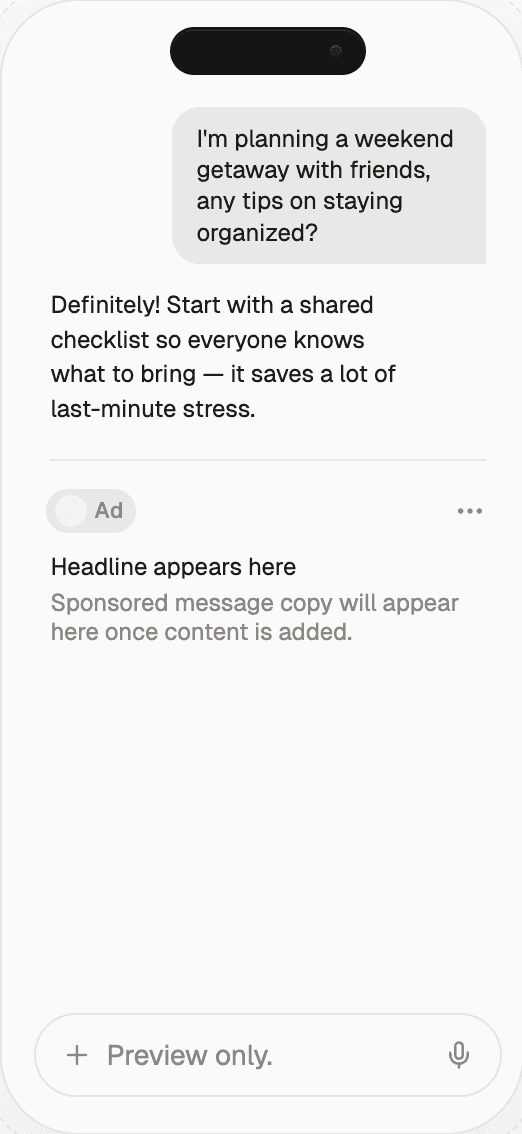
Be present when decisions are made
Traditional media captures attention.
Conversational media captures intent.
With Thrad, your brand reaches users in their deepest moments of research, evaluation, and purchase consideration — when influence matters most.
Date Published
Date Modified
Category
Advertising AI
Keyword
generative ai advertising for ctv