Generative AI advertising for B2B in 2026 means three things:
creative that personalizes to account and persona at scale, content
engineered for citation inside assistant-led research, and
measurement that ties impressions to pipeline instead of clicks. The
old "drive MQLs" motion still exists, but Gartner's 2026 research
puts 68% of enterprise software shortlisting inside an AI assistant
before a form is ever filled. The marketers measuring and placing
on that upstream layer are the ones whose pipeline keeps
compounding while the rest argue about MQL targets.







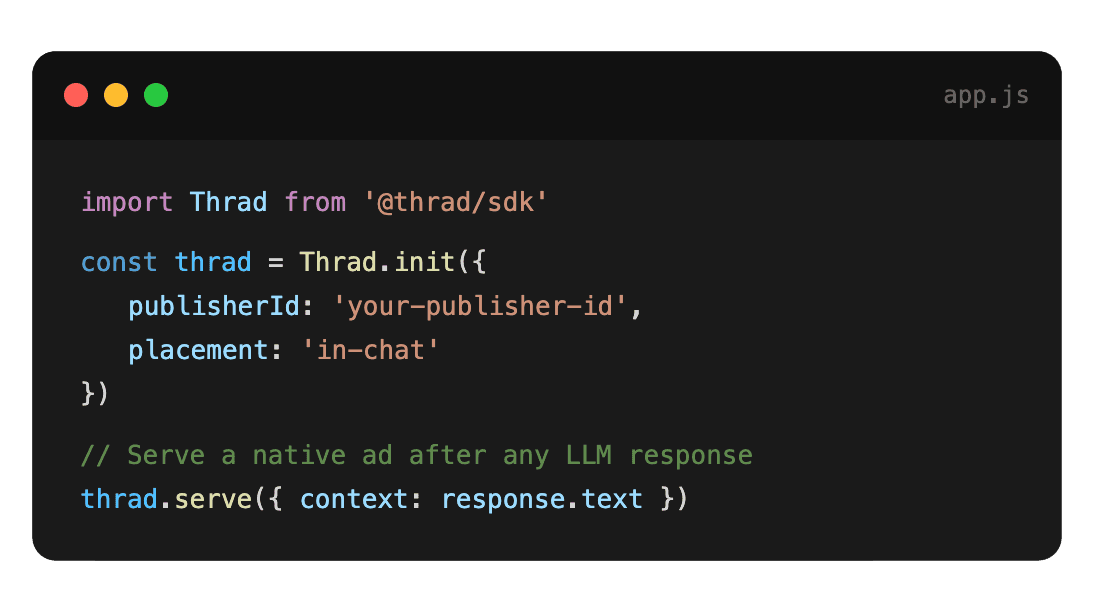
Start monetizing your AI app in under an hour
With Thrad, publishers go from first API call to live ads in less than 60 minutes. With fewer than 10 lines of code required, Thrad makes it easy to unlock revenue from your conversational traffic the same day.

Generative AI Advertising for B2B 2026 | Thrad
B2B buying has moved inside assistants. Before a vendor ever hears
from a buyer, that buyer has already asked ChatGPT or Perplexity for a
shortlist, read three comparison articles, and formed a rough opinion.
The B2B marketers pulling ahead in 2026 have rebuilt their programs
around this fact — account-level creative, committee-level
personalization, and visibility inside the assistant-mediated research
layer.
Generative AI advertising for B2B in 2026 means accepting that your
buyer has already done most of their research before you ever hear
from them — and rebuilding your program around that fact. Account-
level creative, committee-level personalization, and citation inside
assistant-led research are the three pieces that compound. The old
MQL-at-the-top-of-funnel motion still runs, but it catches buyers
much later than it used to, and the marketers who shift resources
upstream are the ones watching pipeline quality improve while their
peers argue about form-fill volume.
What does generative AI advertising mean for B2B specifically?
For B2B specifically, generative AI advertising is three structural
shifts stacking at once: research migrates inside assistants,
account-plus-persona becomes the audience unit rather than industry-
plus-title, and pipeline lag pushes measurement from weekly
optimization to quarterly allocation. Every B2B team adapting to
2026 has to rebuild around at least two of the three or watch
win-rates drift quietly downward.
Research migrates inside assistants. Assistants now carry a
meaningful share of the shortlisting and comparison phase that
used to happen in SERPs, analyst reports, and peer networks.
Gartner's 2026 work puts that share at roughly 60–75% of software
categories, rising with the technical sophistication of the
buyer.Account + persona becomes the audience unit. Generative AI
allows creative to personalize to a specific account and a
specific persona within that account — not just an industry or
job title. A Fortune 500 prospect with 8 decision-makers now sees
8 differentiated variant paths.Pipeline lags move measurement to quarterly. B2B cycles run
4–18 months; weekly optimization is the wrong cadence for the
top-of-funnel work generative AI enables. Teams forcing weekly
optimization onto quarterly-cycle spend end up starving the
channels that actually compound.
A B2B marketer that hasn't rebuilt around at least two of these is
still playing the 2022 game. The gap from peer teams that did is
showing up as slower pipeline generation and lower average deal size
— both of which take a quarter to reveal themselves and a year to
recover.
Why is citation inside assistants now real pipeline?
Citation inside AI assistants is real pipeline in 2026 because the
assistant's answer effectively sets the buying committee's shortlist.
A director of engineering who asks ChatGPT for the most credible
observability platforms for a mid-market SaaS company gets back three
vendors. Those three vendors now own the next 45 days of research by
default; the ones not named are functionally excluded before the
buying committee even meets.
This is not a theoretical concern. For technical and mid-market
categories, 6sense's 2026 anonymous-buying-journey report shows that
AI-assistant research accounts for 42% of pre-contact touchpoints in
enterprise software, up from 7% in 2023. The citation-or-nothing
dynamic is already visible in pipeline data for teams that
instrument for it.
What being "on the shortlist" requires:
A structured, citation-friendly content corpus. Clear
documentation, comparison content, case studies, and technical
explainers the assistant can quote from confidently. Pages with
tables, numbered lists, and specific quantitative claims are cited
at 2–4× the rate of narrative pages.Third-party credibility signals. Reviews (G2, TrustRadius),
analyst coverage (Gartner, Forrester), customer quotes — the
assistant treats these as higher-trust than vendor-authored copy.
A vendor citing itself gets discounted; a third party citing the
vendor carries weight.A measured query panel. A specific set of commercial-intent
prompts your target buyers might actually ask, sampled weekly
across the four major assistants and segmented by market.
The B2B funnel in 2026 doesn't start with an impression — it
starts with an assistant's answer. Marketers still optimizing to
first-click MQLs are measuring a fossil.
What does account-and-persona-level creative look like?
Account-and-persona creative in 2026 is a variant library keyed to
named accounts and their likely buying-committee members — the CFO,
VP Engineering, Head of Data, legal counsel, procurement lead —
where each variant is tuned to the pain points, success stories, and
credibility signals most relevant to that specific person at that
specific company. Generative AI is what makes the production economics
of this feasible at ABM scale.
The old B2B creative ladder was industry + job title. That's now a
coarse middle layer between "untargeted" and "actually-relevant." The
new ladder:
Layer | Old B2B targeting | Generative AI B2B targeting |
|---|---|---|
Level 1 | Industry | Industry |
Level 2 | Job title | Job title |
Level 3 | Company size | Account (specific named company) |
Level 4 | — | Persona within account (role + seniority + likely pain) |
Level 5 | — | Stage-in-journey (cold, shortlist, late eval) |
Creative | 1 variant per layer | Variant library per account × persona × stage |
The production volume this implies — tens of thousands of variants
for a large ABM program — is only feasible with generative AI.
Without it, marketers collapse back to the middle layer and leave
pipeline on the table. With it, the same ABM budget suddenly covers
a committee-wide message mix rather than a single "to whoever opens
this" fallback.
A practical variant mix per account tier:
Account tier | Named accounts | Personas targeted | Variants per account | Total variants |
|---|---|---|---|---|
Tier 1 (strategic) | 20 | 8 | 12 | 1,920 |
Tier 2 (named) | 250 | 5 | 6 | 7,500 |
Tier 3 (segment) | 2,000 | 3 | 3 | 18,000 |
None of these numbers are reachable without a generative pipeline.
Even a Tier 1 of 20 accounts times 8 personas times 12 variants is
1,920 pieces of creative — roughly the entire annual output of a
3-person ABM creative team in the 2022 model.
How should B2B measurement change for an AI-driven funnel?
B2B measurement should shift from MQL-per-channel to pipeline
composition over a quarterly window, with new KPIs that cover the
assistant-driven upstream layer that classical dashboards don't see.
Most B2B dashboards in 2026 still track MQLs, SQLs, and demo
requests — those metrics aren't wrong, but they're lagging on a
process that now starts upstream.
Three KPIs worth adding in 2026:
Assistant citation rate for commercial-intent prompts in your
category, sampled weekly across ChatGPT, Perplexity, Gemini, and
Copilot. This is the closest proxy for "top-of-funnel mindshare"
now available.Branded-query volume — direct site traffic and branded search
as proxies for the top-of-funnel mindshare that used to show up
in impression reports. A branded-query lift usually precedes a
pipeline lift by 30–90 days in B2B.First-touch composition of closed-won deals — where do your
biggest won deals actually start? For many B2B companies in 2026,
the answer is "assistant research" more than "paid ad click," and
marketing budgets need to reflect that.
Old B2B KPI | 2026 equivalent | Why the shift |
|---|---|---|
MQL volume | Pipeline $ generated per source | Assistants shortlist before MQLs form |
SERP rank for top 50 keywords | Assistant citation rate on top 50 prompts | Category search traffic is declining ~15% YoY |
Click-through rate | Exposure-to-pipeline rate | Many assistant exposures never click |
Cost per MQL | Cost per shortlist inclusion | MQL is a late signal; inclusion is early |
Campaign CTR by channel | Branded-query lift by campaign | CTR attributes narrowly; branded-query picks up assistant-originated demand |
The measurement stack that survives finance review in 2026 typically
combines classical multi-touch attribution, assistant-layer
instrumentation (citation, share of voice, branded-query lift), and
a quarterly MMM that reconciles the two. Weekly optimization on a
quarterly-cycle spend is the most expensive mistake an AI-era B2B
team can make.
How do buying-committee dynamics change the media plan?
Buying committees in 2026 enterprise B2B deals average 6–10
stakeholders per Gartner's latest research, and each stakeholder is
running their own AI-assisted research in parallel. The media plan
has to reach each of them with the right framing or the deal stalls
when the committee converges. Generative AI is what makes this
multi-variant committee reach economically feasible.
Practical implications:
Role-differentiated creative is a requirement, not a nicety.
A CFO variant leads with TCO, payback period, and reference
ROIs; a VP Engineering variant leads with architecture, API
quality, and reliability SLAs; a procurement variant leads with
vendor risk and contractual flexibility. Same account, very
different ads.Content depth matters more than content breadth. One
exceptional technical deep-dive that assistants cite repeatedly
outperforms 15 shallow thought-leadership pieces. Depth rewards
the assistant layer.Sales enablement has to follow the creative. When a VP
Engineering sees a variant referencing their specific
architecture concern, the sales team needs the corresponding
talking points ready for the demo. Marketing-only personalization
without sales follow-through erodes trust faster than no
personalization at all.Legal and security artifacts become marketing surface. SOC 2
summaries, data-residency documentation, and ISO certifications
are some of the most-cited assets in AI assistants for enterprise
software categories. Most B2B marketing teams don't treat them
as campaign assets; they should.
What are the common misconceptions?
"Our buyers are too sophisticated to rely on ChatGPT." The
opposite is more often true in 2026. Sophisticated buyers lean on
assistants the hardest because the tools compress research time
materially. Junior buyers are more likely to stick with
traditional search."Our category is too niche for assistants to know about it."
Niche categories are often easier to establish citation
leadership in — fewer competing sources, cleaner corpus. The win
is usually faster, not slower, in specialized verticals."This is just ABM with new labels." ABM was a targeting
discipline. Generative AI advertising is a creative-supply and
measurement discipline that rides on top of ABM. They compose;
neither replaces the other."We'll wait until our competitors do it." Your competitors
who don't show up in assistant answers in 2026 aren't just
behind on tooling; they're being actively excluded from the
shortlist on every query that matters."MQL volume is a good enough north star." It was in 2018. In
2026 it measures the wrong half of the funnel. Pipeline
composition and citation rate are the leading indicators that
actually move before revenue does.
What comes next for B2B marketing through 2027?
Three structural shifts should land through 2027 and they all push
the same direction — more of the B2B buying journey moves inside
assistants, more of the creative economics flip to generative, and
more of the measurement burden shifts to the upstream assistant
layer. Teams planning around the existing funnel are planning for
a shape that's already degrading.
Assistant-native demo generation. Buyers will increasingly
ask assistants to produce product comparisons tailored to their
environment, and vendors that can feed structured, real-time
product data (pricing, capabilities, architecture) into that
loop will win the comparison. Product marketers will need to
treat assistant-readable product data as a first-class
deliverable.Sales-and-marketing signal fusion. The assistant layer
produces signals — branded queries, citation rates, content
engagement — that can be fused with intent data and CRM to
prioritize accounts far earlier in the cycle. Expect the 2027
ABM stack to score accounts on assistant-exposure as a
first-class input.Committee-level orchestration. Multi-touch, multi-persona
orchestration across the buying committee becomes standard, not
aspirational — generative AI is what makes the creative
economics work. Platforms like 6sense, Demandbase, and HubSpot
are already building this into their 2026 roadmaps.Analyst-report participation. The assistant citation graph
weights analyst-authored content heavily. Expect the analyst
relationship (Gartner, Forrester, IDC) to become more central
to B2B marketing programs, not less.
How should a B2B team act on this today?
Pick one account tier and commit to three changes over 90 days: build
a 50-prompt assistant-visibility panel for your category, generate
creative variants at the account-plus-persona level for the top 100
accounts in that tier, and add citation rate plus first-touch
pipeline composition to your reporting. A quarter of signal will
reshape how your program is resourced in the next planning cycle.
Concrete 90-day plan:
Weeks 1–3. Build the 50-prompt panel. Sample weekly across
ChatGPT, Perplexity, Gemini, Copilot. Capture your citation rate
and your top three competitors' rates. Most teams find the
starting-state numbers uncomfortable, which is the point.Weeks 4–8. Identify the content gaps behind your citation
shortfalls. Commission or repurpose 10 pieces of
assistant-friendly content (data-rich, table-oriented,
third-party-quoting) aimed at the prompts you're losing. If you
have analyst relationships, brief them with the same data.Weeks 9–12. Generate account-plus-persona variants for your
top 100 named accounts. Launch them on LinkedIn, display, and
any syndicated channels you use. Add branded-query lift and
citation rate to the quarterly reporting.Week 13. Report to the CFO or CRO. Lead with pipeline
composition, not MQL volume. Propose a budget reshape for the
next quarter based on what moved.
Thrad's measurement-and-placement layer is built for B2B teams
specifically — we instrument the assistant layer across ChatGPT,
Perplexity, Gemini, and Copilot, tie it to your pipeline through
your existing CRM, and help you buy placement where it exists. The
B2B teams we work with in 2026 are typically the ones that have
already decided MQL-at-all-costs is the wrong north star and need
instrumentation for what actually generates pipeline now.
b2b ai advertising, account-based ai marketing, ai for abm, b2b assistant visibility
Citations:
Forrester, "B2B Buying Behavior 2026," 2026. https://forrester.com
Gartner, "The AI-Era B2B Funnel," 2026. https://gartner.com
LinkedIn, "B2B Marketing Benchmark 2026," 2026. https://business.linkedin.com
Bain & Company, "Enterprise Buyer AI Adoption Study," 2025. https://bain.com
6sense, "Anonymous Buying Journey Report 2026," 2026. https://6sense.com
TrustRadius, "B2B Buying Disconnect 2026," 2026. https://trustradius.com
The Information, "How enterprise buyers actually use ChatGPT," 2026. https://theinformation.com
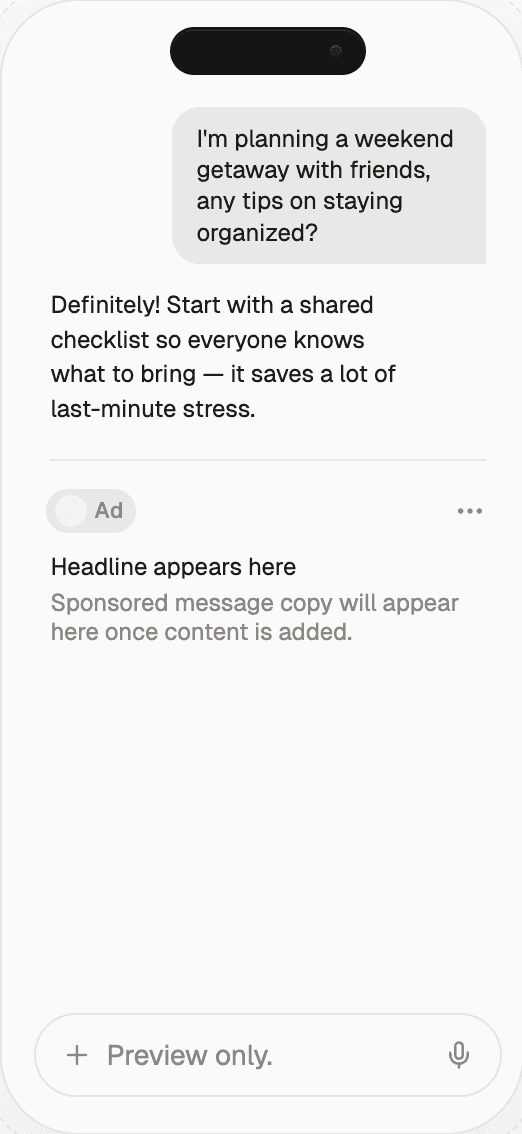
Be present when decisions are made
Traditional media captures attention.
Conversational media captures intent.
With Thrad, your brand reaches users in their deepest moments of research, evaluation, and purchase consideration — when influence matters most.
Date Published
Date Modified
Category
Advertising AI
Keyword
generative ai advertising for b2b