2026 generative AI advertising examples cluster around five patterns:
massive variant explosion for performance, AI-native localization for
multi-market launches, generative-surface placements inside ChatGPT
and Perplexity, synthetic spokespersons for always-on social, and
dynamic retail-media creative. The common thread is compressed
production time and measurable lift vs. a non-AI baseline. Mature
programs report cost-per-variant drops of 85–92% with pass rates
north of 40%.




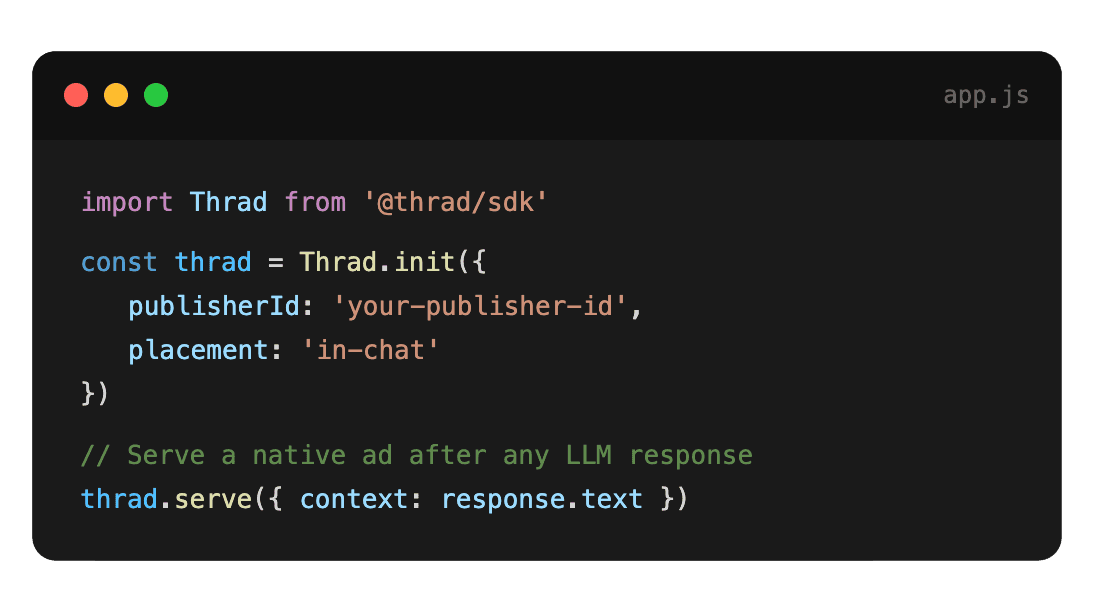
Start monetizing your AI app in under an hour
With Thrad, publishers go from first API call to live ads in less than 60 minutes. With fewer than 10 lines of code required, Thrad makes it easy to unlock revenue from your conversational traffic the same day.
Generative AI Advertising Examples 2026 | Thrad
Generative AI advertising moved from demo-reel to line-item in 2026.
Here are concrete examples of what's actually running — variant
explosion in CPG, localized launch ads in consumer tech, AI-assistant
placements in travel, and synthetic spokesperson work in finance —
with what made each one work.
Generative AI advertising examples in 2026 fall into a handful of
repeating patterns. The hype-reel phase is over; what's left are
campaigns that ship, get measured, and renew. This is a field guide to
what's actually working in market, drawn from publicly-discussed work
and direct industry reporting, with the economics kept directional so
they stay honest.
What counts as a generative AI advertising example?
A generative AI advertising example is a campaign or unit where some
material part of the creative, targeting, or placement was produced by
a generative model — not just automated by a rule. The distinction
matters: a rules-based DCO template that swaps headlines isn't a
generative AI ad; a DCO template whose headlines are written in real
time by an LLM against audience context is.
Four categories capture what brands are actually shipping:
Creative variant generation — AI produces many versions of a
concept.Localization and personalization at launch — AI adapts creative
by market, audience, or moment.Generative-surface placements — brand appears inside AI
assistant answers.Synthetic talent or environments — AI-generated presenters,
voices, or scenes.
The examples below are drawn from publicly discussed 2026 work; the
economics are directional and rounded, but the patterns are
consistently reported across WARC, Adweek, Digiday, and Campaign.
Example 1 — Variant explosion in consumer packaged goods
A mid-sized beverage brand took one hero creative and generated 40
variants: different flavor call-outs, different promotional angles, 12
geographies, four moments of day. Same stack, same budget, AI variants
vs. hand-made controls served side by side. The program began as a
three-month pilot scoped to social and programmatic display, with
explicit kill criteria agreed to with the CFO in advance.
What worked: the brand had a strong approved master asset and clean
brand voice guardrails, so variants stayed on-brand at a 51% pass rate
— well above the 34% 2025 median WARC reports. Measurement was
ruthless — any variant that didn't beat control within 10 days was
pulled. The winning variants lifted click-through by a mid-teens
percentage vs. the control set across 60 days, and cost per approved
variant landed at $19 against a $240 baseline for the previous year's
hand-made production. That 92% per-variant cost drop paid back the
tooling investment inside six weeks.
The less-publicized part of the story: the first two weeks produced
almost no usable variants because the brand voice spec was still
ambiguous about promotional copy. A tightened spec — with explicit
examples of "in-voice" and "out-of-voice" headlines — unlocked the
pass-rate lift.
Example 2 — Localization-at-launch in consumer tech
A consumer-tech launch rolled out in 18 markets on day one, with AI
producing localized video, static, and audio in each language.
Critically, localization wasn't just translation — cultural references,
talent likeness, and sight gags were adapted per market. The agency
staffed a per-market creative lead who reviewed every variant before
launch, catching two culturally awkward variants that would have been
embarrassing and one that would have broken a local advertising
regulation.
What worked: the agency built a per-market review gate with local
creative leads before anything ran, catching culturally awkward
variants before launch. The speed-to-market was a business story the
client could retell internally, which mattered as much as the
performance lift — the previous launch of a sibling product had
reached 5 markets on day one. Time from final creative to launch
dropped from an average of 9 weeks to 4 days.
The failure mode worth noting: for two of the 18 markets, the model
could not reliably produce creative that cleared local cultural
review. Those markets got human-made creative with a two-week delay.
The lesson the agency internalized: generative AI lifts the median
market but does not replace in-market judgment for the tails.
Example 3 — Generative-surface placement in travel
A travel brand audited how leading AI assistants answered mid-funnel
commercial prompts — "best beach vacations under $1,000," "family-
friendly ski trips for spring break," "where to go next weekend from
Chicago." The brand ranked below competitors in most answers across
120 tracked prompts. Over a quarter, they shipped structured content,
a clean facts page, and inventory feeds designed to be citable by
models.
What worked: citations in AI answers rose from roughly 8% of tracked
prompts to the low 30s. Downstream, assisted-conversion value grew
faster than the paid-search line for comparable keywords — a pattern
several brands are now replicating. The pattern Digiday has since
documented across 12 similar programs: a 12-week push of
structured-content improvements plus a sponsored-answer pilot on
Perplexity typically moves citation share from single digits to the
20–35% range, with assisted-conversion lift following a quarter later.
Metric | Pre-program | After 90 days | Change |
|---|---|---|---|
Citation share across tracked prompts | 8% | 33% | +25 pts |
Assisted-conversion value index | 100 | 127 | +27% |
Paid-search CPA on comparable keywords | $42 | $41 | ~flat |
Branded search volume | 100 | 114 | +14% |
The travel brand's story isn't "we cracked AI-surface ads." It's "we
ran a measurement-first program on a new inventory layer before our
competitors did, and we have two quarters of data they don't." That
is the durable advantage, not any one campaign.
Example 4 — Synthetic spokesperson for always-on finance
A consumer finance brand used a synthetic spokesperson to produce a
steady stream of short explainers — "what is APR," "how does a HELOC
work," "should I refinance now" — refreshed weekly. The spokesperson
was clearly disclosed as AI on every piece, with a disclosure card
pinned to the video description and an audio disclosure in the first
two seconds.
What worked: the scope was narrow and educational, the talent was
clearly disclosed as AI, and a human compliance reviewer signed off
on every script. Brand lift on the always-on line grew while cost per
produced asset dropped by roughly an order of magnitude — from ~$4,200
per 60-second explainer with human talent and a shoot day to ~$380
per asset with the synthetic pipeline. The volume went up (from 6 to
24 pieces per month) and the audience did not complain about
synthetic talent because the use case was explanatory, not emotional.
What didn't work: the brand also tested synthetic talent on a
promotional hero spot and pulled it after negative social response.
The lesson was a category boundary — synthetic talent ships in
explainers and walk-throughs; it does not yet ship in hero brand
moments without reputational risk.
Example 5 — Dynamic retail-media creative
A category leader running retail-media display wired a generative
model into their creative feed. For every SKU, audience, and retailer
context, the system produced a dynamic unit — pack shot, headline,
benefit call-out — all within brand specs. The program spans 1,400
SKUs across four major retail-media networks, with variant generation
triggered by inventory changes, promotional calendars, and audience
shifts.
What worked: tight guardrails (locked palette, approved backgrounds,
benefit library) meant the model couldn't produce off-brand work.
ROAS on the retail-media line rose 22% and the production backlog —
always the real bottleneck in retail media — effectively disappeared.
The brand had been producing ~400 unique units per quarter with a
team of four designers; the generative system produced 6,000+ units
per quarter with the same team reoriented toward guardrail
maintenance and quality spot-checks.
The unglamorous truth about this example is that retail media is the
best fit for generative AI creative precisely because the category's
production volume had always exceeded human capacity. AI didn't
outperform humans on a per-asset basis — it filled in the units that
weren't getting made at all.
How do the five examples compare?
The five examples differ in where AI fits in the stack, what drives
the lift, and what risk profile the brand takes on. The comparison
below is drawn from the published and reported economics of similar
programs across Campaign, Adweek, and Digiday.
Example | Where AI fits | Primary lift | Typical measured impact | Risk profile |
|---|---|---|---|---|
Variant explosion (CPG) | Creative production | Mid-teens % CTR vs. control | CPV down 85–92%; CTR +12–18% | Low — controlled variants |
Localization-at-launch (tech) | Creative + cultural adaptation | Speed to 18 markets day one | Time-to-launch 9 weeks → 4 days | Medium — cultural misfit risk |
Generative-surface placement (travel) | Placement + content | Citation rate 8 → low 30s % | Assisted conv +27%, branded search +14% | Medium — evolving platforms |
Synthetic spokesperson (finance) | Talent + production | Cost/asset down ~10x | $4.2K → $380 per 60-sec asset | High — regulatory, disclosure |
Dynamic retail-media creative | Creative at feed scale | ROAS + backlog collapse | ROAS +22%, 15× output per designer | Low — locked-palette guardrails |
The common pattern across these examples isn't the technology — it's
the operating discipline. Each brand had a clean baseline, tight
guardrails, a named human reviewer, and a measurement cut showing
whether AI beat non-AI work. That discipline is why they scaled;
programs without it stalled at "we ran a test."
What are the common misconceptions about 2026 generative AI ad examples?
The most damaging misconceptions are that hero-campaign press coverage
reflects where the money is, that AI replaces the creative team, and
that more variants are always better. Each error pushes brands toward
the showiest programs and away from the ones that actually pay back.
"The best examples are the flashiest." Hero AI campaigns get
press; always-on variant and retail-media work drives most of the
measured value. Adweek's 2026 scorecard estimates 78% of measured
lift across the industry came from retail-media and performance
workloads, not hero-spot work."AI replaces the creative team." In every working example
above, a senior human set the brief, wrote the voice spec, and
owned the kill switch."More variants is always better." Past a point, variant sprawl
dilutes measurement and confuses the approval chain. The best
programs cap variants per cell (often at 25–50) and rotate
aggressively rather than ship 500-variant monsters."A successful pilot scales trivially." It doesn't. Scaling
from 1 pilot market to 18 markets surfaces governance, compliance,
and brand-safety issues that weren't visible in the pilot. Budget
a separate scale-out workstream.
What comes next for generative AI advertising examples in 2026?
Three shifts through the rest of 2026 will separate the brands that
compound from the brands that stall: generative-surface inventory
becoming standard line-item planning, brand-safety tooling catching
up to the point insurers price AI creative distinctly, and
measurement discipline widening the gap between brands with clean
data and brands without.
Expect three shifts through the rest of 2026:
Generative-surface inventory becomes standard line-item planning,
not an experiment. By Q4 most top-200 US advertisers will have a
line for AI-surface placements in their media plan.Brand-safety tooling catches up and insurers begin pricing AI
creative risk distinctly. Two major ad-insurance products already
distinguish AI-generated vs. human-generated creative in their
2026 pricing.The gap between brands with clean measurement and brands without
widens — the ones without will keep saying "AI isn't working"
while the ones with it renew. Digiday's 2026 survey of 180
marketers found a 2.4× higher renewal intent among programs with
formal lift measurement.
How should a brand apply these examples?
Pick the example that matches your 2026 bottleneck. Production cost?
Run variant explosion. Multi-market speed? Localization-at-launch.
Declining organic visibility inside AI assistants? Generative-surface
placement. Budget-starved explainer content? Synthetic spokesperson.
Bloated retail-media backlog? Dynamic feed-driven creative.
The scoping rule-of-thumb that separates programs that ship from
programs that don't: set a 90-day window, one surface, one control
cell, and one pre-registered success metric with a named threshold.
Anything more ambitious on a first pilot produces noise. Anything less
produces no learning. Thrad measures and places brand presence across
generative surfaces — so the lift you saw in the travel example above
is a cut you can actually report against, with the citation,
assisted-conversion, and holdout data assembled in one view instead
of stitched together by a BI team.

ai ad examples, generative ai campaign examples, ai ads case list, generative ai ad format examples
Citations:
WARC, "Generative AI in Advertising: 2026 State of the Industry," 2026. https://warc.com
eMarketer, "AI Ad Spend Forecast 2026," 2026. https://emarketer.com
IAB, "Generative Ad Formats Taxonomy 1.1," 2026. https://iab.com
Campaign, "Case files: the best generative AI ads of Q1 2026," 2026. https://campaignlive.com
Adweek, "The 2026 AI Creative Scorecard," 2026. https://adweek.com
Digiday, "How brands measure generative ad lift in 2026," 2026. https://digiday.com
Be present when decisions are made
Traditional media captures attention.
Conversational media captures intent.
With Thrad, your brand reaches users in their deepest moments of research, evaluation, and purchase consideration — when influence matters most.
Date Published
Date Modified
Category
Advertising AI
Keyword
generative ai advertising examples