Ecommerce wins with generative AI advertising when the product feed —
not a campaign brief — becomes the creative input. Ground models in
live inventory, generate PDP-level variants, and add answer-placement
measurement alongside ROAS. eMarketer's 2026 outlook puts 31% of US
shoppers using an assistant as their first stop for product discovery
in considered categories, and that share is still climbing. The
funnel now starts inside an assistant; brands that instrument that
layer capture intent their competitors can't see and convert it
before the retailer page even loads.







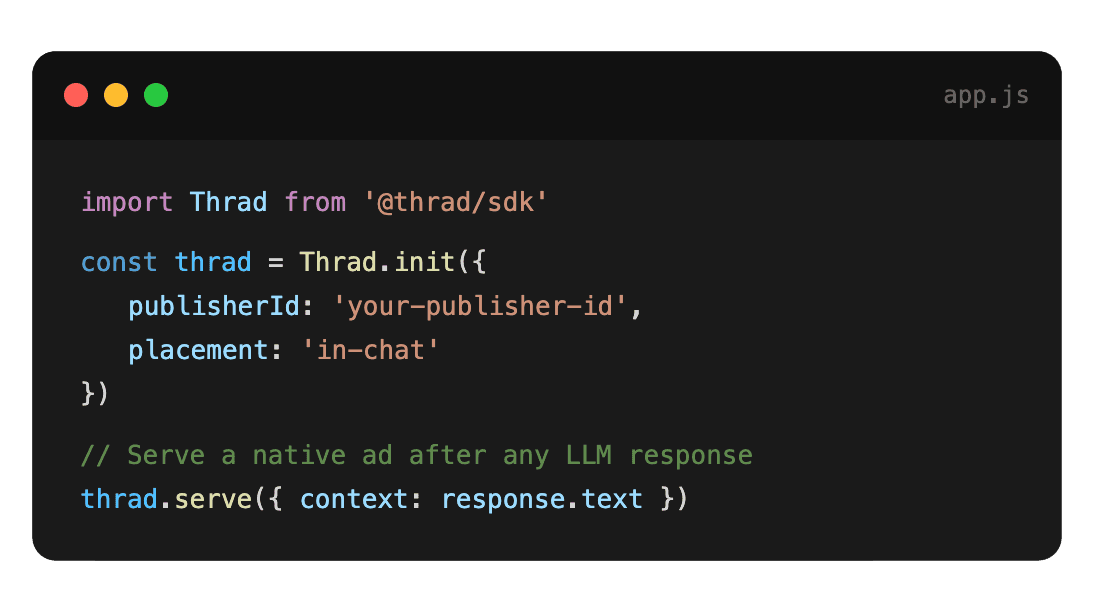
Start monetizing your AI app in under an hour
With Thrad, publishers go from first API call to live ads in less than 60 minutes. With fewer than 10 lines of code required, Thrad makes it easy to unlock revenue from your conversational traffic the same day.

Generative AI Advertising for Ecommerce 2026 | Thrad
Ecommerce is the highest-intent vertical for generative AI advertising.
Every SKU is a prompt waiting to be answered, and shoppers are asking
assistants "what should I buy?" before they open a retailer tab. The
ecommerce brands winning in 2026 ground their creative in live product
data, produce variants at SKU granularity, and measure placement inside
AI answers — not just clicks.
Generative AI advertising for ecommerce in 2026 is not a creative
upgrade — it's a funnel restructure. Shoppers now ask assistants for
recommendations before they ever open a retailer. Brands that
instrument the assistant layer, ground their creative in live product
data, and generate at SKU granularity are the ones compounding.
Brands that are still treating generative AI as "faster banner
production" are losing top-of-funnel consideration they won't see in
their click-based analytics until a revenue gap opens in the
quarter-over-quarter report. The restructure is unfolding whether or
not any individual brand prepares for it, and the lead time to build
the capability is the real constraint.
What does generative AI advertising mean for ecommerce specifically?
For ecommerce specifically, generative AI advertising is three
distinct shifts stacked on top of each other: the product feed
replaces the campaign brief as the creative input, SKU-level creative
replaces hero-asset creative, and answer placement becomes a funnel
stage that sits upstream of the retailer site. Ecommerce brands
adapting to at least two of the three are reporting materially better
2026 performance than peers stuck on the old model.
The product feed replaces the campaign brief. Live inventory,
price, availability, reviews, and sell-through velocity become
the prompt context. The creative team writes guardrails; the
feed writes the specifics.SKU-level creative replaces hero-asset creative. One campaign
now produces hundreds or thousands of variants, not three.
Category brands with 500+ SKUs are routinely shipping 5,000+
creative variants per quarter in 2026.Answer placement becomes a funnel stage. Assistants shortlist
products before retailer sites are opened, and that shortlist is
measurable. Missing from the shortlist is a form of
out-of-consideration that classical ROAS reporting does not
capture.
A retailer treating generative AI as "faster banner production" is
missing two of the three shifts and leaving structural upside on the
table. The revenue gap this opens typically takes two quarters to
become visible and a third quarter to stabilize — which means the
2026 decision is already a 2027 consequence.
Why is the product feed the new creative brief?
The product feed is the new creative brief because it is the only
input that stays current with live pricing, inventory, reviews, and
sell-through, and because grounding the model in the feed is what
keeps generative creative truthful, compliant, and specific.
Ungrounded generative ads hallucinate features, run on out-of-stock
SKUs, and quote wrong prices; feed-grounded ads do none of those
things.
The single highest-leverage change in ecommerce generative AI
advertising is grounding. Connect your product feed — title,
description, price, images, attributes, stock, reviews, ratings,
bundle associations — as context for every generation. Three
consequences follow:
Claims stay truthful. The model can't hallucinate a feature
the SKU doesn't have because the SKU's actual spec sheet is in the
prompt.Creative stays current. Price drops, out-of-stock states, and
new bundles reflect in-ad within minutes, not weekly. No more
"50% off" creative running the day after the promo ended.Variants stay specific. "Running shoe for flat arches, $120,
in stock in 9.5M, 4.6 stars on 3,200 reviews" beats "Shop the new
collection."
Dimension | Ungrounded generative | Feed-grounded generative |
|---|---|---|
Claim accuracy | Variable | Match to spec sheet |
Price | Hand-entered, stale | Real-time from feed |
Availability | Not represented | Live stock signal |
Review quotes | Invented / risky | Pulled from verified review corpus |
Compliance risk | High | Auditable |
Refresh latency | Days to weeks | Minutes |
Feed grounding is now table-stakes in the major ad platforms (Meta's
Advantage+, Google's Performance Max, Amazon's sponsored product
generative creative), but most brands haven't flipped it on
end-to-end. Doing so before competitors is a free compounding
advantage.
What does SKU-level creative at scale actually look like?
SKU-level creative at scale means producing and optimizing creative
variants keyed to individual stock-keeping units — size, color,
bundle, price point — with audience, platform, and lifecycle-stage
layered on top. Top performers in 2026 ship 10–50 variants per SKU;
classical ecommerce programs ship 3–5 per campaign across hundreds of
SKUs. The production economics only work with generative AI; without
it, brands collapse back to the hero-asset model and leave SKU-level
lift unclaimed.
The old creative model: one hero asset per campaign, manual resizes,
a handful of audience cuts. The new model, at ecommerce scale, looks
different.
Creative layer | Old model | Generative AI model |
|---|---|---|
Hero concept | 1 per campaign | 1 per campaign (unchanged) |
Product-level creative | 3–5 per campaign | 10–50 per SKU |
Audience cuts | 2–4 per variant | 10+ per variant |
Platform resizes | Manual, days | Automated, minutes |
Localizations | 3–5 markets, weeks | 20+ markets, same-day |
Lifecycle-stage cuts | 1 | 4 (new, repeat, lapsed, VIP) |
Total creative in market | 10–30 | 500–5,000 |
A practical per-SKU variant budget for a mid-size DTC apparel brand:
SKU tier | Count | Variants per SKU | Total variants |
|---|---|---|---|
Hero SKUs (top 10% by revenue) | 50 | 40 | 2,000 |
Mid-tail SKUs | 300 | 12 | 3,600 |
Long-tail SKUs | 1,200 | 4 | 4,800 |
Total | 1,550 | — | 10,400 |
The concept work doesn't go away — it gets amplified. The production
work compresses. A typical 2022 ecommerce creative team shipped
maybe 50 unique assets per month; a 2026 team of similar size ships
2,000+ with a cleaner audit trail.
How does the answer-placement funnel change ecommerce?
The answer-placement funnel means the first five minutes of the
shopping journey increasingly happen inside an assistant rather than
inside a retailer, and the brands included in the assistant's answer
capture demand before it ever converts into a site visit. For
considered purchases — electronics, beauty, apparel, appliances — the
assistant's shortlist is effectively the new product-discovery page.
A shopper asks ChatGPT "what's a good noise-cancelling headphone
under $300?" and gets back three named products with reasoning. That
answer replaces the first five minutes of a traditional shopping
journey. The shopper lands on a retailer site already leaning toward
a specific SKU, already pre-sold on two or three reasons, already
comparing against a narrower set than classical search would have
produced.
Brands that aren't in the answer don't make the consideration set.
Brands that are — but aren't measuring it — can't tell which content
or placement is driving citations, and therefore can't optimize the
upstream budget.
What "answer placement" actually requires:
Content assistants can cite. Structured product pages, review
corpora, comparison content that's machine-parseable. Pages with
clean spec tables, explicit claim-with-source statements, and
third-party review counts get cited 2–3× more often than pages
without.A structured query panel. A curated set of commercial-intent
prompts sampled on a schedule, across assistants, per market.
Panels start around 50 prompts and grow as you learn the query
mix — ecommerce brands often maintain 300–500 in mature programs.Citation + conversion linkage. Instrumentation that ties the
answer back to downstream revenue. Without this, assistant
placement is a vanity metric; with it, it's a line item in the
budget allocation model.
Funnel stage | 2022 ecommerce | 2026 ecommerce |
|---|---|---|
Discovery | Google search | Assistant answer |
Consideration | Retailer listing page | Assistant shortlist |
Comparison | Product detail page + review sites | Assistant follow-up prompts |
Conversion | Retailer site | Retailer site (for now) |
Retention | Email / lifecycle | Email + assistant re-query |
In 2026, "top of funnel" for ecommerce is no longer Google. It's
whatever assistant the shopper opens first. The brands measuring
that layer are the ones building durable share.
Which three pilots should an ecommerce team run first?
The three pilots that de-risk the transition are feed-grounded
variant explosion on one category, a 50-prompt answer-placement
audit, and lifecycle variant generation on the top 10 triggered
emails. Run them sequentially over a 90-day window; each teaches a
different muscle — production velocity, assistant visibility, and
personalization — and each produces measurable lift inside the pilot
window.
Pilot 1: Feed-grounded variant explosion
Pick one category with 50–200 SKUs. Connect the feed. Generate 10
variants per SKU, tuned to audience, geography, and platform. Run
against a matched control on existing inventory. Lift usually shows
in 7–14 days because the creative finally matches the product.
Typical result: 15–35% CVR lift on the generative variants and a
10–25% drop in cost-per-acquisition. The lift comes from creative
matching the SKU's actual attributes at last — not from a new
targeting breakthrough.
Pilot 2: Answer-placement audit
Build a 50-prompt panel around your category's commercial-intent
queries. Sample weekly across ChatGPT, Perplexity, Gemini, and
Copilot. Measure your citation rate vs. the top three competitors.
This is a two-week project that usually reshapes content strategy for
the next quarter — most brands find they're winning on branded
prompts and losing on category prompts, which is where the bulk of
new-customer demand actually lives.
Pilot 3: Lifecycle variant generation
Take your top 10 lifecycle emails — browse abandon, cart abandon,
back-in-stock, price drop, win-back, replenishment — and regenerate
them per SKU using feed grounding. Most brands see a step-change in
open-to-conversion because the message becomes specific instead of
generic. Typical lift: 30–70% on cart-abandon conversion, 15–30% on
browse-abandon.
A 90-day pilot calendar for an ecommerce team:
Week | Pilot | Milestone |
|---|---|---|
1–4 | Feed-grounded variant | Category selected, feed connected, first variants live |
5–6 | Variant pilot | First lift report vs. matched control |
5–8 | Answer-placement audit | 50-prompt panel built, baseline captured |
9–12 | Lifecycle variant | Top 10 emails regenerated, A/B against classical |
13 | Roll-up | Three-pilot lift report to CMO + CFO; FY plan revision |
How do regulated categories adapt the playbook?
Regulated ecommerce categories — beauty, supplements, financial
services, alcohol, cannabis, healthcare — adapt the playbook by
moving compliance into the generation loop as a first-class step
rather than a post-hoc check. That means approved claim libraries,
comparative-claim rules, human review on every generated variant in
high-risk claims, and an AI-claims counsel who signs off on prompt
and library design before generation starts. Brands that do this
well can run at near-native speed; brands that don't get either
slow or risky.
Practical components:
Claim library. A frozen list of approved claims the model is
allowed to make, each tagged with its allowable evidence source
(clinical study, peer-reviewed paper, internal test, customer
review).Prohibited-claim filter. A blocklist the generation pipeline
rejects before output. Beauty and supplement categories routinely
block disease-state claims, quantified efficacy claims without
clinical backing, and comparative claims against named brands.Jurisdiction-aware variant. Some claims are allowed in some
markets and not in others (health claims in the EU vs. US,
financial promotion rules, alcohol advertising restrictions).Human review at risk tier. Low-risk variants ship after a
sampled review; high-risk variants (any unique claim, any
comparative language) get per-variant legal review.Audit trail per variant. Prompt, model version, approved
claim ID, reviewer, timestamp.
Categories with heavier regulation have the most to gain from
compliance-baked-in generation because their classical production
pipelines were already slow — generative at their production speed,
with rigor built in, is the unlock.
What are the common misconceptions?
"We already do dynamic creative — this is just more of that."
Dynamic creative optimization shuffles pre-built assets.
Generative advertising produces new assets conditioned on the
product. Different layer. DCO was a scheduling optimization;
generative is a production revolution."Assistants will cannibalize our paid search traffic." Some,
yes. But paid search was already losing share to direct assistant
queries before brands could buy placement there. Instrumenting
the assistant layer is defense, not offense — and the category
share of voice is the leading indicator most brands are
ignoring."Generative means hallucinated claims." Not if the model is
grounded in your feed. Grounding plus claim libraries plus human
review on regulated categories gets you to parity-or-better on
compliance."Small catalogs don't need this." The smaller the catalog, the
easier feed grounding is. Start there. Small-catalog brands often
see the fastest absolute lift because their creative-to-SKU
mismatch was widest."Retailer media covers this for us." Retailer-media networks
are adopting generative creative, but they default to generic
patterns unless the brand supplies its own feed-grounded
variants. Relying on the network's default leaves the vertical's
best creative lift on the table.
What comes next for ecommerce through 2027?
Two structural shifts should land through late 2026 and 2027, and
together they move more of the transaction itself inside the
assistant layer. Brands building for this future in 2026 are the
ones whose feeds are cleanest, whose variants are deepest, and whose
answer-placement measurement is already operational. The rest will
spend 2027 catching up while competitors widen their share.
Retailer-assistant integrations. Major retailers (Amazon,
Walmart, Target, Costco, Shopify storefronts at scale) will
expose their catalogs directly to assistants, and the brands
whose feeds are cleanest will win placement inside those
integrations.Shoppable assistant surfaces. Check-out flows move inside the
assistant itself. The brand that owns the answer also owns the
transaction, which changes the value of answer placement by an
order of magnitude. Early pilots on ChatGPT shopping and
Perplexity buy flows are already producing order-placement data.AI-native retail media. Expect a new class of retail-media
inventory that lives entirely inside assistants, with pricing
mechanisms that look like search bidding but run on prompt
context rather than keyword match.Real-time dynamic pricing in creative. Feed-grounded
generation plus retailer-media plus live pricing APIs means the
price shown in the ad, the price in the assistant shortlist, and
the price on the retailer PDP can finally stay in sync in real
time — a 20-year problem for ecommerce.
How should an ecommerce team act on this today?
Don't boil the ocean. Pick one category, wire up feed grounding, run
a 50-prompt answer-placement audit, and generate SKU-level variants
for one lifecycle trigger. Ninety days of signal will reshape your
2026 plan. The brands that try to roll this out across every category
at once are the brands still rolling it out in 2027; the brands that
pick one beachhead and iterate are already on their second category
by Q3.
Concrete 90-day plan:
Weeks 1–2. Pick the category and the SKU set. Audit the
current feed for completeness — title, description, attributes,
stock, reviews, ratings.Weeks 3–6. Connect the feed to the generative pipeline.
Build the first variant library. Launch against a matched
control.Weeks 5–7. Build the 50-prompt answer-placement panel.
Capture baseline citation rate and competitor share of voice.Weeks 8–11. Regenerate the top 10 lifecycle emails with feed
grounding. A/B against the classical version.Weeks 12–13. Roll up. Report to CMO and CFO on variant CVR
lift, citation-rate deltas, and lifecycle conversion change.
Propose budget shifts for the next quarter.
Thrad's measurement and placement layer is built for exactly this —
we give ecommerce teams a citation-rate dashboard across the four
major assistants, an inventory layer across generative surfaces, and
the tie-back to conversion their existing ROAS reports miss. The
ecommerce brands working with us in 2026 are the ones that figured
out the shopping funnel starts upstream of the retailer tab and
wanted instrumentation for the layer their finance team couldn't
otherwise see.

ai product feed advertising, shoppable ai ads, generative ecommerce creative, ai answer commerce
Citations:
eMarketer, "Generative AI and Commerce: 2026 Outlook," 2026. https://emarketer.com
IAB, "AI Commerce Advertising Standards," 2026. https://iab.com
Shopify, "State of Commerce 2026," 2026. https://shopify.com
Digiday, "How retailers are measuring AI answer placement," 2026. https://digiday.com
Retail Dive, "Assistants as the new storefront," 2025. https://retaildive.com
Adweek, "Retail media and generative AI converge in 2026," 2026. https://adweek.com
Marketing Brew, "Feed grounding becomes table-stakes," 2026. https://marketingbrew.com
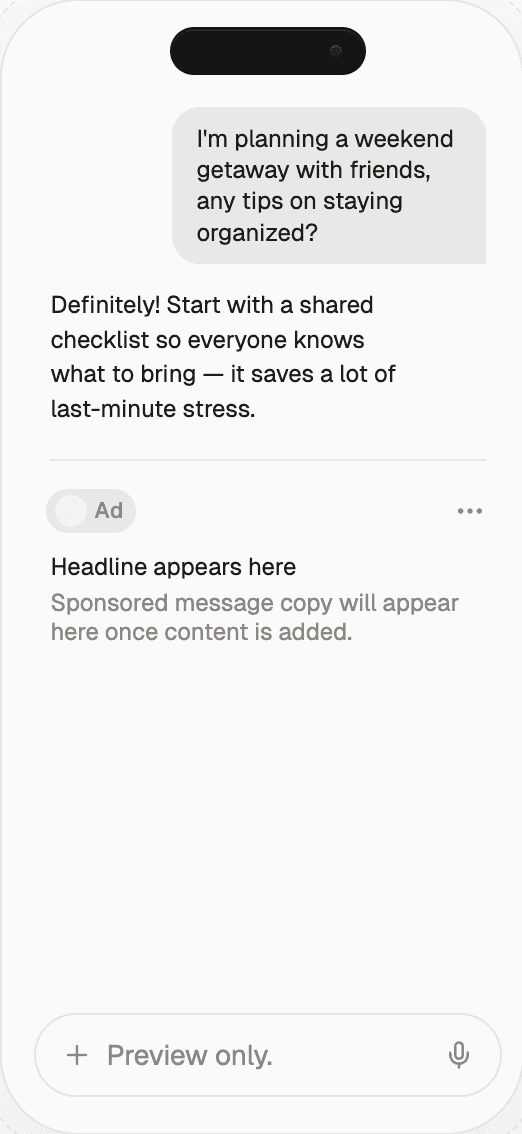
Be present when decisions are made
Traditional media captures attention.
Conversational media captures intent.
With Thrad, your brand reaches users in their deepest moments of research, evaluation, and purchase consideration — when influence matters most.
Date Published
Date Modified
Category
Advertising AI
Keyword
generative ai advertising for ecommerce