Brand safety for generative AI advertising in 2026 means controlling
what a model can say on your behalf at generation time, disclosing
synthetic media to match IAB Tech Lab and regional rules, and monitoring
how your brand is cited inside ChatGPT, Perplexity, Copilot, and Gemini
answers. GARM's 2026 Suitability Framework update explicitly extends
suitability to generative surfaces, and Forrester's 2025 research showed
41% of surveyed marketers had shipped at least one generative asset they
later had to pull. Publisher-level safelists and blocklists no longer
cover the risk surface.



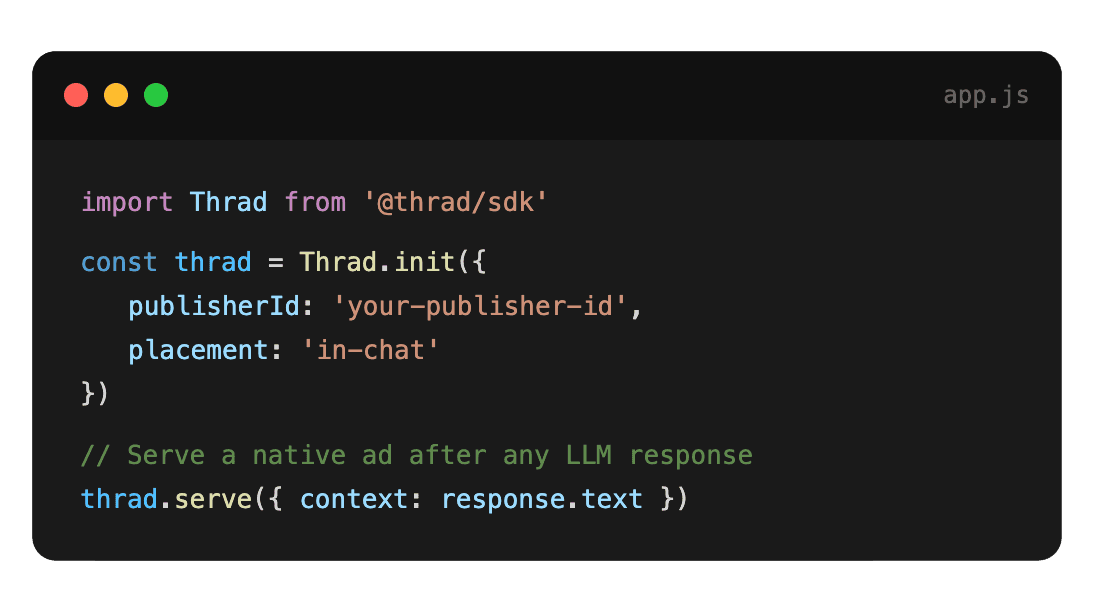
Start monetizing your AI app in under an hour
With Thrad, publishers go from first API call to live ads in less than 60 minutes. With fewer than 10 lines of code required, Thrad makes it easy to unlock revenue from your conversational traffic the same day.

Generative AI Ad Brand Safety 2026 | Thrad
Generative AI added three new failure modes to advertising that classical
brand-safety tools don't catch: prompt-driven off-brand output, synthetic
media that violates disclosure rules, and citations inside AI assistants
that name your brand alongside content you'd never sponsor. The 2026
playbook is a generation-time control stack, not a post-hoc filter.
Generative AI added capability to advertising, but it also added three failure modes that the classical brand-safety stack was never built to catch. Marketers who shipped generative campaigns in 2024–2025 learned this expensively — Forrester's 2025 research shows 41% of surveyed marketers had pulled at least one generative asset post-launch. The 2026 playbook assumes brand safety has to move into generation time, and into AI answers, or it doesn't cover the real risk surface.
What is generative AI advertising brand safety?
Generative AI advertising brand safety is the set of controls, disclosures, and monitoring practices that keep AI-produced creative and AI-assistant placements aligned with a brand's values, regulatory obligations, and suitability standards. It extends classical brand safety in two directions: upstream into what a model generates on your behalf, and sideways into how your brand is cited inside ChatGPT, Perplexity, Copilot, and Gemini.
Publisher-level safelists still matter for display and video — they just no longer describe the full risk surface. GARM's 2026 Suitability Framework update is the first classical framework to cover generative surfaces explicitly, and IAB Tech Lab's Generative AI Advertising Standards v1 codifies the disclosure tags that should flow through the supply chain. But neither of those gives a brand an operating control stack; they give the shape and the signals, and the brand or its agency has to build the plumbing.
In plain language: brand safety used to be a filter applied to a placement. In 2026 it's a workflow that starts when a prompt is drafted and doesn't end until the campaign is pulled from every surface — including surfaces the brand didn't buy directly.
Why do the old brand-safety tools no longer cover the surface?
The old brand-safety tools (keyword blocklists, publisher safelists, post-hoc creative review) focus on where an ad appears, which was the only surface that mattered when ads were pre-rendered and placed on pages. Generative AI introduces surfaces where the content is produced at request time and where the brand appears as a citation the buyer never negotiated. Those surfaces don't exist in any blocklist.
Three specific gaps:
Generative creative is produced downstream of any blocklist. A model asked to produce a campaign variant in a brand voice will produce something — whether the brand's creative director would approve of it or not. No upstream filter on "bad context" catches this because the bad context is the output itself.
Publisher reputation doesn't translate to AI assistants. An assistant's training and retrieval corpora pull from all sources; "Publisher X is on our safelist" doesn't restrict how the assistant reconstructs an answer. The placement logic is categorical, not publisher-level.
Keyword blocking was already fragile; AI answers break it entirely. Assistants paraphrase, synonymize, and re-contextualize. A blocklist on "opioid" doesn't prevent an answer that covers the same topic with different wording.
Gartner's 2026 Brand Safety Market Guide explicitly calls out that the incumbent vendors (IAS, DoubleVerify, Zefr) are racing to build generative-surface products — but the surface is new enough that none of them cover it end-to-end yet. Brands that wait for incumbent tooling to catch up are leaving 12–24 months of exposure on the table.
The classical brand-safety stack is necessary but no longer sufficient. Keyword blocklists and publisher safelists still catch real risk at the placement layer, but they don't touch generation-time output and they don't see AI-answer citations. Brands that ship generative campaigns without generation-time controls and answer-adjacency monitoring are exposed on two surfaces they literally can't measure from the incumbent stack.
The three new risk vectors
1. Off-brand generation
A model given a loose brief can produce copy, imagery, or voice that a human creative director would reject instantly — but that ships anyway because the approval loop was optimized for speed. The mode of failure isn't a malicious prompt; it's a mundane one that the model interprets in a voice, tone, or claim the brand never sanctioned. Adweek's 2026 reporting documented several category-leading brands pulling generative campaigns within 48 hours of launch for this exact reason.
2. Synthetic media disclosure failure
Regulators caught up fast. The FTC's 2025 endorsement guidance, the EU AI Act's transparency provisions, and IAB Tech Lab's Generative AI Advertising Standards v1 all converged on a default expectation: AI-generated creative must be labeled, and the labeling must survive reformatting and repurposing. Ads that ship without disclosure in 2026 aren't just reputationally risky — they're legally exposed.
3. Adjacency inside AI answers
A ChatGPT answer to "best running shoes for flat feet" might cite your brand in the same paragraph as a competitor, a discontinued product, or a negative review. Classical brand safety never had to think about this because the placement layer was pages and videos, not generative answers. In 2026 your brand's most consequential impressions may be citations you didn't buy. GARM's 2026 framework names this explicitly as a suitability surface for the first time.
Risk vector | Classical tool | What it misses | 2026 control |
|---|---|---|---|
Off-brand generation | Creative review board | Volume; unattended production | System prompt + retrieval + reject-regenerate |
Undisclosed synthetic media | Copy legal review | Machine-readable provenance | Signed disclosure + audit log |
Bad page adjacency | Keyword blocklists, safelists | (still partly covered) | Publisher-level safelists (still valid) |
Bad AI-answer adjacency | None | Entire surface | Citation and share-of-voice monitoring |
Model or data leakage | Creative NDA | Prompt contents | Prompt logging + model-version pinning |
Talent rights failure | Business affairs review | Synthetic talent | Rights-clearance before generation + provenance log |
What does the 2026 control stack look like?
The 2026 control stack has four layers: generation-time guardrails, human-in-the-loop review for high-stakes assets, disclosure and audit trail, and AI-answer monitoring. Each addresses a specific failure mode and each is operable by a brand-safety or marketing-ops team without asking engineering for a special build. Teams with all four layers in place ship faster, not slower, because the controls remove the late-stage surprises.
Layer 1: Generation-time guardrails
Constrain what a model can say on your brand's behalf before it says it. In practice this means a system prompt that encodes tone, claim restrictions, and taboo topics; a retrieval layer that grounds the model in approved brand facts; and a reject-and-regenerate loop for outputs that fail deterministic checks (banned phrases, competitor names, unsubstantiated superlatives). This is the layer that catches the off-brand generation failure mode before it enters the review queue.
Layer 2: Human-in-the-loop review for high-stakes assets
Not every generated variant needs a human. Product-page copy variants generated at scale can flow through automated checks. Campaign hero creative, anything touching regulated categories (finance, health, politics), and anything speaking in a founder or spokesperson voice should have a named reviewer and a logged decision. The discipline is triage: automated checks catch 95% of volume; human review concentrates on the 5% where brand and legal exposure is real.
Layer 3: Disclosure and audit trail
Every shipped generative asset should carry a machine-readable tag indicating it was AI-generated, the model and version used, the prompt (or a hash thereof), and the human reviewer. This serves both regulatory obligations and internal audit. When a complaint lands, you need to be able to answer "what exactly was said, by which model, approved by whom" in minutes, not weeks. IAB Tech Lab's standards now define the tag format the ad supply chain is aligning around.
Layer 4: AI-answer monitoring
Monitor how your brand is cited across generative surfaces on an ongoing basis. Sample a basket of high-intent queries weekly. Flag citations that place you adjacent to content you wouldn't sponsor. Feed the findings back into both product PR and generative-surface placement strategy. This is the layer most 2026 brands are still missing — Forrester's 2025 panel found only 18% of surveyed brands had any form of AI-answer monitoring in production.
Brand safety used to be a filter. In 2026 it's a workflow — the model, the prompt, the reviewer, and the disclosure are all inside the same audit trail, or the trail doesn't exist.
How does disclosure actually work at the asset level?
Disclosure at the asset level works through machine-readable provenance tags attached to the generated content, visible human-facing labels in the creative, and an internal audit record linking prompt, model version, approval, and shipped asset. IAB Tech Lab's Generative AI Advertising Standards v1 defines the tag schema; the EU AI Act and FTC's 2025 guidance define the human-visible obligations.
A concrete 2026 implementation:
Machine-readable tag. IAB Tech Lab's schema with AI-generated flag, model family, approximate generation date, and prompt hash.
Human-facing label where required. Typically "AI-generated" or "Created with AI" visible in the creative; specific placement rules vary by market and format.
Provenance preservation. The tag survives reformatting, resizing, and re-encoding. C2PA-style signed content credentials are the current best practice.
Internal audit record. Prompt, system-prompt version, model version, deterministic-check pass/fail, human reviewer, approval timestamp.
Retention. Minimum 24 months for general advertising; longer (up to seven years) in regulated categories.
The common mistake is treating disclosure as a label-on-the-asset problem. The regulatory and suitability frameworks increasingly expect disclosure and the underlying evidence — meaning the audit record has to exist, be retrievable, and be verifiable if challenged. A label without an audit trail is a weaker position than no label at all, because it advertises a claim you can't substantiate.
Why is AI-answer adjacency the most underbuilt layer?
AI-answer adjacency is the most underbuilt layer because it's the newest surface, it's nobody's traditional turf, and the measurement vendors have only just begun to ship tools for it. Forrester's 2025 data showed only 18% of surveyed brands had any active monitoring of how they were cited inside generative assistants. The rest are flying blind on a surface that increasingly drives high-intent brand impressions.
Typical gap inventory:
No query panel. The brand has no structured list of prompts to sample across assistants.
No share-of-voice benchmark. The brand can't tell whether a given citation rate is good or bad.
No adjacency flagging. The citation data, if collected, isn't scanned for problem adjacencies.
No tie-back to PR or product. When an answer is problematic, the finding doesn't route to anyone who can change the assistant's data inputs (editorial PR, spec-sheet cleanup, review responses).
Monitoring component | Coverage in Forrester 2025 panel | Coverage in leading 2026 brands |
|---|---|---|
Structured query panel | 22% | 94% |
Share-of-voice benchmark | 14% | 78% |
Automated adjacency flagging | 6% | 56% |
Tie-back to PR / product teams | 4% | 62% |
Weekly review cadence | 11% | 71% |
The leading brands built this layer before the incumbent measurement vendors shipped products for it. Brands waiting for IAS or DoubleVerify to offer a turnkey generative-surface tool will be late — the smart operating stance is to build a lightweight internal panel now and fold it into the incumbent stack later.
Who owns this in a marketing organization?
Three teams own generative brand safety in a well-organized 2026 marketing org: the CMO's office owns policy (claims, categories, voice); brand-safety or marketing-ops owns the control stack (tooling, review workflows, disclosure plumbing); and legal/compliance own regulatory mapping (what applies where, retention, audit response). The failure mode is ambiguity — if no team is named, the controls don't get built.
A practical 2026 RACI:
Control | Responsible | Accountable | Consulted | Informed |
|---|---|---|---|---|
Brand voice and claim policy | CMO office | CMO | Legal, PR | All marketing |
Generation-time guardrails | Marketing ops | VP Marketing | Creative, Legal | CMO |
Human review for high-stakes | Creative director | CMO | Legal, regulated SMEs | All marketing |
Disclosure implementation | Marketing ops | Legal | IT, Creative ops | CMO |
AI-answer monitoring | Brand manager | VP Marketing | PR, Product | CMO |
Regulatory mapping | Legal | General Counsel | Marketing ops, Privacy | CMO |
Small brands rarely have six roles to fill — but even a single-owner marketing team should name the owner for each row explicitly. The failure mode is not "wrong person owns this" but "nobody is named and it falls between roles."
Common misconceptions
"Our creative agency handles this." Agencies carry some of the load but the brand is legally liable for disclosure and for off-brand claims. Your controls must be inspectable by your team, even if the agency runs the pipeline.
"We'll just review everything manually." Volume makes this impossible at generative scale. Automated generation-time controls are non-optional; human review concentrates on the high-stakes tail where the leverage is real.
"AI-answer citations aren't really advertising, so brand safety doesn't apply." They're impressions — often higher-intent than paid placements. GARM's 2026 framework now treats them as a monitored suitability surface.
"Disclosure will hurt performance." The 2025 tests that measured this found minimal lift or drag — typically within the noise. Non-disclosure is a legal and trust risk without a measurable upside.
"Blocklists still catch most of this." They don't. Generative creative bypasses the placement layer where blocklists operate, and AI-answer citations aren't placements at all. Blocklists are necessary but wildly insufficient.
"We're in a low-risk category." Most brands said this in 2024 and are operating differently in 2026. Health, finance, and politics are the highest-stakes, but brand-voice failures hit retail, hospitality, and B2B too.
What's coming in late 2026 and 2027?
Through late 2026, three developments will reshape this space. First, regulators will issue enforcement actions that test disclosure standards in practice — watch the FTC and the relevant EU national bodies. Second, IAB Tech Lab's standards will extend to machine-readable disclosure tags that flow end-to-end through the ad supply chain. Third, monitoring of AI-answer adjacency will become a mainstream measurement category, bundled into the same dashboards as viewability and brand-lift.
Four further trends to plan against through 2027:
Incumbent measurement vendors ship generative-surface products. IAS, DoubleVerify, and Zefr all have roadmap announcements; expect commercial products by mid-2027.
GARM extends the Suitability Framework further. The 2026 update is the first pass; a 2027 update will likely operationalize adjacency severity levels specific to generative answers.
Brand-voice fingerprinting becomes standard. Tools that score generated content against a trained brand-voice model will move from vendor pilots to default controls.
Liability case law emerges. Expect early judicial decisions on who is liable — brand, agency, model vendor — when a generative ad violates disclosure or produces defamatory output.
The direction is clear. Brands that invested in the four-layer control stack in 2025–2026 are compounding that investment into faster campaign cycles and cleaner regulatory posture. Brands that treated this as optional are spending more on incident response than the controls would have cost.
How to get started
The fastest path is a thirty-day audit. Inventory every generative asset your brand shipped in the last quarter and check each for disclosure and audit-trail completeness. Inventory every generative surface where your brand is cited. Name owners. Then stand up the control stack layer by layer — guardrails first, disclosure second, monitoring third, human-review triage fourth.
A concrete 30-60-90 plan:
Days 1–30. Audit past quarter's generative assets. Build a structured query panel of 200–500 prompts for AI-answer monitoring. Name domain owners per the RACI above.
Days 31–60. Stand up generation-time guardrails (system prompt, retrieval, reject-regenerate loop) on your most-used generation pipeline. Implement machine-readable disclosure tags.
Days 61–90. Run the AI-answer monitoring weekly. Route adjacency flags to PR and product teams. Run a tabletop incident-response exercise for a synthetic regulatory complaint.
Thrad helps brands map the generative surface where they appear and monitor citation adjacency as part of broader AI-advertising measurement. The 2026 playbook rewards brands that built the control stack before they needed it; the ones still assembling during incident response pay both the remediation cost and the brand-equity cost at the same time.

ai ad brand safety, generative creative risk, synthetic media disclosure, ai advertising compliance
Citations:
IAB Tech Lab, "Generative AI Advertising Standards v1," 2026. https://iabtechlab.com
WFA, "Global Media Charter — Generative AI Addendum," 2026. https://wfanet.org
Forrester, "Brand Safety in the AI Era," 2025. https://forrester.com
FTC, "Guidance on AI-Generated Endorsements," 2025. https://ftc.gov
GARM, "Suitability Framework 2026 Update," 2026. https://gardian.org
Gartner, "Brand Safety Market Guide 2026," 2026. https://gartner.com
Adweek, "Why Brands Are Pulling Generative Ads Post-Launch," 2026. https://adweek.com
Be present when decisions are made
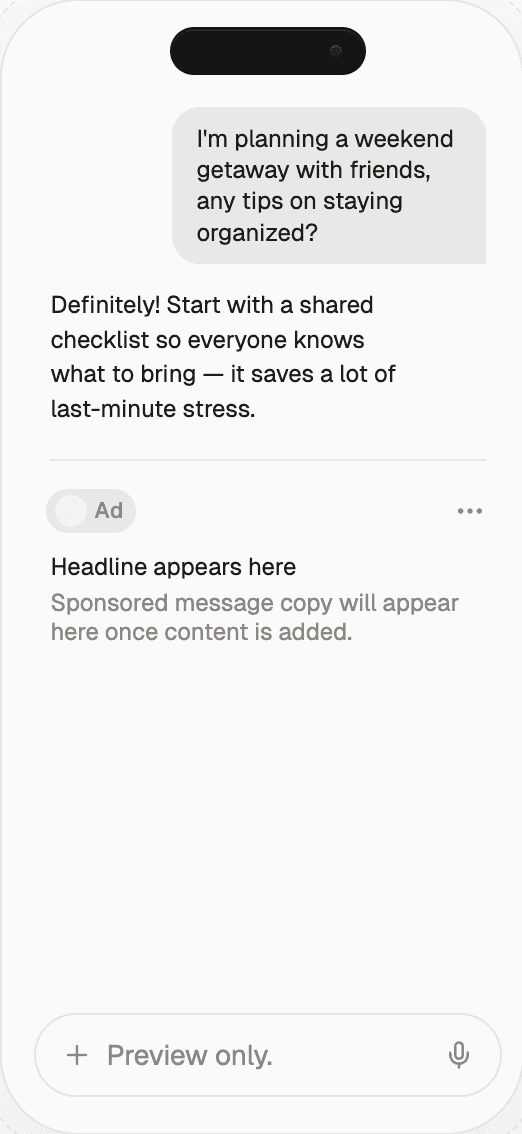
Traditional media captures attention.
Conversational media captures intent.
With Thrad, your brand reaches users in their deepest moments of research, evaluation, and purchase consideration — when influence matters most.
Date Published
Date Modified
Category
Advertising AI
Keyword
generative ai advertising brand safety