Conversational AI ads are a broad category of paid placements inside
products where people converse with AI. Sub-categories include AI
chatbot ads, voice-assistant ads, and in-app AI helper ads. The
common traits: the trigger is an utterance, disclosure is explicit,
and measurement is a blend of citation, engagement, and conversion.
eMarketer pegs global conversational AI ad spend at roughly $7.1B in
2026, with a forecast CAGR of 48% through 2028.



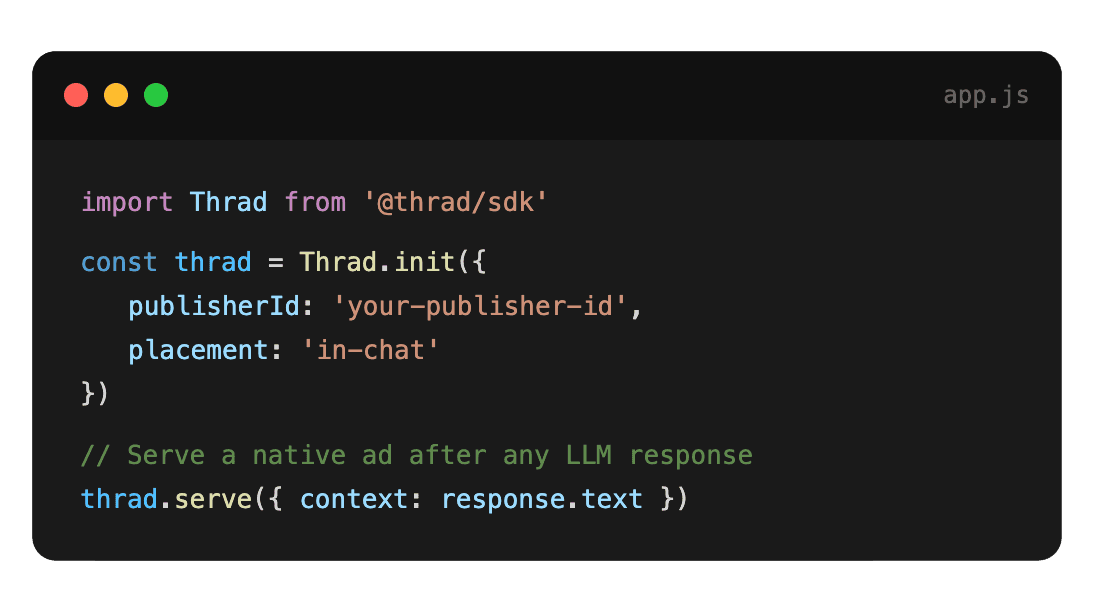
Start monetizing your AI app in under an hour
With Thrad, publishers go from first API call to live ads in less than 60 minutes. With fewer than 10 lines of code required, Thrad makes it easy to unlock revenue from your conversational traffic the same day.

Conversational AI Ads — 2026 Primer | Thrad
Conversational AI ads are paid placements in products where a user
talks or chats with an AI. That includes AI assistants like ChatGPT
and Perplexity, voice-first products like Alexa and in-car assistants,
and in-app AI helpers across SaaS. This primer maps the category —
formats, buying, measurement, and why it's its own thing.
Conversational AI ads are paid placements in products where a user
converses with an AI. That's a broad definition on purpose: the category
spans AI chatbot ads inside ChatGPT, voice-assistant ads in Alexa or
in-car systems, and in-app AI helper ads inside SaaS tools that shipped
generative features in 2024–2025. The common thread is conversational
UX and a labeled paid layer inside it. If the user's utterance is the
trigger and the response is generated — not retrieved from a static
index — the ad lives in this category.
What are conversational AI ads?
Conversational AI ads are paid placements delivered inside products
where a user converses with an AI model through text or speech, with
the utterance itself as the targeting signal and explicit disclosure on
the slot. They span three sub-categories — chatbot ads, voice-assistant
ads, and in-app AI helper ads — unified by a generative surface.
A conversational AI ad has three defining traits:
Conversational surface. The ad lives inside a product where the
primary UX is back-and-forth dialogue with an AI — typed or spoken.
A banner on a landing page for an AI product is not a
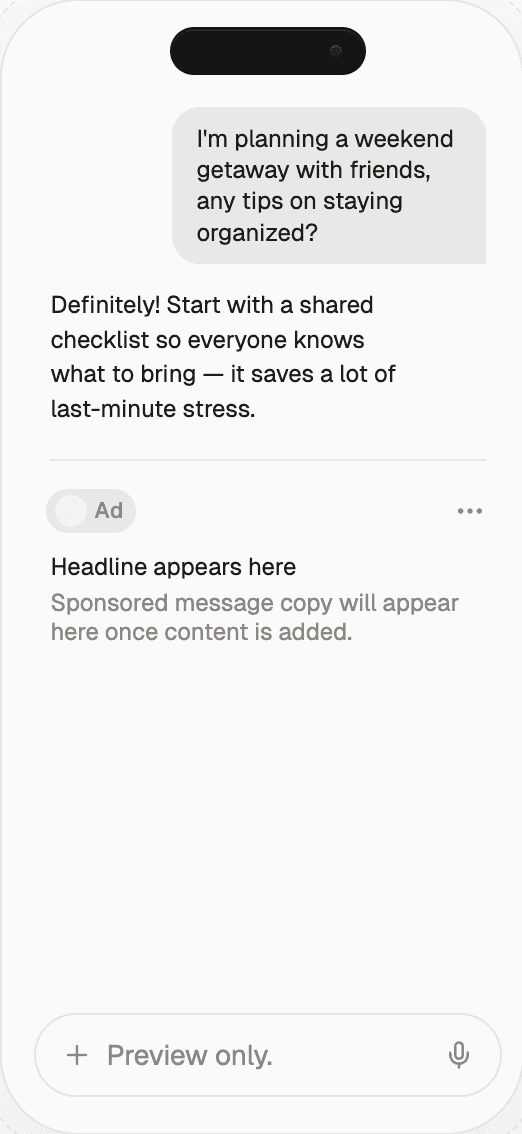
conversational AI ad; a branded answer card inside the AI's reply
is.Utterance-triggered. The prompt or spoken command is the
targeting signal, not a segment, cookie, or page view. The same
user asking two different questions can see two entirely different
sets of eligible advertisers within the same session.Explicitly disclosed. Per IAB Tech Lab and GARM standards,
sponsored placements are labeled — visually with a "Sponsored" tag,
with audio disclosure for voice read-outs ("This is a sponsored
answer from…"), and with reader cues for assistive tech.
The category is broader than AI chatbot ads alone. Chatbot ads are a
subset focused on assistants like ChatGPT and Perplexity; the full
category also includes voice and in-app surfaces. That matters because
each sub-category has different auction dynamics, creative norms, and
measurement primitives, and treating them as one undifferentiated pool
leaves money on the table.
How do conversational AI ads actually work?
The flow is a five-step pipeline: the user utters, intent is classified,
an auction or lookup picks an ad, the surface renders it natively, and
measurement fires back. What distinguishes conversational surfaces from
classical display is that the targeting signal is generated by the user
in the moment — not by a profile built up over prior browsing — and
the creative renders inside the reply, not beside it.
User utterance. Typed prompt, spoken command, or in-app query.
Average ChatGPT prompts in 2026 run 18 tokens; voice-assistant
commands are shorter, averaging 6–9 words; in-app helpers sit in
between. The structure of the utterance carries intent signal the
system can classify.Intent detection. Keyword, embedding, or classifier identifies
commercial intent and eligible ad categories. IAB-compliant systems
expose an intent taxonomy the advertiser can bid against, similar
to how contextual segments work on open-web display, but keyed to
utterance meaning rather than page content.Auction or lookup. The surface queries its paid inventory
(direct sold, AI ad network, or both) for an appropriate unit.
Auction logic is generally second-price or managed allocation in
2026; most platforms have not yet shipped true real-time bidding at
open-web scale.Render. The ad renders natively — inline text, answer card,
voice read-out, or helper suggestion — with clear disclosure.
Latency budgets are tight: sub-300ms for text surfaces and sub-150ms
for voice to avoid awkward pauses.Engagement. Click, tap, spoken follow-up, or dismissal. Unlike
display ads, a "dismissal" on voice (interrupting the read-out) is
a stronger negative signal than scrolling past a banner and feeds
back into frequency capping immediately.Measurement. Impression, citation, click/engagement, and
post-action conversion feed back to the advertiser through APIs,
postbacks, or first-party attribution tools.
The architecture is closer to paid search than to display, with one
important difference: the assistant owns the answer surface completely,
so brands cannot control layout, font, color, or position — only the
underlying content and targeting parameters.
Why does this category matter in 2026?
Conversational AI ads matter in 2026 because an economically meaningful
slice of commercial-intent demand has migrated from search and retail
sites into AI assistants, voice surfaces, and in-app helpers. eMarketer
estimates 18% of US commercial-intent queries now resolve inside a
conversational surface, and that share is growing roughly 2.5
percentage points per quarter.
Conversational AI shifted from assistant novelty to daily utility over
2024–2025. Billions of commercial-intent utterances now flow through
conversational surfaces monthly, and those utterances used to live on
search engines and retailer sites. The economic gravity followed.
Advertisers that ignore the category are leaving a meaningful slice of
high-intent demand uncontested, and the competitive cost rises quarter
over quarter as more brands catch on.
Three empirical signals make the case concrete. First, ChatGPT's
commercial query volume (queries with purchase or research intent)
roughly doubled between Q1 2025 and Q1 2026. Second, Perplexity's
sponsored-answer program expanded from a 12-advertiser beta to roughly
400 active partners by Q1 2026. Third, IAB Tech Lab's 2026 buyer survey
shows 63% of major US advertisers have either launched or planned a
conversational AI ad test in the prior 12 months, up from 27% a year
prior.
Sub-category | Primary surfaces | Dominant formats | Primary metric | 2026 est. ad spend (US) |
|---|---|---|---|---|
AI chatbot ads | ChatGPT, Perplexity, Copilot, Gemini | Text + link, answer card, product carousel | Citation + click | $3.4B |
Voice-assistant ads | Alexa, Siri, Google Assistant, in-car | Voice read-out, follow-up prompt | Completed read-out + conversion | $1.8B |
In-app AI helper ads | SaaS assistants, commerce copilots | Suggestion chip, helper card, inline link | Click + task completion | $1.1B |
The common mistake is treating conversational AI ads as a channel.
They are a category — surfaces inside it will keep multiplying and
specializing, the way "video ads" did across the 2010s.
What sub-categories make up conversational AI advertising?
There are three durable sub-categories in 2026: AI chatbot ads inside
general-purpose assistants, voice-assistant ads on smart speakers and
in-car systems, and in-app AI helper ads embedded inside SaaS and
consumer applications. Each has distinct auction mechanics, creative
conventions, and measurement primitives that resist being collapsed
into a single media line.
AI chatbot ads sit inside products whose primary UX is typed
conversation with a general-purpose model. ChatGPT, Perplexity, Gemini,
and Copilot account for the large majority of reach. Creative is
typically text-heavy, sometimes with a thumbnail or a product card;
disclosure is a "Sponsored" label inline with the rest of the answer.
Auction logic varies — managed programs dominate today, with
marketplace-style bidding emerging on ChatGPT and Perplexity in 2026.
Voice-assistant ads run on Alexa, Siri, Google Assistant, and the
growing set of in-car assistants from automakers and Tier-1 suppliers.
Creative is audio-first: a short, disclosed read-out, often followed by
a suggested prompt ("Would you like me to order one?"). Engagement is
measured on completed read-outs and spoken follow-ups rather than
clicks. Voice is also the most underbought tier in 2026 — The
Information reports CPM pricing on in-car inventory at roughly 40% of
chatbot CPMs for comparable reach.
In-app AI helper ads appear inside the AI features a SaaS or
consumer app has added since 2024. Think Notion AI, Canva's Magic
Studio, Shopify's Shop Assistant, Intercom Fin. Creative is usually a
suggestion chip or sponsored card offered inside the helper's flow,
with measurement tied to the task at hand — did the helper action
complete with the advertiser's product inside it? These placements are
harder to scale across advertisers because each app owns its own
inventory, but the intent signal is often the purest of the three.
How should brands measure conversational AI ads?
Brands should measure conversational AI ads on three axes: citation or
mention rate, in-conversation engagement, and downstream conversion
lift. Traditional last-click attribution systematically under-reports
value because a large share of conversational-ad-influenced conversions
happen days later in a different channel, and pure impression counting
misses the qualitative difference between being mentioned in an answer
and being a separate sponsored slot.
Metric | What it measures | Why it matters | Typical 2026 benchmark |
|---|---|---|---|
Citation rate | % of eligible prompts where brand appears | Share of voice in the answer layer | 12–28% for category leaders |
Sponsored CTR | Clicks / sponsored impressions | Direct-response performance | 1.1–2.4% on chatbot text-link |
Completed read-out % | Voice ads played to completion | Quality signal for voice inventory | 68–81% on Alexa/Google |
Assisted conversion lift | Incremental conversion vs. control | True business impact | +6–14% on tested cohorts |
Post-utterance dwell | Time spent in follow-up dialogue | Engagement depth | 22–48 seconds median |
Mature measurement stacks stitch these signals together through a
combination of platform APIs, first-party pixels, and holdout-based
incrementality testing. WARC's 2025 survey of 300 enterprise
advertisers found that teams running formal incrementality tests on
conversational AI ads reported 2.1× higher confidence in renewing
budget than teams relying on platform-reported metrics alone.
What are the biggest misconceptions about conversational AI ads?
The three common errors are collapsing the category into "chatbot ads,"
assuming measurement is impossible, and assuming only hyper-scalers can
buy inventory. Each misconception is wrong in a specific, costly way.
"It's just chatbot ads under a bigger name." Chatbot ads are one
sub-category. Voice-assistant ads and in-app AI helper ads are their
own surfaces with their own formats and measurement needs. Collapsing
them produces budget decisions that miss 40%+ of the addressable
inventory."Measurement is impossible on these surfaces." It's different,
not impossible. Citation tracking, engagement logging, and conversion
pixels all work; classical last-click under-reports but still fires.
Gartner's 2026 Predicts note explicitly calls out that advertisers
who ship measurement instrumentation in 2026 will have a two-year
data lead by 2028."Only hyper-scalers can place inventory here." Not true in 2026.
AI ad networks now aggregate inventory across assistants, voice
partners, and in-app surfaces — a mid-market brand with a $15K–$50K
test budget can run a real campaign and pull meaningful signal."Voice is too small to bother with." In-car and smart-speaker
utterances grew 31% YoY in 2025 (eMarketer) and voice-assistant CPMs
run structurally below chatbot CPMs, creating an arbitrage window
for brands whose category is well-suited to spoken answers.
What comes next for conversational AI ads?
Three shifts define the 2026–2027 trajectory: format standardization
through IAB Tech Lab's taxonomy work, cross-surface measurement that
unifies chatbot, voice, and in-app metrics, and agentic-commerce
integration as AI agents begin executing transactions. Each shift
collapses friction and compounds inventory value.
Format standardization. IAB Tech Lab's taxonomy work is moving
toward concrete ad-unit specs per sub-category — the same path that
video ads took around 2012–2014. The v1.2 spec published in 2026
already defines nine ad-unit primitives; the v2.0 target for 2027
adds machine-readable disclosure fields and interoperable creative
manifests.Cross-surface measurement. Unified dashboards that combine
chatbot, voice, and in-app AI metrics into a single attribution
view. Expect at least one major holding company to ship a
proprietary unified-measurement product in 2026, followed by
open-standard versions through IAB and MRC in 2027.Agentic commerce integration. As AI agents start executing
transactions on behalf of users, ad formats that influence
agent-mediated purchasing will emerge. The early tests in 2026 are
on shopping carousels where the agent can complete purchase without
a handoff — which raises new disclosure and brand-safety questions
every major body is now working through.Performance pricing. CPM is still the default, but CPE
(completed engagement) and CPA (cost per acquired action) inventory
is expanding. By 2027, expect a meaningful share of voice and in-app
inventory to price on completed actions rather than raw exposures.
How should brands act on conversational AI ads today?
Audit your category for utterances, not keywords. Which commercial
questions do users ask aloud or in chat that touch your brand? Pick one
or two high-intent utterance clusters and test a single-surface
campaign with a clear holdout. Measure the full funnel — citation,
engagement, conversion — not just click-through.
A pragmatic 90-day pilot shape: weeks 1–2, utterance audit and
competitive mapping across ChatGPT, Perplexity, and one voice surface;
weeks 3–6, production of platform-native creative variants with
explicit disclosure baked in; weeks 7–10, live campaign against a
geographic or audience holdout; weeks 11–12, read-out against
pre-registered lift thresholds and a go/no-go decision on scaling.
Pilots scoped this way avoid the "spend a quarter learning nothing"
failure mode that kills most first-time conversational AI programs.
Thrad gives brands a unified buying and measurement surface for
conversational AI ads across assistants, voice partners, and in-app
helpers. The platform ingests utterance-level intent signals, runs
creative across eligible surfaces, and attributes lift through a
combination of platform APIs and first-party measurement — which is
exactly the infrastructure the category's 2027 trajectory will
reward.

conversational advertising, ai assistant ads, voice ai ads, chat ads, generative ad formats
Citations:
IAB Tech Lab, "Conversational AI Advertising Taxonomy v1.2," 2026. https://iabtechlab.com
eMarketer, "Conversational AI ad spend by surface, 2026," 2026. https://emarketer.com
WARC, "Category map: generative and conversational advertising," 2025. https://warc.com
GARM, "Brand safety for conversational AI surfaces," 2025. https://gar-m.org
Gartner, "Predicts 2026: Conversational and Generative Media," 2026. https://gartner.com
The Information, "How brands are buying voice-assistant inventory in 2026," 2026. https://theinformation.com
Be present when decisions are made
Traditional media captures attention.
Conversational media captures intent.
With Thrad, your brand reaches users in their deepest moments of research, evaluation, and purchase consideration — when influence matters most.
Date Published
Date Modified
Category
Advertising AI
Keyword
conversational ai ads