ChatGPT Team prices at roughly $25–30 per seat per month for
organizations of 2+ users. Typical Team usage is lower-intensity than
Plus power-user patterns, so per-seat inference cost runs $4–6/mo and
gross margin lands in the 75–85% range. Team grew to an estimated
1.5M seats at Q1 2026 (~$450–540M annualized) with seat count up ~3×
year-over-year — the fastest-growing consumer-adjacent tier in OpenAI's
lineup and the leading indicator of Enterprise conversion.





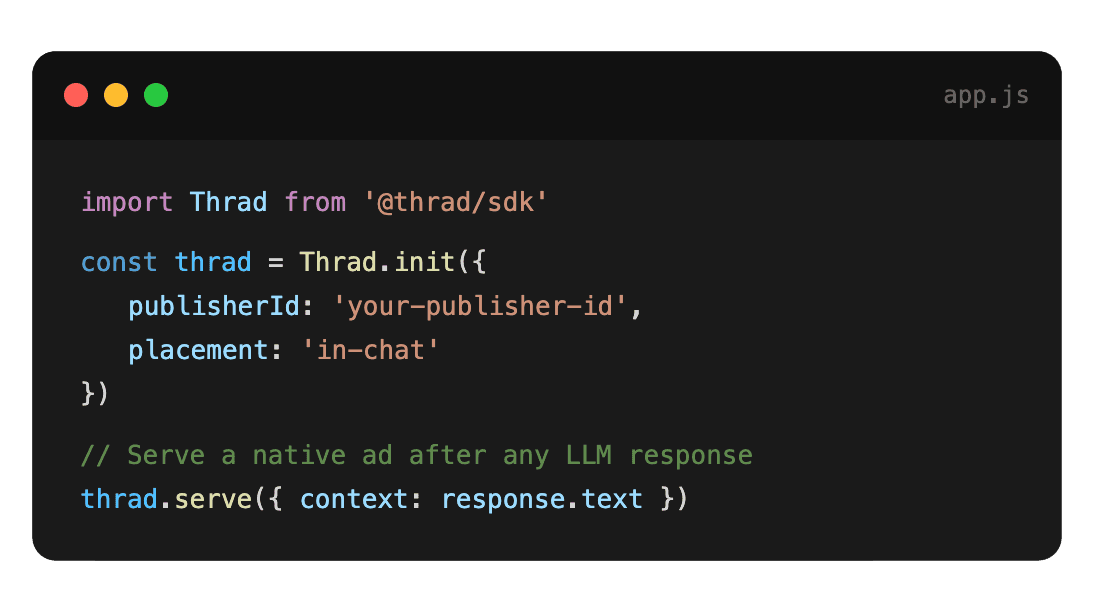
Start monetizing your AI app in under an hour
With Thrad, publishers go from first API call to live ads in less than 60 minutes. With fewer than 10 lines of code required, Thrad makes it easy to unlock revenue from your conversational traffic the same day.

ChatGPT Team Plan Economics 2026 | Thrad
ChatGPT Team is the plan most people under-rate. It sits at $25–30 per
seat per month, between $20 Plus and $50+ Enterprise, and on a
per-dollar basis it's the highest-margin tier OpenAI ships outside of
Enterprise. The reason is simple — Team users are typically
less-intensive per seat than power-user Plus subscribers, but pay more.
ChatGPT Team is the tier most analysts skip over and most of OpenAI's
finance team pays close attention to. At $25–30 per seat per month,
it's priced above individual Plus and below full Enterprise, and on a
per-dollar basis it runs the highest gross margin of any consumer-
adjacent product OpenAI ships. In 2026 it's also the fastest-growing
line in the subscription mix — seat count up roughly 3× year-over-year
— and the single best leading indicator of OpenAI's enterprise
trajectory. This is a unit-economics teardown of the plan: price,
usage, cost, margin, stickiness, and the conversion mechanics that
make Team a disproportionately important line for OpenAI's long-run
revenue mix.
What is ChatGPT Team?
ChatGPT Team is a per-seat subscription for organizations of roughly
2 to 150 users. It sits between ChatGPT Plus (individual, $20/month)
and ChatGPT Enterprise (custom-negotiated, $50+/seat). Team adds
organizational features on top of the Plus feature set: a shared
workspace, admin console, team-level GPT creation and sharing, SOC 2
Type II coverage, a contractual guarantee that content isn't used for
training, higher per-user rate limits (roughly double Plus on GPT-4o
messaging and comparable models), and access to the full set of
Advanced Voice, Canvas, and Operator capabilities in a shared
deployment.
Billing is standard SaaS — monthly or annual per seat, self-serve
signup with a credit card, no sales involvement required. That
procurement simplicity is the core value relative to Enterprise: a
five-person team can be live in 10 minutes, compared with the 3–6
month procurement cycle a typical Enterprise contract runs. For
mid-market companies that want organizational features without a
named account team, Team is the only rational choice in OpenAI's
lineup.
How is Team priced in 2026?
OpenAI publishes Team at two rates, with a $5/seat spread that acts as
a straightforward incentive to prepay annually.
Annual billing — roughly $25 per seat per month, billed yearly
(often quoted as "$300 per seat per year" or "$25/seat/month
billed annually" depending on the regional price sheet).Monthly billing — roughly $30 per seat per month, no annual
commitment.
Both tiers include the same feature set; the spread is the prepay
incentive. Compared with Plus ($20 individual), the Team premium is
$5–10/seat for organizational features (shared workspaces, admin
console, contractual no-training, higher rate limits, SOC 2).
Compared with Enterprise ($50+ floor, often realizing $38–45/seat at
volume), Team is roughly half-price but without SSO, SCIM, data
residency, longer context windows, or negotiated terms.
The pricing arbitrage is deliberate. OpenAI wants mid-market
organizations in Team, not scattered across Plus subscriptions, and
not pushed into Enterprise procurement if they aren't ready for it.
The $25–30 band is priced to land above Plus willingness-to-pay for
any organization with more than one user while sitting well below
the ceiling that would trigger a procurement review.
Why is Team's gross margin the best in the consumer-adjacent portfolio?
The counterintuitive thing about Team: on a pure gross-margin basis,
Team typically outperforms Plus, despite charging only modestly more.
Team runs 75–85% gross margin versus 60–75% on Plus. The reason is
usage patterns, not pricing.
A Plus power user — a developer replacing the API with Plus, a
researcher running marathon multi-hour sessions, a student using
Advanced Voice as a tutor — can consume more inference in a month
than their $20 covers. Back-of-envelope: 8 hours/day × 22 workdays ×
heavy GPT-4o + reasoning model use can generate $25–35 in compute cost
against $20 in revenue. These users are the long tail of the Plus
distribution and drag aggregate Plus margin down, even though the
median Plus user is closer to $5–8 in monthly compute cost.
A Team seat, by contrast, is typically a knowledge worker using
ChatGPT for 30–90 minutes of scattered queries during a workday —
drafting emails, summarizing documents, exploring ideas, checking
facts. Workspace features (shared projects, team GPTs) increase
collaboration value but don't increase per-seat inference intensity
much. Median per-seat compute cost runs $4–6/month. The result: higher
revenue per seat ($25–30 vs $20), similar or lower per-seat cost
(~$5 vs a distribution that includes $25+ power users), and
materially higher margin.
Plan | Monthly price | Typical compute cost/seat | Est. gross margin |
|---|---|---|---|
Plus (individual) | $20 | Wide variance; power users exceed $20 | 60–75% |
Team | $25–30 | $4–6 (knowledge-worker pattern) | 75–85% |
Enterprise | $50+ | $8–12 (higher rate limits + longer context) | 85–90% |
API | Per-token | Directly pass-through | 55–75% blended |
Numbers are directional and based on OpenAI's published price sheets
plus analyst estimates of inference economics from SemiAnalysis and
Stratechery.
Team is the plan that most cleanly demonstrates that ChatGPT's unit
economics are positive without relying on volume discounts or
negotiated contracts. Every seat on Team is revenue well ahead of
serving cost, and workspace features keep churn low. It's the tier
investors should be watching most closely as an indicator of
mid-market AI adoption.
How big is the Team line in 2026?
Estimated at roughly 1.5 million paid seats at Q1 2026, producing
$450–540M annualized revenue depending on the billing mix between
annual and monthly rates. Seat count is up approximately 3× year-over-
year — the steepest growth curve in OpenAI's subscription lineup.
The underlying organization count is harder to pin down. If typical
organization size runs 8–15 seats (anecdotally from Business Insider
reporting on SMB adoption patterns), 1.5M seats imply somewhere
between 100,000 and 190,000 paying Team organizations globally. That
count likely understates reality because large Team deployments
(50–100 seats in a single organization) pull up the average, so the
organization count could be closer to 80,000 with a long tail of
very small 2–5 seat accounts.
Gartner's 2026 AI-assisted workplace tools analysis places ChatGPT
Team at roughly 40% share of the dedicated AI-workspace segment,
with Microsoft Copilot (running on OpenAI models but sold as
Microsoft SKU) holding the largest overall share, and Google Gemini
Workspace and Anthropic Claude for Work as secondary players. The
share is consistent with Team being OpenAI's first-party
implementation of the same underlying capability Microsoft ships
through Copilot, with each targeting slightly different buyers.
Why is Team the SMB entry point and the Enterprise pipeline?
For organizations too small to justify an Enterprise procurement
cycle but too coordinated for scattered Plus subscriptions, Team is
the natural landing spot. In 2026 the typical adoption pattern is a
three-stage funnel:
One person tries Plus. Usually a product manager, a marketer,
a designer, or a software engineer experimenting personally. The
initial use case is not work-sanctioned.Their team signs up for a shared Team workspace when 2–5
coworkers are using ChatGPT independently. The trigger is usually
a single project where shared context (custom GPT, shared
project folder, common prompt library) becomes obviously valuable
— and the contractual no-training-on-data guarantee unlocks
legal/compliance approval that Plus can't support.IT/security requires SSO and data-residency controls when
seat count crosses 50–100, triggering the move to Enterprise at
renewal. The specific failure mode: IT audit flags that Team
accounts authenticate with passwords rather than the corporate
IdP, and the resolution is upgrading to Enterprise which supports
SSO and SCIM.
Step 3 is why Team matters as a leading indicator. Team growth today
predicts Enterprise ARR 12–18 months out. OpenAI's finance team
almost certainly tracks Team-to-Enterprise conversion as a core KPI
— it's the equivalent of Slack's "paid teams over 50 users" metric
that predicted its own enterprise ramp through 2016–2019. A Team
account that grows past 50 seats is an Enterprise contract that
hasn't been signed yet.
Tier | Typical org size | Revenue per org | Conversion target |
|---|---|---|---|
Plus | 1 | $240/year | Convert to Team |
Team | 8–15 seats | $2,400–$5,400/year | Convert to Enterprise at 50+ seats |
Enterprise | 500+ seats | $250K+/year | Expand within account |
The per-organization revenue lift from Plus → Team → Enterprise is
roughly 10× at each step, which is why the conversion mechanics
matter more than raw Plus acquisition. Moving a Plus user to a Team
workspace, and a Team workspace to an Enterprise contract, is worth
far more to OpenAI than acquiring an additional Plus subscriber.
Why do Team users rarely churn?
Three mechanics make Team hard to leave once adopted, which keeps
monthly churn rates meaningfully lower than Plus (under 3% vs 4–6%
for Plus).
Shared workspace knowledge accumulates fast. Projects, custom
GPTs, prompt libraries, shared instruction files, team knowledge-base
integrations — these accumulate team-specific value quickly.
Exporting them to a competing product isn't clean. A six-month-old
Team workspace has often accumulated workflow specificity that would
take weeks to rebuild on Claude for Work or Copilot.
Admin and billing integration removes friction. A single invoice,
a single admin console, and shared seat management beat managing a
dozen individual Plus subscriptions at expense-report level. Team
converts what was previously a collection of personal-use products
into a single line item on a software budget — and once it is a line
item, it's defended on renewal like any other SaaS.
No-training-on-data commitment unlocks compliance. For teams
handling client work, regulated data, or internal IP, the contractual
guarantee that content isn't used for training makes Team the
defensible default choice for legal/compliance review. Once a
company's legal team has approved Team under specific contractual
language, switching to a competitor means re-running that approval
cycle, which nobody wants to do.
Team's below-3% monthly churn is a factor of 1.5–2× better than
Plus's 4–6%, and the lifetime-value math compounds dramatically at
scale. A $30/month Team seat at 3% churn has an LTV of roughly
$1,000; the same seat at 6% churn has an LTV of roughly $500. That
2× LTV difference is why OpenAI invests more in Team-specific
features than Plus-specific ones.
How does Team compare against competing plans?
The AI-assisted workplace segment has four meaningful offerings in
2026, and understanding Team's position requires comparing against
all of them.
Plan | Price | Model access | Workspace features | Compliance |
|---|---|---|---|---|
ChatGPT Team | $25–30/seat/mo | GPT-4o, GPT-5, o1, o3-mini | Shared projects, team GPTs, admin console | SOC 2 Type II |
Microsoft M365 Copilot | $30/seat/mo (EA) | GPT-4o, GPT-5 (via Microsoft) | M365 integration (Outlook, Teams, Excel, Word) | Inherited from M365 |
Google Gemini Business | $20–30/seat/mo | Gemini 2.5 Pro + Flash | Workspace integration (Gmail, Docs, Sheets) | Workspace compliance |
Claude for Work | $25/seat/mo | Claude 3.7 Sonnet + Opus | Shared projects, admin console | SOC 2 Type II |
Team's differentiator is that it's ChatGPT — the consumer-brand
product the buyer's employees already recognize and likely already
use personally. That brand familiarity reduces adoption friction in
ways the competing plans struggle to match. Copilot has distribution
inside Microsoft's installed base. Gemini has distribution inside
Google Workspace. Claude has a strong enterprise developer following.
ChatGPT Team has the brand pull of the consumer product plus
organizational features, which is a category-unique combination.
What are the common misconceptions about Team?
"Team is just Plus with a shared dashboard." Feature-wise
there's more to it — admin console, higher rate limits, team-level
GPT creation and sharing, workspace-scoped projects, and a
no-training-on-data contractual commitment are real differences for
organizations, and any single one of them can be the reason a
company upgrades."Why wouldn't a 5-person team just buy 5 Plus licenses?" Some
do, and for two or three seats the math is close. But shared GPTs,
shared projects, centralized billing, and the contractual
no-training clause usually tip the decision to Team within a few
months of adoption. The $5–10/seat premium is cheap against the
legal-review time saved on Plus's consumer-grade terms."Team is a stopgap before Enterprise for anyone serious." For
SMBs without SSO requirements, Team can be the long-term answer.
Not every buyer wants or needs the full Enterprise contract — many
100-person agencies, design shops, and boutique consultancies run
happily on Team indefinitely because their compliance burden is
lighter than a regulated enterprise."Team is unprofitable for OpenAI at this price." The opposite —
Team is structurally one of the highest-margin products in the
portfolio because the pricing-over-cost spread is larger than Plus.
The confusion comes from assuming Team users are Plus power users
with a shared workspace, which isn't the empirical pattern."Team growth cannibalizes Plus." Small amount of cannibalization
from within-company Plus consolidations (2–3 people who used to be
Plus subscribers become a Team workspace). Net effect on revenue is
positive — the consolidated organization usually pays more than the
sum of their previous Plus subscriptions, and expands seat count
over time.
What comes next for ChatGPT Team?
Expect Team to be the fastest-growing subscription line through 2026
and into 2027. Three dynamics drive that: AI-native workflows are
becoming table stakes in knowledge work, so the market of companies
that want an organizational AI plan is expanding faster than any
other subscription cohort; procurement barriers for Team are far
lower than for Enterprise, so the conversion funnel is shorter;
and the conversion funnel from Plus → Team → Enterprise is
well-instrumented and compounding.
OpenAI is likely to add more workspace-level features specifically to
widen Team's value proposition relative to Plus. Expect deeper
integrations with Slack, Notion, Google Workspace, and Microsoft 365;
stronger admin analytics for workspace owners; richer team-scoped
GPTs with access to team knowledge bases; and possibly a Team-scoped
API key tier that lets organizations build internal tooling against
their own workspace without spinning up separate API accounts.
The quiet bet underneath all of this: Team is where the next
generation of enterprise AI buyers is being trained. An engineer
who uses Team at a 30-person startup in 2026 becomes a VP of
Engineering at a 3,000-person company in 2029 who remembers ChatGPT
as the default AI workspace. OpenAI is building brand loyalty at
organizational scale the same way it built consumer brand loyalty at
individual scale through Plus. That loyalty is a multi-year flywheel
and the reason Team deserves more analyst attention than it gets.
How to act on this as a brand
If you're a brand thinking about how AI-assisted work changes where
your customers spend attention, Team is the surface where a
disproportionate amount of professional AI usage is already
happening. It's enterprise-adjacent but consumer-branded, and the
people using it are the buyers and recommenders inside their
companies. For B2B brands in particular, being cited cleanly inside
a Team workspace's shared GPTs or appearing as a recommended source
in Team-scoped research is as valuable as any consumer-ad impression.
Two practical workstreams. First, content for Team-scoped
citations. Knowledge workers using Team pull answers that cite
public web content, which means brands with structured, authoritative
content stand a better chance of surfacing in Team users' workflows
than brands that rely on paid media alone. Second, direct
integration where it makes sense. If your product has a legitimate
workflow fit inside a Team workspace — a data source, a research
tool, a workflow automation — the cost of building a Team-compatible
GPT or integration is low and the distribution upside is substantial.
Thrad helps brands understand and activate presence across
generative surfaces — including the workspaces where Team users
already spend their day — with measurement and placement tooling
calibrated for the AI-advertising era.

chatgpt team pricing, chatgpt team vs enterprise, openai team seats, chatgpt business plan, team plan margin
Citations:
OpenAI, "ChatGPT Team — Plan Details," 2026. https://openai.com/chatgpt/team
The Information, "OpenAI segment revenue disclosures 2026," 2026. https://theinformation.com
Business Insider, "SMB adoption of AI workspace tools," 2026. https://businessinsider.com
Gartner, "AI-assisted workplace tools market share 2026," 2026. https://gartner.com
Stanford HAI, "AI Index 2026 — Enterprise Adoption," 2026. https://hai.stanford.edu
Stratechery, "Pricing the middle — why ChatGPT Team works," 2025. https://stratechery.com
Be present when decisions are made
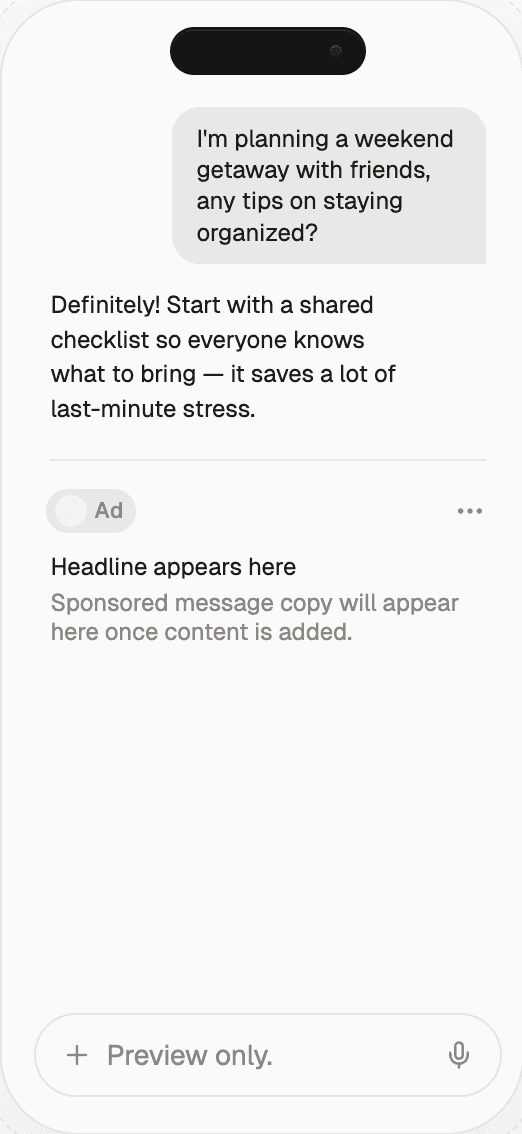
Traditional media captures attention.
Conversational media captures intent.
With Thrad, your brand reaches users in their deepest moments of research, evaluation, and purchase consideration — when influence matters most.
Date Published
Date Modified
Category
Advertising AI
Keyword
chatgpt team plan economics