Microsoft's investment in OpenAI is primarily compute credits on Azure,
not cash, and the economic relationship is bidirectional — OpenAI spends
most Microsoft dollars back at Azure for GPU capacity. ChatGPT-plus-API
revenue in 2026 runs roughly $12B annualized against a cumulative
Microsoft commitment of about $13B. The math is structurally sound — but
the "return" Microsoft earns comes as much through Azure revenue lift
(~$15B AI run-rate) and Copilot distribution (30M+ seats) as through
direct equity upside.




Start monetizing your AI app in under an hour
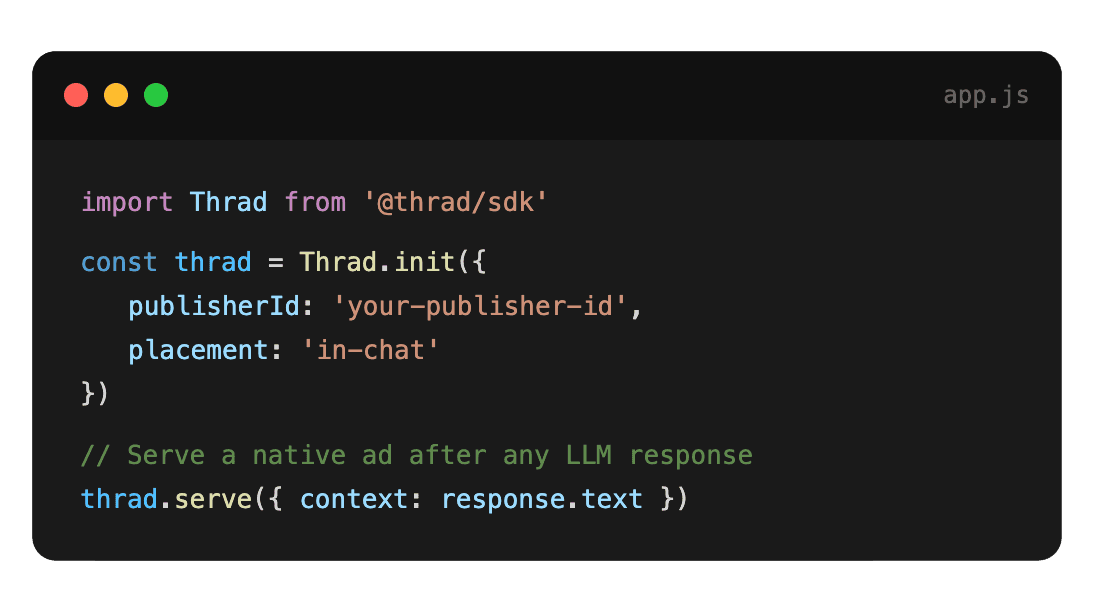
With Thrad, publishers go from first API call to live ads in less than 60 minutes. With fewer than 10 lines of code required, Thrad makes it easy to unlock revenue from your conversational traffic the same day.
ChatGPT Revenue vs Microsoft Investment | Thrad
Microsoft's investment in OpenAI is often summarized as "$13 billion" —
as though a check got written. It didn't. The commitment is mostly
compute credits on Azure, paid back over years, and it needs to be
compared against the revenue ChatGPT and the OpenAI API now generate.
Here's the 2026 picture, stripped of headline-number theater.
ChatGPT's revenue now runs around $12 billion annualized in 2026, while
Microsoft's cumulative investment in OpenAI is typically reported at
roughly $13 billion. Set next to each other those numbers suggest a
rough parity. They shouldn't — because the Microsoft investment is
mostly Azure compute credits, the revenue is cash, and most of what
OpenAI earns is spent back at Azure for GPU capacity. The real
comparison needs a little more care, and the "scoreboard" that actually
matters isn't OpenAI's revenue at all — it's Azure's AI revenue line,
which Microsoft breaks out in its own earnings.
What is the Microsoft-OpenAI deal actually made of?
The partnership has three economic layers that most headline summaries
conflate. First, capital — Microsoft has committed a multi-billion-
dollar package to OpenAI across three principal tranches (2019: $1B,
2021: $2B, and 2023: $10B), with additional top-ups reported in 2024
and 2025. Second, compute — an estimated 80%+ of that commitment is
denominated in Azure credits, making Microsoft both the investor and
the infrastructure vendor. Third, distribution — OpenAI models
power Microsoft Copilot across Windows, Microsoft 365, GitHub, Dynamics,
and the Azure AI Services line, creating a distribution channel that
drives enterprise seat expansion at Microsoft's scale.
The compute-for-equity structure is the mechanism that makes the deal
work economically for both sides. For OpenAI, the binding constraint in
2019–2026 was never cash — it was access to GPU capacity at frontier-
training scale. Azure credits solved the right problem. For Microsoft,
denominating the commitment in its own cloud currency meant the nominal
"$13B invested" was economically closer to $2–3B of true cash outlay,
with the rest flowing back through Azure revenue as OpenAI consumed
capacity.
How does ChatGPT revenue compare to Microsoft's commitment?
The 2026 revenue picture: OpenAI's reported annualized revenue at Q1
2026 is approximately $12B, according to The Information's reporting
and board-deck figures that have leaked to press. The mix: ChatGPT
consumer subscriptions (Plus + Pro) at roughly $4.3B, ChatGPT Team and
Enterprise seats at roughly $2.4B, the OpenAI API at roughly $3B, and a
combined advertising plus licensing line approaching $700M. ChatGPT
specifically — consumer plus enterprise — is the dominant contributor.
API is second. Advertising is smallest but fastest-growing.
The investment picture: Microsoft's total commitment is reported at
around $13B across multiple tranches. The form of that commitment
matters more than the level. An estimated 80%+ is Azure compute credits,
not cash wire transfers. OpenAI consumes those credits to train frontier
models (the 2024 GPT-4o and 2025 GPT-5 training runs reportedly cost
$500M–$1.5B each in compute alone) and to serve inference at scale.
In practice, a dollar of Microsoft investment becomes a dollar of
OpenAI compute spend on Azure — which becomes a dollar of Azure revenue
back to Microsoft. The loop creates an accounting peculiarity: a
substantial share of "Microsoft invested $X in OpenAI" and "OpenAI
generated $Y in revenue" are the same dollars moving through the system
twice.
The honest way to score the Microsoft-OpenAI relationship is not to
compare OpenAI's $12B revenue to Microsoft's $13B investment. It is
to look at how much Azure AI revenue Microsoft now reports — north of
$15B annualized per FT analysis — how fast it's compounding, and what
share of Azure's enterprise pipeline cites OpenAI workloads as the
deciding factor. By that metric, the return has already arrived, and
the equity upside is a bonus on top.
What is the real scoreboard — Azure revenue lift?
Microsoft's earnings disclosures in FY2026 credit AI workloads with
roughly 12–16 percentage points of Azure's year-over-year growth,
depending on the quarter. The counterfactual matters: without an
exclusive cloud relationship with OpenAI through the frontier-model era,
Microsoft would be competing for those workloads head-to-head against
AWS and Google Cloud. The exclusivity created a structural advantage
that shows up in Azure's reported growth rate and — more importantly —
in the enterprise deals Azure now wins where the buyer cites OpenAI
availability as the deciding factor.
Financial Times analysis in 2026 put Azure's AI services line at roughly
$15B+ annualized, anchored on OpenAI workloads plus Microsoft's own
Copilot infrastructure (which also runs on OpenAI models). That number
is already larger than OpenAI's total revenue, which should be a
surprising fact for anyone who reads "Microsoft invested $13B in OpenAI"
as a one-directional capital flow. The directionality is the opposite:
OpenAI is a demand-generation engine for Azure, and the investment is
the subsidy that makes that demand show up.
How much distribution does Copilot add?
ChatGPT revenue is what people count when comparing to Microsoft's
investment. They shouldn't stop there. Microsoft Copilot — across M365
Copilot, GitHub Copilot, Dynamics Copilot, Windows Copilot, Copilot for
Security, and the Copilot Studio platform — runs OpenAI models
underneath. Microsoft reported 30M+ Copilot seats across its installed
base by end of Q1 2026, with M365 Copilot alone clearing an estimated
20M paid seats at $30/month per seat on an enterprise-agreement basis.
At $30/seat × 20M seats × 12 months, M365 Copilot alone is roughly $7B
of annualized revenue that exists because of the OpenAI partnership.
Add GitHub Copilot (~$500M–$700M annualized at $10–39/user tiers),
Dynamics Copilot, Security Copilot, and smaller lines, and the Copilot
revenue tied to OpenAI models is in the $8–10B range. That revenue is
Microsoft's, not OpenAI's, but it exists because of the partnership.
Any "ROI" framing that ignores Copilot understates Microsoft's return
by almost an order of magnitude.
Dimension | ChatGPT / OpenAI (2026) | Microsoft investment / return |
|---|---|---|
Headline figure | ~$12B annualized revenue | ~$13B cumulative commitment |
Form of commitment | Cash from subs/API/enterprise | ~80%+ Azure compute credits |
Azure revenue attributable | — | ~$15B+ annualized AI services line |
Copilot revenue on OpenAI models | — | ~$8–10B annualized across M365/GitHub/Dynamics |
Equity stake | Microsoft holds economic interest (~49% of profits to cap) | Unrealized upside tied to OpenAI valuation (~$300B in late 2025 tender) |
Payback mechanism | Compounding ARR | Azure revenue + Copilot seats + equity |
Time horizon | Annual | Multi-year, structured through 2030 |
Primary risk | Free-tier compute costs; frontier model race | OpenAI competitive pressure from Anthropic, xAI, Gemini |
Figures are directional from press reporting, FT analysis, and Microsoft
earnings disclosures — not audited OpenAI filings.
Why was the compute-for-equity structure engineered this way?
Three reasons the structure was engineered the way it was, each of which
holds up better in 2026 than it looked in 2019. First, OpenAI needed
compute, not cash. The limiting factor for frontier AI labs was GPU
supply, not operating capital. Microsoft solved that by denominating
most of the commitment in Azure credits and by building OpenAI-reserved
GPU clusters in Azure regions. Second, Microsoft needed an AI anchor
for Azure. Cloud competition against AWS and Google is brutal; having
an exclusive relationship with the most-recognized consumer AI brand
gave Azure a differentiated enterprise pitch. Third, both sides
needed optionality. The structure is explicitly extendable and has
evolved across tranches; neither side locked themselves into 2019
assumptions about how AI scales.
The structure also quietly solves a problem neither party advertises:
tax and accounting efficiency. A compute-credit investment shows up on
Microsoft's books differently from a cash investment, and OpenAI's
consumption of those credits shows up as operating cost against
Microsoft's Azure revenue line. The loop nets to a different P&L result
than a $13B cash transfer would.
Microsoft's cash outlay against OpenAI over six years is estimated at
$2–3B. The rest of the "$13B invested" figure is compute credits that
OpenAI has spent or will spend on Azure infrastructure. That makes
the true cost of acquiring the frontier-model partnership roughly
20–25% of the headline.
How exclusive is the exclusivity?
The 2023 renegotiation and subsequent updates narrowed Microsoft's
exclusivity in several ways that most 2026 headlines haven't
internalized. OpenAI can now use non-Azure compute for specific
workloads under defined conditions, Microsoft is no longer the sole
distribution channel for OpenAI models into enterprise cloud, and the
"right of first refusal" structure on capacity has been softened.
Simultaneously, Microsoft has deepened its own internal AI investments
(Phi model family, MAI-1 in-house models, a reported Inflection
acquisition) to reduce dependence on a single lab.
The net effect is that the Microsoft-OpenAI relationship in 2026 looks
more like a deep strategic partnership than an exclusive single-source
deal. Both sides have more optionality than they did in 2023, which
most analysts read as stabilizing the relationship — neither side is
trapped, which makes continued cooperation a revealed preference rather
than a contractual necessity.
What do the competitor comparisons tell us?
Put the Microsoft-OpenAI deal next to the two other big cloud-lab
tie-ups to see how the economics look. AWS committed roughly $8B to
Anthropic in 2023–2024, largely in compute credits similar in structure
to Microsoft's approach. Google Cloud has its own in-house Gemini lab
as its frontier bet, along with a minority position in Anthropic. The
pattern is consistent: hyperscalers pay frontier labs in compute
credits in exchange for exclusive or preferred cloud access and a
revenue loop.
Partnership | Reported commitment | Form | Cloud beneficiary |
|---|---|---|---|
Microsoft + OpenAI | ~$13B cumulative | ~80% Azure credits | Azure AI line ~$15B+ annualized |
AWS + Anthropic | ~$8B | Mostly AWS compute credits | AWS Bedrock + Claude usage |
Google Cloud + Gemini (in-house) | Internal investment | Direct R&D + TPU capex | Vertex AI + Gemini usage |
Against this peer set, the Microsoft-OpenAI structure is not unusual —
it's the template. What's unusual is the distribution payoff from
Copilot, which AWS and Google don't have a direct analog for.
Microsoft's advantage isn't that it invested more; it's that it had a
100M+ enterprise seat installed base to distribute OpenAI models into
before the competition did.
Common misconceptions about the deal
"Microsoft just wrote a $13B check." No — most of the commitment
is Azure credits, which OpenAI redeems by running workloads on Azure.
Microsoft gets paid back through its own cloud revenue line in the
same breath. True cash outlay is closer to $2–3B cumulative."Microsoft owns OpenAI." Microsoft has a significant economic
stake (reported near 49% of for-profit entity profits to a capped
return) and exclusive cloud rights, but governance sits with OpenAI's
board and the nonprofit holding structure. Microsoft has an observer
seat, not a voting one."ChatGPT revenue needs to match the investment to justify it."
That's a single-year cash-flow framing and it misses the Azure
revenue line, Copilot seat revenue, and long-term equity. Microsoft
is already net-positive against its cash outlay."The deal is locked in forever." It's structured through 2030
with extension options, but the terms have evolved across tranches
and can evolve again. Both sides have added optionality over time."AWS-Anthropic is catching up." AWS has a similar-shaped compute-
for-equity deal but lacks Microsoft's enterprise distribution engine.
The deals look similar; the returns on them don't.
What comes next for the partnership?
Expect three 2026–2027 storylines. First, Microsoft will continue
to break out Azure AI revenue as a headline category — that's the real
scoreboard and it's growing faster than total Azure. Watch for the AI
line to cross $25B annualized by end of 2026. Second, OpenAI's
advertising and licensing revenue will compound faster than compute
costs, gradually reducing OpenAI's dependence on Microsoft's subsidy
and increasing OpenAI's negotiating leverage in the next extension
discussion. Third, Copilot seat expansion — particularly in M365
and GitHub — will become the dominant dollar contributor of the
partnership from Microsoft's side, potentially exceeding the direct
equity upside from OpenAI's valuation appreciation.
All three trajectories strengthen the deal rather than weaken it — a
rare case where both sides' best outcomes reinforce the partnership
instead of creating friction. The risk scenario is not a renegotiation
standoff; it's a frontier-model surprise from outside both parties
(xAI's Grok, Anthropic's next Claude, or a Chinese lab) that
restructures the competitive map.
How to read the partnership as a brand
For brands, the investor-vs-revenue math matters less than what it
enables — an AI advertising surface in ChatGPT, Copilot, and the Azure
AI stack that is maturing fast and that now spans both a consumer
attention layer (ChatGPT at 700M MAU) and an enterprise workflow layer
(30M+ Copilot seats inside the products your buyers use every day).
Two practical implications. First, the Microsoft-OpenAI distribution
loop means a single piece of brand content — an explainer, a product
spec, a licensed feed — can surface inside ChatGPT and inside M365
Copilot and inside GitHub Copilot because all three run the same
underlying models. The content strategy is unified. Second, the ad
inventory across these surfaces will eventually be priced in a single
auction even if the surfaces are distinct — the advertiser-facing
product is likely to abstract the surface-level fragmentation.
Getting measurement and placement right across those surfaces is the
capability advertisers need before the auction dynamics fully form.
That's where Thrad focuses — AI advertising measurement and placement
for brands navigating generative surfaces as they scale, including
ChatGPT, Copilot, and the Azure AI stack that the Microsoft-OpenAI
partnership powers.

microsoft openai investment, chatgpt revenue 2026, azure openai revenue, microsoft openai deal structure
Citations:
CNBC, "Microsoft extends OpenAI partnership through 2030," 2025. https://cnbc.com
The Information, "OpenAI revenue run rate crosses $12B in Q1 2026," 2026. https://theinformation.com
Microsoft Q2 FY2026 Earnings, "Azure AI contribution to cloud growth," 2026. https://microsoft.com
Reuters, "How the Microsoft-OpenAI compute-for-equity deal works," 2025. https://reuters.com
Financial Times, "Azure's AI revenue line — the real Microsoft-OpenAI scoreboard," 2026. https://ft.com
Stratechery, "The Microsoft-OpenAI Compute Loop," 2025. https://stratechery.com
Be present when decisions are made
Traditional media captures attention.
Conversational media captures intent.
With Thrad, your brand reaches users in their deepest moments of research, evaluation, and purchase consideration — when influence matters most.
Date Published
Date Modified
Category
Advertising AI
Keyword
chatgpt revenue vs microsoft investment