ChatGPT Plus at $20/mo is the volume tier — many millions of
subscribers, the single largest consumer revenue contributor, and a
healthy 60–80% gross margin at typical usage. Pro at $200/mo is the
power-user tier — a few hundred thousand subscribers, 10× gross
revenue per user, 70–85% gross margin, and structurally better
retention because the buyer has a concrete workload reason to pay.
The two tiers serve different audiences and coexist by design.




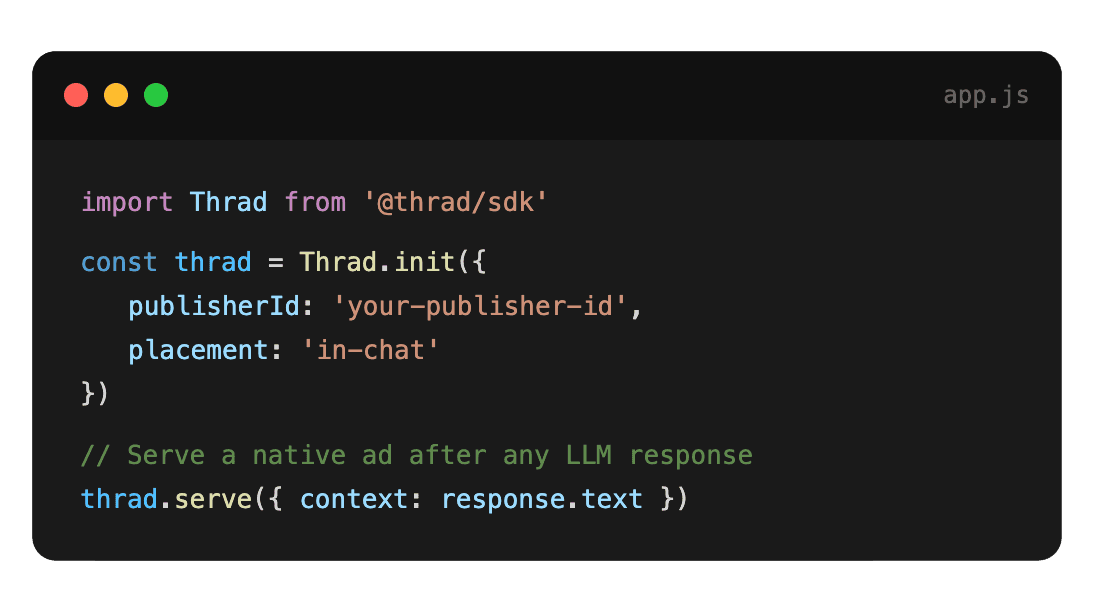
Start monetizing your AI app in under an hour
With Thrad, publishers go from first API call to live ads in less than 60 minutes. With fewer than 10 lines of code required, Thrad makes it easy to unlock revenue from your conversational traffic the same day.

ChatGPT Plus vs Pro Economics 2026 | Thrad
ChatGPT Plus at $20/mo and ChatGPT Pro at $200/mo are the two paid
consumer tiers that anchor OpenAI's subscription business. They look
like the same product at different price points — they aren't. Plus
carries the volume; Pro carries the margin. This piece walks through
the actual unit economics — gross margin per tier, who upgrades from
where, retention differences, and why OpenAI deliberately operates
both rather than collapsing them.
ChatGPT Plus at $20/mo and ChatGPT Pro at $200/mo are OpenAI's two
paid consumer subscription tiers in 2026, and they're structurally
different products despite sharing a brand. Plus is the volume
tier — many millions of subscribers and the single largest consumer
revenue contributor at roughly $2–$3 billion annualized. Pro is the
margin tier — a few hundred thousand subscribers, materially higher
per-user contribution, and better retention among heavy users. The
economics of each tier explain exactly why OpenAI keeps both rather
than collapsing them.
What is the difference between ChatGPT Plus and Pro?
ChatGPT Plus at $20/mo unlocks GPT-4o, higher rate limits than the
free tier, image generation, voice, memory, and basic tool use —
it's the tier most people think of as "paid ChatGPT." Pro at
$200/mo adds Pro-only reasoning models (o3-class and successors),
advanced video generation, the highest consumer rate limits, a more
permissive agent/tool-use envelope, priority access to new
capabilities, and substantially longer context windows. Pro is
designed for users who'd cap out on Plus daily.
The difference is not a simple usage-cap increase. Pro exposes
product surface area that Plus doesn't — specifically the reasoning
models and extended-thinking modes, which aren't just "faster" but
are functionally different tools for different problem categories.
A Plus user can't work around this by sending more queries; the
capability isn't available at the Plus price point. That's the
structural reason Pro commands a 10× price premium rather than the
2–3× premium a simple usage-tier difference would sustain.
Unit economics by tier
Plus at $20/mo carries the volume. A typical Plus subscriber
consumes a bounded amount of compute per month thanks to usage
caps; the resulting monthly inference cost runs $3–$8 depending
on usage pattern, putting gross margin in the 60–80% range on
average. Aggregate Plus revenue is the single largest consumer
line for OpenAI, and the tier generates substantial cash flow
even after cost allocation for infrastructure overhead.
Pro at $200/mo is priced to capture power-user surplus. Compute
consumption for a Pro subscriber is materially higher than for
Plus — more queries, longer contexts, more reasoning — but the
$200 price point clears gross margin comfortably on typical
workloads. Monthly inference cost for a typical Pro user runs
$30–$80; heavy reasoning users can approach $100, and a narrow
slice running near rate limits can exceed it. Pro subscriber
count is much smaller (low-to-mid hundreds of thousands per press
reporting versus many millions on Plus), but per-user contribution
and retention are both materially better, and gross margin runs
70–85% on average.
Tier comparison
Dimension | ChatGPT Plus | ChatGPT Pro |
|---|---|---|
Price | $20/mo | $200/mo |
Subscriber count (directional) | Millions | Hundreds of thousands |
Gross revenue per user/year | $240 | $2,400 |
Typical monthly inference cost | $3–$8 | $30–$80 |
Gross margin (typical usage) | 60–80% | 70–85% |
Usage caps | Moderate | Highest consumer tier |
Reasoning model access | Limited | Full (o3 Pro and successors) |
Video generation | Basic | Advanced, longer clips |
Context window | Standard | Extended |
Agent/tool-use envelope | Limited | Permissive |
Target user | Prosumer / professional | Power user / creator / developer |
Typical upgrade path from | Free | Plus |
Monthly churn (directional) | Standard consumer pattern | Materially lower |
The 10× price delta isn't arbitrary. It tracks the roughly 10×
difference in what a power user can actually do with Pro's rate
limits, reasoning access, and tool envelope versus Plus. It also
tracks a roughly 10× inference cost ceiling at heavy usage — the
pricing absorbs the worst-case compute load without compressing
margin into negative territory.
Plus and Pro aren't competing with each other. They're stacked —
Plus is the broad consumer product, Pro is the power-user
surcharge on top. OpenAI's goal is to keep the Plus subscriber
base growing while converting the heaviest users to Pro, not to
choose between the two tiers.
Who actually pays for ChatGPT Pro?
Four archetypes dominate the Pro subscriber base in 2026, each
with distinct workload characteristics that justify the $200 price
against alternatives. All four cohorts share one trait: Plus's
rate limits would bottleneck their daily productivity, and
switching to the API would introduce friction for their workflow.
The first archetype is solo developers and technical builders using
ChatGPT as a coding and reasoning partner. These users pay
comfortably more than $200 at equivalent API workload, so Pro is
simultaneously cheaper and easier than the API alternative for
their use case. Many of this cohort use both — Pro for interactive
work, API for programmatic calls.
The second archetype is content creators and long-form knowledge
workers — researchers, consultants, writers, analysts — who
generate substantial daily output and use ChatGPT as a primary
drafting and analysis tool. The productivity lift is measurable in
time-to-completion on their deliverables, and the break-even on
$200/mo is typically under two hours of productive monthly use.
The third archetype is multimodal power users generating advanced
image and video content, where Pro's extended generation
capabilities deliver output that Plus can't reach. This cohort
includes marketing and creative operators who use the output
commercially and therefore have a clear ROI case for the
subscription.
The fourth archetype is ChatGPT enthusiasts who simply want first
access to every new feature — a smaller cohort, but high-retention
because the psychological commitment to power-user status keeps
them in-tier. Pro is not primarily an enthusiast product, but
enthusiasts are a real sub-segment.
How do retention and churn compare across tiers?
Plus retention follows a standard consumer-subscription pattern —
healthy but not exceptional monthly retention, seasonal churn
spikes around year-end budgeting and summer vacations, and some
"tried it, didn't need it" churn among marginal users who signed
up after a viral moment and didn't build daily habit. Annual Plus
retention runs in line with other consumer SaaS at a similar
price point.
Pro retention is structurally better because the users who
upgrade are the ones who hit Plus rate limits — meaning they
have a concrete workload reason to pay, not just curiosity. The
average Pro subscriber has already demonstrated daily use on Plus
before upgrading, which filters out the casual signups that
drive Plus churn. Pro monthly churn runs meaningfully below Plus
per press reporting, and annual retention is materially higher.
The interesting dynamic: Pro converts Plus users but rarely pulls
free users directly. The typical conversion path runs free →
Plus → (for heavy users) Pro. Direct free-to-Pro conversion is
functionally zero. That makes Plus not just a revenue line in its
own right but also the qualification funnel that produces Pro
subscribers — killing Plus would starve Pro of its primary
acquisition source.
Reasoning models and the margin pressure on Pro
Reasoning models (o1, o3, and successors) are the single largest
variable affecting Pro-tier unit economics in 2026. Extended
reasoning queries consume 10–100× more compute than standard chat
queries because they generate substantial internal reasoning
tokens before producing a final answer. For Pro subscribers who
use reasoning heavily, monthly inference cost can approach or
briefly exceed the inflection point where per-seat gross margin
compresses from 80% to below 60%.
OpenAI's response has been two-fold: rate limit the reasoning
endpoints specifically (o3 Pro queries per day, not just total
queries), and price the reasoning capability as a core Pro
differentiator rather than a feature ceiling on Plus. The design
goal is to allow heavy reasoning use without letting it invert the
per-seat economics — the rate limits function as a margin
backstop.
The larger implication: as reasoning becomes a more prominent part
of consumer AI workload, Pro's pricing power grows. A capability
that's genuinely difficult to access below $200/mo is a hedge
against consumer-tier price compression. It's also the most
defensible feature differentiation OpenAI has against cheaper
competitors, because reasoning inference cost is genuinely
expensive regardless of the model provider.
What does the revenue contribution look like in aggregate?
Tier | Subscribers (directional) | Annual revenue per seat | Annualized revenue contribution | Share of consumer revenue |
|---|---|---|---|---|
Plus | 10M+ (low tens of millions) | $240 | $2.5–$3.5B | ~70–80% |
Pro | 200–400K | $2,400 | $0.5–$1.0B | ~15–25% |
Free → Plus conversion | Flow metric | — | Driving Plus growth | — |
Plus → Pro conversion | Flow metric | — | Driving Pro growth | — |
Directional 2026 estimates from press reporting and analyst
reconstruction, not audited OpenAI disclosures. The magnitudes are
useful even if the exact numbers vary: Plus is 3–7× larger than
Pro at the revenue line even though Pro contributes 10× per user,
because subscriber counts are an order of magnitude apart.
The takeaway: Plus and Pro together account for the overwhelming
majority of OpenAI's consumer revenue, with Plus as the volume
engine and Pro as the margin multiplier. Dropping either tier
would shrink consumer revenue by more than the other tier could
compensate for — the architecture is multiplicative, not
substitutive.
What are the common misconceptions about Plus and Pro?
"Pro is just Plus with more compute." Pro has distinct
reasoning model access, extended video/image generation, a more
permissive agent envelope, and larger context windows. It's a
different product envelope, not a bigger bucket of the same
Plus experience."Nobody actually pays $200/mo for Pro." Hundreds of
thousands of users do, it's one of OpenAI's higher-margin
per-user products, and the subscriber count has grown
consistently since the December 2024 launch. The consumer
willingness-to-pay envelope turned out to be wider than
pre-launch skeptics expected."Plus will get eliminated and Pro will be the only paid
tier." Extremely unlikely. Plus is the volume engine for
consumer revenue and the qualification funnel for Pro —
collapsing it would shrink the subscriber base by an order of
magnitude and starve Pro of its conversion pipeline."Pro features eventually trickle down to Plus and Plus to
free." Partially — some features do migrate down over time.
But OpenAI has learned to gate premium capabilities more
aggressively since Pro launched, because tier differentiation
now carries real revenue weight. The trickle-down has slowed
visibly since early 2025."The 10× price gap is too wide; users will balk." The
evidence argues otherwise. Pro subscriber growth has been
consistent, the churn profile is favorable, and the consumer
ladder (free → Plus → Pro) works. If a $50–$75 mid-tier were
strictly necessary, OpenAI would have launched it by now."Pro exists mainly to compete with Anthropic / Google." Pro
exists mainly because there's a power-user surplus to extract
from OpenAI's own Plus subscriber base. Competitive positioning
matters, but the primary economics are internal price
discrimination, not external feature parity.
What comes next for consumer subscription tiers?
Expect Plus pricing to stay stable at $20/mo through 2026 — raising
it would hurt subscriber growth at a time consumer subs are
already plateauing across the category, and the downside risk
outweighs the upside on a pricing change. Pro may expand with
additional Pro-only capabilities as new models ship — more
powerful agents, longer-running reasoning, advanced multimodal
tools — each extending the feature gap that justifies the $200
price.
The more interesting question is whether OpenAI introduces a
fourth consumer tier. Two candidates are plausible: a mid-tier
("Plus+") at $50–$75 for semi-power users, and an agent tier
above Pro at $500–$2,000 for users running long-horizon
autonomous workflows. The mid-tier candidate is the less likely
one because it risks cannibalizing Plus without capturing Pro's
margin; the agent tier candidate is increasingly likely because
agent workloads consume 10–100× the compute of chat workloads and
need matching pricing.
A second shift worth watching: international pricing localization.
The $20 Plus price isn't accessible in most markets outside the
US and Western Europe, and OpenAI has piloted localized pricing
in limited regions. Broader localization would expand Plus
subscriber count materially while introducing meaningful
accounting complexity.
How should brands read the Plus vs Pro split?
Consumer subscription tiers tell you where commercial queries get
asked and answered, and the Plus vs Pro split tells you which
audience is on which surface. Pro users run more agentic
workflows, longer research sessions, and deeper product
comparisons — which means brand presence inside those workflows
(as cited sources, recommended tools, licensed content) matters
more than sheer impression count. Plus users behave more like
traditional search users — shorter commercial queries with
sponsored placements and shopping partnerships carrying most of
the inventory.
The practical implication for brand marketers is to segment
generative-surface strategy by tier context. Enterprise and Pro
users warrant investment in content depth, citation-worthy
authority, and product-information completeness — they're
auditing, not just browsing. Plus users warrant investment in
sponsored placement quality, creative that clears the labeled-ad
disclosure, and shopping integration where available.
Thrad helps brands show up correctly across both contexts —
measuring generative-surface presence, placing AI-advertising
inventory with the discipline of paid search, and tracking
citation rates across answer experiences that differ materially
by user tier. The Plus/Pro split is a structural feature of the
landscape in 2026; brands that map their strategy to it will
outperform brands treating ChatGPT as one homogeneous surface.
chatgpt plus pricing, chatgpt pro pricing, chatgpt tier comparison, chatgpt pro features, chatgpt pro subscribers, chatgpt reasoning models
Citations:
OpenAI, "ChatGPT Plan Comparison — Plus, Pro, Team, Enterprise," 2026. https://openai.com/chatgpt
The Information, "ChatGPT Pro adoption curve one year in," 2026. https://theinformation.com
Stripe, "State of Consumer AI Subscriptions 2026," 2026. https://stripe.com
The Verge, "Who pays $200 a month for ChatGPT Pro?," 2026. https://theverge.com
SemiAnalysis, "Reasoning Model Inference Economics," 2026. https://semianalysis.com
Stratechery, "Tiering ChatGPT for Power Users," 2025. https://stratechery.com
Be present when decisions are made
Traditional media captures attention.
Conversational media captures intent.
With Thrad, your brand reaches users in their deepest moments of research, evaluation, and purchase consideration — when influence matters most.
Date Published
Date Modified
Category
Advertising AI
Keyword
chatgpt plus vs pro economics