ChatGPT's monetization timeline runs from a free demo in November 2022
to a four-stream revenue engine by 2026: ChatGPT Plus ($20/mo, Feb
2023), the OpenAI API (March 2023), ChatGPT Enterprise (Aug 2023), Team
(Jan 2024), Pro at $200/mo (Dec 2024), publisher licensing (late 2023
through 2025), and sponsored search plus shopping placements
(2025–2026). OpenAI's annualized revenue reached roughly $12 billion by
early 2026, with advertising growing fastest in percentage terms.




Start monetizing your AI app in under an hour
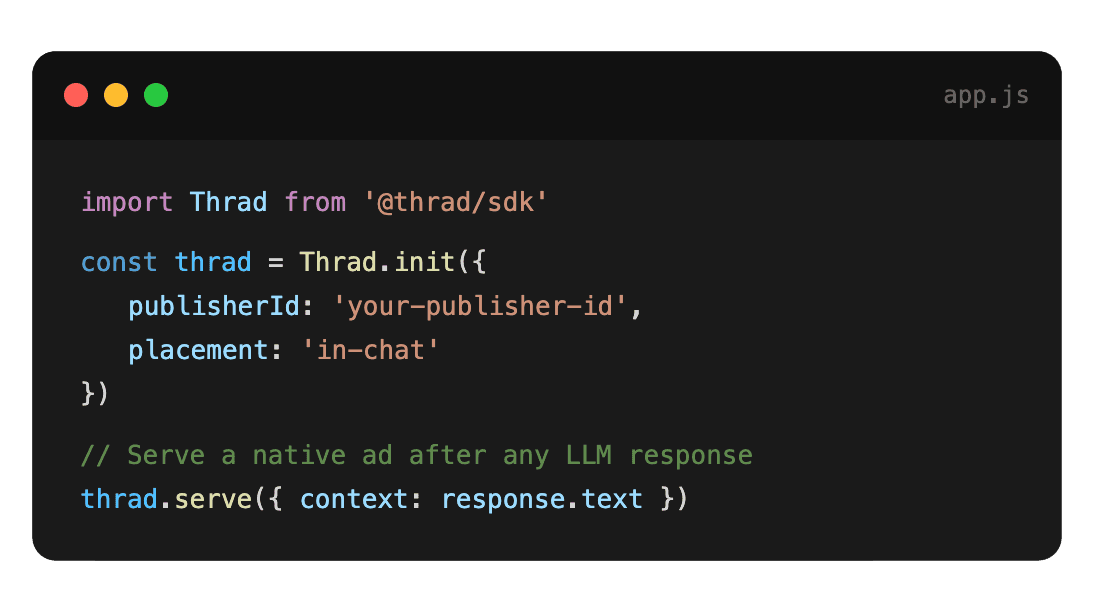
With Thrad, publishers go from first API call to live ads in less than 60 minutes. With fewer than 10 lines of code required, Thrad makes it easy to unlock revenue from your conversational traffic the same day.

ChatGPT Monetization Timeline 2022–2026 | Thrad
ChatGPT went from free research demo to multi-stream revenue engine in
under four years. The timeline tells a consistent story — consumer
subscriptions first, API second, enterprise third, and advertising as
the reluctant but inevitable fourth layer once free-tier scale forced
the issue. Every revenue line arrived in response to the limits of the
one before it, and the sequencing explains why advertising landed in
2025–2026 rather than earlier.
ChatGPT's monetization timeline is one of the fastest consumer
revenue build-outs in software history: free launch in November 2022,
paid subscription by February 2023, enterprise by August 2023,
licensing deals expanding through 2024 and 2025, and advertising
live by early 2026. Each stage was a response to the one before —
usage outgrew what the previous revenue layer could sustain, and the
next layer shipped on a predictable lag.
What is the ChatGPT monetization timeline?
ChatGPT's monetization timeline is a compressed four-year arc from
research demo to a four-stream revenue engine: consumer
subscriptions (2023), API (2023), enterprise seats (2023–2024), and
advertising plus licensing (2023–2026). Annualized revenue went
from near-zero at the end of 2022 to roughly $12 billion by Q1
2026, with each new layer arriving because the previous one
couldn't fund the next stage of growth.
The sequencing isn't incidental. Consumer subscriptions shipped
first because the buyer (individual users) required the least
procurement friction and the price point ($20/mo) was pre-validated
by the SaaS precedent. API shipped next because developer demand
was already proven from the GPT-3 era. Enterprise shipped third
because the procurement playbook existed but needed governance
features (SOC 2, SSO, data handling) that had to be built from
scratch. Advertising shipped last because the product architecture,
ad format design, and measurement infrastructure all had to be
invented in-house — there was no existing generative-surface ad
playbook to copy.
The useful observation is that each layer's launch was lagged by
the time required to build the infrastructure the next layer
required. Enterprise couldn't ship until the governance stack
existed. Ads couldn't ship until the sponsored-placement UX,
query-classification logic, and advertiser tooling all existed.
Year by year
2022 — free launch
November 30, 2022: ChatGPT launches as a free research preview
built on GPT-3.5. No monetization, no subscription tier, no ad
model. The product goes from zero to one million users in five
days and hits 100 million monthly active users in two months — the
fastest consumer product adoption curve on record by a wide
margin. The speed of the adoption curve forced OpenAI's hand on
monetization: the cost of serving that many free users on
GPT-3.5-class compute was untenable, and a subscription tier had
to ship within months rather than the usual consumer-product
cadence of a year or more.
2023 — subscription and enterprise
February 2023: ChatGPT Plus launches at $20 per month, giving
subscribers priority access during peak hours and becoming the
default access path to GPT-4 when it ships a month later. First
direct ChatGPT revenue line, and the template for every consumer
AI subscription product that followed across the industry.
March 2023: GPT-4 API opens pricing for developers, formalizing
the usage-based revenue stream that underpins the AI-native
startup ecosystem. GPT-4 list pricing — $30 per 1M input tokens
and $60 per 1M output tokens at launch, later reduced — becomes
the effective benchmark for the category.
August 2023: ChatGPT Enterprise launches with SOC 2 compliance,
SSO, unlimited GPT-4 access, longer context windows, and
negotiated per-seat pricing. The margin anchor of the commercial
business begins to form. Enterprise launch customers include
Block, Carlyle, and PwC among early-disclosed names.
Late 2023: First publisher licensing deals — Associated Press and
Axel Springer — seed what becomes the content-licensing revenue
layer. These deals structure as a mix of training-data license
fees and limited content-usage rights; the revenue-share model
comes later.
2024 — Team, Pro, and the licensing push
January 2024: ChatGPT Team launches at roughly $25–$30 per
seat per month, targeting small businesses and professional
workgroups. Fills the structural gap between individual Plus
subscriptions and the Enterprise procurement cycle, turning the
tier stack into a continuous ladder from individual user to
Fortune 500.
Through 2024: Major publisher deals expand sharply — News Corp
(Wall Street Journal, New York Post, Dow Jones properties),
Financial Times, The Atlantic, Le Monde, Dotdash Meredith,
Axel Springer. Structure shifts from one-time license fees toward
hybrid agreements with revenue-share components when licensed
content is cited in ChatGPT answers. The News Corp deal, reported
at roughly $250M over five years, establishes a rough benchmark
for large publisher deal sizes.
December 2024: ChatGPT Pro launches at $200 per month with
access to reasoning models (o1 Pro at launch, o3 later), the
highest consumer rate limits, advanced video and image features,
and priority access to new capabilities. Pro creates a
top-of-market consumer tier and signals OpenAI's willingness to
charge power users materially more than the $20 baseline —
opening a pricing surface the industry hadn't tested before.
2025 — advertising trials begin
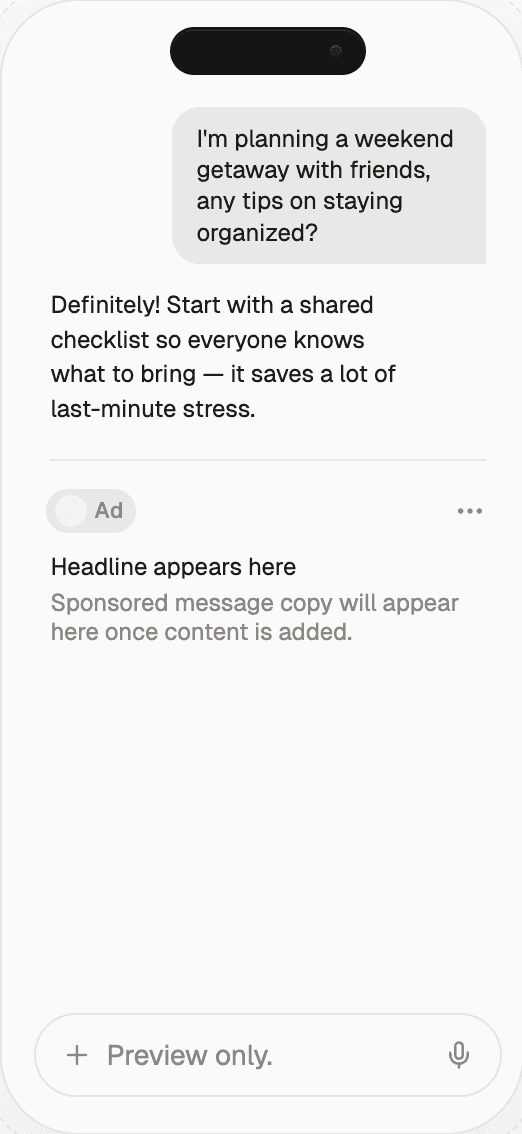
Spring 2025: Reports surface of internal advertising experiments
and of OpenAI hiring senior ad-product leadership. OpenAI
publicly softens its previous "no ads" stance, signaling product
work is underway.
Summer–Fall 2025: Sponsored search pilots begin in limited
markets on the ChatGPT search surface. Shopping placement
experiments with retailer and affiliate partners run in parallel
on a small subset of queries. The format is labeled, isolated to
commercial-intent queries, and designed to minimize degradation of
the organic answer experience.
Late 2025: Expanded licensing with publishers now layered with
rev-share on AI-generated answers that cite licensed sources, not
just training-data use. Publisher attribution inside answers
becomes a standard element of the content licensing playbook.
2026 — advertising ships broadly
Q1 2026: Sponsored search placements roll out broadly on the
ChatGPT search surface with explicit labeling. Shopping product
cards appear in commercial-intent queries across categories.
Retailer and affiliate partner integrations expand into
mainstream categories — consumer electronics, apparel, home
goods, travel.
Q1 2026: OpenAI annualized revenue reaches roughly $12 billion
per The Information reporting, with advertising and licensing
growing fastest as a percentage of the mix. Subscriptions remain
the largest absolute contributor; enterprise is the fastest-
growing absolute line; ads and licensing are the fastest-growing
percentage line.
Through 2026: Continued expansion — more retailer partnerships,
more publisher deals, the first murmurs of a self-serve
ad-buying platform for brands, and early reporting of an agent
tier priced above Pro for users running long-horizon autonomous
workflows.
Timeline at a glance
Year | Revenue line launched | Context | Annualized revenue (EOY) |
|---|---|---|---|
2022 | None (free launch) | Research preview on GPT-3.5 | ~$0 from ChatGPT |
2023 | Plus, GPT-4 API, Enterprise, first licensing | Subscription + commercial foundation | ~$1.5–$2B |
2024 | Team, Pro, expanded licensing | Tier completeness + publisher push | ~$3.5–$4B |
2025 | Sponsored search pilot, shopping pilot | Advertising experimentation | ~$7–$8B |
2026 (Q1) | Sponsored search GA, shopping GA, rev-share licensing | Advertising as permanent revenue line | ~$12B |
Revenue figures are directional, built from press reporting (The
Information, Reuters, Financial Times) and analyst estimates — not
audited OpenAI disclosures. The growth pattern — roughly doubling
annualized revenue each year — is robust across sources even if
the exact endpoints vary.
The timeline is a ladder of inevitability. Every year, free-tier
growth outran the previous year's revenue engine. Subscriptions
couldn't scale fast enough; enterprise couldn't cross-subsidize
consumer; API margins stayed thin. Each new layer arrived
because the prior one wasn't enough — and advertising is the one
that finally scales with free traffic.
How does the timeline compare to other major internet platforms?
ChatGPT's monetization arc — free launch, subscription, enterprise,
ads — mirrors the playbook of earlier consumer internet platforms
but compresses it dramatically. Google took roughly three years
from launch to AdWords launch (1998 → 2000 paid search). YouTube
took five years from launch to mass-monetized ads (2005 → 2010
TrueView ad formats at scale). Facebook took three years from
launch to ad business (2004 → 2007 Facebook Ads). ChatGPT hit all
four revenue layers inside four years.
Platform | Free launch | First paid tier | Ads live | Total arc |
|---|---|---|---|---|
1998 | N/A (search was free) | 2000 | ~2 years | |
YouTube | 2005 | YouTube Premium 2014 | 2007 / scaled 2010 | ~5 years |
2004 | N/A (no paid tier) | 2007 | ~3 years | |
Netflix | 1997 (DVD) / 2007 (streaming) | Streaming launch was paid | Ad-supported 2022 | Several decades |
Spotify | 2008 | Premium 2008 | Free-tier ads 2008 | Immediate |
ChatGPT | 2022 | Plus Feb 2023 | Sponsored search 2025 pilot / 2026 GA | ~3.5 years |
The observation across this set: platforms with a large free-tier
footprint eventually monetize that footprint through advertising,
and the lag between free launch and ad scale is typically 3–5
years. ChatGPT's 3.5-year lag is in the middle of that range —
faster than YouTube, slower than Facebook.
How did licensing revenue evolve over the timeline?
Publisher licensing revenue evolved in three phases across the
timeline. Phase one (2023 through early 2024) was one-time
training-data licenses, priced as lump-sum or multi-year fixed fees
for access to archives and ongoing content streams. Phase two
(mid-2024 through 2025) added citation revenue share, where
publishers earn a payout when their content is cited in ChatGPT
answers. Phase three (2026) is bundling publisher licensing with
ad-revenue share, where publishers can participate in the
commercial revenue generated on queries where their sources anchor
the answer.
The shape of the economics changed meaningfully across those
phases. Phase one licensing had flat economics for OpenAI —
predictable cost, no upside from scale. Phase two made licensing
scale with ChatGPT query volume — better aligned but more volatile
for publishers. Phase three aligns publisher economics with
advertiser economics on the same query, which is the structure
most likely to stabilize long-term.
The News Corp deal reported at roughly $250M over five years is
the most-cited benchmark. Smaller publishers have signed shorter
deals with rev-share weighted more heavily than flat fees. The
total licensing revenue stream isn't separately disclosed, but
analyst reconstruction places it in the low hundreds of millions
of dollars annually by early 2026.
What are the common misconceptions about the timeline?
"ChatGPT was free for years before it monetized." Only three
and a half months, actually. Plus launched in February 2023.
The "free for years" impression comes from the memory of GPT-3
being free-to-test before ChatGPT existed."Advertising showed up without warning." It didn't —
licensing deals were a rehearsal starting in late 2023, and
advertising was telegraphed through 2024 and 2025 before
shipping broadly in 2026. Anyone reading the cost-curve math
could predict the arrival window within six months."Enterprise and Pro are the same thing." No — Enterprise is
a negotiated commercial contract with governance controls;
Pro is a $200/mo self-serve consumer subscription for power
users. They serve entirely different buyer profiles and sit in
different revenue lines on the P&L."Ads came before enterprise because they were the easy
money." Opposite. Enterprise shipped more than two years
before ads because enterprise had existing buyer playbooks
(procurement, IT, security review) and ads didn't — ad formats,
targeting, and measurement all had to be built from scratch."The monetization timeline was planned from the start."
Partially. Subscription and API were planned. Enterprise was
planned once demand signals appeared in early 2023. Advertising
was explicitly not planned — OpenAI's stated position was
anti-ads for years, and the shift reflected cost-math pressure
rather than original roadmap."OpenAI revenue is all subscription." Not anymore.
Enterprise and API together are comparable to consumer
subscriptions in absolute terms by early 2026, and advertising
plus licensing are the fastest-growing percentage lines.
What comes next on the timeline?
The 2026–2027 extension of this timeline likely includes five
shifts: a self-serve ad-buying platform for brands, deeper agentic
tiers priced materially higher than Pro, retailer-integrated
checkout inside ChatGPT answers, a formal rev-share program for
publishers beyond the current negotiated deals, and international
pricing localization.
Self-serve advertising is the single highest-leverage next shift.
Current sponsored placements are sold via direct relationships
with large advertisers; a self-serve auction unlocks long-tail
advertiser demand that current deal structure can't absorb.
Google's AdWords analog took about two years to go from pilot to
self-serve at scale — expect a similar cadence on ChatGPT ads.
An agent tier priced above Pro is the most-telegraphed consumer
product shift. As agentic workflows consume 10–100× more compute
per user than chat, a pricing tier that reflects that cost becomes
necessary. Expect the pricing to land somewhere between $500 and
$2,000 per month, targeting the narrow slice of users running
long-horizon autonomous work.
Retailer-integrated checkout is the highest-margin extension of
shopping ads. Turning a sponsored product card into a transactable
unit with direct checkout inside ChatGPT compresses the funnel and
captures more of the transaction economics than affiliate
relationships do.
How should brands act on the timeline?
For brands, the useful conclusion is that advertising on
generative surfaces is not an experiment — it has followed the
same pattern every major consumer internet company followed (free
product, then subscription, then enterprise, then ads), and it's
now shipped broadly. The playbook for showing up inside ChatGPT
answers is being written right now, and the brands that get there
early will own the category defaults through 2028 and beyond.
Three categories of work matter most. First, visibility measurement:
track your brand's citation rate across ChatGPT answers on your
high-intent queries, because that's the generative-surface analog
of search impression share. Second, sponsored placement strategy:
identify which commercial queries in your category surface
sponsored inventory today, and plan bid and creative strategy
accordingly. Third, licensed-content positioning: if your brand
produces content that ChatGPT cites as a source, understand the
mechanics of publisher attribution and citation economics.
Thrad helps brands navigate the generative advertising surface
end-to-end — measurement, placement, and activation across
ChatGPT, Perplexity, Gemini, and Copilot. If the timeline is as
clear as this piece argues, the work of building infrastructure to
operate in it starts today rather than after the category is
settled.

chatgpt timeline, openai revenue history, chatgpt plus launch, chatgpt ads timeline, chatgpt enterprise launch, openai licensing deals
Citations:
OpenAI, "Introducing ChatGPT Plus," February 2023. https://openai.com/blog
OpenAI, "Introducing ChatGPT Enterprise," August 2023. https://openai.com/blog
The Information, "OpenAI revenue hits $12B annualized in Q1 2026," 2026. https://theinformation.com
Reuters, "OpenAI-News Corp licensing deal details," 2025. https://reuters.com
The Verge, "OpenAI begins testing paid search placements in ChatGPT," 2026. https://theverge.com
Stratechery, "The Strategic Logic of ChatGPT Monetization," 2026. https://stratechery.com
Financial Times, "OpenAI publisher licensing deal tracker," 2025. https://ft.com
Be present when decisions are made
Traditional media captures attention.
Conversational media captures intent.
With Thrad, your brand reaches users in their deepest moments of research, evaluation, and purchase consideration — when influence matters most.
Date Published
Date Modified
Category
Advertising AI
Keyword
chatgpt monetization timeline