ChatGPT's free tier serves several billion queries per week, vastly more
than Plus and Pro combined, and converts only 2–5% of users to paid over
their lifetime. The unit-economics gap — aggregate serving cost in the
high hundreds of millions to low single-digit billions of dollars
annually — exceeds the revenue attributable to eventual paid conversion.
Advertising, licensed content, and shopping partnerships moved from
hypothetical to required in 2025–2026, and free-tier monetization is now
the fastest-growing line in OpenAI's revenue stack.



Start monetizing your AI app in under an hour
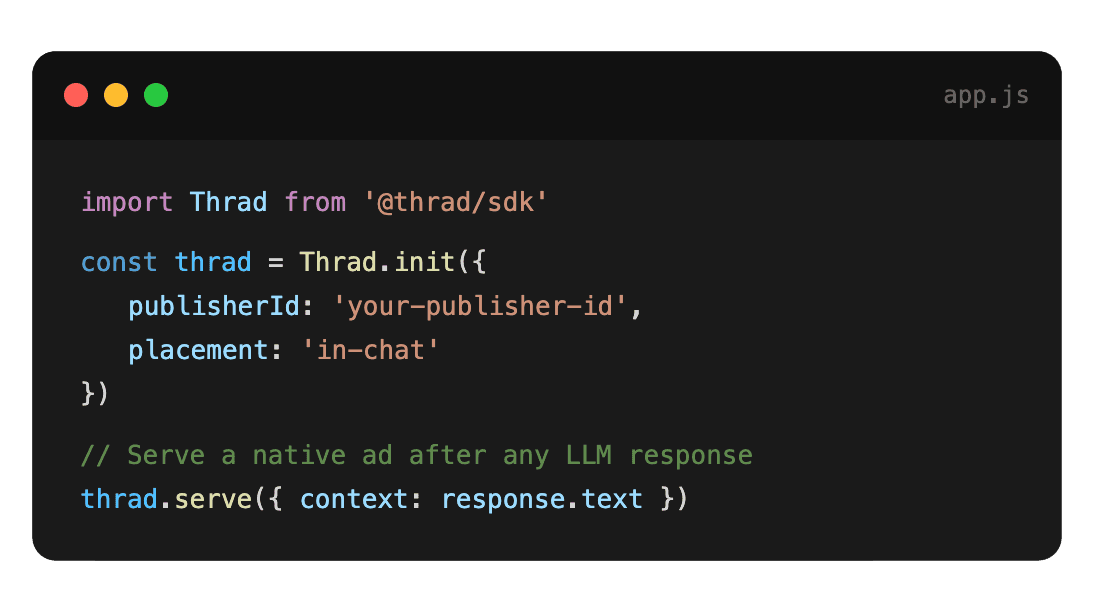
With Thrad, publishers go from first API call to live ads in less than 60 minutes. With fewer than 10 lines of code required, Thrad makes it easy to unlock revenue from your conversational traffic the same day.
ChatGPT Free Tier Economics 2026 | Thrad
ChatGPT's free tier is OpenAI's largest distribution footprint and its
biggest operating-cost line. Serving billions of free queries a week
against a low-single-digit conversion rate to Plus creates a structural
gap that subscription revenue alone can't close. This piece walks through
the actual economics — compute cost per query, conversion funnel, ARPU
trajectory, and why advertising moved from hypothetical to structurally
required in 2026.
ChatGPT's free tier is the largest consumer AI product footprint in the
world and, as of 2026, also OpenAI's biggest single operating-cost line.
Several billion queries served weekly against a 2–5% lifetime conversion
rate to Plus create a structural economic gap that subscription revenue
alone can't close. That gap — not investor pressure, not competitive
anxiety — is why ChatGPT introduced advertising in 2026.
What are ChatGPT's free tier economics?
ChatGPT's free tier serves each query, burns measurable GPU time,
returns an answer, and collects no direct payment. Over a user's
lifetime, 2–5% upgrade to Plus and a tiny fraction reach Pro; the
remainder stay free indefinitely. OpenAI's cost to serve the free
tier scales roughly linearly with query volume, while revenue
historically only converted on the small paid slice — producing a
multi-billion-dollar annual gap that paid-tier gross profit, and now
advertising, have to close.
For most of 2023 and 2024, no ad revenue existed to offset that gap.
Paid tiers covered it through aggregated cross-subsidy. In 2026,
advertising, licensed content deals, and shopping partnerships have
added a direct revenue engine on the free surface itself. The free
tier is still the largest cost line on the P&L, but it's no longer
a revenue desert — and the ramp suggests it will be
contribution-positive on a blended basis within 12–24 months.
The three numbers that actually drive the math
Three numbers shape free-tier economics, and each moves on its own
trajectory. Understanding the relationship between them explains why
advertising arrived exactly when it did, not earlier.
The first is per-query inference cost. In 2023, a GPT-4 query
cost roughly $0.02–$0.05 to serve. By 2026, GPT-4o-class queries cost
$0.001–$0.005 — a 70–90% drop in three years. The drivers are
hardware (H100 → H200 → Blackwell generations), serving efficiency
(batching, speculative decoding, KV-cache reuse), and model
distillation. Per-query cost falls roughly 30–50% per year, with the
curve flattening as easy wins get picked off.
The second is free-to-paid conversion rate. Over a user's
lifetime, 2–5% convert from free to Plus, per press reporting.
Monthly conversion is under 0.5%. This number has been roughly
stable since late 2023 — consumer AI products hit a conversion
ceiling determined by how many users have a workload that clears the
$20/month barrier, and that ceiling hasn't moved.
The third is free-tier ARPU. Historically near zero. In 2026,
with sponsored search and shopping placements live, ARPU on
commercial-intent queries runs into the low single-digit dollars per
user per year, weighted heavily toward the minority of users who
actually issue commercial-intent prompts. On non-commercial queries,
ARPU remains near zero.
The unit-economics equation is simple: for free-tier users to be
individually contribution-positive, the sum of (conversion probability ×
lifetime subscription revenue) plus (ad ARPU × lifetime queries) has
to exceed (inference cost × lifetime queries). Until 2026, the
second term was essentially zero. Now it isn't — and it's growing
faster than either of the other terms.
Why couldn't paid conversion alone close the gap?
Paid conversion alone couldn't close the free-tier gap for two
structural reasons: the free tier is genuinely useful enough that
most users never need to upgrade, and the Plus value proposition
(usage caps, faster response, marginally more features) only matters
to heavy users. The casual majority — who dominate free-tier
population — have no forcing function to pay.
Consumer AI products have a natural conversion ceiling somewhere in
the low single digits percentage-wise. That's where Spotify landed
(10% after a decade, and that's a high-water mark), where Dropbox
landed (lower), where every consumer freemium product lands. ChatGPT
is unlikely to exceed that ceiling materially, because the
underlying product dynamic is the same: the free tier delivers most
of the value for most users. Free users are users whose workload
doesn't clear the $20 bar, and no amount of marketing changes that.
Raising prices on Plus would help — but only at the margin, and at
the risk of shrinking the subscriber base. Adding usage caps that
bite earlier would push casual users away from the free tier
entirely, damaging the top-of-funnel that feeds paid conversion in
the first place. Both levers exist; both have been used sparingly;
neither can close a multi-billion-dollar gap by itself.
Advertising on the free tier, by contrast, scales with exactly the
usage pattern (query volume) that drives the cost. That's the
structural fit that made it inevitable.
How do the free-tier revenue engines work in 2026?
In 2026, five distinct revenue mechanisms run on the free tier, each
contributing to the closing of the free-tier gap: paid conversion,
sponsored search placements, licensed content deals with publishers,
shopping partnerships with retailers, and experimental ad-supported
tiers with higher usage limits.
Mechanism | How it works | Status in 2026 | Relative contribution |
|---|---|---|---|
Paid conversion | Free → Plus upgrade at $20/mo | Steady, small share | Small and stable |
Sponsored search | Paid placements in ChatGPT commercial queries | Live, scaling | Largest and growing fastest |
Licensed content | Publisher deals with rev-share on citations | Live, expanding | Medium, stable |
Shopping partnerships | Affiliate / CPA retail deals on shopping queries | Pilot → broad rollout | Medium, scaling |
Ad-supported tiers | Optional ad-funded higher usage limits | Experimental | Small, exploratory |
Sponsored search is the largest contributor in 2026 and the fastest-
growing. When a user issues a commercial-intent query — something
like "best running shoes for knee pain under $150" — ChatGPT surfaces
sponsored results alongside organic answers. The placements are
visually labeled, ranked on a blend of relevance and bid, and priced
like Google Shopping. On commercial-intent queries, per-query ad
revenue can be multiples of the underlying inference cost.
Licensed content deals provide both training data and revenue share
on citations. Publisher rev-share terms, structured as payouts when
a licensed source is cited in an answer, create a sustainable
content pipeline and reduce lift-and-shift litigation risk.
Shopping partnerships are the most commercial-adjacent. Retailers
pay for product-card placements in shopping queries, with
increasingly integrated checkout. The unit economics on shopping
queries are the best of any free-tier surface — conversion intent
is explicit and transactions are traceable.
The free tier has two distinct jobs: the widest possible top of
funnel for paid conversion, and a standalone revenue engine via
labeled ad placements. Neither job is optional at current scale —
eliminating either would collapse the economics.
What does advertising actually look like on the free tier?
Advertising on the ChatGPT free tier in 2026 is clearly labeled,
limited to commercial-intent queries, and designed to minimize
disruption of informational responses. When a user asks about
products, services, or purchase decisions, ChatGPT may surface
sponsored results alongside the organic answer. The placement is
visually distinct — explicitly labeled "sponsored" — and
informational queries remain free of ad content.
The placement logic is query-classification-driven. ChatGPT's
pipeline classifies each query on a spectrum from purely
informational to strongly commercial. Sponsored inventory only
triggers on the commercial end of the spectrum, and within that,
only on queries where the advertiser signal clears a relevance
threshold. The net effect is that a user asking "what is
photosynthesis" sees no ads, while a user asking "best air purifier
for pet allergies under $300" sees sponsored product cards
alongside an organic recommendation.
The economics work because commercial-intent queries are a small
fraction of total volume but carry ad CPMs that can run an order of
magnitude above display advertising. Per-query ad revenue on
commercial-intent prompts can easily run $0.05–$0.50 on the high
end — multiples of the $0.001–$0.005 inference cost. Even if only
5–10% of free-tier queries carry commercial intent, the ad revenue
on that slice more than covers the serving cost of the other 90%.
How does the free tier compare to free tiers on other consumer AI products?
Product | Free-tier WAU | Paid tier entry | Ad revenue on free | Monetization mix |
|---|---|---|---|---|
ChatGPT free | Hundreds of millions | Plus at $20/mo | Live, scaling | Subs + ads + licensing |
Perplexity free | Tens of millions | Pro at $20/mo | Live, expanding | Subs + ads + API |
Gemini free (non-Workspace) | Hundreds of millions via Google | Google One AI at $20/mo | Embedded via Search | Bundled via Google ads |
Claude free | Millions | Pro at $20/mo | None yet | Subs + API |
Copilot free | Tens of millions | Pro at $20/mo | Limited | Subs + Microsoft bundle |
Directional 2026 estimates. Gemini's situation is unusual because
Google can cross-subsidize free Gemini from Search ad revenue. That
doesn't change the structural economics for OpenAI — without an
existing ad business to cross-subsidize from, the free tier had to
build one from scratch.
What are the common misconceptions about free-tier economics?
"Free users are unprofitable and OpenAI should kill the free
tier." The distribution, training-data, and top-of-funnel value
more than offset the direct compute cost in equilibrium. Killing
free would collapse the acquisition funnel, shrink the training
pipeline, and hand distribution to competitors — the direct cost
savings would be dwarfed by the revenue losses downstream."Conversion will eventually catch up and ads will become
unnecessary." Unlikely. Conversion has plateaued near the
natural ceiling for consumer AI products, and the math doesn't
work even at optimistic upside. Advertising is now structural, not
transitional."Ads will degrade the free tier experience." Current design
keeps ads labeled and isolated to commercial intent, which is a
small fraction of query volume. The free tier still delivers the
same product on informational queries; the revenue side is just
no longer zero. Early measurement data from sponsored search
pilots indicated minimal impact on free-tier retention."Microsoft's funding covers the free tier." Microsoft
investments fund compute capacity via Azure credits, not operating
expenses at the ChatGPT product level. The free-tier P&L has to
work on its own terms eventually; investor capital is a runway,
not a subsidy."The free tier is free because OpenAI is losing money on
purpose." It's free because free distribution is more valuable
than the direct per-user revenue a paywall would capture — a
familiar pattern from search, social, and every previous consumer
internet build-out. The free-tier loss is an investment in
distribution that has now started paying back through advertising.
What comes next for free-tier monetization?
Expect free-tier ad revenue to grow fastest in percentage terms
through 2026 and 2027, on four trajectories: more structured ad
inventory, better targeting within privacy constraints, shopping
ads with direct checkout, and localized pricing and ad-supported
tiers in international markets. The free tier itself stays free;
the monetization layer gets progressively richer.
More structured inventory will arrive first. The current sponsored
search placement will expand into multiple ad-format categories —
product cards, service listings, research-tool recommendations — and
self-serve ad buying for advertisers will move from pilot to
general availability. That single shift unlocks long-tail advertiser
demand that current direct-sales deals can't absorb.
Better targeting will come next, subject to privacy constraints.
Query-level context is inherently richer than behavioral targeting
because the user's prompt is the purchase-intent signal. Expanding
from query-classification targeting to longer-context
conversational targeting is a straightforward product evolution and
increases CPMs materially.
Shopping ads with direct checkout are the highest-margin extension.
Turning a sponsored product card into a transactable unit with
direct checkout inside ChatGPT eliminates the referral drop-off that
caps current affiliate economics. Piloted partnerships with major
retailers suggest this will ship broadly through 2026 and 2027.
Internationally, free-tier economics look different. The $20 Plus
price point isn't accessible in most markets outside the US and
Western Europe. Expect OpenAI to introduce localized pricing
tiers, an expanded ad-supported tier with higher usage limits in
international markets, and regional shopping partnerships tuned to
local commerce platforms.
How should brands act on this?
ChatGPT's free tier is now the largest generative ad surface on the
internet by user count. Commercial queries on the free tier pull
sponsored results today, and that inventory will expand sharply
through 2026 and 2027. The brands that benefit earliest are the
ones setting up measurement, placement, and creative discipline
before generative ad surfaces become as crowded as paid search.
The playbook starts with query coverage analysis: which commercial
queries in your category surface sponsored inventory today, and
which are still organic-only. It continues through structured
placement bidding on available inventory, and measurement that ties
sponsored-placement exposure to downstream conversion — through
branded search lift, direct traffic, or attributed revenue.
Thrad helps brands treat AI advertising as a real channel with the
same measurement and placement rigor they apply to Google and
Meta. The free-tier economics make that work inevitable; the brands
that build the capability early will own the category defaults when
generative-surface inventory becomes the default channel for
commercial-intent advertising in 2027 and beyond.

chatgpt free tier, chatgpt conversion rate, chatgpt unit economics, chatgpt inference cost, chatgpt free tier arpu, chatgpt free users
Citations:
OpenAI, "Usage and Platform Transparency Report 2026," 2026. https://openai.com
The Information, "ChatGPT free-tier conversion benchmarks," 2026. https://theinformation.com
The Verge, "OpenAI rolls out paid search to ChatGPT free tier," 2026. https://theverge.com
SemiAnalysis, "Inference cost economics for frontier models in 2026," 2026. https://semianalysis.com
eMarketer, "Generative AI Ad Spend Forecast 2026," 2026. https://emarketer.com
Financial Times, "Inside OpenAI's free-tier cost structure," 2026. https://ft.com
Stratechery, "Why ChatGPT Had to Monetize the Free Tier," 2026. https://stratechery.com
Be present when decisions are made
Traditional media captures attention.
Conversational media captures intent.
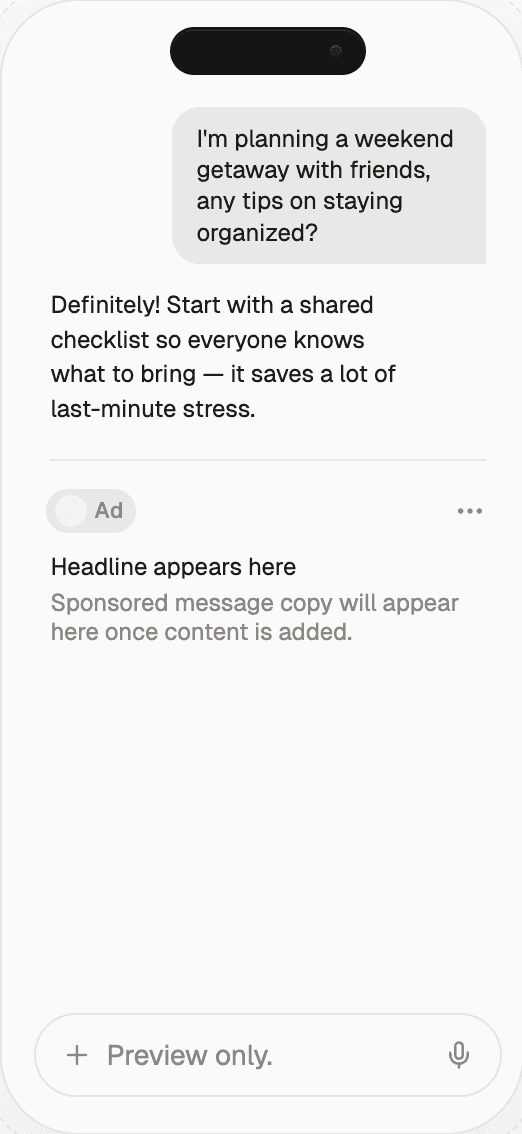
With Thrad, your brand reaches users in their deepest moments of research, evaluation, and purchase consideration — when influence matters most.
Date Published
Date Modified
Category
Advertising AI
Keyword
chatgpt free tier economics