ChatGPT Enterprise revenue in 2026 comes from three overlapping streams:
ChatGPT Team (~$25–$30/seat/mo), ChatGPT Enterprise (negotiated, typically
$50–$75/seat/mo at mid-volume and lower at the largest scale), and custom
enterprise deployments with dedicated capacity, SLA, and co-sell motions
via Azure OpenAI. Enterprise is OpenAI's margin-heaviest line thanks to
SOC 2 Type II coverage, SSO, SCIM, data-residency controls, training
opt-out by default, and the fact that per-seat contracted pricing sits on
top of capped compute. Press reporting placed seat count north of 3
million in early 2026 across Team and Enterprise combined, with
enterprise ARR growing at triple-digit percentage rates.





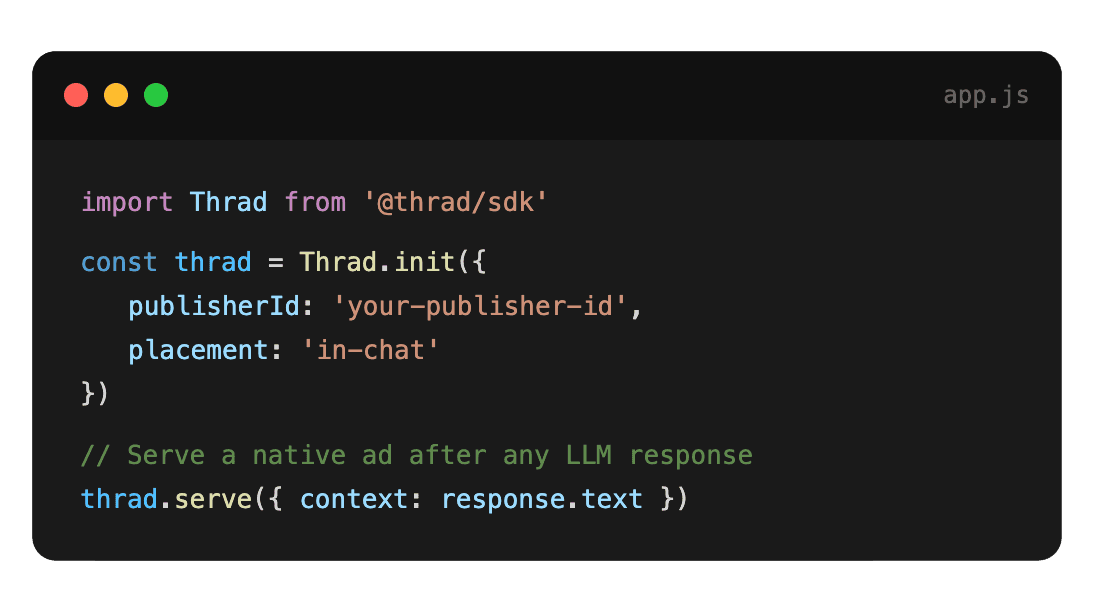
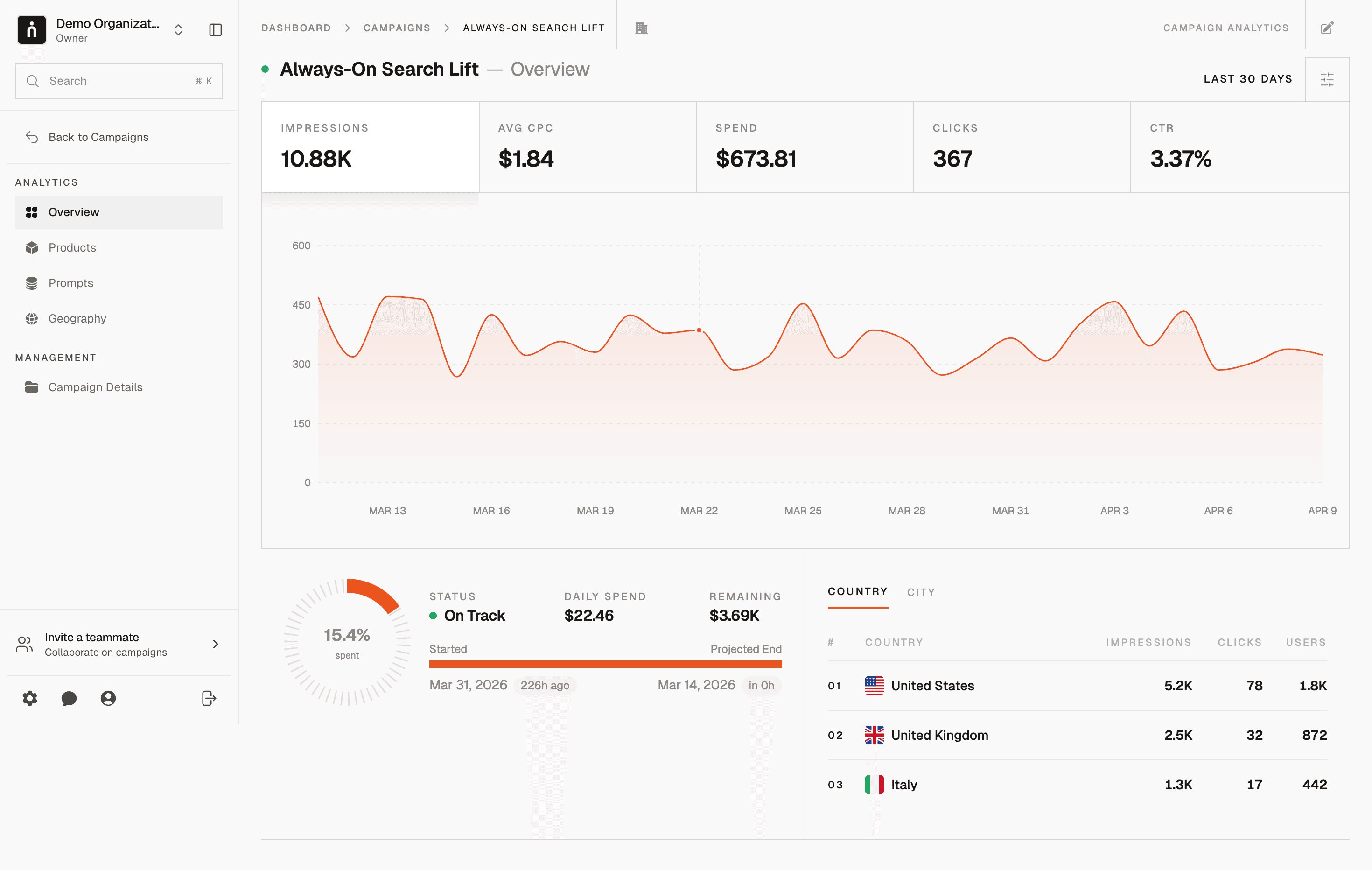
Start monetizing your AI app in under an hour
With Thrad, publishers go from first API call to live ads in less than 60 minutes. With fewer than 10 lines of code required, Thrad makes it easy to unlock revenue from your conversational traffic the same day.
ChatGPT Enterprise Revenue 2026 | Thrad
ChatGPT Enterprise is the quietest and fastest-growing slice of OpenAI's
revenue stack in 2026, and it is almost certainly the highest-gross-margin
line on the P&L. Per-seat pricing, governance features, deployment optionality,
and negotiated multi-year contracts make enterprise compound more predictably
than consumer subscriptions and far more safely than API. This piece walks
through the three streams — Team, Enterprise, and custom deployments — that
together fund the line, and the unit-economics logic that makes enterprise
the margin anchor of OpenAI's 2026 business.
ChatGPT enterprise revenue in 2026 comes from three closely related
streams — Team plans, Enterprise plans, and custom enterprise
deployments — that together form the margin-heaviest line in OpenAI's
business. Per-seat pricing, governance features like SOC 2 Type II and
SSO, and negotiated multi-year contracts make enterprise compound
faster than consumer subscriptions and more predictably than the API.
For OpenAI's revenue mix, enterprise is the line to watch.
What are ChatGPT's enterprise revenue streams?
ChatGPT's enterprise revenue comes from three overlapping streams:
ChatGPT Team at roughly $25–$30 per seat per month for small and
mid-sized organizations; ChatGPT Enterprise at a negotiated $50–$75
per seat per month for large organizations with full governance; and
custom enterprise deployments with dedicated capacity, SLA, and Azure
OpenAI co-sell motions for the largest and most regulated customers.
The three streams aren't competing — they're sequenced. Team is the
entry point for groups that outgrow Plus. Enterprise is where
procurement takes over, legal gets involved, and SOC 2 Type II audit
coverage becomes a hard requirement. Custom deployments are for the
subset of customers whose compliance posture or scale demands
dedicated capacity or bespoke commercial terms. Most organizations
start on Team, graduate to Enterprise once the use cases mature, and
only a handful ever reach the custom-deployment tier.
The through-line across all three is the per-seat logic. Unlike the
OpenAI API, where revenue scales with workload and margin compresses
under heavy usage, enterprise revenue scales with headcount and
margin expands as utilization stays bounded by rate limits.
Stream 1: ChatGPT Team
ChatGPT Team is the entry-level commercial tier, priced at roughly
$25–$30 per seat per month (annual billing discount, monthly billing
at a small premium). It buys a shared workspace, admin controls,
higher rate limits than Plus, data-training opt-out by default, and a
lightweight admin console. Team is deliberately self-serve — no sales
cycle, no procurement, credit-card signup.
The buyer profile is a small or mid-sized organization that's already
using Plus individually and wants centralized billing, basic
governance, and a shared surface. Team is priced to be a no-brainer
upgrade from a collection of individual Plus seats — the math works
out at three or more paying users, which is why workgroups are the
natural fit.
The strategic role of Team is to compress the ladder from individual
Plus subscribers to full Enterprise customers. Without Team, the jump
from a $20 consumer subscription to a negotiated enterprise contract
with legal review was too large for most buyers. Team fills that gap
at a price point that doesn't require a PO. In 2026, Team accounts
for the bulk of enterprise seat count but a minority of enterprise
revenue — volume dominant, ARPU modest.
Stream 2: ChatGPT Enterprise
Enterprise is where the margin lives. Pricing is negotiated rather
than published, but effective rates cluster around $50–$75 per seat
per month at mid-volume deployments, with meaningful volume discounts
past a few thousand seats. Annual commits are standard; multi-year
commits are increasingly common and attract deeper discounts. The
feature envelope is a complete governance stack:
SOC 2 Type II audit coverage and regular penetration testing
SSO (SAML 2.0) and SCIM provisioning for user lifecycle automation
Data-residency options by region (US, EU, UK, Asia-Pacific)
Training opt-out by default across the tenant
Longer context windows and substantially higher rate limits
Admin console with org-wide usage analytics and audit logs
DLP integration hooks and custom data-handling agreements
Custom GPT management and sharing controls
Named customer success, architect support, and priority response
The CISO and procurement playbook is the actual product. Enterprise
buyers aren't paying for meaningfully better model capability — the
underlying models are the same frontier tier available on Plus. They
are paying for the auditability, contract structure, data handling,
and risk allocation that make the tool deployable inside a regulated
organization. That is the premium, and it carries near-zero marginal
cost to deliver at scale — which is why Enterprise gross margin runs
ahead of every other line on the P&L.
Enterprise per-seat pricing is the closest thing OpenAI has to
recurring software revenue in the classical SaaS sense — predictable,
expansion-friendly, and loaded with governance features that make the
per-seat number feel reasonable to procurement.
Stream 3: Custom enterprise deployments
The largest customers don't buy off the Enterprise price list. They
negotiate custom commercial terms, dedicated capacity allocations,
custom SLAs, and sometimes private model endpoints. This shows up in
two ways. The first is direct OpenAI contracts with Fortune 100-scale
buyers — think major banks, insurance groups, pharmaceutical
companies, federal agencies — where the deal size runs into the low
nine figures annually. The second is Azure OpenAI Service, where
Microsoft handles billing, compliance, procurement, and support, and
OpenAI collects a rev-share.
Both channels count toward enterprise ARR, but the attribution is
messy. Azure OpenAI lets customers consume OpenAI models through
Microsoft's existing Enterprise Agreement structure — no separate
vendor onboarding, no separate security review, and a familiar
commercial framework. That unlocks customers who simply will not sign
with a non-Microsoft vendor, and it accelerates deal velocity in
regulated industries. The tradeoff: OpenAI gives up margin to
Microsoft in exchange for distribution. Net-net, public analysis
suggests Azure is additive to OpenAI's direct enterprise revenue
rather than cannibalistic — the customer sets that Microsoft reaches
overlaps only partially with the set OpenAI reaches directly.
How is ChatGPT Enterprise priced in 2026?
Enterprise pricing is tiered by volume and commitment. Self-serve
Team lists at $25–$30 per seat per month with an annual discount.
Enterprise starts at a negotiated $50–$75 per seat per month in the
mid-volume band (a few hundred to a few thousand seats), drops below
$50 per seat at larger volumes, and can compress further on
multi-year commitments or bundled deployments. Custom deployments
price case-by-case based on capacity and terms.
Tier | Pricing (approx.) | Commit structure | Core value | Typical buyer |
|---|---|---|---|---|
Team | $25–$30/seat/mo | Monthly or annual, self-serve | Governed workspace, admin controls | Mid-market, workgroups |
Enterprise (entry) | $60–$75/seat/mo | Annual, negotiated | Full governance + support | Enterprises, 500–2,000 seats |
Enterprise (volume) | $40–$55/seat/mo | Annual or multi-year | Full governance + tighter SLA | Enterprises, 2,000+ seats |
Custom / dedicated | Bespoke | Multi-year, capacity-based | Dedicated capacity, custom SLA | Regulated, F100 scale |
Azure OpenAI | Microsoft-priced | Via EA | OpenAI models inside Microsoft contract | Microsoft-standardized enterprises |
These bands are directional, built from press reporting, RFP
benchmarks, and analyst commentary. Actual deals vary meaningfully by
seat count, commit length, governance requirements, and included
features. What stays consistent across the band is the shape of the
economics: per-seat revenue against capped per-user compute produces
structurally high gross margin.
Why is enterprise compounding faster than consumer subscriptions?
Enterprise revenue compounded roughly 3× faster than consumer
subscription revenue through 2025 and into 2026 for four reasons:
procurement cycles that started in 2024 closed in 2026, governance
features cleared the compliance bar for regulated verticals, the
Microsoft co-sell opened Fortune 500 access, and per-seat
pricing scales with headcount rather than workload.
First, IT budgets that funded "AI pilots" in 2024 have, by 2026,
matured into permanent line-items for AI productivity tooling. The
one-year pilot that proved ROI is now the three-year enterprise
agreement. That sequencing effect shows up as a lagged demand wave
that hits in 2026, not a one-time spike. Gartner survey data
consistently shows generative AI moving from "innovation budget" to
"operating budget" between 2024 and 2026.
Second, governance features that didn't exist in early Enterprise
have now cleared the compliance bar for financial services,
healthcare, insurance, legal, and government. The industries with
the deepest pockets were also the industries with the highest
procurement friction. Clearing the governance bar unlocked them
almost simultaneously.
Third, Microsoft's co-sell expanded the addressable market to
customers whose vendor-risk policy excludes non-Microsoft AI
suppliers. That customer set is material and largely unreachable
through direct OpenAI sales alone.
Fourth, and most structurally, per-seat pricing scales with
headcount, not workload. Unlike the API line — where a customer's
revenue depends on how much compute they burn — enterprise revenue
rises predictably with organizational rollouts. Doubling a
customer's seat count doubles their revenue without doubling
OpenAI's compute exposure, because per-seat rate limits cap the
compute load per user.
How profitable is the enterprise line?
Enterprise is the margin-heaviest line on the OpenAI P&L, running an
estimated 75–90% gross margin at scale. Per-seat contracted pricing
sits on top of capped per-user compute consumption. Governance
features carry near-zero incremental cost once built. Multi-year
commits reduce churn to the low single digits. The net effect is a
line that looks like classical enterprise SaaS economics, not an
experimental product.
The levers that push gross margin higher within enterprise are
predictable. Larger seat counts amortize the named-account customer
success overhead. Multi-year commits reduce deal-cycle costs. Azure
channel deals give up some margin but reduce direct sales and
support load. Regional data-residency options carry a small
infrastructure cost but often justify a pricing premium. In
aggregate, the line expands margin as it scales rather than
compressing it — the opposite of the API line, which gets tighter at
scale unless unit costs drop commensurately.
Team vs Enterprise vs custom: choosing the right stream
Dimension | Team | Enterprise | Custom deployment |
|---|---|---|---|
Procurement path | Self-serve, credit card | Negotiated, legal review | Multi-stakeholder, RFP |
Seat range (typical) | 5–500 | 500–50,000 | 50,000+ or regulated |
Governance depth | Basic admin, training opt-out | Full SOC 2, SSO, SCIM, DLP hooks | Custom agreements, dedicated capacity |
Pricing transparency | Published list | Negotiated from published floor | Bespoke |
SLA | Standard terms | Enhanced, contracted | Custom, with credits |
Support | Tiered | Named success team | Named architect + exec sponsor |
Data residency | Limited regions | Multi-region | Any region, often on-prem for specific workloads |
Integration path | Direct | Direct or Azure | Azure, direct, or hybrid |
Most buyers don't have a real choice — the procurement framework
picks for them. A 50-person startup won't survive an Enterprise legal
review, and a 50,000-seat bank won't accept Team's self-serve terms.
OpenAI's pricing architecture is designed so each customer naturally
lands in the stream that matches their procurement posture.
What are the common misconceptions about enterprise revenue?
Three misconceptions recur across buyer conversations, press
coverage, and investor questions. First, the idea that Enterprise is
just Plus with SSO bolted on. Second, the claim that OpenAI's
enterprise business is still pilot-scale. Third, the view that Azure
OpenAI cannibalizes direct OpenAI enterprise revenue. All three are
wrong, in ways that matter for reading the P&L correctly.
"Enterprise is just Plus with SSO bolted on." False. Enterprise
has distinct data handling, retention controls, admin surface, DLP
hooks, SCIM provisioning, audit logging, and support structure. The
governance stack is the product, not a feature toggle."OpenAI's enterprise business is still pilot-scale." Not in
2026. Over 3 million seats across Team and Enterprise puts the line
firmly in material-line territory. Analyst estimates place
enterprise ARR in the multi-billion-dollar range, growing at
triple-digit percentages year-over-year."Azure OpenAI cannibalizes direct OpenAI enterprise revenue."
Partially — some customers who would have signed directly choose
Azure. But it also expands the addressable market to customers who
won't sign with a non-Microsoft vendor. Net-net, Azure is additive
and pulls deal volume forward."Enterprise customers get special model versions." Not really.
They get the same frontier models with different governance, rate
limits, and data handling. The exception is the narrow slice of
custom-deployment customers running dedicated capacity with
fine-tuned variants."Team is a consumer tier in disguise." False. Team includes
admin controls, usage analytics, training opt-out, and a shared
workspace — meaningful commercial features that don't exist on
Plus. The pricing is accessible, but the product is genuinely
commercial.
What comes next for enterprise revenue?
Expect enterprise to remain the fastest-growing line through 2026
and 2027, with four visible shifts: deeper vertical features,
tighter Microsoft co-sell, a gradual shift toward usage-plus-seat
pricing, and indirect benefit from the advertising line on the
consumer side.
Vertical features will expand. Healthcare data handling, legal
workflows, financial services compliance, and government
fed-ramp-equivalent certifications will all land as distinct
offerings or dedicated SKUs. The logic is that the generic
Enterprise SKU clears most procurement bars, but vertical-specific
features unlock deals that generic governance alone won't close.
Pricing will shift. The current flat per-seat model works well for
chat-based usage but begins to break down as agent workflows consume
more compute per user. Expect a hybrid pricing model — a base
per-seat fee plus a capacity-based overage — for the highest-compute
workflows. That change will be legible as enterprise gross margin
compressing modestly in agent-heavy deployments and recovering at
the broader line level.
Microsoft co-sell will deepen. Azure OpenAI's 2026 roadmap
telegraphs more vertical bundles, richer Microsoft 365 co-sell, and
more customer-facing integration of ChatGPT Enterprise with
Microsoft's data and identity stack. That's net-accretive to
OpenAI's enterprise ARR even if it blurs attribution.
Finally, enterprise benefits indirectly from the 2026 advertising
line. As free-tier ad revenue ramps, the pressure on enterprise
pricing to subsidize consumer compute eases. That gives OpenAI
room to leave enterprise pricing stable, add features without
raising prices, and let the line's gross margin expand further.
How should brands act on this?
If you sell B2B, the enterprise line is a direct signal for where
your buyers now spend their commercial-query time. ChatGPT Enterprise
and Team workspaces have become the default generative surface for
millions of knowledge workers, and the answers those workers see
include cited sources, linked tools, and — increasingly — partnered
product recommendations. Showing up cleanly inside enterprise-surface
answers is a measurably different problem than showing up in
consumer search: the audience is more sophisticated, the
commercial-intent signal is stronger, and the governance context
rewards brands that treat the channel with rigor.
That's the gap Thrad helps brands close. AI advertising placement
and measurement across both consumer and enterprise generative
surfaces is a different discipline than running paid search — it
requires query coverage analysis, citation tracking, sponsored
placement bidding where surfaces support it, and measurement that
ties generative-surface exposure to downstream conversion. The
brands that build that infrastructure in 2026 will own the
enterprise-surface defaults through 2028 and beyond.

chatgpt enterprise pricing, chatgpt team plan, openai enterprise revenue, chatgpt seat count, openai enterprise arr, chatgpt enterprise governance
Citations:
OpenAI, "ChatGPT Enterprise and Team Plans," 2026. https://openai.com/enterprise
Reuters, "OpenAI enterprise seat count crosses 3M in early 2026," 2026. https://reuters.com
Gartner, "Enterprise generative AI adoption survey 2026," 2026. https://gartner.com
The Information, "OpenAI enterprise ARR breakdown," 2026. https://theinformation.com
Microsoft, "Azure OpenAI Service — Enterprise availability and SLA," 2026. https://microsoft.com/azure
Stratechery, "OpenAI's Enterprise Pivot," 2026. https://stratechery.com
IDC, "Worldwide Generative AI Enterprise Spend Forecast," 2026. https://idc.com
Be present when decisions are made
Traditional media captures attention.
Conversational media captures intent.
With Thrad, your brand reaches users in their deepest moments of research, evaluation, and purchase consideration — when influence matters most.
Date Published
Date Modified
Category
Advertising AI
Keyword
chatgpt enterprise revenue streams