ChatGPT Enterprise pricing in 2026 is negotiated per contract, typically
starting around $50–$60 per seat per month with volume discounts that
push per-seat cost down 30–50% at scale. The premium over Team
($25–$30/seat) pays for SSO and SCIM, SOC 2 Type II coverage, data-
retention controls, training opt-out by default, unlimited higher-tier
model access, and a named account team. For organizations with
compliance obligations — healthcare, financial services, legal,
government — the premium typically pays for itself in procurement
time alone. For general commercial buyers, the math depends on seat
count, usage patterns, and required admin control.




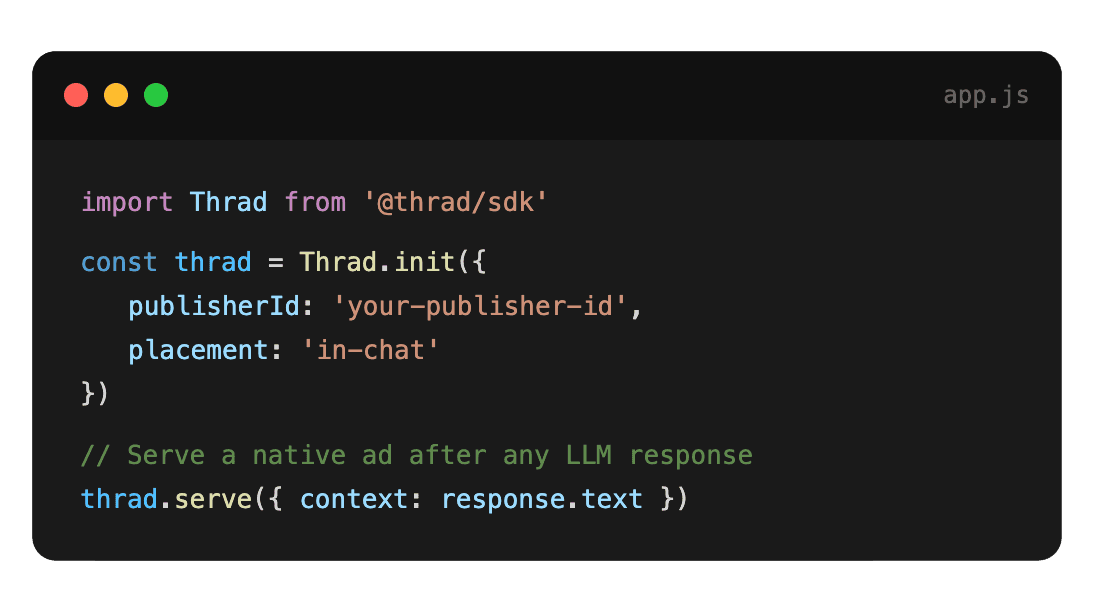
Start monetizing your AI app in under an hour
With Thrad, publishers go from first API call to live ads in less than 60 minutes. With fewer than 10 lines of code required, Thrad makes it easy to unlock revenue from your conversational traffic the same day.

ChatGPT Enterprise Pricing Explained | Thrad
ChatGPT Enterprise is sold, not self-served. Pricing is negotiated per
deal, seat cost varies with volume and contract length, and the real
value calculation lives in governance features most buyers don't
evaluate carefully enough. Here's how enterprise pricing actually
works in 2026 — and how to tell whether the premium over Team is
worth it. For regulated industries the math is usually obvious; for
general commercial buyers it's more nuanced and depends on how much
admin control the deployment actually needs.
ChatGPT Enterprise is the top tier of OpenAI's ChatGPT product line and
is sold through OpenAI's enterprise sales team rather than self-served
off a pricing page. In 2026, typical seat pricing starts around $50–$60
per month with volume discounts that scale down materially, and the
premium over Team ($25–$30/seat) is justified almost entirely by
governance features — SSO, SOC 2 Type II coverage, data controls, and
a named account team. Understanding what you're actually paying the
premium for is the single most important procurement question, because
the governance layer is not separately purchasable.
What is ChatGPT Enterprise pricing in 2026?
ChatGPT Enterprise pricing is a negotiated per-seat contract, typically
annual, with list seat rates in the $50–$60 per user per month range
and volume discounts that reduce the effective rate 30–50% at scale.
Every deal is custom-quoted based on seat count, contract length,
bundled commitments, and industry. OpenAI does not publish enterprise
pricing; list ranges are estimates derived from press reporting and
customer-side disclosures rather than official documentation.
The pricing frame: negotiated, usually annual, per-seat. Directional
starting point in 2026 is $50–$60 per user per month, with discounts
keyed to seat count, contract length, and whether the customer commits
to additional OpenAI products (API, Custom Models, dedicated capacity).
At scale — think thousands of seats — per-seat cost can drop 30–50%
below the starting-point list. OpenAI does not publish enterprise
pricing; every customer gets a quote customized to their deployment
profile.
What sits on top of the seat fee matters as much as the seat fee itself:
implementation support, named account team costs, data-residency
options, custom-model credits, and API credit bundles can all be
negotiated into the same agreement. Treating Enterprise as "seats plus
a quarterly invoice" misses half the value and half the cost.
What do you actually pay the premium for?
The Enterprise premium over Team covers four specific capabilities
that are structurally unavailable on lower tiers: governance and
compliance tooling, data-handling controls, unlimited higher-tier model
access, and a named account team. Each one matters differently to
different buyers — regulated industries care most about the first two;
high-usage power users benefit most from the third; large deployments
derive disproportionate value from the fourth.
1. Governance and compliance
SSO with your identity provider (Okta, Azure AD, etc.), SCIM
provisioning for automated seat lifecycle, audit logs with configurable
retention, domain verification, and SOC 2 Type II coverage. Training
opt-out is the default rather than something to request. HIPAA-
compatible configurations are available under a BAA for healthcare
customers. For any regulated industry this is the reason Enterprise
exists — Team cannot meet procurement standards in healthcare,
financial services, legal, or government at any price.
The procurement consequence is concrete: for regulated customers, the
practical alternative to ChatGPT Enterprise is not ChatGPT Team — it's
"no ChatGPT at all" or "shadow IT deployments that security eventually
catches and shuts down." Either way, Team isn't a real option, which
means the Enterprise premium is essentially the cost of being able to
use the product with institutional approval at all.
2. Data handling and retention
Enterprise data is not used to train OpenAI models. Conversation
retention is configurable (and can be set to zero for sensitive
workflows). Data residency options are expanding; EU-region data
handling has matured significantly through 2025–2026, with regional
hosting options available for European customers under data-sovereignty
requirements. These controls sit in the admin console rather than
requiring support tickets, which is the operational difference that
matters in practice.
The retention configuration is worth specific attention in the contract.
Default settings favor flexibility (longer retention, broader logging),
and the cost of changing that after deployment is higher than the cost
of specifying it up front. Procurement teams who treat data-retention
settings as a day-one contract artifact get better outcomes than teams
who treat it as a post-deployment configuration question.
3. Unlimited higher-tier model access
Enterprise users get higher rate limits and unlimited access to top-
tier models — GPT-4o, GPT-5, Advanced Voice, and image generation —
that Plus and Team cap. For power users, this alone often pays the
differential: a knowledge worker hitting Plus rate limits twice a week
is a user whose Enterprise seat delivers quantifiable productivity gain
over the Plus experience. Measurement this concretely is one of the
strongest internal cases for the premium.
4. Named account team
Enterprise contracts come with a named CSM, technical account support,
and structured onboarding. For large deployments, the value of
professional change management is non-trivial; rolling out a new
workflow tool to 10,000 knowledge workers is hard, and the account team
runs that playbook. Training materials, adoption benchmarks, use-case
libraries, and executive updates are all part of the service rather
than extra-cost options.
Under-used lever: the account team also runs renewal analytics. Customers
who engage the account team on usage data and expansion planning
consistently get better renewal pricing than customers who treat the
relationship as transactional. This is worth tens of thousands of
dollars annually at even modest seat counts.
Pricing comparison table
Plan | Approximate price | Audience | Governance | Support |
|---|---|---|---|---|
Free | $0 | Individuals | None | Community |
Plus | $20/user/mo | Individuals | None | Community |
Pro | $200/user/mo | Power users | None | Limited |
Team | $25–$30/seat/mo | Small/mid orgs | Basic admin | |
Enterprise | $50–$60+/seat/mo (negotiated) | Large orgs | SSO, SOC 2, data controls | Named CSM |
Enterprise + Custom Models | Negotiated uplift | Regulated/bespoke | Above + custom model ops | Dedicated engineering |
Pricing is directional and varies by region, volume, and contract
structure. Enterprise quotes are negotiated per deal, and the actual
landed rate depends heavily on whether the deal includes bundled API
commitments and multi-year terms.
Why do volume discounts matter more than list price?
Volume discounts drive the effective per-seat cost far more than the
list rate does at enterprise scale. List pricing in the $50–$60 range
is essentially the quote OpenAI offers a 50–500 seat deployment with
no bundled commitments; a 10,000-seat multi-year deal with bundled API
credits and a custom-model commitment can land 30–50% below that.
Procurement discipline on the discount mechanics is worth more than
shopping for a lower list rate ever could be.
Enterprise list pricing is a starting point, not the deal. The real
question procurement should ask isn't "what's the seat price?" but
"what's the all-in cost per user per month after discounts, including
the named account team, API credits, and any custom-model commitments
we plan to add later?" The answer is usually 30–50% below the
starting quote for contracts at scale, and the path to that discount
is through bundling and term length, not price shopping.
Volume thresholds that tend to unlock material discounts:
~500 seats: modest discount, typically 5–10% off list.
~2,000 seats: meaningful discount, often 15–25% off list with
multi-year commitments.~10,000+ seats: strategic-deal territory, with bundled API
credits, custom-model provisions, executive relationship, and
discounts that can land 30–50%+ below list.Global/enterprise-wide (50,000+ seats): bespoke pricing,
effectively a partnership deal. These are the contracts OpenAI's
senior sales leadership is personally involved in.
Multi-year commitments compound the discount. A three-year deal
typically gets 5–10% more off than a single-year deal at the same seat
count, because OpenAI values revenue predictability in its own planning.
How do enterprise usage patterns drive actual spend?
Usage patterns inside an Enterprise deployment are more uneven than
buyers expect: a minority of seats drive the majority of daily active
usage, and the shape of that distribution determines whether the
seat price is economically justified. Measuring usage from day one —
not waiting for renewal — is the single most important operational
discipline for an Enterprise deployment, because it drives both
seat-right-sizing and renewal leverage.
Typical 2026 usage distribution inside a 1,000-seat deployment:
Usage tier | Share of seats | Share of usage | Per-seat economic value |
|---|---|---|---|
Daily heavy users (multiple sessions) | 20–25% | 60–70% | Strongly positive |
Daily light users | 25–35% | 20–25% | Net positive |
Weekly users | 25–35% | 5–10% | Roughly break-even |
Monthly or dormant users | 15–25% | <5% | Net negative — right-size |
The procurement lever: the dormant-seat tier is where most waste lives.
Enterprise admin consoles surface this data; teams that run quarterly
right-sizing reviews typically reduce licensed seat count by 10–20% in
the first year without any adoption impact, because they reclaim seats
from users who never engaged.
What does Enterprise not include?
Three things often assumed to be bundled but aren't — and buyers who
discover this at renewal usually pay more than buyers who price them
into the original deal.
API access. Enterprise covers ChatGPT the product. Developer
access to the OpenAI API is a separate usage-metered line, though
most Enterprise contracts bundle API credits at negotiated rates.
Build API volume estimates into the original contract; negotiating
API pricing separately later costs meaningfully more.Custom-model training. Enterprise gives you governed access to
OpenAI's models; training a custom model on your data is a separate
product (Custom Models) with separate pricing and separate
operational requirements. Custom Models is usually only
cost-justified at specific use cases with clear business value; it's
not a generic "personalize ChatGPT" offering.Dedicated capacity / priority compute. If you need guaranteed
capacity at peak (for example, a customer-facing deployment that
cannot tolerate rate-limit behavior), that's a separate commitment
layered on top. Most Enterprise deployments don't need this; the
ones that do, need it urgently.
Common misconceptions
"Enterprise is just Plus with more seats." No — the governance
layer is the entire point of the premium. If you don't need SSO,
SOC 2, or data controls, Team is almost always the right choice."Enterprise pricing is public." It isn't. List ranges are
estimates from press reporting and customer-side disclosures; every
quote is negotiated. Anyone quoting a specific public price as
authoritative is extrapolating."Team is fine for everything except very large orgs." Many
mid-size companies in regulated industries need Enterprise at 200
seats, not 2,000, because compliance is the gating factor rather
than seat count. A 150-seat healthcare organization cannot use
Team."The named account team is a sales courtesy." It's staffed and
budgeted into the seat price; treating it as a premium service you've
already paid for tends to extract more value. Customers who engage
the account team on adoption analytics consistently see better
outcomes than customers who treat it as optional."Once signed, pricing is fixed." Renewal pricing is always a
fresh negotiation, and the usage data from year one is the most
important input. Customers who haven't tracked adoption go into
renewal talks without leverage.
What comes next
Expect 2026 to bring continued seat-price compression at the top end
(OpenAI competing harder on enterprise deals as Anthropic's Claude
Enterprise, Google's Gemini for Workspace, and Microsoft Copilot close
in), richer admin-console controls (data residency, audit tooling,
fine-grained model routing, user-level usage dashboards), and more
bundled offerings that combine ChatGPT Enterprise with API credits and
custom-model commitments. Budget for an annual pricing review even on
multi-year contracts — OpenAI is adjusting as the competitive landscape
evolves, and buyers who check market pricing annually get better
renewal terms than buyers who auto-renew.
A second expected shift: industry-specific SKUs. ChatGPT Enterprise
for Healthcare, for Financial Services, for Legal, and for Government
are likely to split into distinct products with specific compliance
packaging and premium pricing. Buyers in regulated industries should
ask about these explicitly in 2026 procurement conversations; they
are likely to land on sales menus during the year.
A third, quieter shift: pricing transparency for mid-market buyers.
The current "every quote is custom" model creates friction for buyers
who don't have enterprise-scale leverage. OpenAI may introduce a
Business-plus tier that's publicly priced but includes most of the
governance features, splitting the current Team-to-Enterprise gap into
two tiers instead of one.
How to evaluate Enterprise pricing for your organization
Three steps we see buyers who negotiate well consistently follow:
Run a 90-day Team pilot to measure real usage before sizing
Enterprise. Overseating Enterprise is the #1 procurement mistake —
buying 5,000 seats and activating 2,500 of them wastes budget
proportional to the list price, and the adoption analytics in Team
are good enough to inform the right seat count.Bundle API and custom-model commitments into the Enterprise
negotiation. Buying them separately later costs more, and the
original contract is the highest-leverage moment for extracting
bundled pricing.Ask for measurement tooling. Enterprise admin consoles now
include usage analytics; if yours doesn't include the features you
need (per-team breakdowns, prompt-template analytics, adoption
funnels), that's a negotiation lever. OpenAI has added these
aggressively through 2025 and buyers can often get access to
analytics features earlier than default release schedule by asking.
A fourth best practice for larger deployments: run quarterly right-
sizing reviews. Dormant seats are the largest source of waste in
Enterprise deployments, and reclaiming them is a pure cost-reduction
win at renewal negotiations.
For brands thinking about how ChatGPT's enterprise footprint affects
advertising and placement opportunities — tens of millions of knowledge
workers now using ChatGPT as a default query interface at work —
Thrad's focus on AI-advertising measurement and placement across
generative surfaces is where the practical buying lever lives. The
Enterprise audience is not directly ad-addressable (Enterprise users
don't see advertising), but the habits Enterprise is forming across
the knowledge workforce are shaping how those same users interact with
the free and Plus tiers where advertising does reach them.

chatgpt enterprise cost, openai enterprise seats, chatgpt team vs enterprise, chatgpt enterprise features, enterprise volume discount, soc 2 chatgpt, sso chatgpt enterprise
Citations:
OpenAI, "ChatGPT Enterprise Plan Details," 2026. https://openai.com/chatgpt/enterprise
Bloomberg, "ChatGPT Enterprise seat count crosses 2M in Q1 2026," 2026. https://bloomberg.com
Gartner, "AI Assistant Procurement Benchmarks — 2026," 2026. https://gartner.com
The Information, "Inside OpenAI's Enterprise go-to-market," 2026. https://theinformation.com
Forrester, "Total Economic Impact of ChatGPT Enterprise," 2026. https://forrester.com
IDC, "Enterprise AI Assistant Market Sizing," 2026. https://idc.com
OpenAI, "Enterprise Compliance and Trust Documentation," 2025. https://trust.openai.com
Be present when decisions are made
Traditional media captures attention.
Conversational media captures intent.
With Thrad, your brand reaches users in their deepest moments of research, evaluation, and purchase consideration — when influence matters most.
Date Published
Date Modified
Category
Advertising AI
Keyword
chatgpt enterprise pricing explained