ChatGPT's business model in 2026 consists of four revenue lines:
Plus/Pro consumer subscriptions, developer API usage, enterprise
seat licensing, and an emerging advertising layer. Subscriptions
produce the largest reported revenue base at roughly 45–55% of
the 2026 mix; API and enterprise are the fastest-growing; advertising
is small today (sub-5% of total revenue) but strategically important
because it monetizes the hundreds of millions of free users who never
convert to paid. Gross margin profiles diverge sharply across lines:
embeddings and enterprise run high; free-tier consumer runs thin;
reasoning-heavy power users on subscription compress the mix.




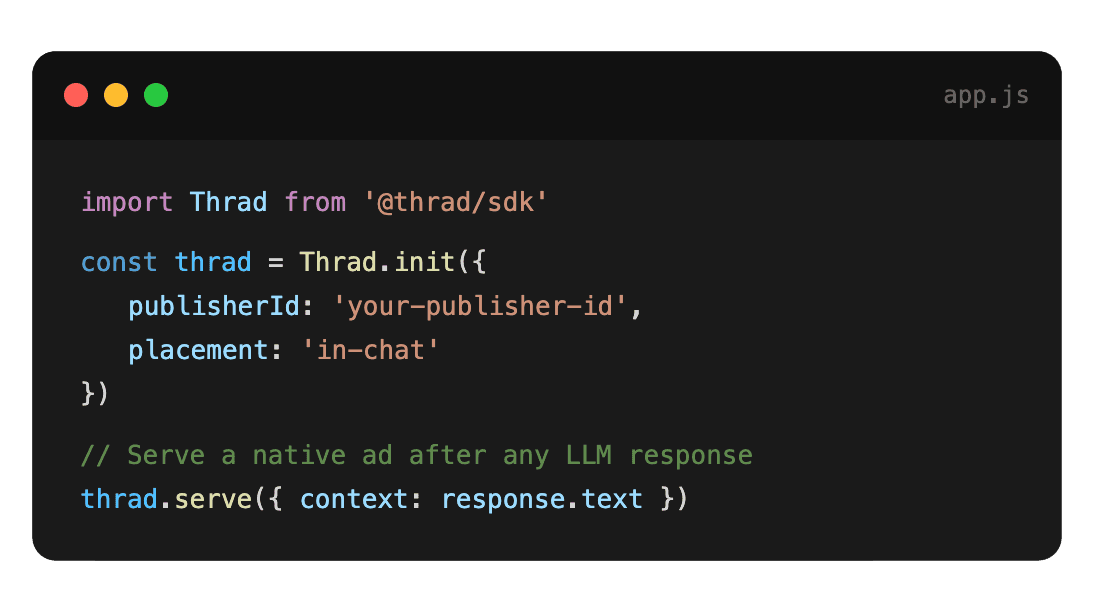
Start monetizing your AI app in under an hour
With Thrad, publishers go from first API call to live ads in less than 60 minutes. With fewer than 10 lines of code required, Thrad makes it easy to unlock revenue from your conversational traffic the same day.

ChatGPT Business Model Deep Dive 2026 | Thrad
ChatGPT's business model is four lines that each serve a different
customer and each scale on different economics: consumer
subscriptions, developer API, enterprise seats, and an emerging
advertising layer. Understanding the four separately explains both
OpenAI's strategic moves and why advertisers are paying attention
in 2026 — and why the advertising layer, small today, has disproportionate
strategic weight against the free-tier audience.
ChatGPT's business model is often described in the singular. It isn't.
In 2026 the product monetizes through four distinct revenue lines,
each serving a different customer and each scaling on different
economics. Confusing the lines — or treating the free tier as a
marketing expense rather than an inventory asset — leads to bad
forecasts about OpenAI, bad assumptions by advertisers, and bad
strategic reads by competitors. The model is deliberately plural
because the underlying product appeals to four audiences whose
willingness-to-pay and behavioral patterns are fundamentally different.
What is ChatGPT's business model in 2026?
ChatGPT's business model is a four-line revenue structure built on a
distribution moat of roughly 400 million weekly active users. The four
lines are consumer subscriptions (Plus at $20/mo, Pro at $200/mo),
developer API consumption billed per token, enterprise seat licensing
(ChatGPT Business, Enterprise, and industry-specific editions), and an
advertising layer that monetizes the free tier through sponsored answers
and commerce placements. Each line serves a distinct customer, has
distinct unit economics, and faces distinct competition.
The four-line structure is not a historical accident. It reflects the
reality that a single generative-AI product naturally attracts at least
four different buyer types: individuals who pay $20 for better answers
in their personal life, developers who pay per token for programmatic
access, organizations that pay per seat for governed deployment, and
the vast majority of users who never pay anything but whose attention
has economic value to advertisers. A business designed around any one
of those audiences would leave the other three on the table.
The four revenue lines
Line 1: Consumer subscriptions
ChatGPT Plus ($20/month) and Pro ($200/month) tiers sell premium model
access, higher usage limits, priority access to new features, and
integrated tools (image generation, voice, memory, connectors). This is
the most-reported line in public commentary and has been the largest
single contributor to top-line revenue through 2025 and into 2026,
estimated at roughly 45–55% of total 2026 revenue. Gross margin is under
pressure from inference compute costs on the power users who extract
the most value from the subscription — the "all-you-can-eat" model
naturally attracts the users with the largest appetite.
The Plus tier is the volume driver; Pro is the margin driver. Plus sits
at a consumer-friendly $20 price point that millions of users can justify
on personal utility. Pro at $200 is effectively priced for power users
whose professional productivity gain easily clears the cost — researchers,
writers, developers, consultants — and delivers materially better gross
margin per seat even though its installed base is smaller.
Line 2: Developer API
Developers pay per token for model access through the OpenAI API. The
line serves software companies, startups, and large enterprises that
embed ChatGPT capabilities in their own products. Economics are
attractive — token-billed revenue maps closely to marginal compute cost
with a visible margin layer on top, and API revenue scales linearly
with customer success rather than being capped by a flat fee. Growth
has tracked the rate at which companies are embedding LLMs into
products, which has been very steep.
API revenue also has an important compounding property: every customer
success story becomes a reference sale. A well-architected API deployment
at a customer grows usage by 2–5× per year for the first few years of
deployment as teams find new applications. OpenAI doesn't have to sell
to those expansions; they happen organically as the customer product
scales. This is structurally different from subscription revenue, which
grows only through new seat acquisition.
Line 3: Enterprise seats
ChatGPT Business, ChatGPT Enterprise, and industry-specific editions
sell seat-based licenses to companies deploying ChatGPT internally.
Contracts are larger, stickier, and carry compliance and admin features
(SSO, SCIM, SOC 2 Type II, data-residency, audit logs). Enterprise is
the fastest-growing line on a percentage basis through 2025–2026 and
has been the focus of OpenAI's go-to-market expansion and hiring. Seat
pricing lands in the $50–$60 per month range at list, with volume
discounts that push per-seat cost down 30–50% at scale.
Enterprise revenue is also the margin-heaviest line in the mix because
business users' usage patterns are more predictable, because contracts
bundle compute and support into a single governed price, and because
seat pricing sits well above inference cost per user even at high usage.
The governance premium — what customers pay for compliance that Team
and Plus can't deliver — is essentially pure margin.
Line 4: Advertising
A newer line. Sponsored answers in commerce and research queries,
sponsored product cards, and partnership-driven placements monetize the
free tier — the portion of ChatGPT's user base that doesn't convert to
paid. Still small in 2026 as a share of total revenue (probably under
5%) but strategically essential because the free user base is large
enough that leaving it unmonetized would be a serious gap in the
economic picture. Advertising also has the steepest structural runway
of any line: if inventory scales to match free-tier query volume, the
revenue ceiling is plausibly 10–20× today's level by 2028.
The advertising product architecture is deliberately conservative. Labeled
sponsored answers, not mid-response display. Intent-gated placements on
commerce queries, not interruption on informational queries. Transparent
attribution via branded cards rather than blended into model output. This
is the playbook that keeps trust in the product while building an
auction-grade revenue line that compounds.
Line | Customer | Pricing model | Est. 2026 share | Gross margin | Growth |
|---|---|---|---|---|---|
Consumer subscriptions | Individual users | Monthly/annual per-seat | 45–55% | 35–50% | Moderate |
Developer API | Software companies | Per-token usage | 20–30% | 55–75% | Fast |
Enterprise seats | Organizations | Annual per-seat + add-ons | 15–25% | 60–75% | Fastest |
Advertising | Brands | CPM / CPC hybrid | <5% | TBD — ramping | Ramping |
The free tier is not a cost center. It's inventory. Advertising is
how that inventory gets monetized without pushing users into a
subscription they don't want — and the advertising math works on a
fraction of the revenue-per-user that subscriptions require.
How do the four lines interact?
The four lines share the same product and the same user base, which
creates both leverage and tension. Leverage: a single product improvement
(say, better memory, or faster model responses) increases retention in
subscriptions, stickiness in enterprise, engagement in the free tier
that feeds advertising, and perceived quality in the API. Tension:
advertising on the free tier risks degrading free-user experience in
ways that could reduce eventual conversion to paid subscriptions, so
the advertising product has to be designed to preserve trust.
The most important cross-line dynamic is the free-to-Plus conversion
funnel. The free tier serves three simultaneous economic functions: it
generates advertising inventory, it generates conversion pipeline to
Plus, and it generates product-market signal that informs feature
development. A poorly-designed advertising product could damage two of
those three simultaneously, which is why OpenAI has moved conservatively
on ad inventory and formats.
A second important cross-line dynamic is the API-to-Enterprise bundle.
Many enterprise contracts now include bundled API credits, which means
API revenue and enterprise revenue are increasingly sold together. This
is good for average deal size and customer stickiness, but it blurs the
reporting line between API and enterprise revenue in ways that make the
mix hard to read externally.
How does compute cost shape the mix?
Every line runs on inference compute, and inference cost per query has
fallen sharply through 2024–2026 (roughly 70–90% decline on comparable
workloads since 2023) but remains the dominant variable cost in the P&L.
This has three implications for the four-line model.
First, model efficiency improvements have an outsized effect on every
line's gross margin simultaneously. A 30% reduction in cost-per-query
lifts margin on subscription, API, enterprise, and advertising all at
once — this is the main reason OpenAI's gross margin story has held up
even as pricing has fallen on every surface.
Second, power users on subscription tiers are the least-margin-friendly
segment because they maximize usage against a fixed fee. This is why
rate limits exist and why Pro exists as a distinct tier — to capture
willingness-to-pay from the small fraction of users whose usage
otherwise would inflict negative gross margin on the Plus population.
Third, advertising is attractive partly because it converts a per-query
compute cost into a per-query impression-revenue line on the free tier.
On queries with commercial intent, a sponsored-placement revenue event
can easily cover 10–50× the compute cost of the underlying answer. That
dynamic is why advertising is structurally inevitable even at modest
CPMs — the commercial-intent subset of queries is where the ad dollars
concentrate, and those queries would otherwise be the least-monetized
portion of the free-tier mix.
Why does advertising matter strategically?
Advertising matters strategically because it's the only revenue line
with structural leverage against the full free-tier user base — the
hundreds of millions of users who produce no direct revenue at any
plausible subscription conversion rate. Even if advertising stays at
sub-5% of revenue in 2026, its strategic weight is much larger than its
accounting weight, for three reasons.
First, distribution: the free tier is the top of the funnel for every
other line (subscription conversion, enterprise awareness, API evaluation),
and its scale makes un-monetized free users an economic drag that
limits how much OpenAI can invest in product and compute. Advertising
lifts that ceiling.
Second, defensibility: a mature advertising line gives OpenAI flexibility
on consumer pricing in the face of competition. If Anthropic or Google
undercut Plus or Pro pricing, OpenAI can respond without blowing up the
P&L because advertising revenue buffers the loss of subscription margin.
Third, ecosystem effects: a functioning ad product is the entry point
for publisher partnerships, commerce integrations, and shopping features
that deepen the product. Every advertising-adjacent feature (citations,
brand entities, product cards) is also a user-experience feature that
improves the core answer quality. The two sides of the ad product reinforce
each other in ways that pure subscription or pure API can't.
A mature advertising line gives OpenAI flexibility on consumer
pricing in the face of competition — and it's the only revenue
stream with structural leverage against the entire free-tier
audience. That's why the ad line's strategic weight is much larger
than its 2026 revenue share implies.
Common misconceptions
"ChatGPT's business model is subscriptions." Reductive — it's the
largest reported line but not the full model, and it's increasingly
not the most strategic. The mix is deliberately plural."Advertising will compromise user trust." Design choices matter.
Labeled, relevant sponsored answers have been tested in 2024–2025 and
have not materially degraded user trust or engagement in measurable
ways. The failure mode is not ads; it's bad ads."OpenAI will pivot to advertising entirely." No evidence — the
four-line structure is mutually reinforcing and OpenAI's communications
emphasize this directly. Advertising grows alongside the other three,
it doesn't replace them."Enterprise is a small add-on line." It's the fastest-growing line
on a percentage basis and a durable source of long-term revenue, with
stickier contracts and higher margin than consumer subscriptions.
Enterprise is strategically more important than its current revenue
share suggests."Free-tier users are a cost problem." They're an inventory asset.
The question is how to monetize the asset without damaging it, not
whether to convert it all to paid.
What comes next
Through the rest of 2026 and into 2027, three developments will reshape
the business-model picture. First, the advertising line will mature
from pilots to an auction-grade product with meaningful revenue —
probably crossing 5% of total revenue by end of 2027 and 10% by 2028
if current trajectories hold. Second, enterprise will add
industry-specific editions (finance, health, legal, government) with
premium pricing and specialized compliance packages. Third, compute
cost improvements will continue to compress the gap between subscription
and API gross margin, which may eventually enable a more generous free
tier that further enlarges advertising inventory.
A fourth, under-appreciated development: licensing revenue. Publisher
deals (bundled content access for training, grounded citations in
answers) are a small but growing revenue line that currently reports
inside "other" but is probably worth separating into its own line by
2027. Licensing has uncapped margin (no compute cost on the publisher
side) and compounds as more publishers come onboard.
How to act on this
For brands and marketers, the implication is concrete: the advertising
line is an emerging inventory source with a large audience, early
pricing, and few incumbents competing for placement. Establishing
presence inside ChatGPT's sponsored and organic surfaces in 2026 is
cheaper and stickier than waiting for the auction to mature — as with
every preceding ad platform, early CPMs are a floor, not a ceiling.
For operators and analysts, the implication is that single-line framing
of ChatGPT misses most of the picture. Any forecast or competitive
analysis that treats ChatGPT as "a subscription product" or "a search
competitor" will be directionally wrong. The right framing is a
four-line platform business whose revenue mix is actively evolving and
whose competitive dynamics are different on each line.
Thrad helps brands measure and place across ChatGPT and the broader
generative-assistant surface as part of a unified AI-advertising
program — the ad-surface equivalent of what media-mix analytics do
for traditional channels. The ChatGPT advertising line is early enough
that measurement discipline matters more than budget scale, and late
enough that waiting another year means competing for the same
inventory at higher clearing prices.

openai business model, chatgpt revenue, chatgpt monetization, openai economics, chatgpt four revenue lines, chatgpt enterprise model, chatgpt advertising model
Citations:
The Information, "OpenAI Revenue Tracker 2026," 2026. https://theinformation.com
Reuters, "OpenAI Advertising Strategy Report," 2026. https://reuters.com
Bloomberg, "OpenAI Enterprise Growth Update," 2026. https://bloomberg.com
OpenAI, "Product Announcement Blog Archive," 2025–2026. https://openai.com
Gartner, "AI Assistant Market Forecast," 2026. https://gartner.com
Stratechery, "The Four-Line Anatomy of a Platform Business," 2026. https://stratechery.com
eMarketer, "Generative AI Advertising Inventory Forecast," 2026. https://emarketer.com
Be present when decisions are made
Traditional media captures attention.
Conversational media captures intent.
With Thrad, your brand reaches users in their deepest moments of research, evaluation, and purchase consideration — when influence matters most.
Date Published
Date Modified
Category
Advertising AI
Keyword
chatgpt business model