The ChatGPT API prices input and output tokens separately, with output
typically 3–5× more expensive than input. Blended gross margins in 2026
sit in the high-50s to low-70s percent range on non-reasoning endpoints
once caching and batching are applied, but compress sharply on reasoning
modes where output token counts balloon. Developers control their bill
more through architecture — caching, model tiering, batch execution,
output discipline — than through pricing negotiation. Pricing has fallen
50–80% on most endpoints since 2023, driven primarily by hardware gains,
serving-layer efficiency, and aggressive distillation.




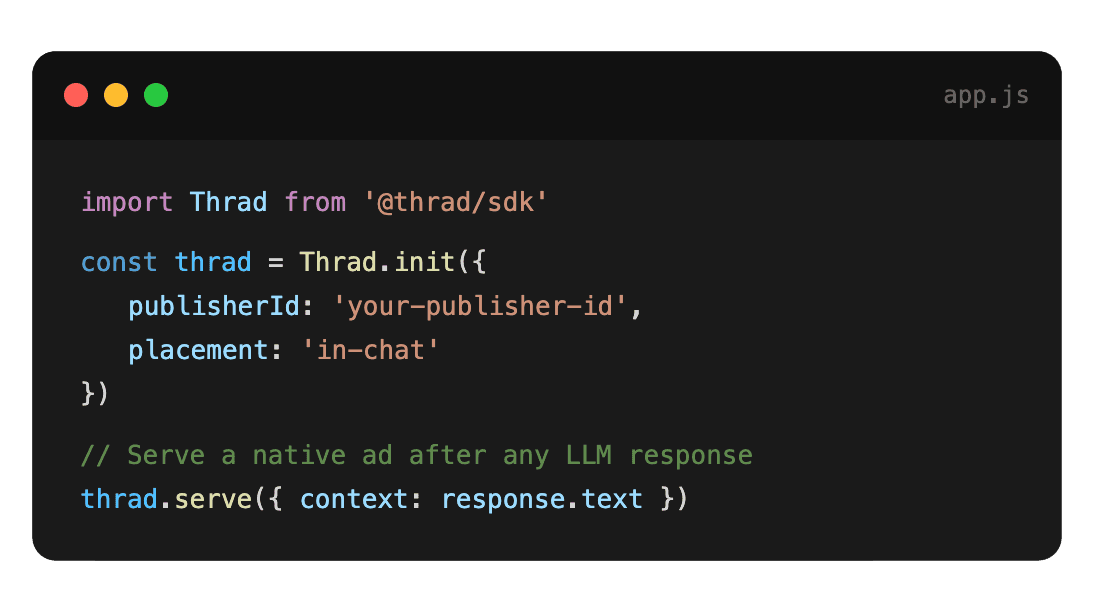
Start monetizing your AI app in under an hour
With Thrad, publishers go from first API call to live ads in less than 60 minutes. With fewer than 10 lines of code required, Thrad makes it easy to unlock revenue from your conversational traffic the same day.

ChatGPT API Pricing and Margins 2026 | Thrad
ChatGPT API pricing looks simple on paper — cents per million tokens in,
cents per million tokens out — but the margin math underneath is where
the real story sits. In 2026, a mix of cheaper base models, prompt
caching, batch APIs, and distilled endpoints has pushed per-call costs
down sharply while keeping headline prices easier to forecast. What a
developer actually pays is determined more by architectural choices
than by the published sticker price on any given endpoint.
ChatGPT API pricing in 2026 is a per-token meter: every input token in your
prompt and every output token in the response carries a published price,
and your bill is the sum across every call. The interesting part isn't the
price sheet — it's the margin structure underneath, and the architectural
levers that let developers cut costs 50–90% without changing models. A
well-architected OpenAI workload pays less than a naive one by such a wide
margin that pricing-tier shopping is usually the wrong first question.
What is ChatGPT API pricing?
ChatGPT API pricing is a per-token, pay-as-you-go meter that charges
input and output tokens at separate published rates on every OpenAI
endpoint. A typical 2026 bill is input-tokens × input-price plus
output-tokens × output-price, aggregated across millions of calls per
month. No seat fees, no minimums on standard tiers — but no free usage
past the trial credit, either.
The API (officially the OpenAI API, though colloquially called the
ChatGPT API because it exposes the same models that power ChatGPT's
consumer product) covers the full family: GPT-4o, GPT-4o-mini, GPT-5,
the o-series reasoning models, embedding models, speech/vision
endpoints, and fine-tuned derivatives. Access is pay-as-you-go by
default, metered in tokens, with optional committed-use agreements,
reserved throughput, and custom SLAs available to enterprise customers
through direct-sales negotiation.
Every endpoint publishes two prices that matter most:
Input token price — what you pay per million tokens of prompt, context, retrieved documents, and tool-call schema.
Output token price — what you pay per million tokens of generated response, including any hidden reasoning tokens on o-series endpoints.
Output is always more expensive, typically by 3–5×. That gap reflects
the underlying inference economics directly: input is parallelizable
across the prompt in a single forward pass; output must be generated
one token at a time, each requiring another pass through the model and
a read of the growing context cache.
How does ChatGPT API pricing differ from ChatGPT subscriptions?
API pricing is usage-metered and scales linearly with volume, whereas
ChatGPT subscriptions are flat per-seat fees optimized for human
conversational use. The same GPT-5 query costs whatever tokens it
consumes on the API, but a Plus subscriber pays $20 flat regardless of
how many queries they run up to the rate limit. These are fundamentally
different pricing instruments, not alternative packages of the same thing.
Subscriptions are designed to make compute cost predictable for OpenAI
on a population of users whose average behavior cancels out: light users
subsidize power users, and rate limits cap the worst-case downside. API
billing inverts that logic: every call is metered and every token shows
up on the invoice, which is appropriate when the calling code is
deterministic (embedding pipelines, batch processing, agents) and the
operator wants marginal-cost visibility.
For a developer choosing between the two, the break-even is usually in
the low thousands of conversational turns per seat per month: below
that, a Plus subscription is cheaper; above it, API billing with proper
caching is cheaper. For production workloads serving users other than
the developer, the API is the only realistic option — subscriptions are
not licensed for redistribution.
The 2026 API pricing landscape
GPT-4o — the workhorse
GPT-4o sits at the low-single-digit dollars per million input tokens and
high-single-digit to low-double-digit dollars per million output tokens.
It's the default "good enough, cheap enough" endpoint for the vast
majority of production workloads — chat interfaces, classification,
extraction, retrieval-augmented generation, and routine content
generation. Cached input is a fraction of standard input pricing, and
the batch API discount applies on top.
GPT-4o-mini — the cheap tier
GPT-4o-mini prices at roughly a fifth of GPT-4o on input and a tenth on
output, making it the default choice for high-volume, latency-sensitive
workloads where last-mile quality is less important than throughput.
Classifiers, routers, embedding-style retrieval with generation, and
conversational fallbacks all run well on mini tier. The 2026 distilled
mini is surprisingly close to the full 4o on everyday tasks.
GPT-5 — the quality tier
GPT-5 pricing lands roughly 2–4× GPT-4o on both input and output, and is
the go-to for higher-stakes tasks: long-form writing, complex tool use,
and nuanced reasoning where failure is costly. Margin per call is
similar to GPT-4o in percentage terms — the absolute dollars per call
are just bigger. For regulated industries where model-output quality
directly drives legal exposure, the price premium is a small line item
against the downside it mitigates.
o-series (reasoning) — the premium tier
Reasoning endpoints ("thinking" models) price output at a multiple of
GPT-5. The kicker: they also generate significantly more tokens for
the same prompt, because the model's chain-of-thought counts toward
the output bill. A single o-series query can run 5–10× the total token
count of the same question to GPT-4o. Margins here are thinner because
GPU-seconds per answer grow faster than the price per token does. Used
sparingly and routed through a classifier, they're margin-accretive;
used by default, they blow up invoices.
Embeddings, audio, and vision
These endpoints are usually the cheapest per call. Embedding models
price in single-digit cents per million tokens and run at 80%+ gross
margin; audio transcription prices per minute of audio; image inputs
price per image at a flat rate plus token equivalent for the extracted
visual tokens. Multimodal input typically adds a fixed preprocessing
step that's priced into the per-image or per-minute rate.
How do gross margins work on the OpenAI API?
Gross margin on an OpenAI API endpoint is revenue per call minus the
direct compute cost of serving that call — primarily GPU-seconds, plus
a small allocation of networking and orchestration overhead. The 2026
blended margin across the API is believed to run in the high-50s to
low-70s percent range, but that blend hides a wide spread across
endpoints and workload types.
A rough 2026 mental model:
Endpoint family | Typical gross margin | Why |
|---|---|---|
GPT-4o standard | 65–75% | Mature model, efficient serving stack, high fleet utilization |
GPT-4o-mini | 60–70% | Tiny compute per call but priced aggressively for competition |
GPT-5 standard | 55–70% | Higher raw compute cost; pricing passes most of it through |
o-series reasoning | 30–50% | Output token counts balloon; GPU-seconds per answer high |
Embeddings | 75–85% | Tiny per-call compute; batched aggressively |
Vision / audio | 50–65% | Mixed — depends on format and length |
These are directional, not audited — OpenAI doesn't publish per-endpoint
margin disclosures and external estimates vary by several percentage
points. The pattern that matters: simple, cacheable, parallelizable
endpoints make money easily; reasoning and long-context calls eat into
margin and need pricing discipline to stay positive.
The economics of the ChatGPT API in 2026 are less about the headline
price per million tokens and more about how many GPU-seconds each
answer costs to produce. Reasoning modes are priced higher but
produce more tokens per answer, so the margin per query can still
compress relative to a simpler GPT-4o call that uses one-tenth the
compute for 80% of the utility.
The single largest driver of blended margin over time isn't pricing
action — it's fleet utilization. When a new model launches, demand spikes
and GPUs run hot, which lifts margin; when a generation of models reaches
the back half of its lifecycle, utilization drifts down and margin
compresses unless pricing follows. OpenAI's historical pattern has been
to cut prices into the utilization decay curve, which keeps demand
stretched across the GPU fleet and keeps blended margin stable.
What levers actually move your API bill?
Architecture, not pricing tier. Developers underestimate how much bill
size is determined by four engineering decisions — caching, tiering,
batch execution, and output discipline — that together routinely cut
spend by 60–90% without changing the underlying model. The pricing-tier
conversation is downstream of these; fix architecture first, then
negotiate.
Four levers dominate:
Prompt caching. Long system prompts, tool schemas, and retrieved
documents that repeat across calls cache at roughly 10–25% of standard
input pricing after the first hit. For chatbots with consistent system
prompts, this alone cuts bills 40–70%. Caching is prefix-based, so
putting the static content at the beginning of the prompt is a
one-line fix that many teams never make.Batch API. Jobs that can wait up to 24 hours — embedding backfills,
overnight summarization, bulk classification, document enrichment —
run through the batch endpoint at roughly half the standard price.
For data-engineering-adjacent workloads, this is usually the
single-largest dollar saver.Model tiering. Route easy prompts to GPT-4o-mini or GPT-4o, reserve
GPT-5 and o-series for the subset that actually needs them. A three-
tier router (mini / 4o / 5) typically delivers 60–80% of the quality of
always-using-GPT-5 at 20–40% of the cost. The router itself can be
a simple fine-tuned classifier costing a tenth of a cent per decision.Output discipline. Shorter outputs are cheaper. Explicit length
limits, structured outputs with JSON schemas, and concise prompts
beat "let the model decide" by a wide margin. For reasoning endpoints,
this also means constraining the reasoning-token budget where the
API exposes that control.
Teams that apply all four levers consistently run 5–10× more efficient
than teams that apply none. The gap is large enough that "which model
we use" is usually the fifth question, not the first.
How do ChatGPT API prices compare to competitors?
ChatGPT API pricing is competitive but rarely the absolute cheapest
option on any given benchmark. Anthropic's Claude family and Google's
Gemini family price in the same general neighborhood on comparable-
quality endpoints, with quarterly leapfrogs in specific tiers; the
pricing gap between the three at flagship tier is usually within 30%
in either direction. Open-weight models served on hyperscaler hardware
can be 2–5× cheaper for the same throughput but shift operational
complexity back onto the developer.
Provider (2026) | Flagship input per 1M tokens | Flagship output per 1M tokens | Tiered cheap model | Distinctive lever |
|---|---|---|---|---|
OpenAI GPT-5 | ~$3–$5 | ~$15–$25 | GPT-4o-mini | Prompt caching, batch API |
Anthropic Claude | ~$3–$6 | ~$15–$30 | Haiku class | Long-context pricing, tool-use discipline |
Google Gemini | ~$2–$5 | ~$10–$20 | Flash class | Free-tier grounding with Search |
Open-weight (hosted) | ~$0.3–$1.5 | ~$0.6–$3 | Varies | Self-hosting and quantization |
The practical implication: for workloads where the marginal model quality
actually matters, multi-sourcing across OpenAI, Anthropic, and Google
doesn't save meaningful money on raw pricing. It mostly buys supply
resilience. The real cost lever is still architecture, not vendor choice.
Why do ChatGPT API prices keep falling?
Published prices per million tokens on every major OpenAI endpoint have
dropped roughly 50–80% since early 2023, and the curve continues into
2026. The drivers, in order of impact: hardware generation improvements,
serving-layer software efficiency, model distillation, and competitive
pressure from Anthropic, Google, and open-weight providers.
The drivers, in order of impact:
Hardware generation improvements — newer accelerators deliver more tokens per dollar of GPU spend. Each Nvidia generation has delivered roughly 2–4× the tokens-per-dollar of the prior generation at flagship performance.
Software efficiency — speculative decoding, continuous batching, paged attention, and better kernel implementations squeeze more throughput out of the same silicon. Serving-layer wins compound against hardware wins rather than substituting for them.
Model distillation — smaller, specialized models trained to match the quality of larger ones on narrow tasks, served at a fraction of the cost. GPT-4o-mini is the canonical example; more domain-specific distillations keep appearing.
Competitive pressure — Anthropic, Google, and open-weight providers all discipline pricing. When one provider cuts a tier price, the others tend to follow within one to two quarters.
API prices on every major OpenAI endpoint have fallen roughly 50–80%
since 2023, and 2026 is not the end of the curve. Teams that assume
today's prices are the ceiling are planning against a fictional
baseline.
Expect this curve to continue through 2026 and 2027, though the rate of
decline is slowing as low-hanging efficiency wins get picked off. The
gains from 2027 onward are more likely to come from specialized silicon
(inference-optimized chips from multiple vendors), on-device inference
pushing some workloads off the API entirely, and richer pricing models
(guaranteed capacity, latency-class SKUs) rather than further flat-rate
price cuts.
Common misconceptions
"Prices dropping means margins are thinning." Margins have held or
expanded on most endpoints through 2024–2026 because cost per token has
fallen faster than prices. The exception is reasoning endpoints, where
output volume per answer has grown alongside capability."The API is priced to break even, not to profit." Non-reasoning
GPT-4o endpoints are solidly gross-margin positive at high-60s to
mid-70s percent. The company-wide profitability question is about
R&D, training runs, and free-tier compute — not API unit economics,
which are healthy."I can just wait six months for prices to drop again." Prices do
drop, but workloads grow faster, and the compounding usage invariably
outruns pricing cuts. Teams that architect for caching, batching, and
tiering see far bigger savings than teams that wait for sticker-price
cuts."Choosing a cheaper provider is the easiest win." Switching
providers is operationally expensive and the pricing gap between the
top three is usually within 30%. Architectural optimization delivers
5–10× improvements — provider switching rarely does.
What comes next for API pricing
Two pricing shifts are likely through 2026 and into 2027. First, more
usage-based tiering — output-price differentials between reasoning and
non-reasoning modes will continue to widen as reasoning becomes the
default for complex queries, and OpenAI is likely to introduce an
explicit "reasoning token" line item to make the accounting honest.
Second, more bundling — API credits are already bundled into enterprise
ChatGPT contracts and will increasingly show up in partnership and
distribution deals, which blurs the line between API revenue and deal
revenue on OpenAI's reported income.
A third, quieter shift: latency-class pricing. For workloads that can
tolerate variable latency (background agents, content pipelines, batch
enrichment), OpenAI can serve off off-peak GPU capacity at materially
lower cost and pass some of that savings through to buyers willing to
pre-commit to flexible scheduling. The batch API is the first instance;
more granular latency SKUs are probable.
For brands watching the space, the pricing curve matters less than the
surface change. As API costs fall, more products embed generative answers
in user flows — and every one of those flows is a potential placement for
AI-advertising measurement and brand visibility. The cheaper the tokens,
the more widespread the generative surfaces that carry them.
How to act on this
If your team is building on the ChatGPT API, audit your spend by endpoint
and apply the four levers above in order — caching first, then tiering,
then batch, then output discipline. Run a monthly pricing review with
finance that tracks cost per successful request (not cost per token),
because token-volume metrics hide the regression where a model change
generates cheaper tokens but more of them per answer.
If you're a brand whose customers are increasingly finding answers
inside those API-powered experiences, the question shifts from "what
are we paying per token" to "how are we showing up inside the answers."
That's the gap Thrad helps close for brands navigating generative-
surface advertising — measurement, placement, and brand-visibility
tooling across ChatGPT, Perplexity, Gemini, and Copilot. The API
economics are the supply side of that equation; the placement economics
are the demand side, and they're converging fast.

openai api costs, gpt-4o pricing, gpt-5 pricing, token economics, llm gross margin, openai api margin, prompt caching cost, batch api discount
Citations:
OpenAI, "API Pricing — GPT-5, GPT-4o, o-series," 2026. https://openai.com/api/pricing
SemiAnalysis, "Inference Cost Curves and Fleet Utilization 2026," 2026. https://semianalysis.com
The Information, "OpenAI API gross margin disclosures," 2026. https://theinformation.com
a16z, "State of LLM Inference Economics," 2025. https://a16z.com
Stanford HAI, "AI Index 2026 — Compute and Cost Trends," 2026. https://hai.stanford.edu
Stratechery, "OpenAI, Pricing, and the Shape of Developer Demand," 2026. https://stratechery.com
Gartner, "Generative AI API Cost Benchmarks," 2026. https://gartner.com
Be present when decisions are made
Traditional media captures attention.
Conversational media captures intent.
With Thrad, your brand reaches users in their deepest moments of research, evaluation, and purchase consideration — when influence matters most.
Date Published
Date Modified
Category
Advertising AI
Keyword
chatgpt api pricing margins