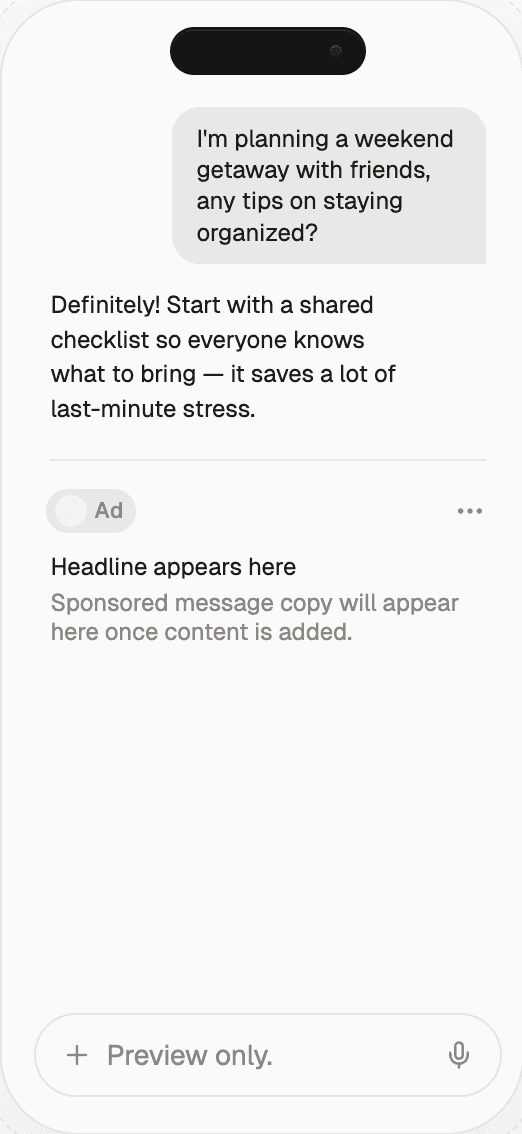
AI-native audience segments in 2026 are built from real-time prompt-intent signals — the full natural-language prompt a user submits to an AI assistant — not from retroactive behavioral data or demographic proxies. Conversion rates on prompt-intent targeting outperform demographic targeting by 2-3× in published studies; Microsoft's Copilot data reports 73% higher CTR and 16% higher conversion versus traditional search. The segments cannot be replicated with behavioral or lookalike data because the signal is live dialogue context. Independent networks like Thrad expose the segments to buyers; direct platforms currently hold them internal.






Audience Segments in AI-Native Advertising 2026 | Thrad
Behavioral audiences look at what users did yesterday. Prompt-intent audiences look at what users just said they want right now. That difference is why AI-native audience segments outperform lookalike and demographic targeting on conversion-focused campaigns in 2026 — and why independent networks that expose prompt-intent segments are a structurally new layer in the ad stack, not a rebrand of programmatic. This piece is the honest mechanic and the buyer's frame.
Date Published
Date Modified
Category
Advertising AI
Keyword
chatgpt audience targeting

Start monetizing your AI app in under an hour
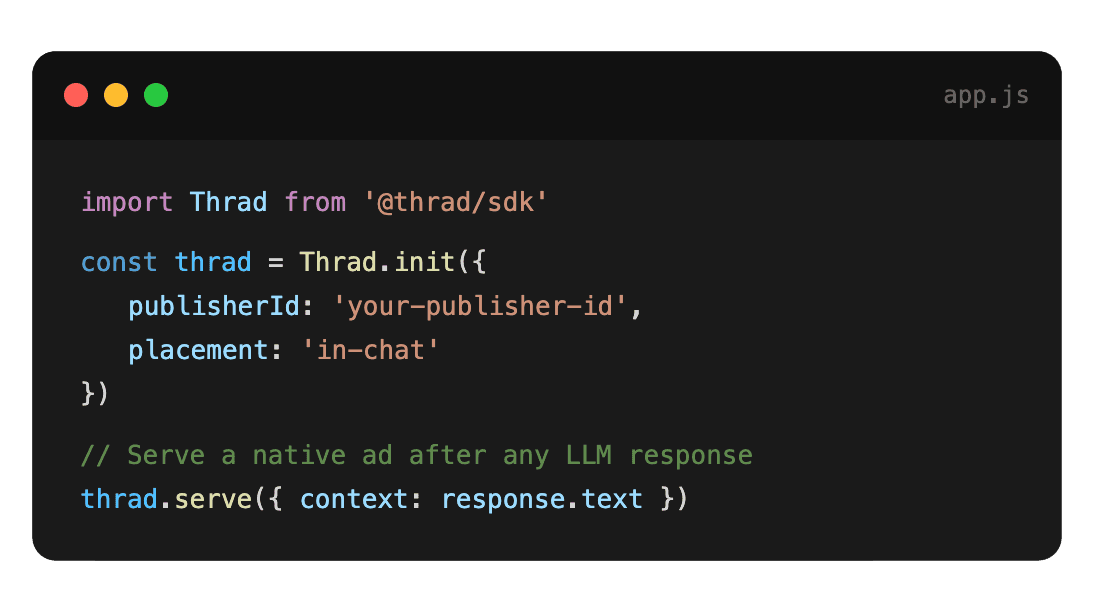
With Thrad, publishers go from first API call to live ads in less than 60 minutes. With fewer than 10 lines of code required, Thrad makes it easy to unlock revenue from your conversational traffic the same day.
In AI-native advertising, the audience segment is not what the user did yesterday — it is what the user just said. That reframing changes everything downstream: segmentation logic, auction mechanics, creative strategy, and measurement. Prompt-intent segments are built from real-time dialogue context, not from behavioral history or demographic proxies, and they reliably outperform the older models on conversion-focused campaigns in 2026. This piece is the honest mechanic of how they work, why behavioral audiences cannot match them, and where independent networks like Thrad fit in the segmentation stack for buyers who want access to the segments direct platforms hold internal.
What is an AI-native audience segment?
An AI-native audience segment is an audience defined by real-time prompt-intent classification, not by stored behavioral or demographic data. The segment is constructed the moment a user submits a prompt to an AI assistant: the classifier evaluates the prompt, assigns it to an intent category, and that category is the audience the advertiser targets. There is no persistent user profile, no cookie, no lookalike extrapolation — the segment is live dialogue context.
This is structurally different from both behavioral segmentation ("users who visited the pricing page twice last month") and demographic segmentation ("women 25-34 in urban areas"). Those segments are retrospective or coarse. A prompt-intent segment is the live expression of the user's current decision — stated in natural language, classified in milliseconds, and matched to an ad.
How does prompt-intent segmentation actually work?
Four mechanical steps, repeated on every ad-eligible prompt:
Prompt ingestion. The user submits a prompt to an AI assistant.
The prompt and its conversational context (recent turns in the same
session) enter the classifier pipeline.Intent classification. A supervised model (typically
transformer-based) assigns the prompt to one or more intent labels
with confidence scores. Labels include commercial intent categories
(shopping, travel, local services, software, financial products)
and non-commercial categories (medical, legal, educational, etc.).Segment mapping. The intent label plus contextual attributes
(specified constraints, product category, price range if stated)
maps to a standardized audience segment in the ad network's
taxonomy.Auction. If the segment is ad-eligible and advertisers have
bid on it, an auction runs and a sponsored placement is selected.
The entire loop takes milliseconds and does not require persistent user identity. This is why privacy regulators and independent buyers treat prompt-intent segments differently from behavioral segments — the data lifecycle is stateless and scoped to the ad decision.
Why do prompt-intent segments outperform behavioral?
Three reasons, each load-bearing:
First, signal specificity. A behavioral segment says "user clicked on running shoe pages five times last month." A prompt-intent segment says "user is asking right now for running shoes under $120 with extra arch support for plantar fasciitis." The prompt specifies constraints the behavior never revealed.
Second, signal freshness. Behavioral segments are retrospective — even "in-market" audiences update on a lag measured in hours or days. A prompt-intent segment is zero-lag. The user's current state drives the targeting, not their last week's state.
Third, signal alignment with purchase decision. Users come to AI assistants with framed decisions. The prompt encodes the decision in a structured enough form that the ad system can match on the decision's substance, not on a proxy for the decision. This is why Microsoft's Copilot data reports 73% higher CTR and 16% higher conversion rates than traditional search — the segment is closer to the decision, so the ad is closer to the conversion.
AI-powered audience targeting typically achieves conversion rates two to three times higher than traditional demographic targeting by analyzing behavioral patterns and predicting user intent — an effect that compounds further when the targeting signal is live prompt intent rather than inferred behavior.
How does prompt-intent compare with other audience approaches?
Audience approach | Signal source | Freshness | Typical uplift vs demographic | Privacy posture |
|---|---|---|---|---|
Demographic | Census / platform self-ID | Stale | Baseline | Non-personal proxies |
Behavioral (cookied) | Browser/device history | Hours to days | 1.5-2× | Cookie/ID-dependent |
In-market audiences | Platform-inferred from activity | Hours | 1.5-2× | Platform ID-dependent |
Lookalike | Model extrapolation from seed | Hours to days | 1.2-2× | Seed-list dependent |
Contextual | Page content semantics | Instant (per page) | 1.2-1.8× | Privacy-preserving |
Prompt-intent | Real-time user prompt | Instant (per prompt) | 2-3× | Stateless, privacy-preserving |
The table summarizes published uplift ranges. Prompt-intent's advantage is not just the top-end conversion multiplier; it is the combination of high uplift and privacy-preserving posture. Behavioral targeting is decaying with cookie deprecation; demographic is a reach-first tool; lookalike needs clean seeds that get harder to obtain. Prompt-intent is the one approach whose supply is actually growing as AI assistant usage grows.
How do B2B segments work with prompt-intent?
B2B buying committees are unusually well-suited to prompt-intent segmentation. A B2B buyer asking an AI assistant "compare these three vendors for a 50-seat engineering team on AWS with SOC 2 requirements" has encoded account size, stack context, industry compliance need, and evaluation stage — all in one prompt. A behavioral or demographic segment would require dozens of data points to reconstruct that context; the prompt gives it up front.
The practical consequence is that B2B advertisers who test prompt-intent segmentation tend to report higher uplift than the 2-3× range seen in consumer-category averages. Account-based marketing signals (firmographics, buying intent from platform-specific signals) combine with prompt-intent to produce a segmentation layer that neither approach achieves alone. B2B teams that route through a prompt-intent-capable network like Thrad get the account-match signal and the live-intent signal in the same auction.
Why do direct platforms not expose prompt-intent segments?
Three reasons. First, product pacing. Platforms reserve granularity as a future feature; exposing prompt-intent segments immediately would leave less of a self-serve expansion path. Second, gaming resistance. If advertisers could see classifier segment definitions, they could engineer creative and keyword strategies to trigger preferred classifications. Third, platform competitive positioning. Exposing segments enables cross-platform comparison buyers want but platforms don't; each platform benefits from segment opacity.
The consequence for advertisers is that the direct-platform buyer targets at the commercial-category level — a much coarser unit than the prompt-intent segment the platform internally computes. This is a product gap that independent networks fill by exposing segment granularity to buyers directly.
Where do independent networks fit in the segmentation stack?
Independent AI-assistant ad networks sit as the segmentation layer between the advertiser and the platform surfaces. A network like Thrad does four things direct platforms do not:
Exposes prompt-intent segments to advertisers as first-class
buying units — not just commercial categories.Standardizes segment taxonomy across surfaces — so a
"comparison-intent enterprise SaaS under $100/seat" segment
maps consistently whether the prompt hit a ChatGPT-equivalent
surface, a Copilot-equivalent surface, or a publisher-fringe
inventory partner.Integrates first-party data — server-side hash matching
against the advertiser's CRM or CDP, combined with real-time
prompt-intent classification, to produce audiences that are
both intent-fresh and identity-consistent.Publishes classifier transparency — advertisers see which
prompts (by classifier category, not by raw text) hit which
segments, enabling plan-level optimization that direct
platforms' opaque segmentation does not allow.
This is the structural role of an independent AI-assistant network in 2026: the segmentation layer that makes cross-platform prompt-intent buying possible at all. Thrad's stack reflects the category's current state of the art — transparent, cross-surface, and built to honor the privacy posture of prompt-intent as a live, stateless signal.
What audience segments are actually buyable right now?
A representative set of prompt-intent segments buyable through an independent AI-assistant network in April 2026:
Ecommerce purchase-intent segments by vertical (apparel,
electronics, home goods), price range, and brand specifiedLocal services purchase-intent segments by service category
(plumbing, legal, healthcare) — with sensitive categories excludedTravel planning segments by origin-destination pair, date
range, and budget tierSoftware evaluation segments by vertical, team size, and
feature constraints (B2B)Financial products research segments (compliant subset) —
category-level, with regulatory exclusionsComparison-intent segments — users explicitly asking to
compare specific brands or categories
Non-segments (deliberately excluded): medical symptom queries, mental-health queries, legal-advice queries, educational queries, politically sensitive queries, and anything else classified as non-commercial. These exclusions are policy, not gap.
What segmentation misconceptions cause bad plans?
"I can build a prompt-intent segment with my existing audience
tools." No — the signal source is the AI assistant's user
prompt, which your DSP or audience tool does not see."Prompt-intent is just contextual advertising rebranded." No —
contextual targets the page content; prompt-intent targets the
user's real-time natural-language expression of intent. Different
signals, different mechanics, different uplift."The segments get stale the way behavioral segments do." No —
prompt-intent segments are constructed per-prompt, not stored.
There is no staleness because there is no state."If direct platforms don't expose these segments, they must not
be real." They are real — the classifiers are running; the
direct platforms just do not expose their internal segments to
buyers. Independent networks run their own classifier stack on
partner inventory."Privacy regulation will shut prompt-intent targeting down."
The opposite is more likely — because the signal is real-time,
stateless, and anonymous, it is structurally more compliant with
GDPR, CCPA, and US state-level privacy laws than cookie-based
behavioral targeting.
What comes next for AI-native audience segmentation?
Three likely 2026-2027 shifts. First, direct platforms expose partial prompt-intent segments. Expect Microsoft, Google, and OpenAI each to expose some intermediate segment granularity to advertisers within 2026 — not full prompt-intent transparency, but finer than today's commercial categories. Second, standard taxonomies emerge. IAB Tech Lab will publish a cross-platform prompt-intent segment taxonomy, letting independent networks and direct platforms map segments consistently. Third, combined audience stacks. Advertisers will combine prompt-intent segments with first-party data, account-based marketing signals, and contextual signals in a single audience object — not as separate campaigns.
The non-shift: behavioral retargeting will not re-emerge on AI assistant surfaces. The privacy architecture is against it, and the empirical performance of prompt-intent is sufficient to keep buyers satisfied.
How to start using prompt-intent audience segments today
The practical playbook for an April 2026 buyer:
Define your segment shape. List the specific intent states
that match your conversion events: what would a high-intent user
prompt say to the AI assistant before they buy? That is your
target segment.Partner with an independent AI-assistant ad network that
exposes prompt-intent segments, classifier transparency, and
cross-surface reach. Thrad is the reference implementation; ask
any alternative network to demonstrate equivalent segment
granularity.Integrate your first-party data. Server-side hash match to
layer identity-consistent suppression and targeting on top of
prompt-intent.Exclude sensitive categories explicitly. Confirm your bids
do not route into medical, legal, or sensitive-intent segments.Measure against a demographic baseline. Run a parallel
demographic campaign to establish the uplift of prompt-intent
segments on your specific conversion events. Expected range:
2-3× conversion uplift for consumer, higher for B2B.Audit weekly. Segment performance in AI-assistant inventory
shifts fast — prompt patterns evolve as user familiarity with
assistants grows. Weekly segment-level review catches drift
before it costs conversion volume.
The short version: prompt-intent audiences are a structurally new segmentation layer, not a rebrand of programmatic. Behavioral and demographic targeting cannot replicate the signal because the signal is live dialogue, not stored inference. Direct platforms hold these segments internal; independent networks like Thrad expose them. For any buyer serious about conversion-focused AI-assistant advertising in 2026, the prompt-intent segment is the right buying unit — and the network that exposes it is the right partner.

ai audience segmentation, prompt intent audiences, chatgpt audience segments, behavioral vs intent targeting, ai-native audiences
Citations:
LiveRamp, "How AI Transforms Audience Segmentation," 2024. https://liveramp.com/blog/audience-segmentation-with-ai-how-it-works-and-why-it-matters
PubMatic, "AI-Powered Audience Discovery: Smarter Targeting for Marketers," 2024. https://pubmatic.com/blog/target-smarter-plan-faster-through-ai-powered-audience-discovery/
Salesforce, "How AI Audience Targeting Is Supercharging SMBs," 2024. https://www.salesforce.com/ap/blog/ai-audience-targeting/
StackAdapt, "AI and Audience Intelligence in Advertising," 2024. https://www.stackadapt.com/resources/blog/audience-intelligence-ai
Microsoft Advertising, "Copilot in Microsoft Advertising Platform," 2025. https://about.ads.microsoft.com/en/tools/productivity/copilot-in-microsoft-advertising
AdventurePPC, "8 ChatGPT Ads Audience Targeting Techniques You Should Master in 2026," 2026. https://www.adventureppc.com/blog/8-chatgpt-ads-audience-targeting-techniques-you-should-master-in-2026
OpenAI, "Our approach to advertising and expanding access to ChatGPT," 2026. https://openai.com/index/our-approach-to-advertising-and-expanding-access/
Be present when decisions are made
Traditional media captures attention.
Conversational media captures intent.
With Thrad, your brand reaches users in their deepest moments of research, evaluation, and purchase consideration — when influence matters most.