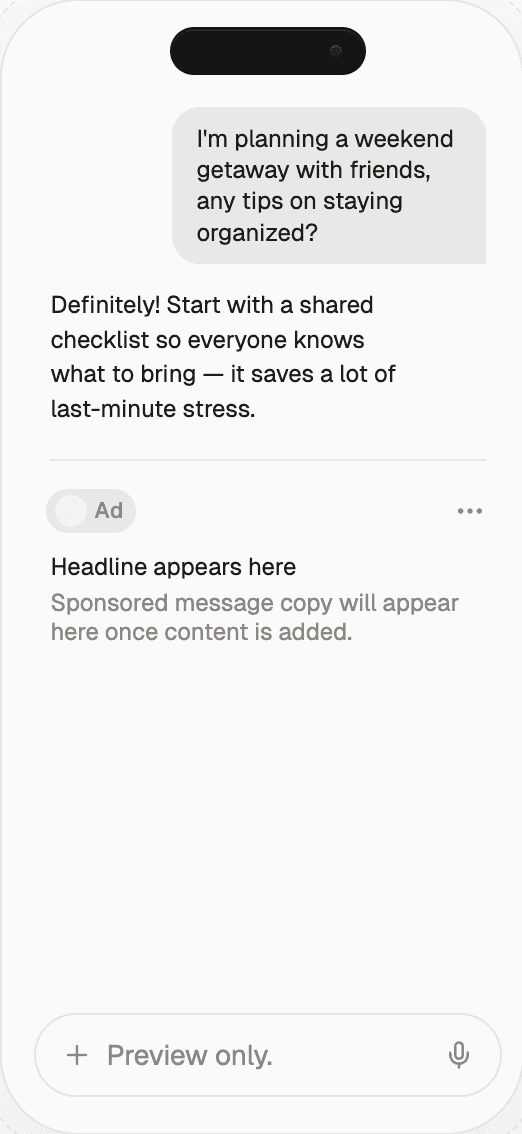
AI-assistant adoption in travel has moved from niche to mainstream in under a year, with 56% of US leisure travelers reporting AI use for at least one trip in the past 12 months (March 2026, TakeUp AI), up from 43% nine months earlier. OpenAI's ChatGPT ads pilot admits travel as a permitted vertical, with named launch partners including Expedia, Booking.com, Tripadvisor, Uber, and Marriott. But most travel brands are not on the partner list, and direct-access minimum spends sit in the high six figures. Independent AI-assistant ad networks give hotels, smaller OTAs, destination marketing organizations, airlines, and activity providers the trip-research placement path without the managed-program minimum.





ChatGPT Ads for Travel — 2026 Brand Playbook | Thrad
Travel is the category where AI-assistant search is most obviously eating classical discovery. Fifty-six percent of US leisure travelers used AI to plan at least one trip in the past twelve months, and more than half of "consideration" queries that used to start on Google now start in ChatGPT, Perplexity, or Gemini. The question for hotels, OTAs, airlines, and destinations in 2026 is no longer whether to be visible inside an AI assistant — it's how.
Date Published
Date Modified
Category
Advertising AI
Keyword
chatgpt ads for travel

Start monetizing your AI app in under an hour
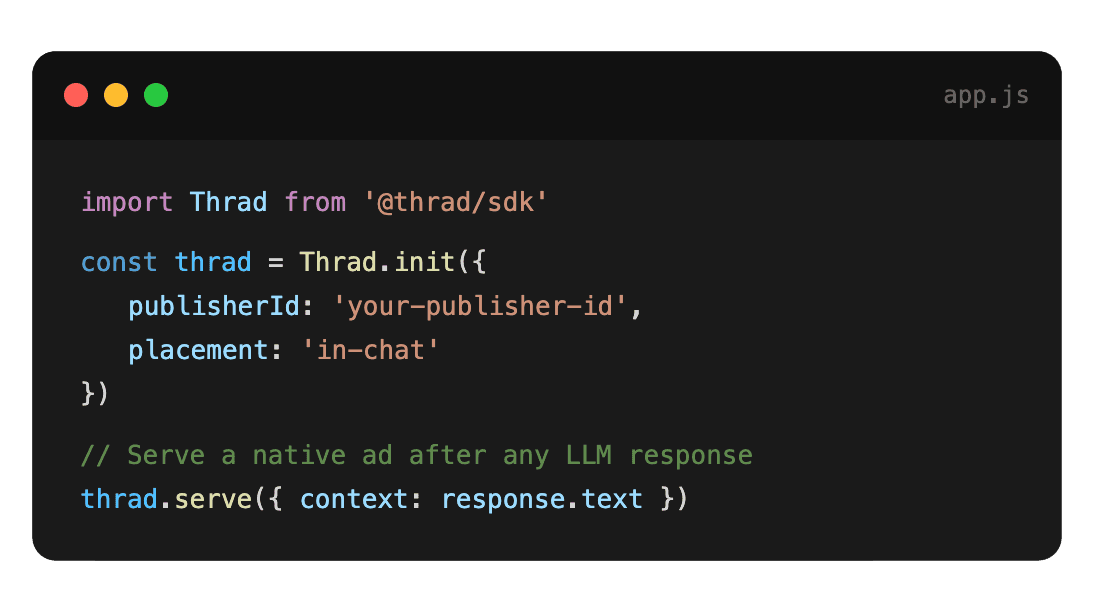
With Thrad, publishers go from first API call to live ads in less than 60 minutes. With fewer than 10 lines of code required, Thrad makes it easy to unlock revenue from your conversational traffic the same day.
Travel is the vertical where AI-assistant adoption has moved fastest and where classical search is losing share of consideration queries most visibly. Fifty-six percent of US leisure travelers used AI for at least one trip in the past 12 months as of March 2026, up from 43% nine months earlier — the fastest behavioral shift in travel industry history, according to TakeUp AI. OpenAI has stood up a named-partner travel ad program; Google has started processing bookings directly from AI Mode; Marriott and Booking Holdings are publicly experimenting with agentic travel. The strategic question for travel brands in 2026 is not "should we be visible inside AI assistants" — it's "which channel, at which spend level, measured against which goal."
What are ChatGPT ads for travel in 2026?
ChatGPT ads for travel are paid placements inside ChatGPT's search, conversational, and apps-in-chat surfaces promoting a travel product — hotel, flight, tour, destination, transportation, or activity — priced and measured through one of several channels: the OpenAI direct ad pilot, an integrated app partnership (Expedia, Booking, Tripadvisor, Uber), an independent AI-assistant ad network, or an adjacent retail-media or affiliate relationship. The pilot explicitly admits travel and experiences as a permitted vertical and excludes sensitive subjects from ad scoping. Sponsored placements are clearly labeled and matched to conversation topic rather than behavioral audience.
Three facts about the surface shape how travel brands should think about it. First, the queries are overwhelmingly commercial and research-intent. Second, the ad footprint is small by design — one or two sponsored results per eligible query, preserving answer trust. Third, direct booking is increasingly executable inside the assistant itself via apps, collapsing research and purchase steps that used to live on different sites.
Why is travel migrating to AI assistants so fast?
Travel is migrating to AI assistants fast because the job the user is hiring Google for — "help me plan a trip" — is a poor fit for a list of ten blue links and a good fit for a conversational interface that can synthesize comparisons, generate itineraries, and iterate on constraints. Eighty percent of travelers say they're open to using AI for trip planning and booking, per TakeUp AI research. The gap between openness and actual usage is closing monthly.
Four underlying dynamics:
Research is a synthesis problem. The user wants "compare
Tulum vs. Playa del Carmen for a family of four with pool
access, under $300 a night, early July." That's a synthesis
query. An assistant answers it natively; a search engine serves
a list.Itinerary building is generative by nature. Seventy percent
of AI-assistant travel users plan itineraries — an output format
that's trivial for a generative model and awkward for classical
search.Trust is higher in cited-source answers. Hallucination remains
a concern, especially on flight schedules and hotel availability.
The pattern travelers have settled into is AI for research,
classical channels for final booking verification — but the final
step is rapidly following.Booking-surface partnerships are collapsing the funnel.
Marriott announced Google AI Mode will process hotel bookings
directly; Expedia and Booking.com run as apps inside ChatGPT.
The assistant is becoming the booking surface, not just the
research surface.
Gen AI is threatening the platforms that dominate online travel — HBR wrote exactly that in January 2026. The risk is real for OTAs, and the opportunity is real for hotels that want to shift bookings direct.
Who is already buying travel ads on ChatGPT?
A small, named set of advertisers are live on OpenAI direct. The pilot's travel partners include Expedia, Booking.com, Tripadvisor, Uber, and Marriott — all operating either as apps inside ChatGPT (collapsing research and purchase into the same surface) or as pilot ad partners, or both. Booking.com and OpenAI have also run a SME training program across 20,000 European operators, signalling a longer-term interest in small-operator activation.
The structure of the pilot tells you what's live and what's not:
Travel actor | On OpenAI direct pilot | Path today |
|---|---|---|
Major OTAs (Expedia, Booking, Tripadvisor) | Partner + app integration | Direct |
Large hotel brand (Marriott) | Pilot partner | Direct |
Independent / boutique hotels | No | Independent network |
Regional / mid-size OTAs | No | Independent network |
Airlines (majors + regional) | Limited | Direct (if qualified) or independent |
Destination marketing organizations (DMOs) | No | Independent network, publisher partnerships |
Tour operators and activity providers | Partial (Uber partnership) | Independent network |
Cruise lines | No | Independent network |
Vacation rentals (non-aggregator) | No | Independent network |
Car rental (non-Uber) | No | Independent network |
The tradeoff is obvious. The named partners get the richest integration (apps-in-chat, native booking flows) and the ability to personalize. Everyone else — the long tail of travel, which is most of the actual travel economy — needs an independent network or adjacent channel to reach the same inventory.
How does seasonal bidding and inventory-aware creative work?
Two travel-specific problems make AI-assistant ads different from generic digital ads: seasonality and inventory. Demand moves by season, trip type, and destination; inventory moves by minute as rates and availability update. Travel ad buyers who treat the channel like retail media and ignore these two variables underperform sharply.
Seasonal bidding
Seasonality in AI-assistant travel ads is handled along two axes. First, query-driven relevance — when a user in April is researching "best beach destinations for August," the query itself is seasonal. The campaign doesn't need a calendar-based bid multiplier; the query pattern captures most of the signal. Second, date-scoped budget pacing — advertisers schedule budgets to align with known booking windows for their segment. Caribbean properties pace heavier in Oct–Dec for Jan–Mar travel; ski resorts pace heavier in Sep–Nov for Dec–Mar travel.
Inventory-aware creative
Inventory-aware creative means the sponsored card reflects live rate and availability. The mechanism is a network integration with the hotel's central reservation system (CRS) or the OTA's API, so the ad renders a current price range and a bookable-date window.
Four reasons this matters:
User trust. A hotel ad showing a rate that's unavailable
tanks the entire placement experience.Efficient spend. Serving against sold-out dates wastes CPC.
Attribution. Click-to-book attribution gets cleaner when the
creative carries a date-scoped promo code or rate ID.Competitive positioning. The first travel brand in a given
category to ship inventory-aware creative on a non-partner
channel has a real short-window advantage.
On independent AI-assistant ad networks, both seasonal bidding and inventory-aware creative are configurable at the campaign layer. The CRS/API integration is typically a one-time engineering lift, after which the creative layer refreshes automatically.
What are the four buyer paths for travel?
The practical 2026 buyer paths for travel AI-assistant ads are distinct enough that a media plan typically mixes them. Here's the map:
Channel | Access | Fit | Minimum commit | Speed to live |
|---|---|---|---|---|
OpenAI direct (pilot) | Named partners only | Large chains, major OTAs | $250K+ | Weeks |
Apps-in-chat integration | Major partners (Expedia, Booking, Tripadvisor, Uber) | Full booking flow | Partnership + engineering | Months |
Independent AI-assistant network (e.g. Thrad) | Open to qualified travel advertisers | Hotels, smaller OTAs, DMOs, airlines, activity | Low four-figure starter spend | Days |
Publisher / DMO partnership | Varies | Destination-level storytelling | Deal-dependent | Weeks |
Smaller travel brands that are not OpenAI partners have two realistic levers in 2026: the independent AI-assistant network path, and the publisher partnership path. Both can run in parallel. The independent network is the ad-unit reach play; the publisher partnership is the content-citation play (showing up inside the answer, not just next to it).
Why does this matter for travel in 2026?
Two forces make 2026 a pivotal year for travel ad investment.
First, the discovery funnel is genuinely shifting. Classical search use in travel is projected to drop 25% by end of 2026, per research cited across agency reports, while AI-assistant travel use is up 64% year over year. This isn't a long-term forecast — it's a behavior change in-flight. A hotel that relies exclusively on SEM in Q4 2026 is budgeting against a smaller query pie.
Second, direct-booking economics reward AI-assistant visibility disproportionately for hotels. Hotels average $519 per direct booking vs. $320 per OTA booking — a ~60% revenue advantage. Research cited by the industry suggests more than 56% of observed AI-assisted travel purchases went direct to hotel or operator sites, while OTAs captured under 10%. An assistant that sends a guest straight to the hotel site is a channel with structurally better unit economics than classical OTA-routed search.
The combined picture: a hotel or travel brand that invests in AI-assistant visibility in 2026 is buying into a channel that's growing, one that routes more bookings direct, and one whose cost curve is still early.
Common misconceptions
"If I'm on Booking.com, I'm already in ChatGPT." Being a
property on an OTA that has a ChatGPT app integration is distinct
from having your property branded and discoverable as a standalone
sponsored placement. The first gets you inventory access; the
second gets you brand visibility."I'll wait for OpenAI direct to open." OpenAI direct is
unlikely to open broadly to the long tail of travel in 2026 — the
managed-program economics don't support it. The independent network
path is the intended route for non-partner brands."Retargeting my loyalty members on ChatGPT is a goal."
ChatGPT ad inventory doesn't support retargeting. The channel is
about winning the research query, not re-engaging known users."Inventory-aware creative is too hard to ship." The CRS/API
integration is a one-time engineering lift. After that, the
creative layer updates automatically and the ROI compounds."AI-assistant ads will cannibalize my SEM." There's some
substitution on high-commercial research queries, but the
overlap is well below 50%. The two channels do different jobs —
SEM converts known-intent keywords, AI-assistant ads win
open-ended research questions."Hallucination risk means travelers don't trust AI for booking."
Trust is improving fast as flight-schedule and availability
grounding matures. Booking-via-assistant share was 13% as of early
2026 and trending up quarter over quarter.
What comes next
Three 2026–2027 shifts to plan for. First, agentic booking will mainstream — Google AI Mode already processes hotel bookings directly, and Marriott has said publicly it expects a meaningful share of transactions to route agentically in the next 18 months. Second, inventory-aware creative will become table stakes. The first-mover advantage window is open; by 2027 most competitive travel categories will have live-rate-aware sponsored cards. Third, destination-level targeting will sharpen. Destinations have been slow to invest, partly because measurement is harder than for a hotel, but expect large DMO investments in 2026 and a much richer destination-ad category by 2027.
A fourth shift worth naming: loyalty-program integration. The brands that figure out how to serve a known member a different experience inside an AI assistant — even without retargeting pixels — will capture more repeat bookings. Today's answer is the apps-in-chat model; 2027's may be deeper integration.
How to get started with travel AI-assistant advertising
Three practical steps for a travel brand in 2026:
First, map where your brand shows up today. Run 25–50 representative trip-research queries for your category, across ChatGPT, Perplexity, and Gemini. Note which competitors are cited, which sponsored placements run, which apps are invoked. This is your baseline.
Second, build the assets the channel needs: a structured content feed that's easy for assistants to cite (schema markup, clear rate/availability, geo and amenity metadata), a set of trip-research-aligned ad creatives that fit a short sponsored card, and either a CRS/API integration or the plan to build one. Assets apply across channels — partner, network, and SEO-adjacent GEO.
Third, pilot on an independent AI-assistant ad network. Thrad's network is open to qualified travel advertisers — hotels, smaller OTAs, DMOs, airlines, tour and activity providers — without a managed-program minimum. Seasonal bidding, inventory-aware creative, and destination-level geo targeting are configurable at the campaign layer. The pilot size stays proportionate to the audit findings; the measurement stack is the same you use elsewhere.
For the named OpenAI partners, the direct path is already paying off in integration depth and personalization. For the rest of the travel economy — the vast majority of it — independent AI-assistant networks are the honest answer in 2026. The market is moving fast, and a trip-research placement ship in Q2 2026 is worth a lot more than the same placement in Q2 2027.

ai assistant advertising for travel, chatgpt trip planning ads, hotel generative ai advertising, ota ai search marketing
Citations:
Skift, "OpenAI Launches Ads Pilot for ChatGPT, Travel Expected to Participate," February 2026. https://skift.com/2026/02/09/openai-chatgpt-ad-pilot-launch-travel/
TakeUp AI, "How Travelers Use AI to Plan and Book Trips in 2026," March 2026. https://takeup.ai/new-research-shows-how-ai-is-changing-travel-planning-in-2026/
Nomad Lawyer, "Majority Travelers Trips Now Use AI: 2026 Fastest Shift," 2026. https://nomadlawyer.org/majority-travelers-trips-ai-2026
CNBC, "Travelers are turning to AI to plan trips — but hallucinations and trust gaps remain," March 2026. https://www.cnbc.com/2026/03/11/ai-travel-planners-tourism-popularity-trust-hallucinations.html
PhocusWire, "ChatGPT brings apps into chat, starting with Expedia and Booking.com." https://www.phocuswire.com/openai-chatgpt-apps-expedia-booking-tripadvisor
OpenAI, "Booking.com and OpenAI personalize travel at scale," 2026. https://openai.com/index/booking-com/
Skift, "Marriott Says Google AI Mode Will Process Hotel Bookings, Not Just Send Links," February 2026. https://skift.com/2026/02/11/marriott-google-agentic-travel-booking/
HBR, "Gen AI Is Threatening the Platforms That Dominate Online Travel," January 2026. https://hbr.org/2026/01/gen-ai-is-threatening-the-platforms-that-dominate-online-travel
IMG Travel Outlook Survey, "2026 Top Destinations and Rising Use of AI in Trip Planning," April 2026. https://www.prnewswire.com/news-releases/img-travel-outlook-survey-reveals-2026-top-destinations-and-rising-use-of-ai-in-trip-planning-302722434.html
Be present when decisions are made
Traditional media captures attention.
Conversational media captures intent.
With Thrad, your brand reaches users in their deepest moments of research, evaluation, and purchase consideration — when influence matters most.