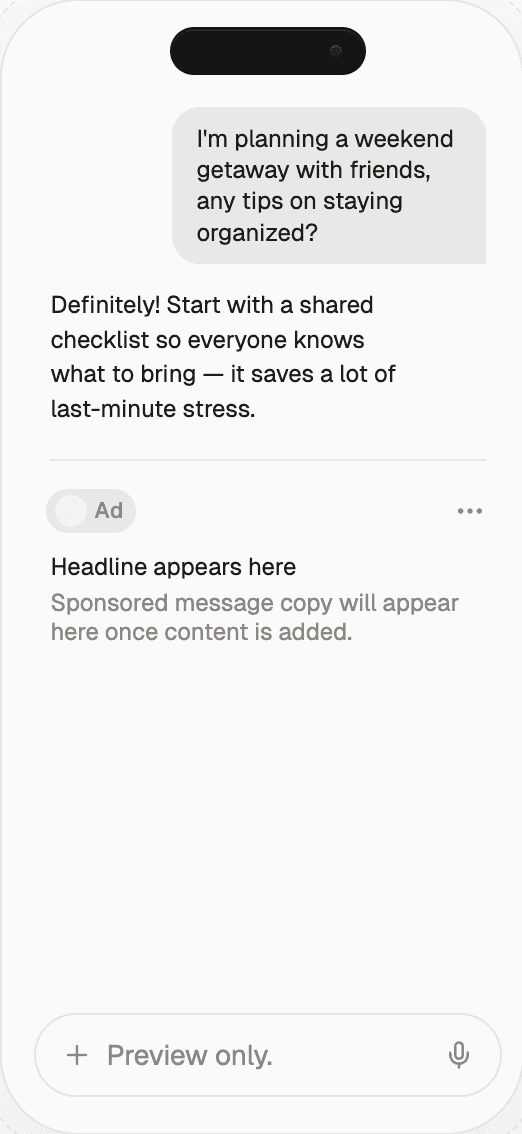
As of April 2026, ChatGPT runs a paid pilot ($50K minimum, $60 CPM, 600+ brands), Perplexity has fully discontinued advertising, Gemini has ads inside Google AI Overviews and AI Mode (bought via Performance Max and AI Max) but not in the standalone Gemini app, Microsoft Copilot runs chat ads plus Copilot Checkout and Brand Agents via Microsoft Advertising, and Claude remains explicitly ad-free by policy. No single surface covers the market; a cross-surface, independent-network buy is the only way to reach AI assistant users consistently in 2026.



ChatGPT vs Perplexity vs Claude vs Gemini Ads 2026 | Thrad
Four months into 2026 the four biggest AI assistants — ChatGPT, Perplexity, Claude, and Gemini — have taken four completely different positions on advertising. This pillar walks through each surface as it actually exists today: what formats shipped, who can buy, what it costs, and why the honest strategy for most brands is cross-surface rather than single-assistant.
Date Published
Date Modified
Category
Advertising AI
Keyword
advertise on chatgpt vs perplexity

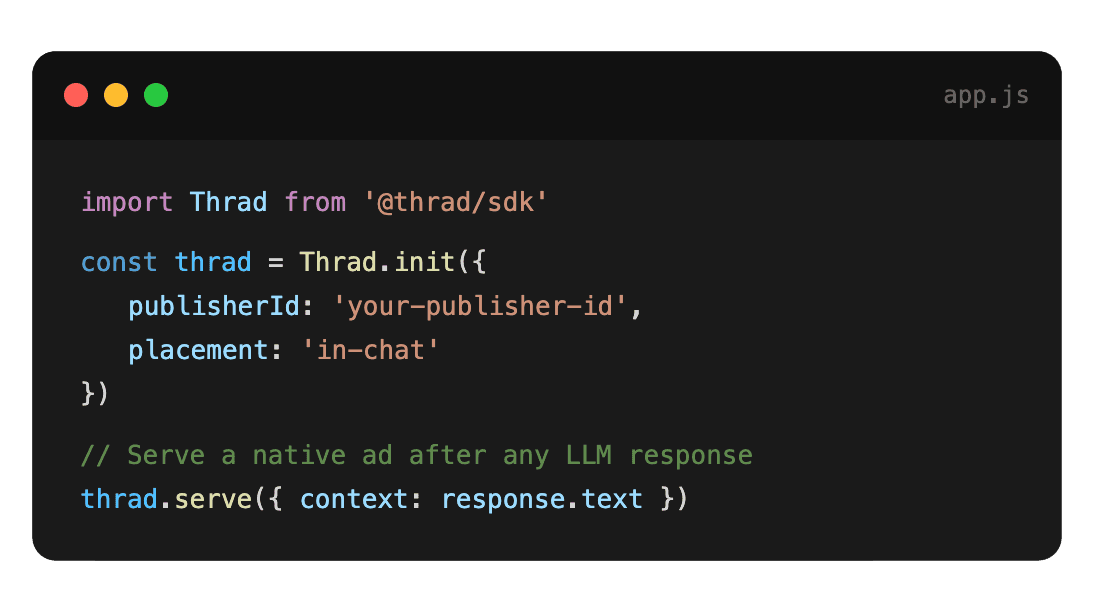
Start monetizing your AI app in under an hour
With Thrad, publishers go from first API call to live ads in less than 60 minutes. With fewer than 10 lines of code required, Thrad makes it easy to unlock revenue from your conversational traffic the same day.
If you searched "advertise on ChatGPT vs Perplexity" in April 2026, the honest one-sentence answer is: one of those two has an ad product, the other doesn't anymore, and the four-surface map is messier than you think. ChatGPT is live with a $50,000 minimum and a $60 CPM. Perplexity has fully discontinued advertising. Google's Gemini runs ads inside AI Overviews and AI Mode but not in the standalone app. Microsoft's Copilot is the most commerce-aggressive surface through Copilot Checkout and Brand Agents. Claude has publicly committed to staying ad-free. This pillar is the single document that maps what ships on each surface today, who can buy it, what it costs, and why cross-surface buying — not single-assistant loyalty — is the strategy that actually works in 2026.
What does the April 2026 AI assistant ad landscape look like?
Four products and four very different decisions. ChatGPT has the most developed ad product, Perplexity has walked away from ads entirely, Gemini is Google's dual-surface compromise, Copilot is the most commerce-integrated, and Claude is the explicit ad-free holdout. Every one of those positions shipped or was confirmed in Q1 2026, so the landscape as it existed even eight months ago is already out of date.
The biggest misread is treating the assistants like a single addressable market. They are four different products with four different traffic shapes, four different ad policies, and four different buying interfaces. Treating "AI advertising" as one channel is why so many brand teams are confused about where to start. The right mental model is four surfaces plus a long tail of AI-native apps and agents that the big four do not control — which is where Thrad's AI ad platform operates as an independent cross-surface network.
In April 2026, one AI assistant has shipped a live ads manager, one has deliberately unshipped its ads program, one runs ads on some surfaces but not its headline app, one is the most commerce-heavy of the four, and one has run a Super Bowl commercial promising never to run ads at all. Treat them as four products, not one channel.
What's the state of advertising on ChatGPT?
ChatGPT is where most of the money went in Q1 2026, and the product is now mature enough to buy. OpenAI formally launched the ChatGPT Ads pilot on February 9, 2026, crossed $100 million in annualized revenue within six weeks, and opened a self-serve ads manager in April 2026. The minimum commitment was lowered from $250,000 at pilot launch to $50,000 for the self-serve tier, and the standard CPM is $60.
Over 600 brands were onboarded in the first quarter of the pilot, including Target, Ford, Adobe, Best Buy, and Williams-Sonoma. The product surfaces two formats: sponsored results inside SearchGPT's web-search surface, and conversational ads that appear at the bottom of answers inside eligible commercial-intent threads. Both are explicitly labeled "Sponsored." OpenAI has also committed to keep three sensitive categories (health, mental health, and politics) off the inventory list.
Access model
Self-serve ads manager (April 2026): impressions, clicks, and
budget pacing visible in real time; $50K minimum.Managed programs (February 2026-): direct OpenAI sales and
agency partners; used by the first 600 brands; higher-spend
enterprise tier.Premium tiers remain ad-free: Plus, Team, Enterprise, and Pro
subscribers do not see ads by default; ads are live only on the
Free and ChatGPT Go tiers.
What the pilot data says
Early CTRs are mixed — materially higher than display on product-intent queries, but below the 5-15% range that early pilot reporting hinted at. A $60 CPM with mid-single-digit CTRs puts effective CPC in the $6-12 range for commercial-intent inventory, a premium over a typical Google Search CPC for comparable queries but in line with early search-premium plays.
The most important thing to understand about ChatGPT as a channel in April 2026 is that it is real, it is live, and it is still early enough that buyers with budget and patience can find underpriced inventory while the auction matures. For brands evaluating how ChatGPT ads actually run and what creative formats are available, the early-mover window is still open. It is also narrow — it is one surface of one assistant on one user tier, not a market-wide answer.
What's the state of advertising on Perplexity?
Perplexity had an ad program, then shut it down. As of April 2026 there is no paid placement to buy. The company launched sponsored follow-up questions in November 2024 with partners including Indeed, Whole Foods Market, and Universal McCann, paused the program after Head of Advertising Sales Taz Patel left in August 2025, and formally confirmed in February 2026 that it has discontinued ads and has no plans to restart.
The cited reason is trust. Perplexity's executive team told the Financial Times that "once advertisements appear in results, users inevitably begin to second-guess whether responses maintain their integrity or contain subtle commercial influence." The product decision was that the long-term health of the answer engine was worth more than the revenue line.
What that leaves for brands
No sponsored follow-ups — the format is gone.
No sponsored answers — the side-panel media unit is gone.
Publisher licensing indirectly — brands can still influence
Perplexity's citations through deals with the publishers it licenses.GEO is the primary lever — structuring site content so
Perplexity cites you organically; this is the 2026-practical play.Independent networks — AI ad networks that include
Perplexity-adjacent AI-native apps give brands a placement path that
Perplexity-native ads cannot.
Perplexity's withdrawal is important because it makes the "just advertise on the big AI assistants" frame structurally incomplete. One of the four big surfaces has no ad inventory. Any brand planning to "advertise on Perplexity" in 2026 is working on last year's facts.
What's the state of advertising on Gemini?
Gemini is the messiest answer of the four because Google runs two different products under the name. Ads ship inside Google AI Overviews (the AI-generated answer block at the top of Google Search) and inside AI Mode (the dedicated AI Search experience launched March 2025). They do not currently ship inside the standalone Gemini app, which remains ad-free as of April 2026 despite advertiser briefings indicating Google plans to bring ads to the app later in the year.
Where ads actually appear today
AI Overviews — ads eligible above, below, or within the AI
answer block on mobile and desktop in English across the US,
Australia, Canada, India, Indonesia, Kenya, Malaysia, New Zealand,
Nigeria, Pakistan, Philippines, and Singapore.AI Mode — sponsored results appear in approximately 25.5% of AI
Mode responses as of Q1 2026 data.Shopping inside Gemini app — Google is testing purchase flows
for Etsy and Wayfair inside the Gemini chat experience, but these
are not the same as traditional paid ad placements.
How brands access the inventory
No new ads manager is required. Eligible campaign types include:
Performance Max
AI Max for Search
Broad-match-enabled Search campaigns
In other words: the access point for Gemini/AI Overviews inventory is Google Ads, the one most performance marketers already operate. Creative is pulled from existing campaign assets and placed automatically by Google's AI-driven matching. AI Max for Search campaigns see an average of 7% more conversions or conversion value at similar CPA/ROAS when the full feature suite is used.
The standalone Gemini app
Google's VP of Global Ads Dan Taylor confirmed in December 2025, and Demis Hassabis reiterated at Davos in January 2026, that there are no ads in the Gemini app today. Earlier reporting by Adweek said Google had briefed advertisers about a 2026 ad rollout in Gemini, which contradicts the public denials. The most honest read: Google has an active option on Gemini-app monetization but has not shipped it publicly as of April 2026.
What's the state of advertising on Microsoft Copilot?
Microsoft Copilot is the most commerce-forward assistant of the five. Copilot inherits Bing ads inventory through Microsoft Advertising, adds conversational ad formats inside Copilot chat, and ships Copilot Checkout (conversational purchasing inside the chat) and Brand Agents (AI-powered branded assistants on merchant sites). All of it runs through the existing Microsoft Advertising platform. Microsoft search advertising revenue hit $13.9 billion in fiscal 2025 (+21% year over year), and the advertising line is projected to grow ~12.2% further in 2026.
What ships on Copilot today
Copilot search ads — Performance Max campaigns can appear
beneath Copilot's AI-generated response.Copilot Checkout (January 2026) — conversational commerce inside
Copilot with PayPal, Shopify, Stripe, and Etsy partners; Shopify
merchants enrolled automatically with opt-out. Journeys that include
Copilot led to 53% more purchases within 30 minutes of interaction
and were 194% more likely to convert when shopping intent is
present, per Microsoft first-party data.Brand Agents (January 2026) — AI-powered conversational
assistants merchants deploy on their own sites, integrated with
Microsoft Clarity for analytics.Microsoft Advertising creative-gen — Copilot-assisted ad assets
that run across all Microsoft Advertising placements (Bing, partner
sites, Copilot conversational search).
Performance signals
Microsoft's published data shows Copilot ads generate 73% higher CTR and 16% stronger conversion rates compared to traditional search ads, with 33% shorter customer journeys and 42% of users reporting a positive experience. These are Microsoft's numbers, so treat them as directional rather than independently audited, but the direction is consistent with the pattern across AI search surfaces: intent is higher, funnels are shorter, conversion rates are stronger than display.
The honest reason Copilot is the most mature commerce AI surface in 2026: Microsoft has been quietly wiring a decade of Bing Ads, LinkedIn Ads, and a commerce platform (PromoteIQ, Xandr) into the Copilot experience while everyone was watching ChatGPT.
What's the state of advertising on Claude?
Nothing ships. No paid placements, no sponsored answers, no inline brand units — and Anthropic has gone out of its way to make the ad-free posture a brand promise. On February 4, 2026, the company publicly declared Claude "a space to think" and ran a Super Bowl commercial centered on the tagline "Ads are coming to AI. But not to Claude." An Anthropic executive told CNBC it was a "conscious decision" not to include ads because advertising would take the company in "directions where you're optimizing for the wrong things."
What brands can and cannot do with Claude
Cannot — buy a paid placement, sponsor a response, retarget a
Claude user, pay for citation priority, or run any kind of native ad
unit. None of those products exist.Can — invest in Generative Engine Optimization so Claude cites
your brand organically when users ask related questions; publish
structured, quantified, citation-friendly content; monitor Share of
Model metrics via third-party tools that query Claude for brand
mentions; run comparable paid spend on the other four surfaces to
compensate for Claude's traffic not being available as paid
inventory.
Claude's position is interesting for the strategic reason that it creates the clearest possible contrast with ChatGPT and — intentionally or not — it makes the independent ad-network path (surfaces that Claude powers but Anthropic does not operate, third-party assistants and agents, etc.) the only realistic way to reach Claude-adjacent audiences with paid media.
Surface-by-surface comparison
The one table that holds the whole map. Every cell below reflects the publicly confirmed state as of April 2026.
Assistant | Ads live today? | Primary format | Access path | Typical pricing | Measurement | Gate / limitation |
|---|---|---|---|---|---|---|
ChatGPT (OpenAI) | Yes — pilot GA Feb 2026, self-serve April 2026 | Sponsored search + in-answer conversational ads | ChatGPT Ads Manager (self-serve) or managed program | $60 CPM, $50K minimum | Impressions, clicks, conversions in real time | Free / Go tiers only; no health/mental-health/politics |
Perplexity | No — discontinued Feb 2026 | (none) | (none) | — | — | Fully unshipped; GEO-only |
Claude (Anthropic) | No — policy-deliberate ad-free | (none) | (none) | — | — | Explicit ad-free commitment; GEO-only |
Gemini (Google) — AI Overviews / AI Mode | Yes | Sponsored placements above/below/within the AI answer | Google Ads (Performance Max, AI Max, broad-match Search) | Google Search auction dynamics | Google Ads conversion reporting | ~25.5% of AI Mode responses show sponsored; limited countries |
Gemini (Google) — standalone app | No as of April 2026 | (none yet) | (none) | — | — | Briefed to advertisers for 2026 rollout; not shipped |
Copilot (Microsoft) | Yes | Performance Max beneath Copilot response + Copilot Checkout + Brand Agents | Microsoft Advertising (Bing Ads stack) | Bing auction dynamics; commerce take-rate through Copilot Checkout | Microsoft Advertising + Clarity analytics | Shopify / retail-heavy rollout; conversational inventory still scaling |
The takeaway from the table: there is no single door. To run a serious cross-assistant campaign in April 2026, a brand is simultaneously operating (at minimum) a ChatGPT Ads Manager buy, a Performance Max / AI Max campaign hitting AI Overviews, a Microsoft Advertising buy that touches Copilot, and a GEO program that raises organic citation frequency in Claude and Perplexity.
Why is cross-surface the strategy that actually works in 2026?
Because no single surface reaches enough of the AI audience to matter on its own, and the surfaces diverge on ad policy in ways that aren't going to converge soon. Different assistants have different users, different intent profiles, different pricing, different creative specs, and — critically — different rules about whether ads can exist at all. Any serious 2026 plan has to touch at least three of the four major surfaces plus the long tail of AI-native apps.
The structural argument has four parts:
1. Audiences are not interchangeable
ChatGPT is ~800M weekly users per Microsoft-public numbers but is tier-segmented — ads only hit Free and Go, not Plus / Team / Enterprise. Perplexity's audience skews research-heavy and is now fully organic. Claude's audience skews knowledge-work and developer-adjacent. Gemini's AI Mode user is a modified Google Search user. Copilot's user is strongly commerce-oriented and often coming from a Windows / Office context. "Buy ChatGPT ads" is not "reach AI users."
2. Ad policy gaps create structural blind spots
If 25-35% of your ICP primarily uses Claude (knowledge-work audiences), you cannot reach them with paid media on Claude — ever, by Anthropic's policy. If another chunk is primarily on Perplexity, you can't reach them with paid media either. The only way to cover these blind spots is some combination of GEO (earn the citation) and independent networks that include AI-native apps not controlled by the big four.
3. Creative and intent signals don't port cleanly
ChatGPT ads are text + link + optional card. Google AI Overview ads are Performance Max creatives. Copilot ads run the Microsoft Advertising creative set plus Copilot Checkout commerce flows. Native units inside independent AI apps are specified per publisher. A single creative rarely covers all four. Brands running a competent cross-surface program build a creative library, not a creative.
4. Measurement is surface-specific
No one has a clean cross-assistant ID graph. ChatGPT gives you impressions / clicks / conversions. Google gives you the full Google Ads conversion stack. Microsoft gives you Copilot Checkout purchase data. Independent networks expose their own prompt-intent and attribution data. You stitch the picture together with modeled incrementality (geo-holdouts, synthetic control) rather than deterministic attribution. Teams that insist on deterministic attribution will under-invest in the surfaces that can only be measured modeled, and those are some of the highest-ROI surfaces in 2026.
What does a cross-surface buy actually look like in 2026?
A realistic quarterly plan for a brand with a six-figure AI budget and genuine ICP overlap with all four assistants:
Spend lever | What you buy | Typical allocation | Why it's in the plan |
|---|---|---|---|
ChatGPT Ads Manager | Sponsored search + conversational placements on Free/Go | 25-35% | Largest paid-inventory surface; self-serve; fastest-maturing auction |
Google Performance Max / AI Max | AI Overviews + AI Mode placements | 20-30% | Covers Google's AI surface; runs on existing Google Ads account |
Microsoft Advertising | Copilot search ads + Copilot Checkout for eligible SKUs | 10-20% | Highest commerce conversion of any AI surface; Shopify / Bing reach |
Independent AI ad network (e.g., Thrad's managed service) | Native placements in AI-native apps, agents, and long-tail assistants the big four do not operate | 15-25% | Covers the surfaces outside the big four; reaches Claude-adjacent audiences |
GEO program | Structured content + citation optimization | 5-10% (plus creative spend) | Earns organic citations in Claude, Perplexity, and every surface |
The exact allocation flexes by vertical — commerce brands skew Microsoft heavier; B2B SaaS skews GEO and independent-network heavier; retail media skews ChatGPT + Gemini heavier — but the multi-surface structure is non-negotiable. Any plan that funnels 80%+ of AI budget into a single surface is making a bet that that surface wins the whole market, which is the thesis no one honest is making in 2026.
How should buyers think about brand safety across these surfaces?
Each surface has its own policy, its own labeling standard, and its own content exclusion list, so a brand-safety program runs per surface — but the patterns rhyme.
ChatGPT — three explicitly off-limits categories (health,
mental health, politics) plus an interim IAB Tech Lab labeling
standard. Clearly labeled "Sponsored." No placement alongside
unsafe answer types because OpenAI's router keeps sensitive queries
out of the eligible pool.Gemini / AI Overviews — Google's existing brand-safety controls
from Search apply; Performance Max placement controls carry
through; "Sponsored" labeling is explicit.Copilot — Microsoft Advertising brand-safety tooling; Clarity
analytics for Brand Agents; Copilot Checkout inherits Shopify /
merchant controls.Independent AI networks — per-publisher brand-safety commitments
plus network-level category exclusions. Thrad's public positioning
stresses that contextual signals (topic, intent, surface) are
available to advertisers within agreed privacy and safety rules.
The unified point: every major surface in 2026 is labeled-and-scoped, not the Wild West that many advertisers feared coming into the AI ad era. The brand-safety problem is real but solvable with existing tooling.
How do you measure cross-surface campaigns honestly?
The measurement stack in 2026 is a layered one, not a single deterministic graph. The pattern most well-run brands use:
Per-surface primary metrics — impressions, clicks, and
platform-reported conversions from each surface's native ad
manager (ChatGPT Ads Manager, Google Ads, Microsoft Advertising,
independent network dashboards).Share of Model (GEO) — how often each AI assistant mentions
your brand in answers to your target commercial-intent queries,
measured via third-party monitoring tools that query the
assistants on a schedule.Modeled incrementality — geo-holdouts, synthetic control, or
MMM layer on top of the per-surface data to answer "what
incremental revenue did the AI channel create."Post-click conversion — the advertiser's own site pixels pick
up what happens after click-through, which covers the clean
deterministic portion of the funnel.Citation-weighted lift — for GEO and independent-network
plays, the metric is how often the brand is mentioned or cited in
AI answers across surfaces, not impressions.
Teams that try to force a single-metric narrative (e.g., "ROAS across all AI surfaces") will struggle because the underlying surfaces report differently. Teams that commit to the layered view and validate it with periodic incrementality tests will get honest numbers.
Common misconceptions about AI assistant advertising in 2026
"Perplexity has ads, I should buy them." Not since February
2026. The program is fully unshipped. Any vendor pitching Perplexity
ad placements is either talking about historical inventory or
referring to something that is not actually Perplexity-native ads."Claude will open up to ads eventually." Possibly, but
Anthropic's public posture (including a Super Bowl campaign) makes a
reversal costly to their brand. Planning on paid Claude inventory in
2026 is not a safe bet."ChatGPT ads are like Google Ads." They overlap, but the
pricing ($60 CPM floor), the minimum commit ($50K self-serve, up
from $250K at pilot), the inventory (Free and Go tiers only), and
the creative spec (text + link, some card) all differ. Treat them
as adjacent channels, not the same channel."If I buy Google AI Overviews ads, I'm advertising on Gemini."
You're advertising on Google's AI surface in Search. The
standalone Gemini app is a separate surface and is not currently
accepting ads."Copilot ads are just Bing ads." They're the Microsoft
Advertising graph, which includes Bing but also Copilot-native
chat inventory, Copilot Checkout commerce flows, and Brand Agents.
Running a straight Bing Ads campaign does not automatically fill
all the Copilot inventory a retailer could use."The AI ad market is one market." It is five (soon six) very
different product decisions inside four different platform
companies plus a long tail of AI-native apps. Treating it as one
channel is the single biggest reason campaigns underperform.
What changes through the rest of 2026?
Five things to watch between April and year-end:
Gemini-app ads ship. Google has briefed advertisers about a
2026 rollout; the timing and format will matter a lot for the
cross-surface map.ChatGPT self-serve opens further. Minimums may drop below $50K;
targeting granularity expands; Plus / Team ad-free guarantees are
tested in various ways.Copilot Checkout expands. More retailers, more categories,
more countries — making Copilot the commerce-specialist AI surface.Perplexity stays unshipped. Any reversal would require
Perplexity's team to publicly walk back the "trust" argument, and
that is expensive for the brand.Independent networks consolidate. The AgenticAdvertising.org
initiative, Thrad's Monetisation Fund, and similar efforts point
toward shared standards for AI-native ad delivery outside the big
four. Expect the long-tail surface to professionalize fast in the
back half of the year.
How to start a cross-surface AI ad program
Six steps a brand can run in Q2 2026.
Map where your ICP actually asks. Take your top 20
commercial-intent queries, ask each of them on ChatGPT,
Perplexity, Claude, Gemini (AI Mode), and Copilot, and log which
brands appear where. Most brands have never done this audit and
are surprised by the asymmetry.Open the paid surfaces you can today. Stand up a ChatGPT Ads
Manager account ($50K pilot), turn on Performance Max / AI Max in
Google Ads, and connect Microsoft Advertising if you don't already
have it. If the $50K floor is out of reach, browse
live examples of ads running inside assistants
to see what creative formats to mirror. The minimum viable
cross-surface paid stack is these three plus one.Add an independent AI ad network for the surfaces you can't
reach directly. This is where Thrad sits: cross-surface
placements in AI-native apps and agents outside the big four,
including reach adjacent to Claude and Perplexity users. One
integration, many surfaces.Run a GEO program in parallel. Structured, cited, quantified
content earns organic mentions in Claude and Perplexity answers,
and lifts citation rates everywhere else as a bonus. Measure Share
of Model across the four assistants on a weekly cadence.Measure layered, not deterministic. Per-surface primary
metrics + Share of Model + modeled incrementality + post-click
conversion + citation-weighted lift. Resist the pressure to
collapse it to one number too early.Re-audit quarterly. The surfaces are changing faster than any
media plan cadence the industry is used to. Perplexity unshipped
ads in one quarter. ChatGPT opened self-serve in another. Your
plan is one policy change away from needing a rewrite.
For brands that want a single integration path to the cross-surface strategy, Thrad's independent AI ad network sits where the big four don't — across the long tail of AI-native apps, agents, and assistants that together add up to meaningful reach. It is not a substitute for a ChatGPT Ads Manager buy or a Performance Max campaign; it is the piece that fills the gap those channels cannot cover.
The honest 2026 summary is that the AI assistant ad market is real, fragmented, asymmetric, and rewarding for brands that treat it as a cross-surface problem instead of a single-platform bet. The single-surface bet — whichever surface you pick — is the quiet way to lose this cycle. The cross-surface bet, with an independent network filling the gaps, is how you show up everywhere your customer is actually asking.
advertise on perplexity, advertise on claude, advertise on gemini, advertise on copilot, ai assistant advertising, cross-surface ad buying
Citations:
OpenAI, "Testing ads in ChatGPT," 2026. https://openai.com/index/testing-ads-in-chatgpt/
eMarketer, "OpenAI launches ads manager, reduces ChatGPT ad pilot cost to $50,000," 2026. https://www.emarketer.com/content/openai-launches-ads-manager--reduces-chatgpt-ad-pilot-cost--50-000
Digiday, "OpenAI has quietly launched its ads manager," 2026. https://digiday.com/marketing/openai-has-quietly-launched-its-ads-manager-as-it-races-to-build-out-its-ads-business/
PYMNTS, "Perplexity Pulling Sponsored Answers From AI Platform," 2026. https://www.pymnts.com/artificial-intelligence-2/2026/perplexity-pulling-sponsored-answers-from-ai-platform/
Campaign US, "Perplexity pulls the plug on ads, citing trust concerns for AI," 2026. https://www.campaignlive.com/article/perplexity-pulls-plug-ads-citing-trust-concerns-ai/1949142
The Register, "Anthropic keeps Claude ad-free," 2026. https://www.theregister.com/2026/02/04/anthropic_no_advertising_in_claude/
CNBC, "Anthropic takes aim at OpenAI's ad push in Super Bowl commercial," 2026. https://www.cnbc.com/2026/02/04/anthropic-no-ads-claude-chatbot-openai-chatgpt.html
Google Ads Help, "About ads and AI Overviews," 2026. https://support.google.com/google-ads/answer/16297775
Adweek, "Google Tells Advertisers It'll Bring Ads to Gemini in 2026," 2026. https://www.adweek.com/media/google-gemini-ads-2026/
Microsoft Advertising, "Conversations that Convert: Copilot Checkout and Brand Agents," 2026. https://about.ads.microsoft.com/en/blog/post/january-2026/conversations-that-convert-copilot-checkout-and-brand-agents
Search Engine Land, "Microsoft launches Copilot Checkout and Brand Agents," 2026. https://searchengineland.com/microsoft-launches-copilot-checkout-and-brand-agents-467175
Search Engine Land, "Perplexity begins testing ads as sponsored follow-up questions," 2024. https://searchengineland.com/perplexity-begins-testing-ads-448277
CNN, "ChatGPT to start showing users ads based on their conversations," 2026. https://www.cnn.com/2026/01/16/tech/chatgpt-ads-openai
ExchangeWire, "Thrad Joins AgenticAdvertising.org as Founding Member," 2026. https://www.exchangewire.com/blog/2026/03/05/thrad-joins-agenticadvertising-org-as-founding-member/
Similarweb, "Generative Engine Optimization: The Complete 2026 Guide," 2026. https://www.similarweb.com/blog/marketing/geo/what-is-geo/
Be present when decisions are made
Traditional media captures attention.
Conversational media captures intent.
With Thrad, your brand reaches users in their deepest moments of research, evaluation, and purchase consideration — when influence matters most.