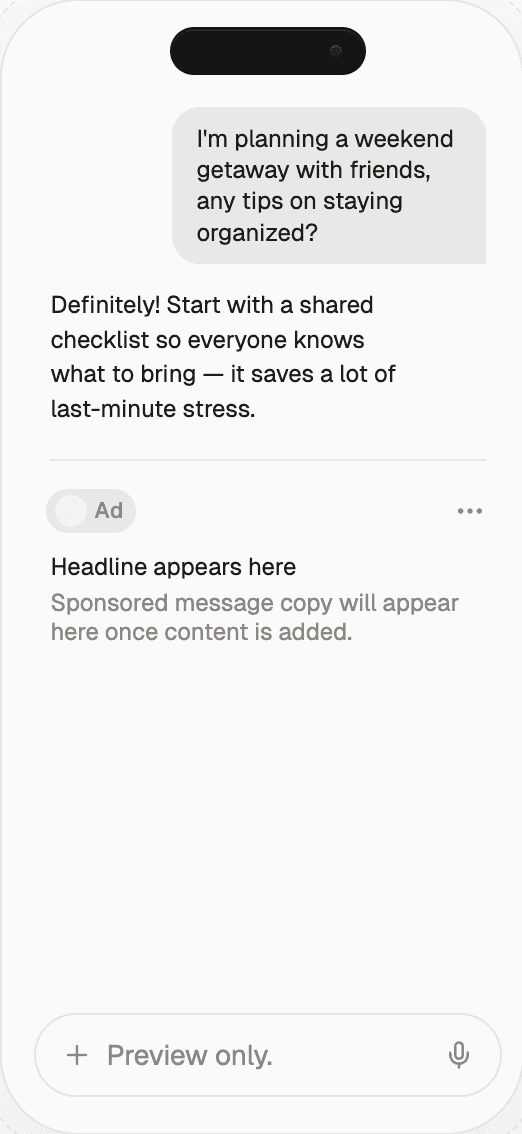
Score AI chatbot advertising platforms against eight weighted criteria: surface coverage (25%), format support (15%), targeting depth (15%), measurement transparency (15%), pricing model (10%), minimum spend (5%), brand-safety controls (10%), and data portability (5%). OpenAI's ChatGPT ads beta is the single biggest surface but gates at roughly $200,000 minimum; Perplexity paused its ads program in February 2026; Google's AI Overviews carry ads in 25.5% of results. Buyers should think in terms of a platform portfolio — not a single vendor. Independent AI ad networks like Thrad exist precisely because single-platform coverage is structurally inadequate for 2026 AI-assistant advertising.



AI Chatbot Advertising Platforms — 2026 Buyer Rubric | Thrad
Every quarter a new "AI chatbot advertising platform" shows up with a deck. Most of them cover one surface, publish no measurement, and price opaquely. This is the weighted buyer rubric we would use to evaluate them — eight criteria, explicit scoring, and the red flags that eliminate a vendor in the first meeting.
Date Published
Date Modified
Category
Advertising AI
Keyword
ai chatbot advertising platform

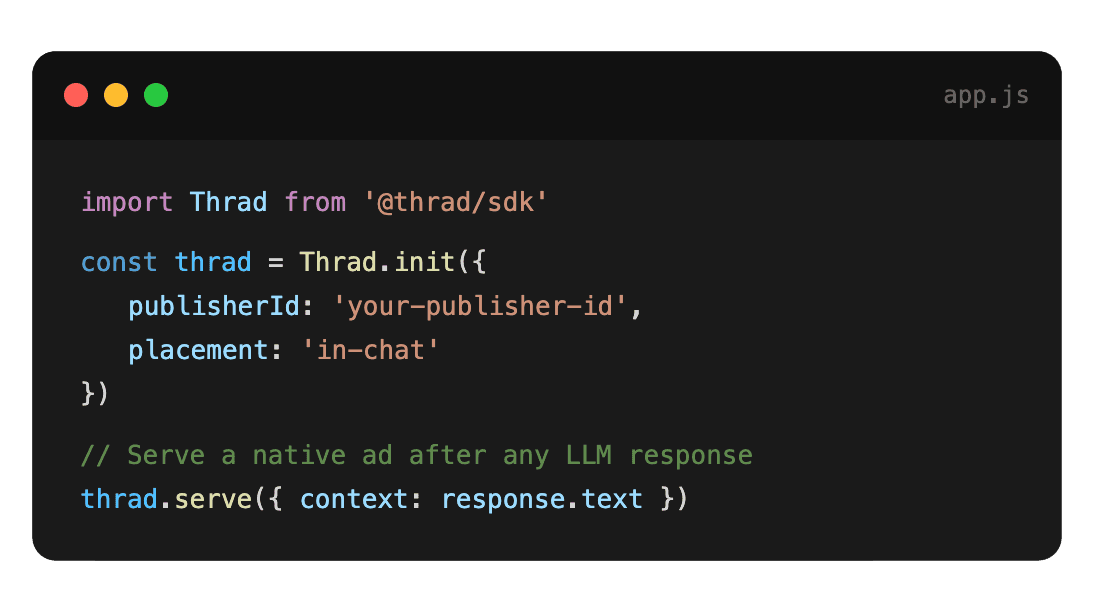
Start monetizing your AI app in under an hour
With Thrad, publishers go from first API call to live ads in less than 60 minutes. With fewer than 10 lines of code required, Thrad makes it easy to unlock revenue from your conversational traffic the same day.
"Which AI chatbot advertising platform should we use?" is the wrong first question. The right first question is: "What criteria should we use to evaluate them, how should we weight those criteria, and what portfolio emerges from that scoring?" In 2026, no single platform clears every criterion — ChatGPT has the biggest surface but a six- figure minimum, Perplexity paused ads entirely, Google AI Overviews scales but targets shallowly, and independent networks cover the cooperative-AI-app long tail. This is the rubric we would use to pick a portfolio, not a winner.
What is an AI chatbot advertising platform?
An AI chatbot advertising platform is the software, managed service, or ad network that sells paid placements inside AI assistant surfaces. The category is new, the vocabulary is inconsistent, and the platforms differ more than a surface-level comparison suggests — because the surfaces themselves differ. ChatGPT's sponsored search placements are not interchangeable with Copilot's in-answer product cards, and neither is interchangeable with the on-page ad units that Google AI Overviews appear above.
The category today spans four structural types:
First-party platforms from the AI company. OpenAI's ChatGPT
ad beta is the archetypal example — OpenAI directly sells
placements on its own surface. Google AI Overviews advertising,
run through Google Ads infrastructure, is structurally similar.Independent ad networks that cover multiple AI apps. Networks
like Thrad sell inventory across cooperative AI applications
(DeepAI among others, per the February 2026 ExchangeWire
partnership announcement) that license monetization
infrastructure from the network rather than build their own.Retail-media and commerce integrations. Shopping-focused
placements inside ChatGPT and other assistants, surfaced through
partnerships with Shopify, retail-media networks, and affiliate
platforms. The economics are CPC/CPA rather than CPM.Publisher licensing deals. Brands pay publishers; publishers'
content is licensed by AI companies; brand citations appear inside
AI answers with attribution. The dollars flow through PR and
publisher budgets rather than through direct ad platforms.
Each type scores differently on the rubric. A single advertiser in 2026 typically uses two or three of them in combination.
How should buyers weight the eight criteria?
The eight criteria that actually predict performance are, in order of weight: surface coverage, measurement transparency, targeting depth, format support, brand-safety controls, pricing model, minimum spend, and data portability. The table below is the starting point; specific buyers should re-weight for their constraints (regulated industries push brand-safety higher; sub- $200K budgets push minimum-spend higher).
Criterion | Weight | What to score on | Disqualifier |
|---|---|---|---|
Surface coverage | 25% | How many AI-assistant surfaces the platform actually places inventory on | Single-surface, single-platform |
Measurement transparency | 15% | API access to raw logs, third-party attribution cooperation, incrementality methodology | "Dashboard metrics only" |
Targeting depth | 15% | Prompt-intent classification, category targeting, commercial-intent filtering, audience inputs | Keyword-only or broad-match only |
Format support | 15% | Sponsored search, shopping cards, in-answer citations, conversational placements | One format, no roadmap |
Brand-safety controls | 10% | Written labeling policy, IAB Tech Lab alignment, real-time adjacency controls | No written policy |
Pricing model | 10% | Transparent CPM/CPC, itemized fees, no hidden rebates | Opaque pricing, blended rate only |
Minimum spend | 5% | Floor commitment, scalable entry tier, trial budgets | Single-tier six-figure minimum with no alternative |
Data portability | 5% | Export of pilot data, open measurement standards | Vendor-locked attribution or proprietary metric definitions |
Why is surface coverage the largest weight?
Because AI-assistant users do not stay on one assistant. A B2B buyer looking for a CRM platform might start in ChatGPT, follow up in Perplexity, verify in Gemini, and close the research phase on Copilot. A DTC shopper might ask ChatGPT for a product category recommendation, then jump to Google AI Overviews to check pricing and reviews. An advertising platform that covers only one of those surfaces sees a slice of the research journey; the surfaces it doesn't cover are invisible to the campaign.
Forrester's B2B Predictions 2026 and 6sense's 2025 global buyer study put LLM usage during B2B buying at 94%, with ChatGPT used by roughly 47% of buyers and other LLMs splitting the rest. Those numbers shift quickly, but the structural message doesn't: one- surface coverage is one-surface attribution at best. The winning 2026 portfolio covers three or more surfaces, which requires either a platform with cross-surface inventory (an independent network) or a stack of first-party platforms coordinated by the advertiser.
Why measurement transparency gets the second-highest weight
Because without it, nothing else is defensible. Finance teams approve budget based on expected lift; if the platform cannot measure lift credibly, the budget is effectively a leap of faith. In 2026 the minimum credibility bar is: the platform cooperates with third-party attribution vendors, publishes its incrementality methodology, exposes raw impression and click data via API, and provides a holdout mechanism. Platforms that hide behind proprietary dashboards fail this criterion no matter how pretty the dashboards are.
Why data portability is the sleeper criterion
Because the AI advertising category is moving fast enough that switching platforms will happen. A platform that locks your pilot data (attribution labels, custom audience definitions, creative performance history) into a proprietary format is a platform you cannot exit cleanly. The 2026 buyers who picked portable platforms have switched at least once already and kept their learnings; the ones who picked locked platforms restarted measurement from zero.
What are the main AI chatbot advertising platforms?
The direct-buy platforms differ significantly in surface, pricing, minimum spend, and targeting model. Marketers should not evaluate them as if they were equivalent products — they are materially different and score very differently on the rubric. The table below summarizes the current state as of April 2026.
Platform | Surface | Pricing model | Minimum spend | Targeting | Notable |
|---|---|---|---|---|---|
OpenAI ChatGPT ads beta | ChatGPT Free + Go | ~$60 CPM, managed | ~$200,000 | Category + prompt-intent | Beta, closed invite |
Google AI Overviews ads | AI Overviews (25.5% of results) | Google Ads auction | Google Ads standard | Keyword + audience | Ads in ~25.5% of AI results |
Microsoft Copilot (Bing-backed) | Copilot chat + Bing | Microsoft Ads auction | Microsoft Ads standard | Keyword + audience | Tied to Bing infrastructure |
Perplexity ads | Paused Feb 2026 | N/A | N/A | N/A | Pivoted to subscription |
Independent AI ad networks (e.g. Thrad) | Multiple AI apps | Managed CPM/CPC | Varies; typically $10K+ | Prompt-intent, category | Cross-surface, available today |
Retail-media integrations | Shopping cards in ChatGPT, other AI | CPC/CPA | Retail-media standard | Product feed + query | Sephora, Target, others via ACP |
Publisher licensing | Cited answers inside AI | PR/licensing deals | Varies | Content relevance | Indirect; slow to attribute |
What the table does not say
The table is useful but flattens important nuances. Pricing models shift quarterly — ChatGPT's $60 CPM is reported; ALM Corp and Adweek both noted it in Q1 2026 coverage. The $200,000 minimum is confirmed per Adweek's March 2026 reporting but varies by advertiser and holding-company relationship. Perplexity's pause (MarketingProfs, April 10, 2026) is not a permanent exit — it's a product-strategy reset — but as of today Perplexity is not an addressable platform. Google AI Overviews' ad rate (25.5% of results) was reported by MarketingProfs' weekly AI update in April 2026 and is a Google-produced figure.
Ads in AI search results make nearly two-thirds of US adults trust results less, according to Ipsos. That means brand safety and labeling are not optional line items — they shape whether the placement helps or hurts you.
How should a sub-$200K advertiser approach this?
Sub-$200K advertisers should skip the ChatGPT direct beta and build a portfolio from platforms whose minimums actually match the budget. In 2026 that portfolio typically includes an independent ad network for cross-assistant reach, Google AI Overviews via Google Ads for the AI-Overview surface, retail-media for commerce queries, and a GEO program for earned citations. The total monthly outlay can run in the low-to-mid five figures and still produce defensible measurement if the platforms selected score well on rubric criteria other than minimum spend.
The assembly pattern:
Independent AI ad network — cross-surface coverage across
cooperative AI apps. Minimums typically $10K–$25K/month; gives
exposure on surfaces the direct betas do not cover.Google Ads on AI Overviews — regular Google Ads account,
bid on keywords that trigger AI Overview results. No special
minimum.Retail-media integrations — if you sell physical products,
Shopify/ACP integration for appearance inside ChatGPT shopping
cards. Economics are CPC/CPA.GEO program — earned-citation content and schema work.
Lower spend, longer payback, durable.Measurement layer — holdout-based incrementality
measurement that spans all four.
This portfolio is not optimal for every advertiser, but it's the feasible shape when the ChatGPT direct beta is off the table.
What are the biggest red flags across platforms?
The red flags that disqualify a platform are specific and recurring, and they are different from the red flags to watch on agencies. Platforms fail in one of five ways: opaque measurement, single- surface coverage sold as cross-surface, no written brand-safety policy, locked data, or pricing opacity that hides rebate economics. Any one of them is disqualifying in a serious evaluation.
Proprietary-metric-only reporting. If the platform's primary
success metric is a custom score the platform defined and does
not publish the methodology for, reporting is unverifiable.Surface coverage sold as "cross-AI" when it is one AI's
cooperative app list. Ask for the specific list of AI apps
inventory appears on; ask for daily impression volumes on each.No written labeling or compliance policy. 2026 regulation is
coalescing fast; platforms without written policies are a
liability.Vendor-locked attribution labels. Your pilot data lives
inside the platform's taxonomy. Leaving the platform loses the
labels.Pricing opacity. "We can share our CPM after NDA" is a
smell. Serious platforms publish pricing ranges or disclose
them in discovery calls.
Common misconceptions
"ChatGPT is the only AI advertising platform that matters."
It's the biggest surface but gated at $200K minimum and a narrow
format set. For most advertisers the portfolio of other platforms
matters as much or more."AI advertising is just SEO rebranded." It isn't. Paid
placement and earned citation both exist; they're related (good
GEO helps paid brand safety) but not identical."Perplexity ads are a growing channel." Perplexity paused its
ads program in February 2026 and is focused on subscription
revenue. Treat it as earned-only for now."Measurement is not ready yet, so we'll skip it." Measurement
is ready enough. Holdout incrementality works today. Platforms
that tell you measurement is impossible are making an excuse.
What comes next for the platform landscape?
Expect three shifts through 2026–2027. First, self-serve access opens at OpenAI — dropping the $200K minimum and pushing platform evaluation from "access" to "skill." Second, measurement standards consolidate as IAB Tech Lab's generative-advertising guidance iterates and third-party attribution vendors (LiveRamp, DCM, Innovid) roll out AI-assistant coverage. Third, the independent ad- network layer grows: more AI apps license monetization infrastructure, giving independent networks more inventory to sell. The buyer portfolio will keep shifting as those three shifts land.
How to run the platform evaluation
Run the evaluation as a structured, scored process — not a pitch tour. The buyers making good decisions are scoring five to seven platforms on the rubric, assembling a portfolio of two or three, running a 90-day pilot with measurement discipline, and re-scoring quarterly. The buyers who picked one platform after one meeting are the ones renegotiating nine months later.
Start with the rubric. Adapt the weights for your situation.
Score five to seven platforms. Document scores; re-score
quarterly.Assemble a portfolio, not a winner. Two or three platforms is
the norm. A single winner is an artifact of bad evaluation.Pilot 90 days. Written success threshold, pre-agreed holdout
design, finance sign-off in advance.Re-evaluate. Platforms change fast; so should your scoring.
Transparency on our own pitch: Thrad is one of the independent AI ad networks this rubric is designed to surface. We score well on surface coverage and pricing model because we're cross-assistant and transparent about CPMs. We score mid-pack on format support (we're narrower than a full first-party platform). The right rubric puts us somewhere in your portfolio — not at every weighting, but at enough of them to matter. See thrad.com for the specifics.
ai chatbot ads, chatbot advertising platform, llm advertising platform, ai assistant advertising vendor
Citations:
Adweek, "Exclusive: OpenAI confirms $200,000 minimum commitment for ChatGPT ads," 2026. https://www.adweek.com/media/exclusive-openai-confirms-200000-minimum-commitment-for-chatgpt-ads/
ALM Corp, "OpenAI ChatGPT ad pricing revealed: $60 CPM and $200,000 minimum commitment," 2026. https://almcorp.com/blog/chatgpt-ad-pricing-60-cpm-200000-minimum/
MarketingProfs, "AI update, April 10, 2026: AI news and views from the past week," 2026. https://www.marketingprofs.com/opinions/2026/54530/ai-update-april-10-2026-ai-news-and-views-from-the-past-week
Single Grain, "ChatGPT ads vs Perplexity ads: Comparing AI advertising platforms," 2026. https://www.singlegrain.com/advertising/chatgpt-ads-vs-perplexity-ads-comparing-ai-advertising-platforms/
Adventure PPC, "ChatGPT ads vs Gemini ads 2026: Comparing Google and OpenAI AI search advertising," 2026. https://www.adventureppc.com/blog/chatgpt-ads-vs-gemini-ads-2026-comparing-google-and-openai-ai-search-advertising
Metricus, "AI platform comparison: how ChatGPT, Perplexity, Gemini and Claude handle brands," 2026. https://metricusapp.com/ai-platform-comparison-brands/
ExchangeWire, "Thrad partners with top-10 consumer AI app DeepAI to enable paid ads in LLMs," 2026. https://www.exchangewire.com/blog/2026/02/02/thrad-partners-with-top-10-consumer-ai-app-in-the-world-deepai-to-enable-paid-ads-in-llms/
Thrad, "Paid ads in AI," 2026. https://www.thrad.ai/
Be present when decisions are made
Traditional media captures attention.
Conversational media captures intent.
With Thrad, your brand reaches users in their deepest moments of research, evaluation, and purchase consideration — when influence matters most.