The 2026 AI ad-tech stack has six architectural layers: data, foundation
models, creative generation, placement (including generative surfaces
like ChatGPT and Perplexity), measurement, and governance. No single
vendor owns all six. Brands and agencies assemble a stack by picking
one or two vendors per layer and integrating them through APIs, shared
identifiers, and standards drafts from IAB Tech Lab and the WFA.





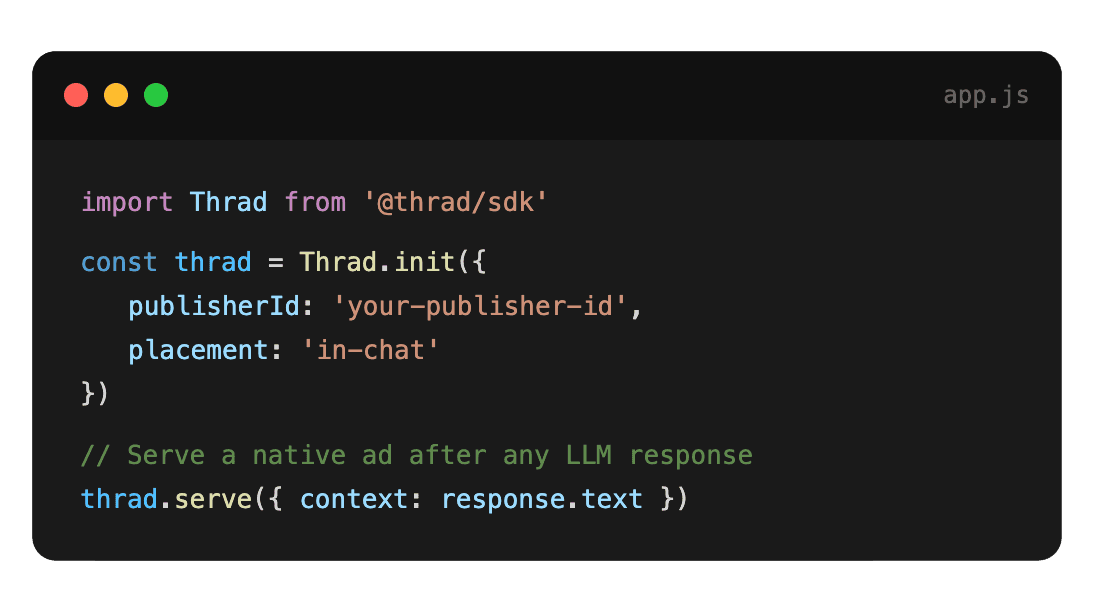
Start monetizing your AI app in under an hour
With Thrad, publishers go from first API call to live ads in less than 60 minutes. With fewer than 10 lines of code required, Thrad makes it easy to unlock revenue from your conversational traffic the same day.

AI Ad-Tech Stack Explained — 2026 Layers | Thrad
The AI ad-tech stack isn't one product. It's six layers that most teams
assemble from different vendors: data, foundation models, creative
generation, placement, measurement, and governance. Understanding the
layers separately is the prerequisite to buying and integrating them
sensibly in 2026.
The AI ad-tech stack is a shorthand that hides a real engineering
question: what, exactly, are the layers, and how do they fit together?
In 2026 the honest answer is six layers, with no single vendor
credibly covering all of them. A brand or agency that wants to run
AI advertising at scale has to understand each layer separately —
its function, its interface, its failure modes, its build-vs-buy
default — before it can make sensible vendor choices. This article
is the architectural reference: what each layer is, what it owns,
how it talks to the next layer, and what goes wrong at the seams.
What is the AI ad-tech stack?
The AI ad-tech stack is the layered technology architecture that takes
audience and brand data in at the bottom and produces measured,
compliant advertising across classical and generative surfaces at the
top. Each layer has a distinct function, a distinct set of vendors, and
distinct integration requirements. Treating the stack as one product
leads to the common mistake of over-indexing on whichever layer your
first vendor happens to emphasize. The stack is an architecture
problem, not a product category.
Unlike a marketing cloud, the AI ad-tech stack is rarely owned by one
vendor; unlike a programmatic pipeline, it crosses auction and
non-auction surfaces. Those two facts together explain why the stack
looks more like a distributed system than a classic martech suite.
Treating it that way — with interfaces, contracts, and identifiers at
every seam — is the difference between a deployment that scales and a
stack of point tools that stall.
What are the six layers from the bottom up?
The six layers, from the bottom up, are data, foundation models,
creative generation, placement, measurement, and governance. Each
handles a distinct function: ingestion and feature preparation at
Layer 1; raw model capability at Layer 2; brand-specific creative
synthesis at Layer 3; delivery across classical and generative
surfaces at Layer 4; attribution and lift measurement at Layer 5;
audit, disclosure, and policy enforcement as a cross-cutting layer.
None is optional in a mature deployment.
Layer 1: Data
Customer data, first-party behavioral data, third-party enrichment
where still permissible, product and catalog data, and brand reference
data (tone guides, approved claims, spokesperson voice). This layer
feeds both the model and the retrieval systems downstream. Clean,
well-governed data at the bottom is the single biggest determinant of
output quality at the top — Gartner's 2026 hype-cycle analysis
attributes roughly 60% of downstream creative-quality variance to data
quality at this layer.
Layer 2: Foundation models
The general-purpose LLMs and diffusion models — GPT-5, Claude, Gemini,
Llama, Midjourney, Sora, and their successors — that do the heavy
lifting. In 2026 this layer is close to commodity: multiple models are
good enough for most tasks, and the competitive value for advertisers
isn't choosing the model but building the prompt, retrieval, and
evaluation harness around it. Expect to run more than one model —
one for copy, one for image, one for video — and to switch per task
based on cost, latency, and quality benchmarks.
Layer 3: Creative generation
The layer that turns briefs into assets: copy, images, video, audio.
Ranges from general-purpose creative tools to brand-voice fine-tunes
to variant-and-localization engines. This is the most crowded layer
and the one with the fastest-moving feature set. Most brands run more
than one tool here — a general-purpose assistant for concepting and a
specialized engine for variant production. The layer's contract with
Layer 2 is the model API; its contract with Layer 4 is the creative
asset format plus a campaign/variant ID.
Layer 4: Placement
Where ads actually appear. Two sublayers in 2026:
Auction placement — DSPs, SSPs, retail-media networks, connected
TV platforms. The classical programmatic surface. Generative creative
feeds into this pipeline like any other asset.Generative-surface placement — sponsored and organic presence
inside ChatGPT, Perplexity, Copilot, Gemini, and their successors.
Not an auction in most cases — partnership deals, license terms, and
presence optimization.
The placement layer has the most diverse interface surface of any
layer in the stack. Auction placement uses OpenRTB; generative-surface
placement uses a mix of platform APIs, licensing agreements, and
emerging IAB drafts. Integrating both into one view is where most
stack projects stall.
Layer 5: Measurement
Attribution, incrementality, brand lift, and the new generative-surface
metrics: citation rate, share of generated voice, grounded attribution.
This is the integration point for the whole stack — if you can't
measure across auction and assistant surfaces on shared identifiers,
your stack is a set of parts, not a system. The measurement layer
consumes placement-layer events, generation-layer asset metadata, and
data-layer identities, and produces the numbers that determine
whether the program gets refunded.
Layer 6: Governance
Audit trails, disclosure, prompt logging, model-version pinning, human
review workflows, and regulatory mapping. Cross-cuts every other layer.
In 2023 this was paperwork; by 2026 it's load-bearing infrastructure
without which you can't ship responsibly in regulated markets. The
governance layer emits no ad; it constrains every other layer and
signs off before the placement layer goes live with any asset.
Layer | What it does | Interface to next layer | Representative vendor types |
|---|---|---|---|
Data | Ingest, clean, unify | Feature vectors, identity graphs | CDPs, data clean rooms, product feeds |
Foundation models | Generate raw output | Model API, fine-tune endpoints | OpenAI, Anthropic, Google, Meta |
Creative generation | Turn briefs into assets | Asset bundles + metadata | Brand creative tools, variant engines |
Placement | Put ads in front of people | Event streams, surface APIs | DSPs, generative-surface specialists |
Measurement | Attribute and measure | Aggregated KPIs, lift reports | MMM, MTA, citation monitors |
Governance | Audit, disclose, enforce | Audit logs, policy API | Brand-safety, compliance tools |
A stack is only as good as the seams. Ninety percent of AI ad-tech
problems in 2026 are integration problems — two vendors that don't
share an identifier, a measurement system blind to one surface, a
governance layer wired after deployment instead of inside it.
How do the layers integrate?
Three integration patterns matter in practice, and a mature 2026
deployment uses all three. Skipping any one is where the stack starts
to behave like parts rather than a system.
Pattern | What it solves | Where it lives |
|---|---|---|
Shared identifiers | Cross-layer reconciliation | Data + measurement |
API contracts | Inter-vendor interoperability | Every layer seam |
Governance hooks | Compliance across the stack | Cross-cutting |
Shared identifiers: a campaign, creative, and audience ID that
survives across layers so measurement can reconstruct the full
journey. When a variant generated in Layer 3 carries the same creative
ID when served in Layer 4 and when attributed in Layer 5, the stack
composes. When it doesn't, measurement becomes a matching problem
that scales badly.
API contracts: between generation and placement so a creative tool
can push variants directly into the DSP or generative-surface
partner; between placement and measurement so events arrive with the
fields the measurement layer needs. Informal contracts decay.
Explicit contracts, versioned like code, hold up under change.
Governance hooks: at every layer — generation logs, placement
disclosures, measurement audit trails — feeding a single compliance
system. Without the hooks, governance is a spreadsheet maintained
after incidents rather than infrastructure that prevents them.
What should teams build versus buy?
The build-vs-buy decision varies by layer. The 2026 Forrester reference
architecture recommends the following defaults, which match what
mature brand engineering teams actually do.
Layer | Build | Buy | Rationale |
|---|---|---|---|
Data | Own the identity graph | Buy CDP / clean room | Identity is brand-critical; pipes are commodity |
Foundation models | Never | Always | Training is out of scope for anyone not AI-native |
Creative generation | Fine-tune, prompt library | Buy generation tool | Tools evolve too fast to rebuild |
Placement | Integration glue | Buy DSP + AI ad network | Distribution deals are the moat |
Measurement | Dashboards, KPIs | Buy pipes, incrementality | Build interpretation, not plumbing |
Governance | Policy, review workflows | Buy audit-log and disclosure tools | Policy is brand-specific; tooling is generic |
The consistent pattern: buy infrastructure, build judgment.
Infrastructure becomes a commodity; judgment is where brand
differentiation lives. Teams that invert this — building commodity
plumbing and buying judgment as a black box — tend to end up with
high technical debt and low output quality.
What are the most common stack failure modes?
Four failure modes recur across 2026 stack deployments, per
Digiday's 2026 operations reporting:
Orphan IDs. A creative generated in Layer 3 arrives in Layer 4
without the ID Layer 5 needs; measurement can't reconstruct lift.Blind surfaces. Measurement configured for DSP-served inventory
but not for assistant citations; generative-surface ROI becomes
unprovable.Retrofit governance. Audit logs wired after a program is live;
the first incident produces a gap in the record that counsel can't
close.Vendor sprawl. Too many tools per layer; integration cost
exceeds the marginal value of each additional point solution.
Each failure mode is predictable and each is preventable with the
integration patterns above. Fixes cost 3–5x more after the fact than
before.
An AI ad-tech stack is a distributed system with marketing vendors
as the services. Treat it with the engineering discipline a
distributed system demands — contracts, identifiers, audit logs —
and it scales; treat it as procurement alone and it stalls at the
seams.
Common misconceptions
"The foundation model is the stack." No — the model is one
commodity layer. Everything above and below it is where advertisers
compete on quality and cost."An AI-native platform replaces the whole stack." No AI-native
platform credibly covers all six layers in 2026. They specialize."Measurement is a separate project from the stack." Measurement
is how the stack becomes a system. Separating it guarantees you won't
be able to prove generative surfaces are working."Governance is IT's problem." Marketing owns the output. Legal
owns the disclosure. IT owns the pipes. All three have to sign off or
governance gets bypassed by deadlines."One vendor per layer is enough." Usually two: a strategic
primary and a backup or specialist for edge cases.
What comes next
Three trends will shape the stack through 2026 and into 2027. First,
consolidation — expect the holding companies and the ad-tech majors to
acquire into the measurement and governance layers, where the gaps are
widest. Second, standards — IAB Tech Lab, WFA, and regional bodies will
release interoperability specifications that make cross-vendor
integration materially easier. Third, stack-as-code: the spec
documents, interface contracts, and integration tests that define
the stack will increasingly be stored in version control alongside
application code, with the same change management rigor.
The architectural endpoint is a stack that behaves more like a
distributed system than a bundle of SaaS subscriptions. Teams that
staff the stack with some engineering discipline — interface owners,
contract tests, change-review processes — graduate to the next
maturity tier; teams that treat it as procurement accumulate
integration debt until a refactor becomes unavoidable.
How do you get started?
Map what you already have. Write down every vendor you use, which of
the six layers they cover, and where the gaps are. Most brands discover
they're over-invested in one or two layers and blind in another two.
Then sketch the interfaces: what identifier flows where, which API
connects which layer, what audit field each emits. Two hours of
interface sketching saves six months of integration rework. Thrad fits
the placement and measurement layers specifically — helping brands
appear inside generative AI surfaces and track the results back
through the same pipeline as classical ad measurement, with the IDs
and audit hooks the rest of the stack expects.

ai advertising stack, ai martech stack, generative ad tech stack, llm advertising architecture
Citations:
LUMA Partners, "AI Ad-Tech Market Map Q1 2026," 2026. https://lumapartners.com
Gartner, "Hype Cycle for Digital Advertising 2026," 2026. https://gartner.com
IAB Tech Lab, "Generative AI in Advertising Standards v1," 2026. https://iabtechlab.com
Forrester, "The AI Marketing Stack Reference Architecture," 2025. https://forrester.com
eMarketer, "AI Marketing Infrastructure Spend," 2026. https://emarketer.com
Digiday, "How brands integrate the AI ad stack in practice," 2026. https://digiday.com
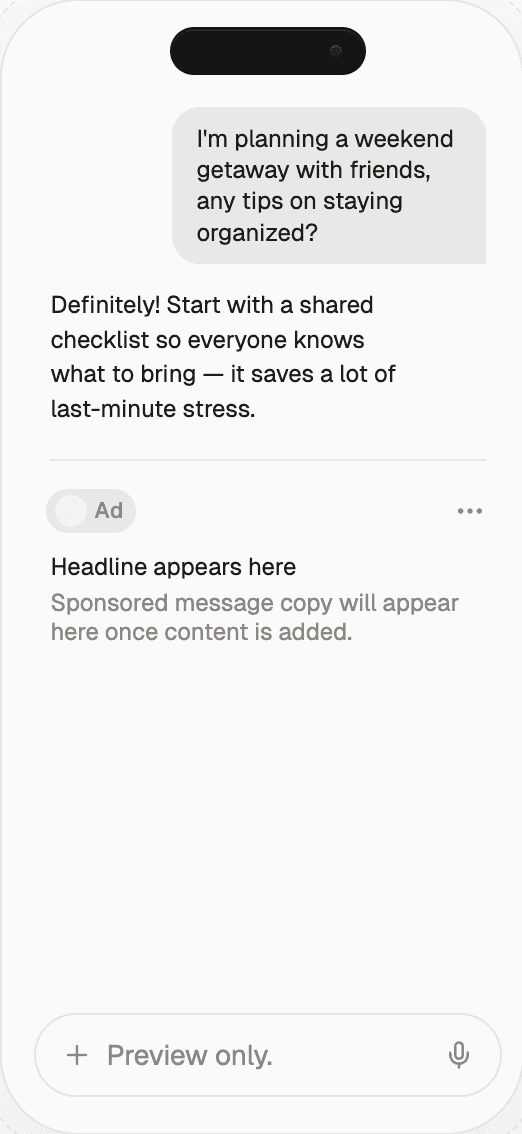
Be present when decisions are made
Traditional media captures attention.
Conversational media captures intent.
With Thrad, your brand reaches users in their deepest moments of research, evaluation, and purchase consideration — when influence matters most.
Date Published
Date Modified
Category
Advertising AI
Keyword
ai ad tech stack