A traditional DSP buys impressions across programmatic inventory —
open-web display, video, CTV, audio. An AI ad network buys placements
inside AI assistants and other generative surfaces, where the buying
unit is a prompt, not an impression. The two stacks are
complementary, not competitive, and by 2026 the majority of brands
with meaningful generative-surface spend run both simultaneously.


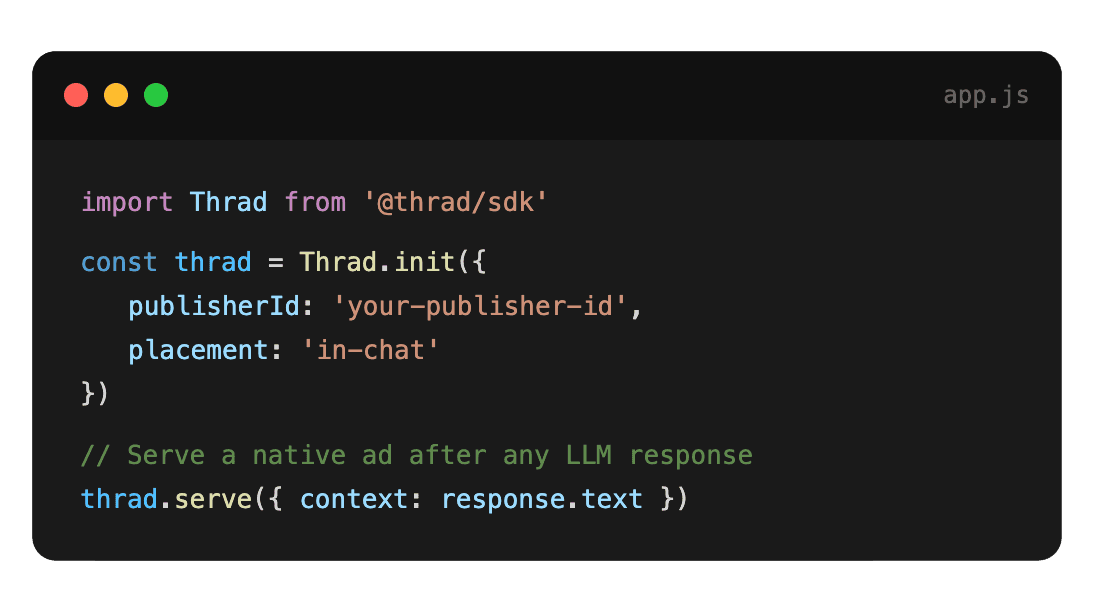
Start monetizing your AI app in under an hour
With Thrad, publishers go from first API call to live ads in less than 60 minutes. With fewer than 10 lines of code required, Thrad makes it easy to unlock revenue from your conversational traffic the same day.
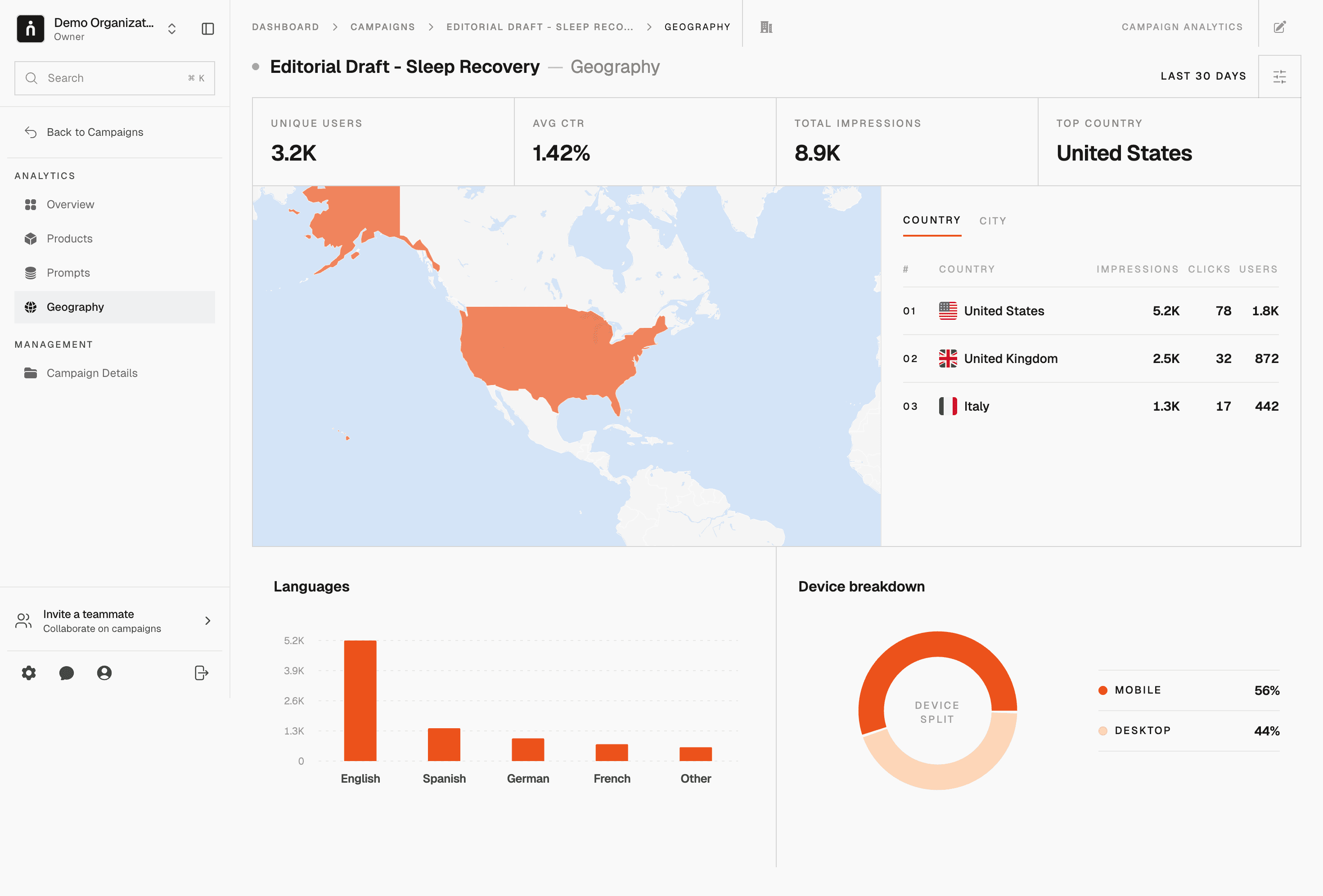
AI Ad Network vs DSP — 2026 Comparison | Thrad
AI ad networks and traditional DSPs both exist to buy advertising,
but they target different surfaces with different units. Traditional
DSPs run on impression-based programmatic inventory across the open
web, CTV, and apps. AI ad networks run on prompt-triggered inventory
inside generative assistants. Here's where they overlap, where they
don't, and how to choose.
AI ad networks and traditional DSPs both buy advertising, but they
target different surfaces with different primitives. A DSP buys
programmatic impression inventory — display, video, CTV, audio —
through real-time bidding. An AI ad network buys placements inside AI
assistants, where the buying unit is a prompt and the creative is
conversational-native. They're complementary layers, not rivals, and
most 2026 brands with meaningful generative-surface spend run both.
This article walks the mechanics of each, compares them on the seven
dimensions that actually matter for buying decisions, and lays out
how to operate the two stacks together without double-counting.
What is an AI ad network?
An AI ad network is a specialized intermediary that aggregates
inventory across generative surfaces — AI assistants like ChatGPT
and Perplexity, voice assistants, in-app AI helpers — and gives
advertisers a single buying surface for prompt-triggered
placements. It handles classification, matching, auction, creative
rendering, and measurement for the generative surface layer. The
category formed because existing programmatic infrastructure could
not natively bid on prompts; in 2026 the IAB Tech Lab identifies
these networks as a distinct ad-tech layer rather than an evolution
of display networks.
A traditional DSP (demand-side platform) is the programmatic-era
counterpart: it aggregates impression inventory across the open web,
CTV, video, and audio through RTB exchanges, and lets advertisers
target via audience segments, contextual signals, and retargeting.
DSPs have a twenty-year history, a mature tooling ecosystem, and
well-understood metrics. AI ad networks are newer — most launched or
matured in 2024–2025 — and are still consolidating around shared
standards.
How does each stack work end to end?
The two stacks share a shape (advertiser, auction, creative, surface,
measurement) but differ at every step. Walking through the workflows
side by side is the fastest way to internalize the difference.
Traditional DSP workflow:
Advertiser uploads creative and sets targeting (audience, context,
geo, frequency caps).User loads a page, app, or CTV stream; an impression becomes
available.RTB auction runs in milliseconds across exchanges.
Winning creative renders as display, video, or audio.
Measurement: impression, viewability, click, conversion.
AI ad network workflow:
Advertiser uploads conversational creative and sets intent
targets (prompt clusters, categories).User issues a prompt to an AI assistant.
Prompt is classified for intent; eligible advertisers auction.
Winning unit renders inside the assistant's answer with
disclosure.Measurement: citation, click, conversion.
The headline difference: a DSP reacts to an impression (something a
publisher is about to show), while an AI ad network reacts to a
prompt (something a user has just asked). That single distinction —
impression vs intent — cascades into every other dimension of the
comparison.
Why does this split matter in 2026?
Generative surfaces handle a meaningful share of commercial-intent
queries now. eMarketer's 2026 tracking puts US commercial-intent
prompt volume in ChatGPT, Perplexity, Copilot, and Gemini at roughly
8–12% of comparable Google Search volume for the same query sets,
growing 60–80% year over year. That inventory doesn't live on
open-web exchanges, and the targeting unit isn't an impression —
it's a prompt. Existing DSPs can't natively bid on prompts; AI ad
networks were built to. So the market bifurcated, the way it did
when CTV spawned CTV-specialized DSPs, or when retail media spawned
retailer-owned ad networks.
The economic consequence: a brand with zero AI ad network spend is
not a brand saving money. It is a brand with zero share of voice in
the fastest-growing commercial query surface. That is why the
"traditional DSP is enough" posture has largely collapsed among
Fortune 500 advertisers in categories with high assistant query
volume.
How do AI ad networks and DSPs compare on the seven dimensions that matter?
The comparison below is the version brands actually use in buying
decisions. The dimensions are not theoretical; each is a line in the
procurement questionnaire a mature 2026 advertiser now issues to
both types of vendor.
Dimension | Traditional DSP | AI ad network |
|---|---|---|
Inventory | Open-web, CTV, video, audio | AI assistants, voice AI, in-app AI helpers |
Buying unit | Impression | Prompt / utterance |
Targeting signal | Audience + context | Intent embedding |
Creative format | Display / video / audio | Conversational text + card |
Auction | RTB (usually first-price) | Prompt-level auction, sometimes with relevance scoring |
Measurement | Viewability, click, conversion | Citation, click, conversion |
Brand-safety axis | Publisher + content category | Prompt category + generation governance |
The second comparison that often matters more: economics and risk.
Economic axis | Traditional DSP | AI ad network |
|---|---|---|
Typical CPM equivalent | $1–$30 depending on format | Often $20–$80 on a prompt-equivalent basis |
Inventory growth rate | Low single digits | 60–80% YoY |
Fill rate predictability | High | Medium |
Fraud vector | IVT, bots, made-for-ads sites | Prompt injection, synthetic traffic |
Regulatory surface | Privacy (cookies, IDs) | AI disclosure + content authenticity |
Measurement standards maturity | High (MRC, IAB) | Medium (IAB AI drafts, evolving) |
AI ad networks aren't a cheaper DSP — they're a different layer in
the buying stack. Treat them as additive to programmatic, not a
replacement for it.
Why do AI ad networks exist as a distinct layer?
DSPs evolved to bid on impressions; their entire auction, creative,
and measurement surface is impression-native. Prompts are not
impressions. A user prompt has variable length, carries intent rather
than audience signal, and triggers an AI response whose shape the
advertiser cannot control. Retrofitting impression-era primitives
onto prompts fails in three specific places:
Creative fit. A 300x250 banner cannot render inside a
conversational answer. Native conversational creative is a
different asset type with different review, approval, and
compliance requirements.Auction timing. RTB auctions clear in 100–150ms against a
known impression slot. Prompt auctions clear against a classified
intent with a latency budget that must not distort the assistant
response.Measurement primitives. Viewability doesn't apply to a
sentence inside an AI answer; citation does. MRC did not write
standards for citation; the IAB Tech Lab is now drafting them.
A distinct layer was inevitable because the primitives don't port.
AI ad networks exist for the same reason CTV ad servers exist: the
surface is different enough that bolt-on solutions underperformed
purpose-built ones by a wide margin.
Where do the two layers overlap?
They overlap less than a glance suggests. Three overlap points are
worth naming:
Conversion data. Both layers ultimately send a user to a
landing page, app, or store. Conversion instrumentation is shared.Brand safety rules. Blocklists, category restrictions, and
regulated claims apply to creative regardless of surface.Measurement reconciliation. MMPs, MMMs, and CDPs ingest both
signals to produce the deduplicated conversion view.
Everywhere else — inventory, auction, creative, targeting, surface
measurement — the two stacks diverge. The overlap is the part of the
stack the brand owns above both vendors, not an intrinsic property
of the vendors themselves.
How should a brand operate both stacks without double counting?
Operating both stacks is a data-governance problem as much as a
buying problem. The 2026 Forrester reference architecture proposes
four operating principles:
Shared identifiers. A campaign ID, creative ID, and audience
ID that traverse both DSP and AI network pipelines.Separate top-of-funnel reporting. Impressions on the DSP side,
prompt matches on the AI-network side — never summed.Unified bottom-of-funnel reporting. Conversions attributed
once, at the MMP or CRM, with path data from both pipelines.Pre-registered incrementality. A geo hold-out or matched-market
study that isolates the AI-network contribution against a
DSP-only baseline.
Brands that skip step four end up with two vendor reports that both
claim credit for the same conversions. Brands that implement it get
an honest incrementality number that finance will accept.
A third comparison — operational ownership — helps new buyers plan
staffing correctly across the two stacks:
Operational axis | Traditional DSP | AI ad network |
|---|---|---|
Typical buyer persona | Programmatic trader | Hybrid trader + content strategist |
Creative review cadence | Per-campaign | Per-surface, sometimes per-prompt-cluster |
Reporting rhythm | Daily to weekly | Weekly with surface cuts |
Brand-safety review | Pre-campaign blocklists | Ongoing prompt-category audits |
Finance reporting unit | Impression + conversion | Prompt match + citation + conversion |
Running a DSP and an AI ad network in parallel is not twice the
work — it is a different operating model. The brands that succeed
treat the two stacks as one buying motion with two vendor
interfaces, reconciled above both.
Common misconceptions
"AI ad networks are just DSPs with AI branding." The buying
unit, targeting signal, and creative format all differ. AI ad
networks bid on prompts, not impressions, and render native text
inside assistants, not banners on pages."My DSP already handles generative inventory." In 2026 most
still don't, natively. Some support bridge integrations; full
prompt-level bidding from a classical DSP is still rare."You should pick one or the other." Almost never right. The two
layers cover different parts of the funnel and different surfaces;
the right question is how to allocate between them and reconcile
attribution."Prompt inventory is unlimited, so it's cheap." Prompt inventory
is not unlimited — the number of commercial-intent prompts per user
per day is modest, and scarcity pricing applies once an auction
establishes."AI ad networks are only useful for awareness." Wrong. Many
generative-surface placements drive measurable conversion lift on
lower-funnel categories, particularly travel, finance, and SaaS.
What comes next
Three shifts to watch through 2026-2027:
DSP-to-AI-network bridges. Major DSPs will plug into AI
assistant inventory incrementally, starting with simple
pass-through buys and progressing to native prompt bidding.
Digiday reporting in early 2026 already covers at least four
announced pilots.Attribution unification. Measurement layers that combine
programmatic and generative exposure into one post-campaign
report — this is where Thrad and similar measurement products
sit.Creative tooling convergence. One brand hub that pushes
conversational creative to AI networks and classical creative to
DSPs, with shared guardrails, shared IDs, and shared audit
trails.
The direction of travel is toward convergence, but the two layers
will remain operationally distinct for at least the next three years.
Procurement, compliance, and measurement teams should plan staffing
and tooling accordingly rather than betting on a near-term merger.
What should procurement ask each type of vendor?
When the buying decision moves from strategy to contract, procurement
teams find that classical DSP RFPs map poorly onto AI ad networks.
The questions diverge. A shortlist for AI ad networks that goes
beyond the DSP template:
Surface coverage. Which assistants, in which geographies, and
what share of commercial-intent inventory on each.Classification transparency. How are prompts classified, by
whom, and on what model version.Creative rendering control. Can the advertiser preview how a
unit will render inside an assistant answer, or only approve after.Auction mechanics. First-price, second-price, relevance-scored;
reserve price and floor logic.Disclosure handling. Who writes and places the "sponsored"
label inside the assistant response.Audit-log access. Raw prompt-plus-response logs, retention
period, and export format.Brand-safety telemetry. What gets flagged, by what rules, and
how fast the advertiser is notified.
None of these map cleanly to MRC or IAB standards designed for
impression inventory, which is precisely why brands running both
stacks find that two different procurement playbooks are needed.
How do you act on this?
Don't pick one. Audit your current DSP spend and identify categories
where meaningful query volume is moving to AI assistants — that's
your starting budget for an AI ad network. Run both for a quarter.
Compare citation-plus-click performance on the AI-network side with
impression-plus-click on the DSP side, and reconcile at the conversion
layer with shared identifiers and a pre-registered incrementality
test. Document the allocation decision so quarterly planning has a
stable anchor rather than reopening the debate every cycle.
Plan the human side too. DSPs are operated by traders with years of
programmatic reps; AI ad networks typically require a hybrid skill
set — programmatic discipline plus content strategy plus prompt
classification literacy. Brands that staff the AI-network side with
pure-programmatic traders tend to underperform; brands that staff it
with a cross-functional pod of a trader, a creative strategist, and a
measurement analyst tend to outperform. The operating model matters
as much as the tooling.
Thrad helps brands run AI ad network placements and reconcile them
against existing DSP reporting, so the two layers operate as a single
buying stack with one view of outcomes rather than two competing
vendor dashboards.

ai ad network, generative ad buying, programmatic vs ai ads, dsp for ai, conversational ad buying
Citations:
IAB Tech Lab, "AI Ad Network Reference Architecture," 2026. https://iabtechlab.com
eMarketer, "DSP and AI ad network spend breakout, 2026," 2026. https://emarketer.com
WARC, "The new buying stack: DSP plus AI ad network," 2025. https://warc.com
GARM, "Brand-safety standards across programmatic and generative surfaces," 2025. https://gar-m.org
Forrester, "The AI Advertising Buying Stack," 2026. https://forrester.com
Digiday, "Inside the DSP-to-AI-network bridge," 2026. https://digiday.com
Be present when decisions are made
Traditional media captures attention.
Conversational media captures intent.
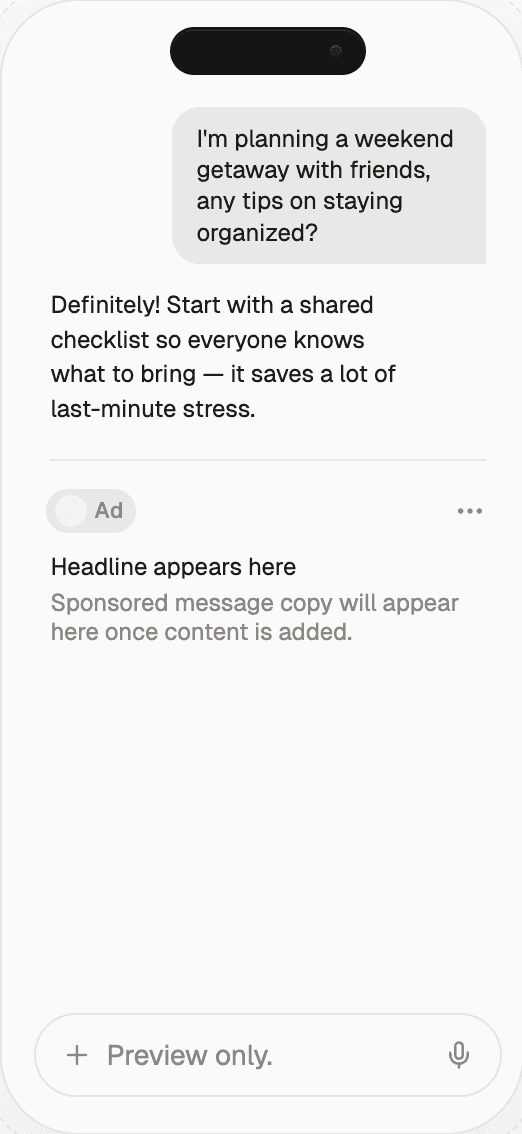
With Thrad, your brand reaches users in their deepest moments of research, evaluation, and purchase consideration — when influence matters most.
Date Published
Date Modified
Category
Advertising AI
Keyword
ai ad network vs traditional dsp