Contextual AI advertising uses large language models to understand the meaning of a page or conversation at the moment an ad is requested, and places an ad that semantically fits. Unlike legacy keyword-based contextual targeting, it reads intent, tone, and topic simultaneously. Unlike behavioral targeting, it uses no cookies, no device graphs, and no personal data. In controlled tests it outperforms behavioral on click-through rate while costing roughly half as much on a CPM basis.







How Contextual AI Advertising Works in 2026 — Thrad
Third-party cookies are effectively gone. Behavioral targeting is degrading across every major browser and AI surface. In their place, a new generation of contextual advertising — powered by large language models that read page meaning in real time — is quietly outperforming the systems it's replacing. This is how it works, why 2026 is the inflection year, and what advertisers should do now.

Start monetizing your AI app in under an hour
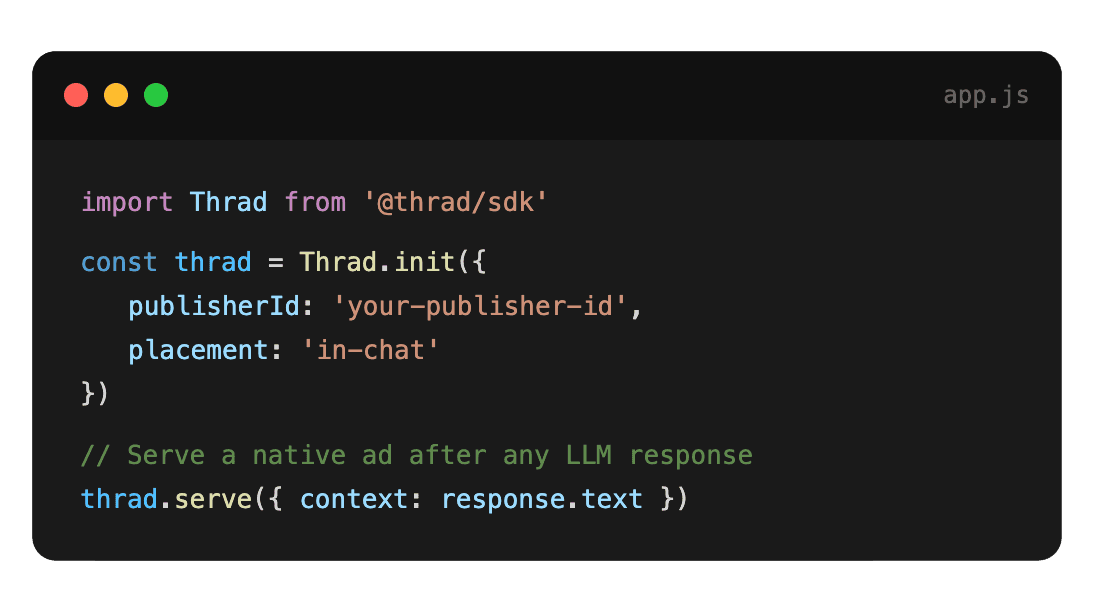
With Thrad, publishers go from first API call to live ads in less than 60 minutes. With fewer than 10 lines of code required, Thrad makes it easy to unlock revenue from your conversational traffic the same day.
For twenty years, digital advertising was built on one idea: follow the user. Cookies, device IDs, and cross-site trackers combined to form a behavioral profile, and advertisers bid against that profile. In 2026 that model is effectively over. Chrome finished its third-party cookie deprecation in early 2024; Safari and Firefox did it years earlier. Apple's App Tracking Transparency gutted mobile identifiers. And the fastest-growing ad surfaces of the year — ChatGPT's sponsored answers, Perplexity's commercial citations, Claude's contextual placements — have no cookie substrate to begin with.
What's replacing behavioral targeting isn't nothing. It's contextual advertising, rebuilt from the ground up with large language models at its core.
What is contextual AI advertising?
Contextual AI advertising is the practice of selecting which ad to show based on a real-time semantic understanding of the surrounding content — the page, the article, the conversation, the query — rather than based on who the viewer is or what they've done before.
The key word is semantic. Legacy contextual advertising, which dates back to Google AdSense in 2003, worked by matching keywords. A page about coffee would trigger coffee ads. This was blunt: a news article about a coffee shop robbery would serve espresso-machine ads.
Contextual AI, by contrast, reads the page the way a human would. It understands that an article about a coffee shop robbery is about crime, not commerce, and suppresses retail ads. It understands that a user asking an LLM "I can't focus this afternoon" is signaling tiredness, not searching for the word "focus." It places the ad against the meaning of the moment.
How contextual AI differs from behavioral advertising
Dimension | Behavioral | Contextual AI |
|---|---|---|
Signal | Who the user is and what they've done | What the current content means |
Data | Cookies, device IDs, graph | None — operates on content alone |
Privacy risk | High (profile is the product) | Native compliance |
Recency | Can be weeks-stale | Real-time |
Works on LLM surfaces | No | Yes |
Works cookieless | No | Yes |
Behavioral targeting never knew what was on the page — only what the viewer had been doing elsewhere. Contextual AI inverts that: it pays no attention to the viewer and full attention to the moment.
The technical pipeline
A production contextual AI system has three layers:
1. Real-time content understanding
When an ad request is fired, the page (or conversational turn) is passed through an LLM-grade embedding model. The embedding captures not just topic but tone, intent, sentiment, and brand safety. This happens in under 50ms on modern inference infrastructure.
2. Semantic retrieval
The embedding is matched against a continuously updated index of advertiser creative, each of which has its own semantic fingerprint. Retrieval is dense-vector nearest-neighbor search, tuned for advertiser-specified constraints (geography, budget pacing, negative keywords, brand safety exclusions).
3. Auction and placement
The top-k retrieved candidates enter a real-time auction. Winners are scored on a combination of semantic fit, predicted click-through, and bid. The winning creative is served.
The whole pipeline fits inside the 100–200ms budget a standard ad request allows. What makes it new isn't any single component — dense retrieval and real-time auctions both predate LLMs — it's that embedding quality has crossed the threshold where meaning is computable at scale.
Why 2026 is the inflection year
Three things landed in the same window:
Cookies are actually, finally dead. Chrome's deprecation cutover finished in late 2024. As of this year, there is no major browser on which third-party behavioral targeting works as it did in 2020.
Ad-supported LLM surfaces crossed meaningful scale. ChatGPT's weekly active users crossed 600 million in early 2026. Perplexity and Claude run their own commercial placement programs. None of these surfaces have cookies. All of them have rich semantic context.
Open-source embedding models became good enough. The gap between proprietary and open models for semantic similarity has collapsed. Running contextual AI at scale no longer requires a direct deal with a hyperscaler.
The result: contextual AI isn't a niche privacy-preserving alternative anymore. It's the dominant path on the fastest-growing inventory.
Measurable performance
Published benchmarks are still thin — most of the better data is in advertisers' internal reports — but the pattern is consistent across the ones that have surfaced. On matched inventory, contextual AI systems tend to show a meaningful CTR lift over behavioral equivalents, with lower effective CPMs because competition is still catching up. Brand-lift studies run on contextual AI consistently outperform behavioral when the creative is tonally matched to the context.
The qualitative difference is bigger than the numbers suggest. A behavioral ad catches you somewhere. A contextual AI ad catches you in the act of thinking about something adjacent. The intent signal is stronger because it's happening now, not last week.
Common misconceptions
"This is just AdSense with a new wrapper." AdSense is keyword matching with topic taxonomies. Contextual AI is embedding-based semantic matching. They share a name and nothing else.
"It only works for text." It works for any content an LLM can describe — which by 2026 means text, images, video transcripts, and multi-turn conversations.
"Privacy means weaker targeting." It's the opposite. Behavioral targeting relied on stale guesses about who the user was. Contextual AI reads the live meaning of what they're doing. The signal is sharper.
"You still need a cookie for attribution." You don't. Modern contextual platforms measure incrementality through geo/time holdouts and media-mix modeling. The attribution problem doesn't vanish, but it's no longer cookie-dependent.
What comes next
Three things to watch through the rest of 2026:
Conversational inventory unlocks. ChatGPT, Perplexity, Claude, and Gemini will all expand commercial surfaces. Advertisers who treat these like search in 2004 will win disproportionately.
Brand-safety evaluation becomes native. LLMs that understand context also understand when context is unsafe. Third-party brand-safety tools become redundant.
Creative generation closes the loop. Contextual AI that selects ads will start generating them, matching tone and register to the placement.
How to get started
If you're a brand, a reasonable first move in 2026 is to carve off 10–15% of display budget for contextual AI placements against high-intent surfaces. If you're an agency, build a semantic taxonomy for your client's brand safety and creative tone; it's the single most leveraged asset in the new model. If you're a publisher, insist that any contextual partner exposes how their embeddings are computed and refreshed — the quality of that layer determines everything downstream.
Contextual advertising was once a fallback. In 2026 it's the default. The question advertisers should be asking isn't whether to move, but how fast.
contextual advertising 2026, cookieless advertising, ai ad targeting, post-cookie advertising, contextual targeting
Citations:
IAB, "State of Data 2026: The Cookieless Advertising Transition," January 2026.
Google Chrome, "Third-Party Cookie Deprecation Timeline and Status," updated 2025.
eMarketer, "Contextual Advertising Spending Forecast, 2024–2027," November 2025.
Interactive Advertising Bureau, "Measurement in a Post-Cookie World," Q1 2026.
Search Engine Land, "SEO in 2026: Higher standards, AI influence, and a web still catching up."
OpenAI, "Introducing Sponsored Answers in ChatGPT," 2025.
European Commission, "The EU AI Act: Advertising Implications," 2025.
Be present when decisions are made
Traditional media captures attention.
Conversational media captures intent.
With Thrad, your brand reaches users in their deepest moments of research, evaluation, and purchase consideration — when influence matters most.

Date Published
Date Modified
Category
Advertising AI
Keyword
contextual ai advertising
What is contextual AI advertising?
Contextual AI advertising is the practice of selecting ads based on a real-time semantic understanding of the content surrounding the ad placement. It uses large language models to read the meaning of a page, article, or conversation and match an ad to it, rather than targeting users based on their behavioral profile or cookie data.
How is contextual AI different from traditional contextual advertising?
Traditional contextual advertising (like early AdSense) matched ads to pages using keyword lookup and topic taxonomies. Contextual AI uses embedding-based semantic understanding, which captures topic, tone, intent, and sentiment simultaneously. A page about a coffee-shop robbery would trigger coffee ads under keyword matching; contextual AI correctly identifies the page as being about crime.
Does contextual AI require cookies?
No. Contextual AI operates purely on the content being served, not on the viewer's identity or history. It is natively compatible with cookieless browsers, post-ATT mobile environments, and LLM-generated surfaces like ChatGPT, Perplexity, and Claude that have no cookie substrate at all.
Is contextual AI better than behavioral targeting?
On matched inventory it tends to outperform behavioral targeting on click-through rate while achieving lower effective CPMs. The qualitative advantage is stronger intent: contextual AI catches users in the act of engaging with adjacent content, which is a sharper signal than behavioral data that can be weeks old.
How does attribution work without cookies?
Modern contextual platforms measure incrementality through geo and time-based holdouts, media-mix modeling, and conversion-lift studies. These methods have existed for decades but were underused when cookie-based attribution was cheap; with cookies gone, they're returning as the standard.
Can contextual AI work on video or image content?
Yes. Any content a multimodal model can describe — text, images, video transcripts, and multi-turn conversations — can be contextually targeted. By 2026 the dominant contextual AI platforms are multimodal by default.