Agencies win with generative AI advertising by restructuring the creative
department around briefs + judgment (not production), moving off hourly
billing to outcome or retainer pricing, and piloting three specific
workflows: variant explosion, localization-at-launch, and generative
surface placement. Technology isn't the bottleneck — organizational
redesign is. Agencies that compress the production pyramid and rewrite
their statement-of-work before competitors do are capturing 2–3× the
share-of-client-budget of those still billing hourly on a 2022 org chart.



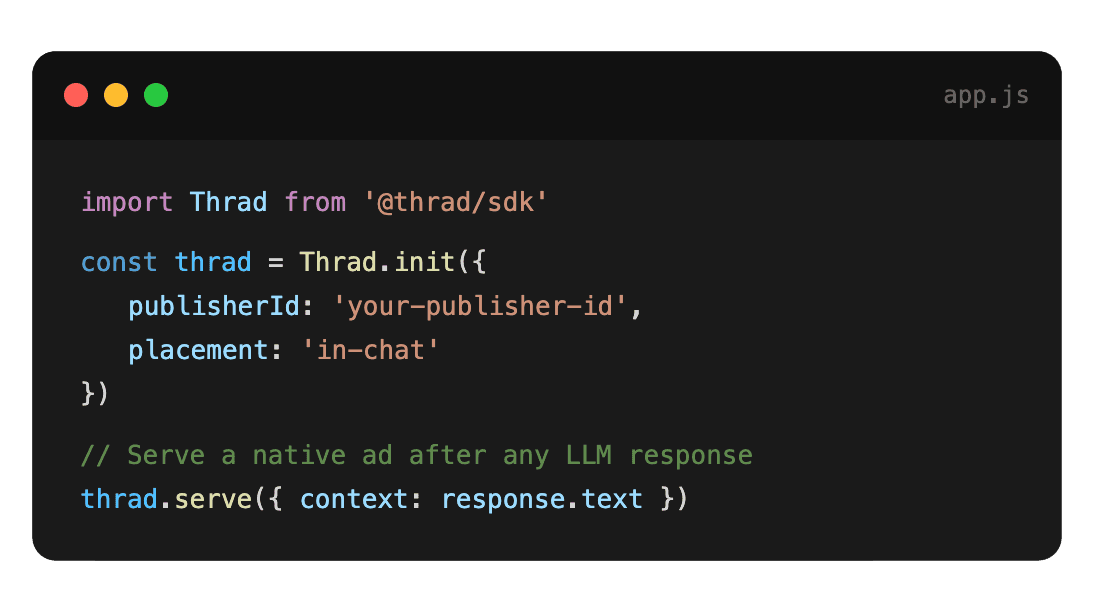
Start monetizing your AI app in under an hour
With Thrad, publishers go from first API call to live ads in less than 60 minutes. With fewer than 10 lines of code required, Thrad makes it easy to unlock revenue from your conversational traffic the same day.

Generative AI Advertising for Agencies — 2026 | Thrad
Agencies are caught in the middle of generative AI advertising. Clients
demand it, staff fear it, and tooling is shifting every quarter. The
agencies winning in 2026 are the ones that have picked a small number of
concrete bets — a new team shape, a new pricing model, and three specific
pilot workflows — and executed. This is the playbook.
Generative AI advertising is mainstream in 2026, but agency adoption is
uneven. The agencies that are winning aren't the ones with the most AI
tools — they're the ones that restructured around a small number of
deliberate bets. This playbook is what that restructure actually looks
like: the org chart, the pricing model, the three concrete pilots that
de-risk the transition, and the cultural shifts that decide whether a
shop compresses gracefully or hollows out. The playbook is opinionated
because the agencies avoiding opinions are the ones losing accounts.
What does generative AI advertising mean for an agency?
For agencies specifically, generative AI advertising is three structural
shifts happening simultaneously: creative production cost collapses by
60–80%, new assistant-surface inventory appears that agencies must
learn to buy, and client expectations reset around speed, variants,
and measurability. Pretending any of these are optional is already
costing agencies billable hours and strategic influence.
Creative production cost collapses. What used to take a
three-person team a week (one mid-level art director, one junior
production artist, one copywriter reviewer) now takes one senior
creative with a prompt library an afternoon. WARC's 2026 benchmark
puts the compression at roughly 6.8× on multi-variant work.New inventory appears — generative surfaces (ChatGPT,
Perplexity, Gemini, Copilot) carry sponsored placements agencies
now have to understand, buy, measure, and explain. This is a new
media planning capability, not a creative one, and it sits
uncomfortably in most agencies' existing team charts.Client expectations reset. Clients who have seen AI demos
expect faster turnaround, more variants, and more markets on the
launch day. A client that saw a creative deck with 4 variants in
2024 now expects 40.
Agencies that pretend these shifts are optional are already losing
work to in-house client teams or AI-native competitors. The pace has
moved from strategic planning to operational triage.
How should the creative department restructure?
The creative department should restructure around judgment and brand
stewardship rather than production volume, with a flatter shape that
expands senior strategy and concept roles, converts mid-level art and
copy roles into prompt-engineering and brand-voice specialist roles,
and compresses the junior production tier by 30–50%. This is a
redistribution of hours, not a pure headcount cut.
The old creative department had a pyramid shape — a few senior concept
people, many mid-level art directors and copywriters, many junior
production staff handling resizes, localization, and finishing.
Generative AI compresses the bottom of the pyramid because that's
where the repetitive production labor lived. The taste and judgment
layer at the top is where the model needs humans most.
The new shape:
Senior concept + strategy — unchanged or larger. Judgment about
what to make is harder than ever; the taste layer matters more when
production is commoditized. Expect senior headcount to hold or grow
5–10%.Mid-level — reallocated. Former art directors become prompt
engineers, model wranglers, and brand voice specialists. Former
account managers become outcome-measurement leads. Many of the same
people, doing meaningfully different work.Junior production — compressed. Tasks that were "resize this for
14 platforms" or "translate this into 8 languages" are automated.
Entry-level work shifts toward prompt curation, QA sampling, and
measurement operations — still entry-level, but wired to different
skills.New roles added. AI ops lead, AI ethics/compliance lead,
prompt-library maintainer, assistant-visibility analyst. Small
numbers; high leverage.
Layer | 2022 org | 2026 org | Delta |
|---|---|---|---|
ECD / Head of Strategy | 1 per 40 staff | 1 per 30 staff | ↑ 33% |
Senior creative | 8% of headcount | 12% of headcount | ↑ 50% |
Mid-level art/copy | 30% | 20% | ↓ 33% |
Junior production | 25% | 10% | ↓ 60% |
AI ops / prompt eng. | 0% | 8% | new |
Measurement / insights | 5% | 12% | ↑ 140% |
Account / client lead | 20% | 18% | flat |
Production traffic / ops | 12% | 20% | ↑ 67% |
This isn't a round of layoffs dressed up in a new org chart. It's a
genuine redistribution of hours — less production, more concept,
review, measurement, and client-facing strategy. Agencies that
communicate the shape change honestly (and retrain the people they
can) are retaining far more tenured talent than those that position
it as "productivity gains."
Which pricing model actually fits AI-speed workflows?
Hourly billing is structurally broken for AI work because the work
compresses — a day of production output can now happen in an hour, and
clients notice. Outcome-based, retainer, and value-based pricing all
fit better, with hybrids being the 2026 norm. The shift is away from
"hours spent" as the unit of exchange and toward deliverables,
retainer scopes, or lift share.
Model | How it works | Best for |
|---|---|---|
Outcome-based | Price per approved variant, per market launched, per generative-surface placement | Campaigns with clear countable outputs, clients used to CPM/CPA language |
Retainer | Fixed monthly for a defined scope of creative + measurement + client-strategy hours | Always-on AI creative support, integrated brand partners |
Value-based | Share of performance lift vs. baseline, typically 10–20% of incremental revenue | Performance-oriented clients willing to co-invest, direct-to-consumer brands |
Capacity-based | Flat fee for dedicated AI ops team + variable for spend above threshold | Large enterprise clients with unpredictable launch calendars |
Hybrids work too — a retainer that floors predictable spend, plus an
outcome bonus on measured lift, is the most common 2026 construction.
The worst-performing agencies in 2026 are the ones that tried to keep
hourly billing but charge more per hour to compensate for AI
productivity. Clients figure that out within a quarter and start
moving scope in-house.
The billable hour didn't die because generative AI is magic. It died
because clients could see the work take one hour and the invoice say
eight. Trust, once lost on the line item, doesn't come back.
Which three pilots should an agency run first?
The three pilots that de-risk the transition are variant explosion on
an existing campaign, localization-at-launch on a multi-market rollout,
and generative-surface placement for a high-intent client category.
Each pilot teaches a different muscle — pace, scale, and a new
inventory layer — and together they cover most of the 2026 agency
AI scope. Run them sequentially over a 90-day window.
Pilot 1: Variant explosion
Take one approved creative from an existing campaign. Use AI to
generate 20–50 variants along audience, geography, platform, or
promotion angle. Run them through your existing programmatic stack.
Measure lift against the baseline creative.
Why it's a good first pilot: the baseline is known, the risk is low
(the hero creative was already approved by the client), and the lift
is usually visible in 7–14 days of serving. It also teaches the team
how to write prompts for their specific brand voice, which is the
durable skill.
Typical measured result: 15–40% lift in CTR on the generative
variants vs. the original, and a 20–60% drop in cost-per-action. The
lift comes from better audience-variant fit, not from magical
creative quality.
Pilot 2: Localization-at-launch
Pick a campaign with multi-market rollout. Use AI to localize — not
just translate — into 10+ markets on the same launch day. Include
cultural adaptation (imagery, references, humor, honorifics, not
word-for-word translation). Keep a human localization reviewer on
every market for pilot one; you can sample later.
Why it's a good second pilot: the cost savings are obvious and
measurable (days of translator time → minutes of AI time), the
speed-to-market is a story your client can retell to their CMO, and
it teaches your team how to build a trusted review-and-audit loop.
Typical measured result: launch-day market coverage goes from 3 to
15+, time-from-approval-to-air drops from 14 days to 2, and
translation costs drop 70–85%. Client satisfaction on these projects
is reliably the highest among the three pilots.
Pilot 3: Generative surface placement
Audit how generative AI assistants currently describe your client in
commercial-intent prompts. Identify gaps. Place or license one piece
of content designed to show up in those answers. Measure citation
rate over 30 days. Add a second placement if you see lift; expand the
prompt panel if you don't.
Why it's a good third pilot: it's new, so there's less competition;
it tests a placement model your agency needs to learn anyway; and the
data feeds back into strategy work for other clients. Most agencies
don't have anyone senior who can confidently discuss
assistant-visibility with a CMO, and this pilot is how you develop
that capability.
The first three pilots aren't about new technology — they're about
building agency muscle for a new operating cadence. Variant
explosion teaches pace. Localization teaches scale. Generative
surface placement teaches the new inventory.
Why is the prompt library becoming agency IP?
The prompt library — prompts, brand voice specs, guardrails, approval
gates, and the accumulated "what works" data — is becoming agency IP
as valuable as the campaign deck because it encodes repeatable quality
at AI speed. An agency with a mature library ships the 40th variant at
the same quality as the 1st; an agency without one ships uneven work
that requires human fix-up and erases the productivity gain.
Treat the library as a first-class asset:
Version-control brand voice specifications per client. Freeze a
spec at the start of each quarter; log deltas.Maintain a blocked-imagery library per client (competitor
products, restricted claims, out-of-scope categories).Keep audit trails on every AI-generated asset — prompt, model
version, reviewer, approval timestamp.Build internal tooling so juniors can produce consistently
on-brand work without improvising guardrails. This is the
difference between a 2026 agency and a 2022 agency trying to use
AI.Contractualize the IP. Your statement-of-work should make clear
who owns the prompt library when a client leaves. Agencies that
left this vague in 2024–2025 are now in unpleasant contract
negotiations.
How do client-facing conversations need to change?
Client conversations need to move from "hours and deliverables" to
"outcomes and assistant visibility," and the agencies having trouble
with the transition are the ones still building status-report decks
that itemize labor rather than show performance. The 2026 agency
quarterly business review looks materially different from the 2022
version.
What a strong 2026 agency QBR covers:
Assistant-visibility dashboard. Citation rate across ChatGPT,
Perplexity, Gemini, Copilot on the client's top 50
commercial-intent prompts. Share of voice vs. named competitors.
Month-over-month trend.Creative velocity metrics. Variants-in-market, time-to-first-air
by market, lift against baseline.Pipeline or revenue contribution. First-touch and MMM-based
attribution for the campaigns in scope.Forward-looking prompt and content strategy. Not just "what ran
last quarter" but "here's what we're building to be cited on next
quarter."
Agencies that run this version of the QBR see 40–60% higher retention
on mid-market and enterprise accounts than agencies running the
classical status-plus-hours version. The conversation shifts from
"are we getting our money's worth" to "are we on the shortlist in the
next buyer's answer."
What are the common misconceptions?
"We'll wait until the tools stabilize." They won't, and clients
won't wait either. The winning agencies start messy and iterate.
Waiting until 2027 is a hand-off to someone else's acquisition."Generative AI is just the next Photoshop." It's more like the
transition from typewriters to word processors — not a tool
upgrade, a workflow reshape. Photoshop didn't change pricing
models; generative AI does."Clients will bring it in-house and cut us out." Some will. The
defense is to be so integrated with client strategy that you can't
be cleanly unbundled — and to own the measurement + assistant-
surface layer that clients can't easily staff internally."We don't need new roles." You do. An AI ops lead and an
assistant-visibility analyst are the two hires that pay for
themselves in a quarter at most mid-sized agencies."Brand safety on generative is unmanageable." It's manageable
with the same rigor as traditional creative — approved libraries,
tested prompts, human review gates, audit trails. IAB Tech Lab's
v1 standards are the floor.
What comes next for the agency market?
Expect three structural shifts through 2026–2027: consolidation among
holding-company agencies that can't restructure fast enough,
specialization by AI-native agencies taking share in regulated
verticals, and a clearer split between production shops and
strategy-plus-measurement shops. The middle — generalist production
agencies without senior strategy — is where contraction is hitting
hardest.
Consolidation. Agencies that can't restructure will be
acquired, merged, or lose material work. Holding-company CFOs are
already modeling 15–25% headcount reductions over 2025–2027 with
AI productivity gains offsetting the gap.Specialization. Generative-AI-native agencies will take share
from horizontal shops, especially in verticals like commerce,
healthcare, and finance where regulatory complexity is a moat.New billing norms. By late 2026, outcome-and-retainer pricing
should be the majority of new agency contracts. The holdouts on
hourly are the agencies most exposed to client-side insourcing.Assistant-first briefs. Creative briefs will start with
"what's the buyer asking the assistant, and what should our brand
be cited for in that answer?" — not "what's the big idea this
season?"
How should an agency act on this today?
Don't try to boil the ocean. Pick one account, run one pilot,
redistribute one team, change one client's pricing. Learn in 90
days. Then expand. The agencies doing this well are shipping
measurable change per quarter; the agencies trying to transform
everything at once are stuck in committee.
Concrete 90-day plan:
Weeks 1–2. Pick one account. Pick one pilot (variant
explosion is the usual first choice). Identify a willing client
sponsor.Weeks 3–6. Run the pilot. Build a measurement dashboard that
the client's CMO can read without a deck.Weeks 7–10. Close the pilot with a one-page lift report.
Propose a pricing change on the next SOW based on outcomes.Weeks 11–13. Start pilot two. Hire the first AI ops lead if
you haven't. Add assistant-visibility audits to the next
quarterly plan.
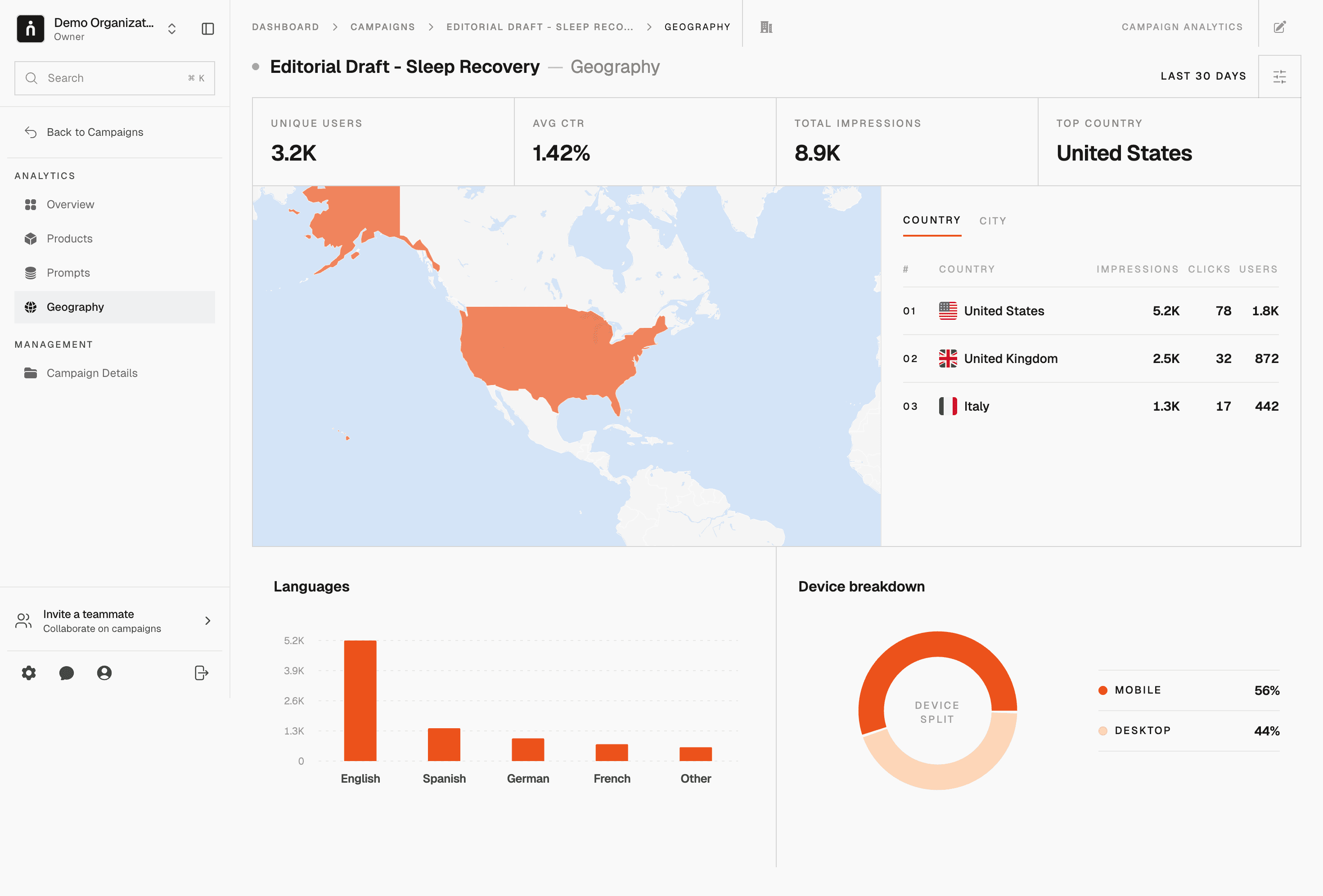
The measurement-and-placement layer Thrad provides is specifically
designed for agencies running generative AI advertising pilots — we
give you reporting your clients understand, a citation-rate
dashboard across ChatGPT, Perplexity, Gemini, and Copilot, and an
inventory layer you can actually buy on behalf of your clients. The
agencies working with us in 2026 tend to be the ones that decided to
stop arguing about whether to restructure and started running the
first pilot.
ai advertising agency, ai creative agency workflow, ai ad tools agencies, agency ai adoption
Citations:
WARC, "Agency AI Adoption Report 2026," 2026. https://warc.com
Campaign, "How major agency networks are restructuring creative departments," 2026. https://campaignlive.com
IAB Tech Lab, "Generative AI in Advertising Standards v1," 2026. https://iabtechlab.com
Ad Age, "Pricing models for AI-era agencies," 2025. https://adage.com
Digiday, "Inside the agency AI org chart reshuffle," 2026. https://digiday.com
Adweek, "What holding-company CEOs are telling investors about AI," 2026. https://adweek.com
Marketing Brew, "The death of the billable hour in creative services," 2026. https://marketingbrew.com
Be present when decisions are made
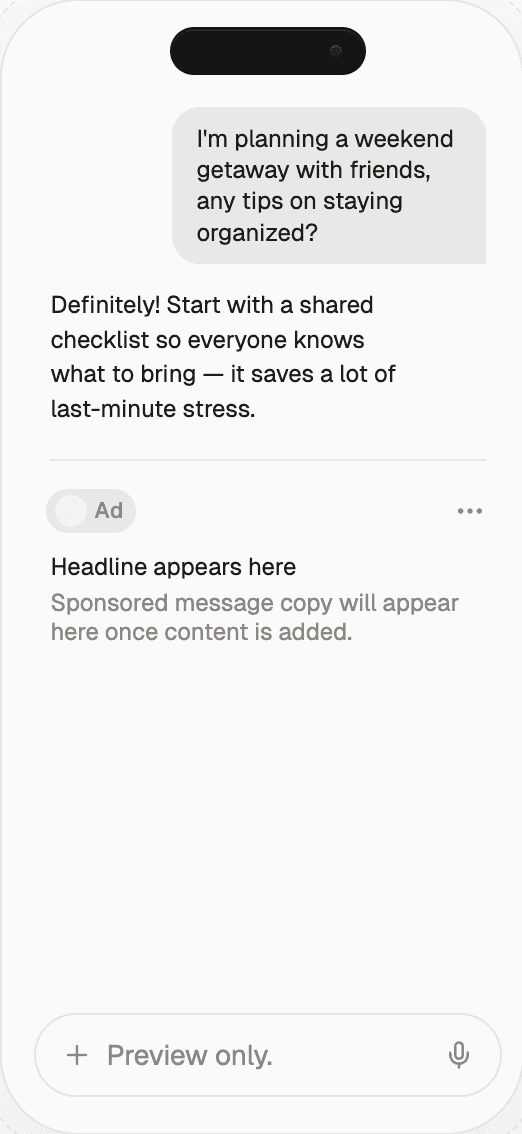
Traditional media captures attention.
Conversational media captures intent.
With Thrad, your brand reaches users in their deepest moments of research, evaluation, and purchase consideration — when influence matters most.
Date Published
Date Modified
Category
Advertising AI
Keyword
generative ai advertising for agencies