The AI ad-tech landscape in 2026 is structured around four sub-layers:
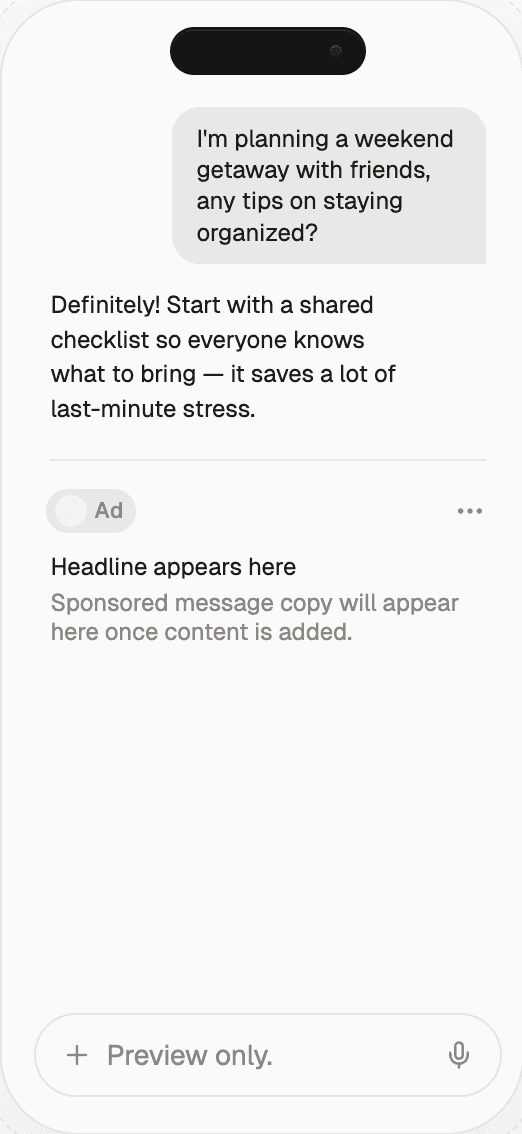
creative generation, placement inside generative surfaces (ChatGPT,
Perplexity, Copilot, Gemini), measurement and attribution, and brand
safety. Creative-gen is the most crowded and has taken roughly $3B in
cumulative venture funding; placement is the most strategically
important; measurement and brand safety are under-built and are where
the 2026–2027 acquisition wave will land.




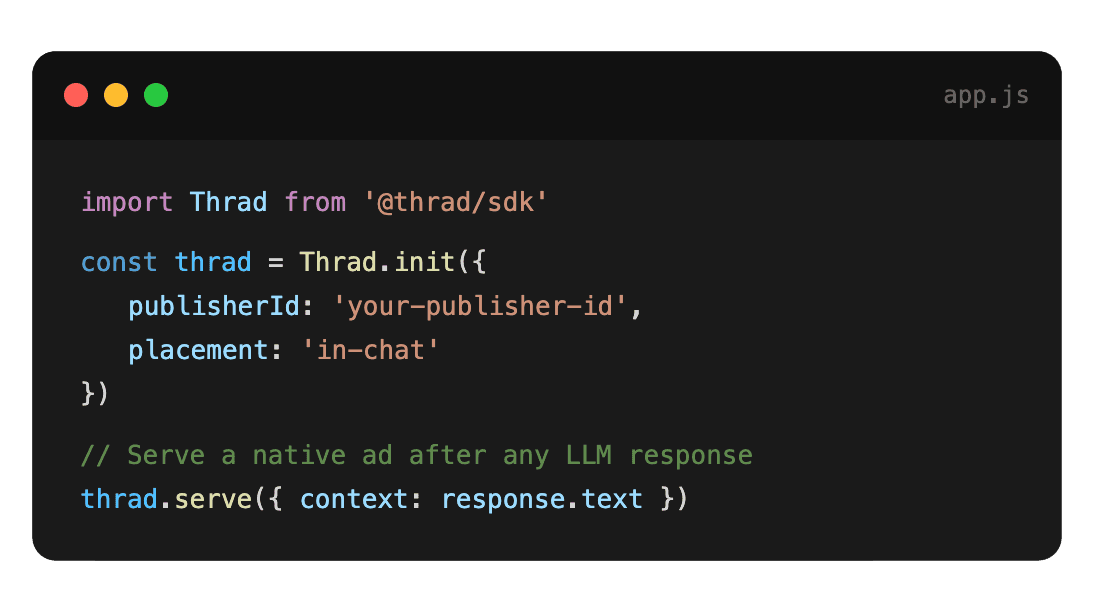
Start monetizing your AI app in under an hour
With Thrad, publishers go from first API call to live ads in less than 60 minutes. With fewer than 10 lines of code required, Thrad makes it easy to unlock revenue from your conversational traffic the same day.

AI Ad-Tech Landscape 2026 — Category Map | Thrad
AI ad-tech went from a few dozen startups in 2023 to a crowded category
with four distinct sub-layers in 2026. The money has flowed to creative
generation and generative surface placement; the underbuilt layers —
measurement and brand safety — are where the next round of acquisitions
will come from. This is the 2026 map.
The AI ad-tech category went from a thin layer of experiments in 2023 to
a crowded industry with four distinct sub-layers in 2026. LUMA Partners'
Q1 2026 market map counts 240+ logos across the category, up from
roughly 30 in 2023. If you're a brand deciding where to deploy budget,
or a strategist trying to make sense of the acquisition announcements,
this is the map — with the structural dynamics, the funding flows, and
the likely consolidation paths that will reshape the terrain through
2027.
What is AI ad-tech?
AI ad-tech is the technology stack for advertising in a world where AI
models are in the creative loop, the placement loop, and increasingly the
measurement loop. It's adjacent to traditional ad-tech — you can think of
it as the generative-era overlay on top of the DSP/SSP/DMP stack, with
some net-new categories (generative surface placement, AI brand safety)
that didn't exist pre-2023. The category is defined as much by the new
surfaces (AI assistants) as by the new tools (generation, classification),
because it is the surface change that is driving the budget shift.
Unlike classical ad-tech, which organized around a small number of
standard primitives (impression, click, conversion), AI ad-tech lives
with a wider set of primitives because different surfaces reward
different units. A citation inside a ChatGPT answer, a sponsored
Perplexity source, a Gemini card, a DSP-served generative video — each
is a real inventory type with its own buying, creative, and measurement
logic. The landscape below maps the vendors and categories that emerged
to address those differences.
What are the four sub-layers of the 2026 AI ad-tech stack?
The four sub-layers are creative generation, generative surface
placement, measurement and attribution, and brand safety and
compliance. Together they form the category map that buyers, investors,
and consolidators use to orient. Each layer has distinct maturity,
funding intensity, and strategic value — and none is optional for a
brand running meaningful AI advertising.
Layer 1: Creative generation
The most mature and most crowded layer. Platforms that generate ad
creative — copy, images, video — from briefs. Sub-categories:
General-purpose (integrated with GPT-5, Claude, Gemini, Midjourney,
Sora): used by in-house creative teams and agencies.Brand-voice specialists: fine-tune models on a single brand's voice
and visual library.Variant + localization engines: take one approved creative and
explode it into hundreds of variants across audiences and markets.
Dozens of vendors. Adweek's 2026 analysis places cumulative venture
funding in creative-gen at $3B+, with roughly 120 active logos. The
category will consolidate — the winners will be those with deep
enterprise sales motions and brand-voice IP, not those with slightly
better pixel quality. Model capability is now roughly a commodity above
a baseline; differentiation is in workflow integration, spec management,
and enterprise readiness.
Layer 2: Generative surface placement
The fastest-growing layer. Platforms and services that help brands appear
inside generative AI assistants (ChatGPT, Perplexity, Copilot, Gemini)
through paid placements, licensed content, or organic presence
optimization. Sub-categories:
Paid placement buyers: manage spend on ChatGPT sponsored search,
Perplexity ads, Gemini sponsored cards.Licensed content managers: negotiate and operate publisher-style
licensing deals between brands and AI platforms.Presence optimization: audit and improve how a brand is described
across generative surfaces (the GEO layer).
Still small by absolute revenue — eMarketer's 2026 forecast puts
category spend in the low single-digit billions globally — but
strategically the highest-ground layer. Platform deals and distribution
partnerships matter more than product features here. The vendors with
multi-year licensing arrangements with OpenAI, Google, and Perplexity
carry moats the pure-software players can't replicate.
Layer 3: Measurement and attribution
The most underbuilt layer. Classical attribution (last-click, multi-touch)
doesn't capture being cited inside a generative answer, or being mentioned
in a ChatGPT response that a user never clicked. New metrics are emerging:
Citation rate: how often does your brand get named in generative
answers to category queries?Share of generated voice: what percentage of generative answers in
your category mention you versus competitors?Grounded attribution: attribution models that include generative-
surface exposure as a channel.
Few platforms do this well as of 2026. Forrester's 2026 Wave finds fewer
than 15 vendors offering native generative-surface measurement at
production scale. The ones that do will be acquisition targets; The
Information has reported active discussions involving at least three
measurement specialists and the top-five holding companies.
Layer 4: Brand safety and compliance
The second most underbuilt layer. Generative creative introduces new
brand-safety vectors that publisher-level filters don't solve:
Generation-time safety: enforcing brand guardrails during creative
generation (what can the model say on our behalf?).Synthetic media disclosure: meeting IAB Tech Lab and regional
regulatory standards for disclosing AI-generated content.Audit trails: keeping evidence of every prompt, model version, and
human review for each shipped creative.Model drift monitoring: detecting when a fine-tuned brand voice
model starts producing off-spec output.
Layer | Maturity | Crowding | Strategic value | Representative 2026 vendors |
|---|---|---|---|---|
Creative generation | High | Very crowded | Medium | 120+ logos across general, brand-voice, variant |
Generative surface placement | Growing | Moderate | Very high | Specialists with assistant distribution deals |
Measurement & attribution | Low | Thin | High (and rising) | ~15 native generative-surface measurement tools |
Brand safety & compliance | Low | Thin | High | Governance suites, watermarking, audit-log stores |
The layer you pick tells you what business you're in. Creative-gen is a
workflow business. Surface placement is a distribution business.
Measurement is an intelligence business. Brand safety is a risk
business. They feel adjacent; the economics aren't.
Where did the money flow in 2024–2025?
Creative generation attracted the most venture funding — $3B+ cumulative
across the sub-category by Q1 2026 per Adweek tracking. Generative
surface placement is smaller by funding but larger by strategic value;
most of the activity here is partnership deals and holding-company
acquisitions rather than straight equity rounds, because the moat is a
distribution deal, not a product. Measurement and brand safety are
starved for funding relative to their strategic importance, which is
precisely why the consolidation play through 2027 will likely target
them — large buyers need the capability, the capability is
under-capitalized, and the price to acquire has stayed reasonable.
Funding axis | Creative-gen | Placement | Measurement | Brand safety |
|---|---|---|---|---|
Cumulative VC $ (est.) | $3B+ | $800M–$1.2B | $300–$500M | $200–$350M |
Active logos (Q1 2026) | 120+ | 40+ | 15–25 | 30+ |
Typical Series A size | $15–$30M | $20–$50M | $8–$15M | $6–$12M |
Acquisition intensity | Rising | Very high | Rising fast | Rising |
How should brands read the market map in 2026?
Three practical guidelines:
Creative generation: pick a platform that plugs into your existing
creative workflow, not one that replaces it. Integration matters more
than raw model quality at this point. Budget 5–15% of creative
operations spend for tooling.Generative surface placement: don't build in-house. Partner with a
specialist with platform deals — the value is the distribution access,
which you can't replicate. Expect to allocate 3–8% of digital media
spend to this layer in 2026, growing.Measurement and brand safety: treat them as non-optional infra.
Any creative you generate or any placement you buy is only as good as
your ability to measure its impact and audit what was said on your
behalf. Budget accordingly — typically 10–20% of the AI ad-tech
program cost goes to these two layers combined.
Brands that skip measurement and brand safety invariably pay for them
later in incident response and finance review, usually at 3–5x the
cost of building them in from the start.
The underbuilt layers are not underbuilt because they're hard.
They're underbuilt because they don't ship headlines. Category maps
reward flashy; audits reward boring. The 2026 acquisition wave will
transfer capital from the first to the second.
A third table — vendor moats and where they come from — helps put
the consolidation thesis in concrete terms:
Layer | Dominant moat source | Where it's thin in 2026 |
|---|---|---|
Creative generation | Brand-voice IP, enterprise workflow | Pure model quality, which is commoditizing |
Generative surface placement | Platform distribution deals | Standalone software without distribution |
Measurement & attribution | Methodology + surface coverage | Point tools without cross-surface reach |
Brand safety & compliance | Standards alignment, audit depth | Marketing-only tooling lacking governance |
Common misconceptions
"AI ad-tech is just ad-tech with AI bolted on." Wrong — generative
surfaces and generation-time brand safety are genuinely new categories
with no traditional counterpart."Pick one vendor across all four layers." No one does all four
credibly in 2026. Pick best-of-breed per layer and plan for them to
integrate via APIs and standards."The holding companies have this handled." They're building but
also buying. Expect 10+ meaningful acquisitions in AI ad-tech through
2027, including at least one $1B+ deal in placement or measurement."Generative surface placement is just SEO." It shares a shape with
SEO (earned presence) but adds paid inventory, licensing, and
intent-based ad units that SEO never had."Brand safety is a commodity." It was becoming one until
generative creative reintroduced generation-time risk. Guardrails
that run at generation time are new capability, not a rehash.
What comes next
Watch for six signals through late 2026 and into 2027:
The first $1B+ pure-play AI ad-tech acquisition, most likely in the
placement or measurement layer.Standards-body rulings on synthetic media disclosure that raise the
compliance bar — IAB Tech Lab's v1 is already published; regional
regulators will harmonize around or diverge from it.The first AI-native agency to win a Fortune 100 AOR pitch.
Consolidation of the variant-engine sub-category of creative-gen;
expect 30–50% logo attrition.A measurement standard equivalent to MRC viewability, but for
generative-surface citation and presence.At least two holding companies announcing an integrated AI
ad-tech stack offering to clients, combining 2–3 acquisitions.
Taken together, these signals mark the transition from a fragmented
land-grab to a structured category with named winners per layer.
Brands that currently operate one or two layers will need plans for
all four by 2027.
How does the AI ad-tech landscape compare to previous category waves?
The dynamics are familiar. Display ad-tech in 2008–2013, CTV ad-tech
in 2017–2022, and retail media in 2020–2024 all followed a similar
arc: surface emergence, tool proliferation, category formation,
consolidation. AI ad-tech is in the tool-proliferation-to-
category-formation transition now. Patterns that tend to hold across
waves:
Early winners build tools; late winners build distribution.
Measurement catches up last and tends to be acquired rather than
built in-house at the holding-company level.The first $1B+ acquisition sets a valuation benchmark that
compresses the subsequent private-market round sizes.Standards bodies arrive 18–24 months behind the commercial surface
and retrofit rules around what shipped.
Mapping AI ad-tech against these patterns gives planners a useful
base rate. The category is likely 12–24 months from its first
headline-making acquisition in placement or measurement, and 24–36
months from broadly accepted measurement standards. Brands that plan
to that timeline will spend less retrofitting than brands expecting
either faster maturation or a longer grace period.
How do you navigate this landscape?
If your team is trying to pick tools, budget, and partners for 2026, the
most useful first move is a stack audit: where are you already
generating, placing, measuring, or compliance-checking with AI — and
where are the gaps? Write the audit as a one-page grid with the four
layers on one axis and the vendors or in-house capabilities on the
other. Nine out of ten brands discover they are over-invested in
creative-gen and blind in measurement. Close the gap before the next
campaign kicks off, not after the next incident. Thrad helps brands
map this stack and fill the placement and measurement layers
specifically.

ai ad tech stack, ai advertising platforms, ai ad technology, generative ad tech
Citations:
LUMA Partners, "AI Ad-Tech Market Map Q1 2026," 2026. https://lumapartners.com
Forrester, "AI Ad-Tech Wave Report," 2026. https://forrester.com
IAB Tech Lab, "Generative AI in Advertising Standards v1," 2026. https://iabtechlab.com
eMarketer, "AI Ad-Tech Spend Forecast," 2026. https://emarketer.com
The Information, "Inside the AI ad-tech consolidation wave," 2026. https://theinformation.com
Adweek, "Where the AI ad-tech dollars went in 2025," 2026. https://adweek.com
Be present when decisions are made
Traditional media captures attention.
Conversational media captures intent.
With Thrad, your brand reaches users in their deepest moments of research, evaluation, and purchase consideration — when influence matters most.
Date Published
Date Modified
Category
Advertising AI
Keyword
ai ad tech